

P2583 on 2017-2021 Honda Civic: Radar Misalignment Causes and Fixes
On a 2017-2021 Honda Civic, code P2583 means the front radar for the Honda Sensing™ safety systems is blocked or misaligned. The most common cause is snow, ice, or dirt on the front emblem. Cleaning the sensor is the first step and often the only fix needed. If the code persists, professional radar aiming is required, costing between $200 and $500. If alignment fails, suspect a bent mounting bracket before replacing the radar unit, which can cost over $2,000 at a dealership.
- P2583 almost always means there is an issue with the front radar sensor for your Honda Sensing™ features.
- Before seeking professional help, always thoroughly clean the Honda emblem on the front grille. This is the most common and cheapest fix.
- Do not ignore this code. Your vehicle's automatic emergency braking and adaptive cruise control are disabled.
- Any repair beyond cleaning, including realignment or replacement, requires a trip to a dealer or a shop with specialized ADAS calibration equipment.
- If a shop recommends replacing the radar unit, make sure they have first inspected the mounting bracket for damage as per Honda's TSB A18080E.
What's Unique About the 2017-2021 Honda CIVIC

The 10th generation Civic's reliance on the millimeter-wave radar for its popular Honda Sensing™ features makes this code particularly common. Honda has issued Technical Service Bulletins (TSBs) acknowledging that the system is sensitive enough to be affected by environmental conditions like snow and ice buildup on the front emblem. Furthermore, TSB #A18080E explicitly states that for persistent P2583-76 codes, the radar's mounting bracket is a primary suspect, as it is susceptible to being bent from even minor impacts, which can make successful realignment impossible without first repairing the mounting hardware.
Diagnostic Flowchart

Tap your situation to follow the diagnostic path that matches what you're seeing on this vehicle.
Symptoms You May Notice

- "Adaptive Cruise Control (ACC) System Problem" message on the dashboard
- "Collision Mitigation Braking System (CMBS) Problem" message on the dashboard
- "Lane Keeping Assist System (LKAS) Problem" message on the dashboard
- Warning lights for ACC, CMBS, and LKAS are on or flashing.
- Adaptive Cruise Control is unavailable or will not activate
- Collision Mitigation Braking System is disabled
- Replacing the radar unit when the actual problem is a bent mounting bracket or a simple obstruction. TSB #A18080E was issued specifically to prevent this misdiagnosis.
- A dealer quoting a full radar replacement without first attempting re-alignment or inspecting the bracket. An Accord owner was quoted $2,200 when the issue was likely just alignment or a loose bracket.
Most Likely Causes

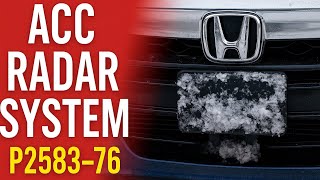
- Obstructed Millimeter-Wave Radar 🔴 High Probability Honda TSB #A21-068 directly states that snow and ice buildup on the front radar can cause DTC P2583-76 during low/near-freezing temperatures. The radar is located behind the smooth front grille emblem, making it a prime target for slush, salty road grime, and bug splatter. Many owners report this as a 'rite of passage', first panicking at the warning lights before realizing the simple fix.
How to confirm: Visually inspect the Honda emblem on the front grille. The radar sensor is located behind this emblem. Look for any snow, ice, mud, or other debris. The obstruction can be on the outside or inside of the radar cover.
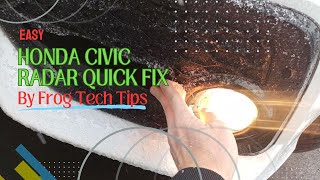
Typical fix: Gently clean the front emblem with a soft cloth. For ice, allow the vehicle to warm up to melt it; do not use scrapers or hot water, which can damage the plastic. Once clean, restarting the car may clear the code. If not, a short drive may be required for the system to self-check and recalibrate.
Est. part cost: $0 - Radar Misalignment 🟡 Medium Probability The radar's aim is very precise. A minor front-end bump, hitting a curb, pothole, or even significant suspension work can knock it out of alignment, triggering the P2583-76 code. Front license plates have also been reported by owners to interfere with the radar's alignment.
How to confirm: This can only be confirmed by attempting a radar aiming procedure with a Honda-specific scan tool (like the HDS) and proper targets and reflectors. If the procedure fails or the code returns immediately, misalignment is the issue. A code P2583-54 (Aiming Incomplete) may also be stored.
Typical fix: Perform a static and/or dynamic radar aiming procedure at a Honda dealership or qualified auto repair shop with ADAS calibration equipment. This is not a DIY procedure.
Est. part cost: $0 (Labor cost is significant, typically $200-$500) - Damaged Radar Mounting Bracket or Clips ⚪ Low Probability According to Honda TSB #A18080E, if the radar will not align, the mounting bracket and clips must be inspected. A minor impact can bend the metal bracket or crack the plastic clips, preventing the radar from holding a stable position. This is a very common point of failure that is often overlooked before recommending a costly radar replacement.
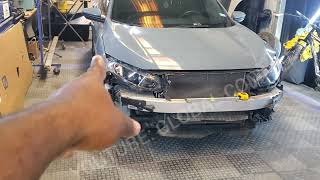
How to confirm: After removing the front bumper cover, physically inspect the mounting bracket for bends and the plastic clips for cracks or missing tabs. Check if the radar unit has any play by trying to twist it by hand before removal; any movement indicates a mounting issue.
Typical fix: Replace the bent mounting bracket and/or any damaged mounting clips. The radar must be re-aimed after the hardware is replaced.
Est. part cost: $50-$150
Rare But Worth Checking
- Faulty Millimeter-Wave Radar Unit: This is the most expensive part and should only be replaced after all other causes, especially the mounting bracket, have been ruled out. During a failed aiming procedure, a Honda Diagnostic System (HDS) may display specific failure codes like '135' for an internal hardware error, which explicitly directs the technician to replace the unit.
- Software Issue: TSB #A21-068 includes a software update for the millimeter-wave radar to reduce its sensitivity to snow and ice. If the issue is recurrent in winter despite the sensor being clean, this update may be the solution. A Honda HDS may also show failure code '132' (Internal Software Error) during a failed aiming, indicating an update is required.
Diagnosis Steps
- Read the code with an OBD-II scanner compatible with Honda systems to confirm P2583 and check for any suffix codes (e.g., -76 for misalignment, -97 for dirt/dust).
- Thoroughly inspect and clean the front Honda emblem and surrounding grille area of any snow, ice, dirt, or other obstructions.
- Restart the vehicle. If the code doesn't clear, drive the vehicle for up to 20 minutes to allow the system to re-check itself.
- If the code persists, inspect the front bumper and grille for any signs of impact or damage.
- Check the radar unit for any looseness or play by gently trying to move it. If it moves, the mounting bracket or clips are likely damaged.
- If no external issues are found, the vehicle must be taken to a dealership or qualified shop for a radar aiming procedure. Inquire if they have the specific targets for your vehicle.
- If the aiming procedure fails, instruct the technician to inspect the radar mounting bracket and clips for damage per TSB #A18080E before replacing the radar unit itself.
- Check if the vehicle is eligible for the software update under TSB #A21-068 to reduce weather sensitivity.
- If the bracket is fine, the software is current, and aiming fails with an internal error code, the radar unit may require replacement, followed by a final aiming procedure.
Parts You'll Likely Need
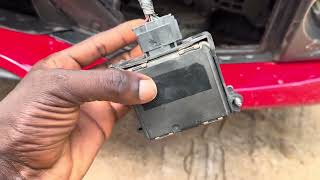
- Millimeter Wave Radar Unit
(OEM #36803-TGG-A24)— This is the sensor that fails or requires replacement if it is internally faulty or physically damaged. It must be replaced if diagnosis points to an internal hardware failure.
Trusted brands: Bosch (OEM supplier), Honda Genuine
OEM price range: $780-$1200
Aftermarket price range: Not Recommended - Radar Mounting Bracket
(OEM #36805-TLA-A00 (example for related CR-V, Civic part may vary))— Often gets bent in minor impacts, preventing proper radar alignment. TSB #A18080E recommends inspecting it before replacing the radar unit.
Trusted brands: Honda Genuine
OEM price range: $50-$100
Aftermarket price range: $30-$60 - Radar Mounting Clips — These plastic clips can crack or break from a small impact, causing the radar to become loose and lose alignment. They are a key inspection point in TSB #A18080E.
Trusted brands: Honda Genuine
OEM price range: $5-$15 per clip
Aftermarket price range: N/A
Related Codes That Often Appear With This One
- B2A60-54: This code for the front camera system can sometimes appear alongside radar codes, as both systems are part of the ADAS suite and may be calibrated at the same time during a repair.
Technical Service Bulletins (TSBs) & Recalls
- A21-068
- A18080E
Platform-Specific Known Issues
- TSB #A21-068: Notes that snow and ice getting stuck to the front radar in near-freezing temperatures can cause DTC P2583-76. The fix may involve a software update to reduce sensitivity, and the bulletin applies to Civic, Accord, CR-V, and Insight models.
- TSB #A18080E: Advises technicians who cannot clear code P2583-76 after re-aiming to inspect the radar mounting clips and bracket for damage before replacing the expensive radar unit. This TSB applies to all models with the Bosch millimeter wave radar.
Mechanic-Grade Diagnostic Values
- Voltage at Millimeter Wave Radar Sensor Connector A74, Pin 8 (IGB) to Body Ground — expected: 11 to 14 V. Failure: No voltage or low voltage indicates a problem with the power supply circuit or fuse.
- Resistance at Millimeter Wave Radar Sensor Connector A74, Pin 1 (SGND) to Body Ground — expected: Below 1 Ω. Failure: High resistance or an open circuit (OL) points to a bad ground connection or a break in the ground wire.
- Live Data from Honda HDS during Aiming Procedure — expected: 0° ± 0.1°. Failure: A reading of 12.8° indicates the radar's view is obstructed; the aiming procedure will fail if this value persists for 15 seconds.
Hidden / Shadow Codes Worth Checking
- 135: Internal Hardware Error. This code explicitly tells the technician to replace the millimeter-wave radar unit. (see via Displayed on the Honda Diagnostic System (i-HDS) during a failed radar aiming service function.)
- 132: Internal Software Error. This code instructs the technician to perform a software update on the millimeter-wave radar module. (see via Displayed on the Honda Diagnostic System (i-HDS) during a failed radar aiming service function.)
- 124: Detected Some Obstacles. The radar detects a reflective object in the aiming area that needs to be removed. (see via Displayed on the Honda Diagnostic System (i-HDS) during the radar aiming procedure.)
- P2583-49: Millimeter Wave Radar Internal Failure. This DTC points to a fault within the radar unit itself. (see via Professional-grade OBD-II scanner or Honda i-HDS.)
Scan Tool Commands That Help
- Honda i-HDS: Millimeter Wave Radar Aiming — This function is required after replacing the radar unit, repairing front-end damage, or if DTC P2583-76 (Misalignment) is stored and will not clear. The procedure uses a special metal target to calibrate the radar's horizontal and vertical position. A critical first step in the procedure is an obstacle check where the i-HDS verifies no reflective objects are in front of the vehicle *before* the target is placed.
Wiring & Ground Locations
- A74 Connector — The 10-pin electrical connector that plugs directly into the back of the millimeter-wave radar unit, behind the front grille emblem.. This is the primary connection point for all power, ground, and communication signals to the radar. Pin 8 (IGB) is the power input, and Pin 1 (SGND) is the chassis ground. Testing voltage and continuity here is essential for diagnosing communication error P2583-87.
- Under-dash Fuse Box — Located in the driver's side footwell, typically up and to the left of the pedals.. For a P2583-87 (Lost Communication) code, checking the fuses for the ADAS system is a key step. Owners and technicians have identified fuse slots 4 and 24 (both 5A) as being related to the radar system's power supply.
"I Checked Everything" — The Actual Cause
- This code is electronic, so a smoke test is not applicable. The equivalent scenario is when the radar aiming procedure repeatedly fails even though the sensor is clean and appears undamaged. Per Honda TSB #A18080E, the root cause in this situation is often a bent radar mounting bracket or broken plastic mounting clips, which are not strong enough to hold the precise alignment required. Technicians are instructed to physically inspect and test the bracket for any play or deformation before replacing the expensive radar unit.
When the Usual Fixes Don't Work
- While cleaning the sensor is the most common fix, it is not a guaranteed solution. If the code returns, especially with the -76 (misalignment) or -87 (communication loss) suffix, a more complex issue is present. For P2583-76, a minor impact may have bent the radar's mounting bracket, making successful re-alignment impossible until the bracket is replaced, as noted in TSB #A18080E. For P2583-87, the problem is likely electrical, such as a blown fuse (slots 4 or 24 in the driver's fuse box) or a failed ground connection at Pin 1 of the radar harness, which would not be solved by cleaning or re-aiming.
OEM Part Supersession History
36803-TGG-A20, 36803-TGG-A21, 36803-TGG-A23→36803-TGG-A24— Standard part revision and update by the manufacturer.
Heads up: While physically similar, always use the VIN to order the correct radar unit. The part is listed as 'Rewritable', indicating it requires programming/aiming with a Honda-specific tool upon installation.
Model Year Variations Within This Range
- 2019-2021: For the 2019 model year refresh, Honda made the Honda Sensing suite standard on all Civic trims (LX, Sport, EX, etc.). On 2017-2018 models, it was typically optional or only included on higher trims. This means the millimeter-wave radar is present on a much larger percentage of Civics from 2019-2021, making this code more common across the entire model range for these years.
Helpful Videos

We Have This Part in Stock


The information in this article is provided for general reference and educational purposes only. Vehicle specifications, procedures, and part compatibility can vary by production date, trim level, and region. Always consult your vehicle's factory service manual and verify part numbers before purchasing or performing repairs. Safety-critical components such as airbags, seat belts, and braking systems should be installed by a qualified professional.
- Honda CIVIC:
- 🎬 Helpful Videos
- 🛍️ Shop This Part
- What's Unique About the 2017-2021 Honda CIVIC
- Diagnostic Flowchart
- Symptoms You May Notice
- Most Likely Causes
- Rare But Worth Checking
- Diagnosis Steps
- Parts You'll Likely Need
- Related Codes That Often Appear With This One
- Technical Service Bulletins (TSBs) & Recalls
- Platform-Specific Known Issues
- Mechanic-Grade Diagnostic Values
- Hidden / Shadow Codes Worth Checking
- Scan Tool Commands That Help
- Wiring & Ground Locations
- "I Checked Everything" — The Actual Cause
- When the Usual Fixes Don't Work
- OEM Part Supersession History
- Model Year Variations Within This Range
- 🎟️ Get 5% Off