

P2583 on 2018-2025 Freightliner Cascadia: Front Radar and Collision System Faults
This code indicates a problem with the front-facing radar sensor, which is part of the Detroit Assurance safety system. This will disable Active Brake Assist and Adaptive Cruise Control. The most common fixes involve inspecting the sensor and its wiring for damage or replacing the sensor, which requires professional calibration.
- P2583 on a modern Cascadia means your advanced safety systems (Active Brake Assist, Adaptive Cruise) are offline.
- Before buying any parts, thoroughly inspect the radar sensor in the bumper for physical damage and check its wiring harness for chafing or loose connections.
- Replacement of the front radar sensor is not a simple DIY job; it requires a mandatory calibration with specialized diagnostic tools to function correctly.
- If the fault appears and disappears, it might be a temporary 'jamming' issue that requires no repair, as noted in fault code P2583-9A.
What's Unique About the 2018-2025 Freightliner Cascadia

The 2018 and newer 'New Cascadia' (P4) models heavily integrate advanced driver-assistance systems (ADAS) under the Detroit Assurance brand. Unlike older trucks, the front radar is not just for cruise control; it's a core part of the vehicle's primary safety system, using a fusion of radar and camera data. Failures in this system are common due to the sensor's vulnerable location in the center of the front bumper. Wiring harness issues are also a known problem on these trucks, sometimes due to routing against sharp edges or insufficient support, which has been addressed in some service bulletins by rerouting and adding protective wrapping.
Symptoms You May Notice
- Warning message on the dashboard, such as 'Active Brake Assist Not Available', 'Collision Mitigation System Unavailable', or 'Front Radar Not Aligned'.
- Adaptive Cruise Control (ACC) will not engage or will disengage unexpectedly.
- Illuminated ABS or stability control warning light, as the systems are interconnected.
- In some cases on bumpy roads, the cruise control may intermittently disengage before the fault becomes permanent. 🎬 Watch: Troubleshooting cruise control issues on your Freightliner.
- Replacing the sensor without checking the wiring first. A simple wiring repair can save over a thousand dollars on an unnecessary sensor replacement.
- Replacing the sensor and failing to perform the mandatory calibration, which leads to the system still not working and throwing a new code.
Most Likely Causes

- Damaged or Misaligned Front Radar Sensor 🔴 High Probability The sensor is located in the front bumper, making it susceptible to damage from minor impacts, road debris, or even improper towing. A slightly bent front cross-member or radar mounting bracket, even from a minor incident, is enough to cause a persistent alignment fault.
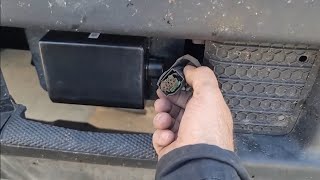
How to confirm: Visually inspect the sensor, located in the center of the bumper, for cracks, deep scratches, or a loose or bent mounting bracket. A diagnostic tool may show alignment or communication faults, specifically codes like P2583-76. 🎬 See this walkthrough for diagnosing SPN 523004 radar codes. Try to gently twist the radar unit; if there is play, the mounting clips may be damaged. A diagnostic tool may show no voltage for the RDF (Radar Front) module, indicating a power issue or internal failure.
Typical fix: If the bracket is bent, it must be replaced to ensure proper alignment. If the sensor itself is cracked or internally damaged, it must be replaced. Replacement always requires calibration.
Est. part cost: $800-$1500 - Wiring Harness Damage 🟡 Medium Probability Wiring harnesses on Cascadias can be prone to chafing where they rub against frame members, brackets, or sharp edges, leading to open or shorted circuits. A common chafe point for the front radar harness is where it passes between the frame and the A/C condenser. Freightliner has issued service bulletins for similar chafing issues on other parts of the truck, such as near the air compressor or on the transmission, indicating a systemic issue with harness routing.
How to confirm: Trace the wiring harness from the back of the radar sensor as far as possible, looking for signs of rubbing, exposed wires, or corrosion at the connector. A common failure point is a broken 12-volt reference wire. Check for power and ground at the sensor connector using a multimeter. A thorough inspection is critical before condemning the expensive sensor.
Typical fix: Repair the damaged section of the harness with new wire and seal it with heat shrink tubing. Soldering the repair is recommended over using butt connectors for a more durable connection. Secure the harness away from any sharp edges to prevent future damage, potentially using extra loom or rerouting according to TSB guidance if available.
Est. part cost: $10-$50 for repair materials - Temporary Radar Jamming ⚪ Low Probability This can happen when driving through areas with high radio frequency (RF) interference, such as near airports or military bases.
How to confirm: This fault (specifically P2583-9A) is often intermittent. If the warning lights clear after stopping and restarting the truck in a different location, jamming was the likely cause.
Typical fix: No parts are required. If the code clears on its own and does not return, no action is needed. Explain to the driver that this can be a normal, temporary event.
Est. part cost: $0
Rare But Worth Checking
- Failed Control Module (CPC4): While rare, the Common Powertrain Controller (CPC4) that manages the radar can fail. This would typically be accompanied by other communication codes and is a last resort after verifying the sensor and wiring. The CPC4 is generally located in the cab behind the center or right-side dash panels.
- Software/Calibration Glitch: Sometimes, the system can lose its calibration due to a software anomaly. A forced recalibration with a diagnostic tool may resolve the issue without replacing parts. This can also happen after a battery disconnect or another unrelated repair. Low battery voltage during operation can also cause modules to malfunction and set faults.
Diagnosis Steps
- Read the fault codes with a compatible diagnostic tool to confirm P2583 and any related codes.
- If the code is P2583-9A, try cycling the ignition off and on in a different location to see if the temporary 'jamming' fault clears.
- Carefully inspect the front radar sensor, located in the center of the bumper, for any signs of physical damage, cracks, or being blocked by debris.
- Check the sensor's mounting bracket to ensure it is not bent or loose, which would cause misalignment. Gently try to move the sensor; excessive play indicates a mounting problem.
- Inspect the electrical connector and wiring harness leading to the sensor. Look for chafed wires, corrosion in the plug, or loose connections. Pay close attention to where the harness is secured or passes near sharp edges, especially between the frame and A/C condenser.
- Using a multimeter, perform a voltage drop test on the power and ground wires at the radar connector. Check for ~2.3V on the ACAN Low wire and ~2.6V on the ACAN High wire. The overall CAN bus resistance between these two wires should be approximately 60 ohms (with the system powered down).
- If a diagnostic tool like JPro or DDDL is available, check for communication with the radar module (often called RDF - Radar Front). Check live data for sensor status and alignment parameters. No voltage reading for the RDF module points to a power supply or wiring issue.
- If the sensor has been replaced or the bumper has been removed, a calibration procedure must be performed. This is a guided process within the diagnostic software that requires driving the vehicle on a straight road with roadside objects like signs or poles.
- If wiring and the sensor appear okay, but the fault persists, the issue may lie within the CPC4 control module, which would require more advanced diagnostics.
Parts You'll Likely Need
- Front Radar Sensor (Detroit Assurance)
(OEM #A0004461649, A0004462249, A0004463549 (Part numbers are frequently superseded; always verify with VIN))— This sensor is the most common point of failure, either from internal faults or physical damage. It is critical to get the correct part number for your truck's specific VIN.
Trusted brands: Detroit Diesel (OEM)
OEM price range: $800-$1500
Aftermarket price range: N/A
Related Codes That Often Appear With This One
- SPN 523004 / FMI 12 — This is a related Freightliner-specific code that can indicate a fault with the front radar sensor, often pointing to a bad component.
- P2583-76 — This specific variant of the code indicates a 'Radar Alignment' issue, meaning the system has detected the sensor is not aimed correctly.
- SPN 523000 / FMI 12 — This fault code was reported by an owner whose front radar was failing, causing cruise control to disengage on bumpy roads, and was ultimately fixed by replacing the radar sensor.
Technical Service Bulletins (TSBs) & Recalls
- SB 54-330: Addresses engine harness chafing at the air compressor support bracket, a related example of known wiring issues on New Cascadia models.
- CAL D21-R22: Customer Advisory Letter regarding potential side guard assist harness chafing on 2020 model year Cascadias, showing a pattern of harness routing concerns.
- SB 54-328: Details procedures for rerouting the Allison transmission wiring harness to reduce chafing, further evidence of systemic wiring vulnerabilities.
Mechanic-Grade Diagnostic Values
- ACAN (Radar CAN Bus) Low Wire Voltage — expected: ~2.3V. Failure: Significant deviation from 2.3V indicates a wiring or module issue.
- ACAN (Radar CAN Bus) High Wire Voltage — expected: ~2.6V. Failure: Significant deviation from 2.6V indicates a wiring or module issue.
- ACAN (Radar CAN Bus) Resistance — expected: ~60 ohms. Failure: A reading of 120 ohms indicates a missing terminating resistor or a break in the circuit. A reading near 0 ohms indicates a short between the CAN high and low wires.
Scan Tool Commands That Help

- Detroit Diesel Diagnostic Link (DDDL) or compatible (JPro): Radar Alignment — This function must be run after replacing the front radar sensor (RDF), removing the bumper, or replacing the radar mounting bracket. It is a dynamic calibration that requires driving the truck on a straight road to allow the sensor to align itself.
- Detroit Diesel Diagnostic Link (DDDL) or compatible (JPro): MPC2 Calibration — After a successful radar alignment, the Multipurpose Camera (MPC2) may also need to be calibrated to ensure the fusion of camera and radar data works correctly. This is also a dynamic, drive-based procedure.
Wiring & Ground Locations

- Front Radar Harness Chafe Point — The wiring harness for the front radar sensor often rubs where it passes between the A/C condenser and the front frame member.. This specific chafe point can damage the power or CAN bus wires for the radar, causing a loss of communication and setting a P2583 code. A visual inspection in this area is critical before replacing the sensor.
- CPC4 (Common Powertrain Controller) — Located in the cab, typically behind the center instrument panel or behind the glove compartment area on the passenger side.. The CPC4 is the primary control module that communicates with the front radar. While rare, a failure here can mimic a sensor or wiring issue. It is the last step in diagnosis after ruling out the sensor and harness.
- X6 Connector — Located at the fuse panel behind the passenger side glove box.. This connector serves as a grounding point for various components. While not specific to the radar in the source, checking grounds at main junction points like this is good practice for any electrical fault.
Real Owner Repair Stories
- YouTube Channel 'GASDIESEL GARAGE' (Freightliner Cascadia (New P4 generation)) — Dashboard message 'Active Brake Assist Not Available'. Diagnostic tool showed the RDF (Radar Front) module was not communicating and had no voltage.
❌ Tried (didn't work) Initial scan showed communication loss, pointing away from a simple alignment issue.
✅ What actually fixed it The technician removed the front bumper and traced the radar harness. They found the harness was chafed and the 12-volt reference wire was broken where it passed between the A/C condenser and the frame. The wire was repaired by soldering in a new section and protecting it. After the repair, the radar regained power, and a dynamic calibration (driving the truck while monitoring with the scan tool) was performed to complete the fix. - YouTube Channel 'TRUCKING TIPS DIY' (Freightliner Cascadia (New P4 generation)) — SPN 523000 / FMI 12 active. Cruise control would disengage on bumpy roads.
❌ Tried (didn't work) Simply plugging in the new sensor without calibration.
✅ What actually fixed it The front radar sensor was identified as the fault. After replacing the sensor, a new code appeared: 'Front Radar Not Aligned' (SPN 523004). The final fix required having the new sensor professionally calibrated. This confirmed that replacement and calibration are two separate, mandatory steps.
OEM Part Supersession History
A0004462249→A0004463049— Part revision or update by the manufacturer.
Heads up: Always verify the correct part number with the vehicle's VIN. While superseded parts may physically fit, they may not be compatible with the vehicle's specific software or other modules.
Model Year Variations Within This Range
- 2018-2019: These earlier 'New Cascadia' models were typically equipped with Detroit Assurance 4.0. This system offered adaptive cruise control and active brake assist, but full braking on stationary objects was a key improvement.
- 2020-2025: Starting mid-2019 for the 2020 model year, the Cascadia came standard with Detroit Assurance 5.0. This system is more advanced, offering Level 2 automation with features like ACC down to 0 mph and full braking on moving pedestrians. It uses a fusion of the front radar and a new windshield-mounted camera (MPC2).
Diagnostic Flowchart
Other Known Issues on This Vehicle
Issues unrelated to this code that are worth knowing about as an owner of this generation:
- DEF System Faults (Sensor/Pump/Heater) 🔴 High — Extremely common. Can occur at various mileages, leading to derates. Issues can stem from the multi-function level/quality/temp sensor, the pump, or heater lines.
- Wiring Harness Chafing 🟠 Medium — A recurring issue in multiple locations, including near the air compressor, transmission, and SCR system. Can cause a wide range of electrical faults. (Ref: Multiple TSBs exist, such as 54-330 and 54-328, to address specific chafing points.)
- HVAC Blend Door / Blower Motor Failure 🟠 Medium — Common complaint of temperature blending issues (stuck on hot or cold) or intermittent blower function. Often caused by a failed actuator, a control module needing a reset, or a melted blower motor connector.
- Leaking Oil Pressure Sensor 🟡 Low — The sensor itself is known to leak oil externally, and in some cases, oil can 'wick' through the sensor into the wiring harness, causing further electrical issues.
- DT12 Automated Manual Transmission Issues 🟠 Medium — Complaints include failure to go into gear, especially after sitting, which can sometimes be related to low system air pressure or require a software reset.
- Brake Light Switch Failure 🟡 Low — A faulty brake switch on the air manifold can cause brake lights to stay on, draining the batteries.
Used vs. New Parts: Buying Guide for This Vehicle
When a used part is the smart pick: For this specific component, a used part is almost never a smart choice. The radar is a sensitive, safety-critical electronic device that is prone to damage from minor impacts and requires professional calibration that is tied to the vehicle's VIN. The risk of buying a faulty or incompatible used unit is very high.
What to inspect on the donor part:
- If forced to consider used, verify the exact part number matches the original.
- Inspect for any cracks, deep scratches, or damage to the housing.
- Check that all mounting tabs and the electrical connector are intact and free of corrosion. Listings for used parts often note broken tabs.
OEM-only on this vehicle (don't cheap out):
- Front Radar Sensor (RDF)
Aftermarket brands forum-validated for this vehicle:
- N/A. This part is currently only available as an OEM component from Detroit Diesel/Freightliner.
Brands owners have reported issues with on this vehicle:
- N/A
Real Owner Stories
Aggregated from forums and TSBs cited above. Mileages and costs reflect what owners reported in those sources.
2021 Freightliner Cascadia
Symptoms: Constant false alarms and the radar system initiating braking unexpectedly.
What fixed it: Modifying the aftermarket bumper guard which was being detected by the radar sensor.
Source hint: Reddit - r/Truckers - '2021 Freightliner Cascadia Radar Issues'
2018-2025 Freightliner Cascadia
Symptoms: Replaced the front radar sensor for SPN 523000 but immediately received a new code for alignment (SPN 523004).
What fixed it: Performing the mandatory calibration procedure after sensor replacement.
Source hint: TruckersReport.com - 'FREIGHTLINER CASCADIA FRONT END RADAR SENSOR...'
Related OBD-II Codes
Frequently Asked Questions
My 2021 Cascadia is giving false alarms and braking on its own; could my aftermarket bumper guard be causing P2583?
I just replaced the front radar sensor on my Cascadia to fix an alignment code, but the warning is still there. Did I get a bad part?
Is there a specific spot on the Cascadia where the radar wiring usually fails?
Does the P2583-9A code mean my radar sensor is permanently broken?
Can a minor collision that didn't crack the sensor still cause a P2583 fault?
Are there any TSBs for wiring issues that might affect my 2020 Cascadia's safety systems?
Helpful Videos


The information in this article is provided for general reference and educational purposes only. Vehicle specifications, procedures, and part compatibility can vary by production date, trim level, and region. Always consult your vehicle's factory service manual and verify part numbers before purchasing or performing repairs. Safety-critical components such as airbags, seat belts, and braking systems should be installed by a qualified professional.
- Freightliner Cascadia:
- 🎬 Helpful Videos
- What's Unique About the 2018-2025 Freightliner Cascadia
- Symptoms You May Notice
- Most Likely Causes
- Rare But Worth Checking
- Diagnosis Steps
- Parts You'll Likely Need
- Related Codes That Often Appear With This One
- Technical Service Bulletins (TSBs) & Recalls
- Mechanic-Grade Diagnostic Values
- Scan Tool Commands That Help
- Wiring & Ground Locations
- Real Owner Repair Stories
- OEM Part Supersession History
- Model Year Variations Within This Range
- Diagnostic Flowchart
- Other Known Issues on This Vehicle
- Used vs. New Parts: Buying Guide for This Vehicle
- Real Owner Stories
- 2021 Freightliner Cascadia
- 2018-2025 Freightliner Cascadia
- Related OBD-II Codes
- Frequently Asked Questions
- 🎟️ Get 5% Off