

P2583 on 2013-2019 Ford Flex: Adaptive Cruise Sensor Fault Causes and Fixes
This code means the front radar sensor for your Adaptive Cruise Control and Pre-Collision Assist is blocked, misaligned, or has failed. The sensor is located in the lower front grille, often on the driver's side. The most common fix is to thoroughly clean the sensor area. If that doesn't work, professional calibration or replacement is necessary, as this is not a DIY-friendly repair beyond cleaning.
- P2583 disables your Ford Flex's Adaptive Cruise Control and Pre-Collision Assist.
- The most likely cause is a blocked sensor. Always start by thoroughly washing the front grille area of your vehicle.
- This is not a DIY-friendly repair beyond cleaning. If the warning persists, professional diagnosis and calibration are required.
- A minor front-end bump is a common reason for this code, as it can easily knock the radar sensor out of alignment.
- Do not replace the expensive sensor module until obstruction, alignment, and wiring have been professionally ruled out.
What's Unique About the 2013-2019 Ford Flex
While P2583 is a standard powertrain code, on the Ford Flex it relates exclusively to the optional Advanced Driver Assistance Systems (ADAS). Unlike many engine codes, this issue is not related to the 3.5L V6 or the 3.5L EcoBoost engine options, but rather to the chassis and safety electronics. The causes and diagnostics are consistent with other Ford models from the same era built on the D4 platform that use the same radar technology, like the Ford Explorer, Lincoln MKT, and Ford Taurus. There are no widespread, documented issues or TSBs specific to the Flex for this code, suggesting it's an occasional fault rather than a common systemic failure.
Symptoms You May Notice
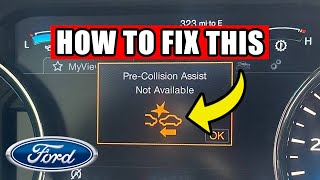
- "Pre-Collision Assist Not Available" message on the dashboard
- "Adaptive Cruise Not Available" message on the dashboard
- Check Engine Light or other warning lamps illuminated
- Adaptive Cruise Control will not engage or will disengage unexpectedly
- Automatic Emergency Braking system is disabled
- Cruise control warning lamp is illuminated 🎬 Watch: Troubleshooting guide for the Adaptive Cruise Not Available warning.
- Replacing the expensive radar sensor when the actual issue is just a dirty sensor face, a misaligned/broken bracket, or a wiring problem. Always start with the simplest and cheapest fix: cleaning the sensor.
Most Likely Causes
- Obstructed Radar Sensor 🔴 High Probability The sensor is located in the front grille area, making it highly susceptible to blockage from snow, ice, heavy dirt, mud, or even a misaligned front license plate bracket.
How to confirm: Visually inspect the front of the vehicle, specifically the lower grille area below the license plate. The sensor is a black, rectangular module. Check for any debris or obstruction on or directly in front of it. A diagnostic scan may show a specific suffix code like P2583-97 for an obstruction.
Typical fix: Thoroughly clean the sensor and the area around it with mild soap and water. A simple car wash often resolves the issue. 🎬 See how to fix the Pre-Collision Assist Not Available message. The code may clear on its own after cleaning and a short drive.
Est. part cost: $0 - Radar Sensor Misalignment 🟡 Medium Probability Even a minor front-end impact, such as a parking lot bump, curb strike, or hitting road debris, can knock the sensor's precise alignment out of specification. This is often indicated by a -76 suffix on the code (P2583-76).
How to confirm: This can only be confirmed with a professional scan tool that can read the sensor's alignment values and specific DTC suffixes. The code will typically return immediately after being cleared if misalignment is the cause.
Typical fix: The sensor must be professionally re-aimed using specialized ADAS static or dynamic calibration equipment. This is not a DIY repair. In some cases, the alignment procedure may fail, pointing towards a damaged bracket or sensor.
Est. part cost: $0 (calibration is a labor charge, typically $250-$500) - Damaged Sensor Mounting Bracket ⚪ Low Probability The plastic bracket that holds the radar sensor can crack or break from a minor impact, preventing the sensor from staying in alignment. The sensor may feel loose when handled.
How to confirm: During a physical inspection (which may require removing the bumper cover), check the bracket for any visible cracks, stress marks, or damage. Try to gently twist the radar unit; if there is play, the mounting clips or bracket are likely damaged.
Typical fix: Replace the damaged mounting bracket and/or clips, and then perform a professional sensor alignment/calibration. This should be investigated before replacing the entire expensive sensor unit.
Est. part cost: $50-$150 - Damaged Wiring or Connector ⚪ Low Probability The wiring harness leading to the sensor is in an exposed area behind the bumper, making it vulnerable to moisture, road salt, and physical damage from road debris.
How to confirm: Visually inspect the wiring harness and the connector pins at the back of the sensor for any signs of corrosion, chafing, or breaks. A multimeter can be used to check for power, ground, and continuity. A code like U0104 often points to a wiring or communication issue.
Typical fix: Repair the damaged section of the harness or replace the connector pigtail. Ensure the connection is secure and weatherproofed.
Est. part cost: $20-$100
Rare But Worth Checking
- Failed Cruise Control Module (CCM): While rare, the radar sensor itself can fail internally due to electronic faults or physical damage. This is usually diagnosed after all other possibilities (obstruction, alignment, wiring, and bracket integrity) have been ruled out. Replacement requires programming and calibration by a professional.
Diagnosis Steps
- Read the Codes: Use an advanced OBD-II scanner to read the code and check for any specific suffixes like -76 (misalignment) or -97 (obstruction).
- Inspect and Clean: Thoroughly inspect the front lower grille area where the radar sensor is located. Clean off any dirt, snow, ice, or other debris with mild soap and water.
- System Reset: After cleaning, clear the trouble codes. Turn the vehicle off for 5-10 minutes, then restart and test drive to see if the code returns.
- Check for Physical Damage: If the code returns, inspect the sensor and its mounting bracket for any signs of physical damage, looseness, or incorrect installation. Gently try to move the sensor to check for play.
- Check Wiring: Inspect the electrical connector and wiring harness leading to the sensor for corrosion, damage, or loose connections. Check for power and ground at the connector.
- Professional Calibration: If no physical issues are found, the vehicle must be taken to a dealership or a qualified auto repair shop with ADAS capabilities. They will verify the alignment and perform a calibration if necessary. A failed calibration may point to a damaged bracket or a faulty sensor.
- Sensor Replacement: If calibration fails and the bracket is intact, or if diagnostic tests point to an internal fault, the Cruise Control Module (sensor) will need to be replaced, programmed, and calibrated.
Parts You'll Likely Need
- Cruise Control Module (Front Distance Sensor)
(OEM #DG1Z-9E731-G)— This is the radar sensor that fails or requires replacement if it has an internal fault or is damaged beyond repair. It supersedes previous part numbers like DG1Z-9E731-C, D, E, and F. Replacement is only done after ruling out obstruction 🎬 Watch this walkthrough for Ford adaptive cruise control sensor repair. and alignment issues.
Trusted brands: Motorcraft
OEM price range: $800-$1200
Aftermarket price range: $300-$600
Related Codes That Often Appear With This One
- U0104 — This code indicates a 'Lost Communication With Cruise Control Module,' which points directly to a wiring issue, a bad connection, or a complete failure of the radar sensor module itself.
- B142E — This is a Ford-specific body code indicating 'Forward Looking Sensor Horizontal Alignment' is out of specification, often appearing with P2583 when the sensor is misaligned.
- P2583-76 — This is a suffix code that specifically indicates 'Wrong Mounting Position.' It confirms the sensor is physically misaligned and requires calibration, or that its mounting bracket is damaged.
Technical Service Bulletins (TSBs) & Recalls
- While no TSB is specific to P2583 on the Flex, Honda TSB A18080E for the same Bosch radar system and P2583-76 code highlights that a bent or damaged mounting bracket is a primary cause for alignment failure, advising technicians to check it before replacing the expensive radar unit.
Mechanic-Grade Diagnostic Values
- HS-CAN Bus Network Resistance — expected: Approximately 60 Ohms. Failure: A reading of ~120 Ohms indicates one of the two terminating resistors (often in the PCM or IPC) is disconnected from the network. An open or infinite reading indicates a break in the CAN wiring.
- CCM Power Supply Voltage — expected: Greater than 10 volts. Failure: Low or no voltage indicates a problem with the power supply circuit, fuse, or wiring.
- Horizontal Alignment Offset (Scan Tool PID) — expected: +/- 3.0 degrees. Failure: A value outside this range will set a fault and requires a horizontal alignment procedure to be run via a scan tool.
Scan Tool Commands That Help
- Ford IDS (Integrated Diagnostic System): CCM (Cruise Control Module) Calibration — This function, found under Toolbox > Electrical > Cruise Control, is required after replacing the CCM, after any front-end collision, or if DTCs related to alignment (like P2583-76 or B142E) are present. It initiates the dynamic calibration process.
- FORScan: CCM Calibrate Cruise Control Sensors — This is a service function used to initiate the dynamic alignment procedure for the CCM. It's necessary after replacing the module or if alignment codes are present. The user must follow on-screen prompts and drive the vehicle under specific conditions (e.g., straight road, >30 mph) until the calibration completes.
- Ford IDS or FORScan: Programmable Module Installation (PMI) / As-Built Configuration — When a new or used CCM is installed, the vehicle's VIN and specific configuration data (As-Built data) must be written to the module. Failure to do this will result in communication errors and prevent the module from functioning.
Wiring & Ground Locations
- C134 — This is the main 6-pin connector for the Cruise Control Module (CCM). On similar Ford platforms like the F-150, it is located on the passenger side frame rail, just behind the front bumper and headlight area.. This is the primary connection point for testing power, ground, and CAN bus signals directly at the sensor harness. Corrosion or damage to this connector is a common cause of communication codes like U0104 that may accompany P2583.
- CCM CAN Bus Wires — Within the harness leading to connector C134, these are a twisted pair of wires. On similar Ford models, these are often Pin 1 (GN-OR) and Pin 2 (GY-BU) in the C134 connector.. These two wires carry all communication between the CCM and the rest of the vehicle. Damage to this pair will cause a loss of communication and set codes. Resistance between these two wires should be checked during diagnosis.
- CCM Ground Wire — One of the pins in the C134 connector will be a dedicated ground wire (typically a black wire with a colored stripe). This wire terminates at a chassis ground point in the engine bay, often shared with other components.. A poor or corroded ground connection can cause intermittent or complete failure of the CCM, leading to P2583 or other communication faults. Verifying a good ground is a key step in electrical diagnosis.
Real Owner Repair Stories
- Honda Service News Bulletin A18080E (applies to similar Bosch radar systems) (Various Honda models using a Bosch millimeter-wave radar, analogous to the Ford system.) — DTC P2583-76 (Misalignment) is present and will not clear even after performing the radar aiming procedure multiple times.
❌ Tried (didn't work) Performing the dynamic or static calibration procedure repeatedly.
✅ What actually fixed it The root cause was a damaged or bent radar mounting bracket, or broken plastic mounting clips. Even if the bracket appears visually okay, twisting the radar unit by hand reveals play. Replacing the damaged clips or the entire bracket allowed the calibration to complete successfully. The bulletin advises checking the bracket and clips *before* condemning the expensive radar unit.
OEM Part Supersession History
DG1Z-9E731-C, DG1Z-9E731-D, DG1Z-9E731-E, DG1Z-9E731-F→DG1Z-9E731-G— Standard part evolution for design, material, or software improvements.
Heads up: DG1Z-9E731-G is the primary service replacement for the earlier versions and should be compatible. When replacing, the new module always requires programming and calibration.
Diagnostic Flowchart
Other Known Issues on This Vehicle
Issues unrelated to this code that are worth knowing about as an owner of this generation:
- Internal Water Pump Failure (3.5L Duratec V6) 🔴 High — Can occur as early as 50,000 miles, but more common around 100,000 miles. Failure can cause coolant to mix with engine oil, leading to catastrophic engine damage.
- Power Transfer Unit (PTU) Failure (AWD Models) 🔴 High — The PTU fluid is considered 'lifetime' by Ford and has no drain plug, causing it to overheat and break down. This leads to gear and bearing failure. Symptoms include a grinding/clunking noise or a propane-like smell from cooked fluid leaking onto the exhaust.
- Timing Chain Rattle/Stretch (3.5L EcoBoost V6) 🟠 Medium — Primarily affects earlier EcoBoost models (pre-2016). A stretched timing chain causes a distinct rattle for a few seconds on a cold start. If not addressed, it can lead to timing-related engine codes and potential engine damage. (Ref: TSB 18-2305 (supersedes earlier versions) addresses this by recommending replacement of the timing chain and all four VCT phasers.)
- Faulty Electronic Power Steering Assist (EPAS) 🔴 High — Common on 2011-2013 models. The EPAS system can fail intermittently or completely, resulting in a sudden loss of power steering, making the vehicle very difficult to steer. (Ref: Recall 15V340000 was issued for this issue.)
- Fractured Rear Suspension Toe Link 🔴 High — Affects 2013-2018 models. The rear toe links can fracture, causing a sudden loss of steering control. (Ref: Recall 20V072000 was issued to replace the rear toe links.)
Used vs. New Parts: Buying Guide for This Vehicle
When a used part is the smart pick: A used CCM is a reasonable choice to significantly reduce cost ($300-$600 vs $1200+ OEM new), but ONLY under specific conditions. It makes sense if you have already ruled out obstruction and bracket damage, and you have confirmed access to a shop with Ford IDS or a fully licensed version of FORScan that can perform the mandatory VIN programming and calibration. It is a gamble, as the used part carries a risk of being faulty.
Donor-vehicle mileage cap: roughly under 50000 miles for the part to have meaningful remaining life.
What to inspect on the donor part:
- Request the VIN of the donor vehicle to check its history for front-end collisions via services like CarFax.
- Visually inspect the sensor face for deep scratches, cracks, or signs of delamination.
- Ensure the electrical connector is clean, with no bent, broken, or corroded pins.
- Confirm the mounting tabs on the sensor housing are intact and not cracked.
OEM-only on this vehicle (don't cheap out):
- Cruise Control Module (CCM) - While a used OEM part is an option, there are no trusted aftermarket versions of the radar sensor itself. Stick with Motorcraft (new or used).
Aftermarket brands forum-validated for this vehicle:
- For the mounting bracket or connector pigtail, Dorman is a generally accepted aftermarket brand if an OEM part is unavailable.
Brands owners have reported issues with on this vehicle:
- Avoid any non-OEM branded complete radar sensor modules. They are unlikely to be compatible or calibrate correctly with the Ford system.
Real Owner Stories
Aggregated from forums and TSBs cited above. Mileages and costs reflect what owners reported in those sources.
2013-2019 Ford Flex (Bosch Radar System)
Symptoms: The owner was quoted $2,200 for a full radar assembly replacement after the system threw a P2583-76 code.
What fixed it: The code indicated a misalignment rather than a hardware failure; the owner was advised to check for a damaged bracket before replacing the entire sensor unit.
Cost: $2,200-$2,200
Source hint: Reddit r/10thgenaccords (referencing similar Bosch system behavior)
Related OBD-II Codes
Frequently Asked Questions
My 2013 Ford Flex is showing 'Pre-Collision Assist Not Available' and 'Adaptive Cruise Not Available.' Could this be related to the EPAS recall?
I have a P2583-76 code on my Flex. Can I fix this myself by cleaning the sensor?
Could a minor parking lot bump cause the P2583 code on my Ford Flex?
Is there a TSB for the P2583 code on the Ford Flex regarding the mounting bracket?
Will a car wash fix the 'Adaptive Cruise Not Available' message on my Flex?
My Ford Flex has a P2583 code and a 'propane-like' smell. Are these related?
Helpful Videos
We Have This Part in Stock


The information in this article is provided for general reference and educational purposes only. Vehicle specifications, procedures, and part compatibility can vary by production date, trim level, and region. Always consult your vehicle's factory service manual and verify part numbers before purchasing or performing repairs. Safety-critical components such as airbags, seat belts, and braking systems should be installed by a qualified professional.
- Ford Flex:
- 🎬 Helpful Videos
- 🛍️ Shop This Part
- What's Unique About the 2013-2019 Ford Flex
- Symptoms You May Notice
- Most Likely Causes
- Rare But Worth Checking
- Diagnosis Steps
- Parts You'll Likely Need
- Related Codes That Often Appear With This One
- Technical Service Bulletins (TSBs) & Recalls
- Mechanic-Grade Diagnostic Values
- Scan Tool Commands That Help
- Wiring & Ground Locations
- Real Owner Repair Stories
- OEM Part Supersession History
- Diagnostic Flowchart
- Other Known Issues on This Vehicle
- Used vs. New Parts: Buying Guide for This Vehicle
- Real Owner Stories
- 2013-2019 Ford Flex (Bosch Radar System)
- Related OBD-II Codes
- Frequently Asked Questions
- 🎟️ Get 5% Off