

P2583 on 2018-2024 Audi Q5: ACC & Pre-Sense Fault Causes and Fixes
On a 2018-2024 Audi Q5, code P2583 means there is a fault with the front radar sensor for the Adaptive Cruise Control (ACC). This is not a DIY fix. The most common causes are sensor misalignment or corrosion, requiring professional calibration or replacement at a dealership, which can be very expensive. The issue is often accompanied by 'Adaptive cruise control unavailable' and 'Audi pre sense: currently limited' warnings on the dash.
- P2583 on a 2018-2024 Audi Q5 disables your Adaptive Cruise Control and Pre-Sense safety systems due to a front radar sensor fault.
- Before seeking professional help, thoroughly clean the sensor domes in the front bumper, as dirt or ice is a common cause.
- This is not a DIY repair. Any fix, including sensor replacement or realignment, requires expensive, specialized calibration equipment and online access to Audi's systems.
- The most common causes are sensor misalignment, obstruction, or water damage to the sensor's electrical connector.
- Be prepared for a potentially expensive repair, with dealer calibration costing several hundred dollars and sensor replacement potentially costing thousands.
What's Unique About the 2018-2024 Audi Q5

The Audi Q5 (Typ FY generation) integrates these radar sensors deeply into its safety systems. Unlike simpler cruise control, a fault here disables critical active safety features like automatic emergency braking. The repair process is complex due to Audi's 'Component Protection' system, which requires online authorization from Audi servers to pair a new sensor to the vehicle. This makes dealership or specialized independent shop intervention mandatory for almost any fix beyond cleaning the sensor. The calibration process itself requires a specific, expensive ADAS calibration rig that most general shops do not own.
Symptoms You May Notice

- "Adaptive cruise control unavailable" message on the instrument cluster.
- "Audi pre sense: currently limited" or similar warning message.
- "Drive system: malfunction! Please contact service" warning.
- Adaptive Cruise Control (ACC) will not engage or turns off unexpectedly.
- Inability to set a following distance for cruise control.
- In rare cases, phantom braking where the car brakes unexpectedly.
- Yellow warning triangle on the dashboard.
- Replacing the sensor without attempting calibration first. Misalignment is a very common cause and does not require a new part.
- Assuming the vehicle is fine after cleaning an obstructed sensor. If the fault returns quickly in clear weather, it points to a deeper issue like misalignment or water damage.
- Replacing the sensor without also replacing a corroded connector pigtail, leading to repeat failure.
Most Likely Causes

- Sensor Misalignment 🔴 High Probability The sensors require precise alignment to function. Minor front-end impacts from parking blocks, curbs, or even road debris can knock them out of calibration. Some owners report the issue happening with no obvious cause.
How to confirm: Diagnosis requires a scan tool to check for alignment-specific fault codes (like C110301 for 'Adaptive cruise control sensor misadjusted'). A visual inspection may not reveal the issue. The definitive test is attempting recalibration with the proper ADAS equipment.
Typical fix: The sensor must be recalibrated by an Audi dealer or a qualified shop with ADAS calibration equipment. This is a labor-intensive process that can take several hours and often costs between $500-$1000.
Est. part cost: $0 - Sensor Obstruction 🟡 Medium Probability The radar sensors are located in the front grille/bumper area, making them susceptible to being blocked by snow, ice, heavy mud, or road grime.
How to confirm: Visually inspect the plastic sensor domes in the front bumper for any obstructions. The issue is often intermittent and may only occur in specific weather conditions.
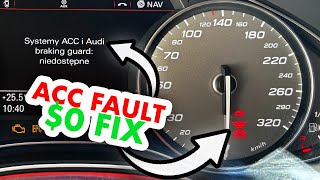
Typical fix: Thoroughly clean the sensor domes with a soft cloth and car wash soap. The system should reset itself 🎬 Watch: How to fix Audi ACC and Brake Guard faults for free after cleaning and restarting the vehicle.
Est. part cost: $0 - Water Intrusion and Connector Corrosion 🟡 Medium Probability Forum and video evidence suggests that the seals on the sensor housing or its electrical connector can fail, allowing moisture to enter. This leads to corrosion on the connector pins and internal sensor failure. This is a well-documented failure mode on the B9 platform.
How to confirm: The bumper must be removed to access the sensor and its connector. Look for signs of water damage, green/white corrosion on the pins, or a swollen connector.
Typical fix: If caught early, it may be possible to clean the connector and pins. More often, the corrosion damages the connector and sensor, requiring replacement of both components. A pigtail repair kit for the connector may be available. Replacement of the sensor is very expensive.
Est. part cost: $400-$2500 - Failed Radar Sensor or Internal Heater ⚪ Low Probability The sensor is a complex electronic component that can fail internally. Some sensors have a built-in heating element to prevent ice buildup, and failure of this heater can cause faults in cold weather.
How to confirm: After ruling out obstruction, misalignment, and wiring issues, the sensor itself is diagnosed as faulty using an advanced scan tool like ODIS. The control module will report an internal error or lack of communication.
Typical fix: The failed radar sensor must be replaced. This requires removing the front bumper, installing the new part, and then performing the mandatory calibration and Component Protection procedures.
Est. part cost: $1500-$2500
Rare But Worth Checking
- Control Module or Software Issue: While less common, forum users have reported that a faulty Comfort Control Module or outdated software can cause a cascade of seemingly unrelated warnings, including ACC faults. A dealer may need to perform a software update (like TSB 2077960/6) to resolve the issue.
Diagnosis Steps
- Read the fault codes with an Audi-specific scan tool (like VCDS or OBDeleven) to see if P2583 is accompanied by other codes like C110301.
- Thoroughly wash the front of the vehicle, paying special attention to the radar sensor domes in the lower grille/bumper area. Clear the codes and test drive.
- If the code returns, perform a visual inspection of the sensor and its mounting bracket for any signs of physical damage from an impact.
- If no damage is visible, the next step is professional diagnosis at a dealership or ADAS-specialized shop.
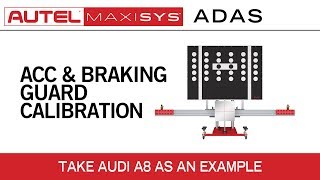
- The technician will connect to the vehicle with the ODIS diagnostic system to check for TSBs, inspect the wiring and connector for corrosion, and attempt to recalibrate the sensor using 🎬 Watch: Professional ADAS calibration procedure using a standard frame an ADAS calibration frame.
- If calibration fails or the sensor is unresponsive (e.g., reports an internal fault), it will likely need to be replaced, followed by component protection removal and another calibration attempt.
Parts You'll Likely Need
- ACC Radar Sensor (Right/Master)
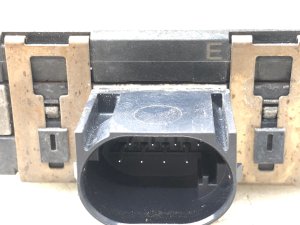
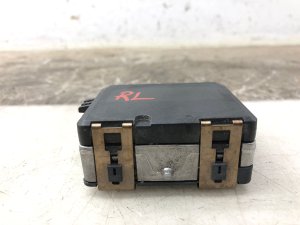
(OEM #8W0907561G / 80A907561F)— This is the part that fails due to internal faults or irreparable water damage. It is the primary component associated with code P2583. Part numbers may be superseded; always check with a dealer.
Trusted brands: Bosch, Audi Genuine
OEM price range: $1500-$2500
Aftermarket price range: $800-$1500 - ACC Radar Sensor (Left/Slave)
(OEM #8W0907541G / 80A907541F)— Less common to fail, but can also cause ACC system faults. The system uses both sensors working together.
Trusted brands: Bosch, Audi Genuine
OEM price range: $1000-$1800
Aftermarket price range: $600-$1200
Related Codes That Often Appear With This One
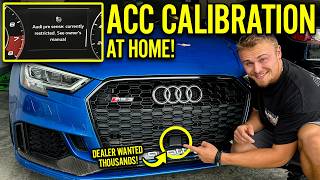
- C110301 — This is an Audi-specific code for 'Adaptive Cruise Control Sensor Misadjusted,' which often accompanies P2583 when 🎬 See this DIY radar alignment walkthrough for the C1103 code the root cause is sensor alignment.
- B200049 — A generic internal electronic failure code that may be stored in the ADAS module (A5) when the sensor has failed internally.
Technical Service Bulletins (TSBs) & Recalls
- TSB 2077960/6: A combined software update that may address various control module glitches, including those affecting driver assistance systems.
- TSB 2058077/9: Relates to unexpected Audi Pre-Sense warnings or braking events, which uses the same hardware. This TSB provides a diagnostic procedure for dealers to analyze the cause of the intervention.
Platform-Specific Known Issues
- A known issue is water intrusion into the sensor or its connector, leading to corrosion and failure.
- The system is very sensitive to misalignment, and owners report needing recalibration even without a clear cause or impact.
- Repair is complicated by Audi's 'Component Protection' system, which prevents simple swapping of used parts and requires online dealer tools for replacement.
- A used sensor can be installed, but it must be from a vehicle with a nearly identical options list, and Component Protection removal is still required, making it a gamble.
Mechanic-Grade Diagnostic Values
- ACC Sensor Misalignment Angle (Live Data) — expected: Between -0.8° and +0.8°. Failure: A value outside of the -0.8° to +0.8° range will trigger a C1103 fault and disable the ACC system.
- CAN Bus Resistance (at ADAS Module A5 connector) — expected: Approximately 60 Ω between CAN-High and CAN-Low pins.. Failure: A reading of ~120 Ω indicates a break in one of the CAN wires or a missing terminating resistor. A reading of 0 Ω indicates a short between the CAN lines.
Hidden / Shadow Codes Worth Checking
- 00234 - Sensor for Automatic Distance Regulation Misadjusted: This is the VCDS/VAG-COM equivalent of the more generic C110301, specifically indicating the sensor's physical alignment is out of specification. (see via VCDS, OBDeleven, or other VAG-specific diagnostic tools when scanning Address 13 (Auto Dist. Reg).)
- 0660 - No Basic Setting: This fault can appear in the A5 (Front Sensors Driver Assistance System) module if a calibration was attempted and failed, or if adaptation values were reset without completing a new calibration. It indicates the system is un-initialized. (see via VCDS or ODIS scan of the A5 module.)
Scan Tool Commands That Help
- ODIS (Official Dealer Tool): Component Protection Removal — This is mandatory after replacing an ACC radar sensor. The function requires an online connection to Audi's servers via a GEKO account to pair the new (or used) sensor to the vehicle's VIN. Without this, the sensor will not function.
- ODIS (Official Dealer Tool): SVM (Software Version Management) Coding — Immediately after Component Protection removal, SVM must be run. It connects to Audi's factory servers to download the correct dataset and coding for the specific vehicle VIN, ensuring the radar calculates distance and braking parameters correctly.
- VCDS or OBDeleven (Pro): Basic Setting: Reset Misalignment Angle — If a temporary obstruction (like ice) caused a misalignment fault that persists after cleaning, you can try resetting the stored angle values to zero. Navigate to Address 13 or A5 -> Security Access (enter code) -> Basic Settings -> Reset misalignment angle. This may resolve software-glitch-related faults without a full recalibration.
- VCDS or OBDeleven (Pro): Adaptation: Set Misalignment Values to 0.00 — As an alternative to 'Basic Settings', this can be used to manually zero-out the stored misalignment values. Go to Module 13/A5 -> Adaptation -> Select 'Misalignment angle horizontal' and 'Vertical dejustment', then write the value '0.00' to each. This can sometimes clear a persistent soft fault.
Wiring & Ground Locations
- Ground Connection Point (Engine Compartment, Left) — In the engine compartment, on the left side between the shock absorber strut tower and the water drainage box (plenum chamber).. This is a primary ground point for components in the front of the vehicle. A loose or corroded connection here can cause intermittent power issues and communication faults for the front ADAS sensors.
- Ground Connection (on left A-pillar) — Behind the driver's side A-pillar trim, at the bottom.. Provides a ground path for various interior modules, including the CAN Gateway (J533), which communicates with the ADAS sensors. A poor ground here can lead to network-wide communication errors.
- Front Bumper Wiring Harness (Part No. 80A971095-series) — Runs along the inside of the front bumper cover, connecting the ACC sensors, parking sensors, and fog lights.. This harness is susceptible to damage from minor frontal impacts, vibration, and moisture. Frayed insulation or corrosion within the harness connectors is a direct cause of sensor communication loss (P2583) and other front-end electrical faults.
Real Owner Repair Stories
- MHH Auto Forum user (2018 Audi (A-platform, likely A6/A7, similar system to Q5)) — ACC stopped working, Component Protection active fault.
❌ Tried (didn't work) The user replaced the original water-damaged ACC sensor with a used one.
✅ What actually fixed it The user attempted to have Component Protection removed by both an Audi dealer and a remote ODIS user, but it failed with an error (FAZ1224E). The story highlights that even with the correct tools, swapping used modules can be problematic and is not a guaranteed fix. The final resolution was not posted, but the critical takeaway is the failure of the standard 'fix'. - Audi Owners Club (UK) user (Audi Q5 (year not specified, but modern)) — Multiple electrical faults and warnings on the dash.
❌ Tried (didn't work) Initial diagnosis was unclear.
✅ What actually fixed it The root cause was water damage to a main control unit due to a missing grommet from a poorly fitted towbar. The repair cost £2400 and required replacing the control unit, vehicle battery, and significant wiring. This demonstrates how water ingress in one area can cause cascading, seemingly unrelated faults like those affecting the ADAS system.
OEM Part Supersession History
8W0907561...→80A907561...— Part number series updated for the Q5 (FY) platform. The leading characters often denote the initial platform the part was designed for (8W0 for A4 B9) and are later updated to the platform it's used on (80A for Q5 FY).
Heads up: While physically similar, using a sensor from a different vehicle model (e.g., an A4 sensor on a Q5) even with the same base part number can be risky. Component Protection removal may fail if the hardware/software index is not on the approved list for the target vehicle's gateway module.
Model Year Variations Within This Range
- 2018-2024: The front bumper wiring harness differs between trim levels. For example, the Prestige trim includes a connector for the front-view camera, while the Premium Plus harness does not. The part numbers are different (e.g., 80A971095R vs. 80A971095T). Dealerships often only sell the highest-spec harness, requiring technicians to tie back unused connectors.
- 2021-2024 (Facelift): The 2021 facelift introduced updated Matrix-design LED headlights and potentially revised software for the ADAS system to achieve a higher IIHS safety rating. While the core radar function is the same, software compatibility and calibration procedures may have subtle differences from pre-facelift models.
Diagnostic Flowchart

Other Known Issues on This Vehicle
Issues unrelated to this code that are worth knowing about as an owner of this generation:
- 3.0T V6 Rocker Arm Bearing Failure 🔴 High — Primarily affects 2018 and some early 2019 models. The needle bearings in the rocker arms can fail, causing a ticking noise, misfires, and potentially catastrophic engine damage if fragments circulate. (Ref: Audi has issued service actions and warranty extensions for some affected vehicles. A Reddit user mentioned a TSB covering cars under 8 years/80k miles.)
- Water Pump / Thermostat Failure 🔴 High — Common across multiple engine variants (2.0T and 3.0T). The plastic housing can crack or the pump itself can fail, leading to significant coolant loss and potential engine overheating. (Ref: Class action lawsuits have been filed, and Audi has extended the warranty for this component on many vehicles (typically to 8 years/80,000 miles).)
- Panoramic Sunroof Drain Clogs & Leaks 🟠 Medium — Widespread issue where the sunroof drain tubes clog with debris, causing water to back up and leak into the cabin, often into the rear cargo area where sensitive electronics (like the Comfort Control Module) are located. (Ref: No recall, considered a maintenance item. Can lead to thousands in repairs if control modules are damaged by water.)
- MMI Infotainment System Glitches/Black Screen 🟡 Low — Owners report intermittent issues with the MMI screen going black, freezing, or losing audio. Often a software glitch that can be temporarily resolved by a system reboot (holding the volume knob for 10-15 seconds). (Ref: Dealers may perform software updates (like TSB 2077960/6) to address persistent issues.)
- 2.0T Engine Excessive Oil Consumption 🟠 Medium — While significantly improved from the previous generation, some 2.0T engines in the FY Q5 can still consume oil. This was a major issue in the prior (8R) generation leading to class-action lawsuits.
Used vs. New Parts: Buying Guide for This Vehicle
When a used part is the smart pick: Due to the extremely high cost of a new OEM sensor, a used part is a financially tempting option. It can make sense IF, and only if, you have confirmed access to a workshop with a legitimate ODIS subscription and GEKO online access who is willing to attempt Component Protection removal on a used part. It is a significant gamble.
Donor-vehicle mileage cap: roughly under 60000 miles for the part to have meaningful remaining life.
What to inspect on the donor part:
- Verify the part number EXACTLY matches the one being replaced, including any letter revisions.
- Inspect the electrical connector pins for any signs of green or white corrosion. Do not buy if any corrosion is visible.
- Check the plastic housing for any cracks, deep scuffs, or signs that it has been opened.
- Obtain the VIN of the donor vehicle if possible. This can sometimes help a technician if issues arise during the Component Protection removal process.
- Ensure the mounting brackets are intact and not bent.
OEM-only on this vehicle (don't cheap out):
- ACC Radar Sensor: This is the strongest recommendation. While a used OEM part is a possibility, aftermarket sensors are not a viable option. They will not be recognized by the vehicle's CAN gateway and will not be able to pass Component Protection, making them completely non-functional.
Aftermarket brands forum-validated for this vehicle:
- None. For the sensor itself, only Audi Genuine or the original OE manufacturer (Bosch) are viable.
Brands owners have reported issues with on this vehicle:
- Any unbranded or 'direct-fit' ACC sensors from online marketplaces. They are guaranteed to not work due to Audi's Component Protection security system.
Real Owner Stories
Aggregated from forums and TSBs cited above. Mileages and costs reflect what owners reported in those sources.
2018-2024 Audi Q5
Symptoms: The owner received a quote for a sensor replacement after the system failed due to an internal heater failure, which is required for cold weather operation.
What fixed it: Replacement of the radar sensor and subsequent calibration.
Cost: $2,800-$3,000
Source hint: Audi Owners Club (UK): Provided a real-world example of a £2,300 dealer quote for sensor replacement due to an internal heater failure.
2018-2024 Audi Q5
Symptoms: Multiple system warnings appearing on the dashboard, including driver assistance malfunctions, traced back to control module issues.
What fixed it: Diagnosis and repair of control module issues, which sometimes affect many new vehicles on this platform.
Source hint: Reddit (r/AudiQ5): Showed instances of multiple system warnings being traced back to control module issues.
2018-2024 Audi Q5
Symptoms: Adaptive cruise control became unavailable due to sensor misalignment caused by a minor impact (outside influence).
What fixed it: Extensive dealer calibration using ADAS equipment.
Source hint: AudiWorld Forums: Corroborated that sensor misalignment from minor impacts ('outside influence') is a common cause requiring extensive dealer calibration.
Related OBD-II Codes
Frequently Asked Questions
Can I fix the P2583 code on my Audi Q5 by just cleaning the front bumper?
Does TSB 2077960/6 apply to the driver assistance malfunctions on my Q5?
Why is the dealer charging so much for a sensor replacement on my B9 platform Q5?
Could my Audi Pre-Sense warning be related to the P2583 code?
Is it true that water can damage the sensors on the 2018-2024 models?
Can I install a used radar sensor from another Audi to save money?
Helpful Videos
We Have This Part in Stock



The information in this article is provided for general reference and educational purposes only. Vehicle specifications, procedures, and part compatibility can vary by production date, trim level, and region. Always consult your vehicle's factory service manual and verify part numbers before purchasing or performing repairs. Safety-critical components such as airbags, seat belts, and braking systems should be installed by a qualified professional.
- Audi Q5:
- 🎬 Helpful Videos
- 🛍️ Shop This Part
- What's Unique About the 2018-2024 Audi Q5
- Symptoms You May Notice
- Most Likely Causes
- Rare But Worth Checking
- Diagnosis Steps
- Parts You'll Likely Need
- Related Codes That Often Appear With This One
- Technical Service Bulletins (TSBs) & Recalls
- Platform-Specific Known Issues
- Mechanic-Grade Diagnostic Values
- Hidden / Shadow Codes Worth Checking
- Scan Tool Commands That Help
- Wiring & Ground Locations
- Real Owner Repair Stories
- OEM Part Supersession History
- Model Year Variations Within This Range
- Diagnostic Flowchart
- Other Known Issues on This Vehicle
- Used vs. New Parts: Buying Guide for This Vehicle
- Real Owner Stories
- 2018-2024 Audi Q5
- 2018-2024 Audi Q5
- 2018-2024 Audi Q5
- Related OBD-II Codes
- Frequently Asked Questions
- 🎟️ Get 5% Off