

P2562 on 2011-2012 Kia Sportage: Turbo Actuator Causes, Symptoms, and Fixes
On a 2011-2012 Kia Sportage with the 2.0L Turbo engine, code P2562 is almost always caused by the electronic wastegate actuator needing a software update, a simple mechanical adjustment, or replacement. The most common symptom is a major loss of power. A dealer reflash or a rod adjustment is the most likely fix.
- P2562 on your 2011-2012 Sportage 2.0T almost always points to the electronic wastegate actuator (EWGA).
- The most common symptom is a severe loss of power, as the computer puts the engine in a protective 'limp mode'.
- Before replacing parts, check if your vehicle needs the dealer-only ECM software update mentioned in Kia TSBs ENG130 and ENG130R1.
- The problem can often be fixed for free by adjusting the actuator rod's length to bring the sensor voltage back into the 4.1V-4.2V range.
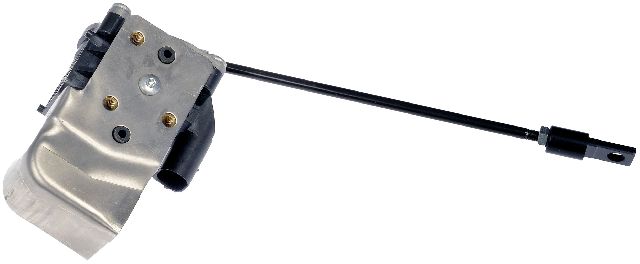
- If an adjustment and software update don't work, the actuator itself (Part # 39400-2G700) likely needs replacement, not the entire turbocharger.
What's Unique About the 2011-2012 Kia SPORTAGE

The 2.0L T-GDI engine in this generation of Sportage and its platform mates (like the Hyundai Sonata/Santa Fe and Kia Optima) uses an electronic wastegate actuator, which is more precise than older vacuum-operated types but also prone to specific issues. Kia and Hyundai issued multiple Technical Service Bulletins (TSBs) acknowledging that this code is often caused by a software glitch in the ECM that needs a dealer-performed update, or by the actuator's control rod stretching or wearing slightly over time, requiring a simple but precise voltage adjustment.
Diagnostic Flowchart

Tap your situation to follow the diagnostic path that matches what you're seeing on this vehicle.
Symptoms You May Notice
- Check Engine Light is on (may be flashing in some cases)
- Significant loss of engine power and acceleration (limp mode)
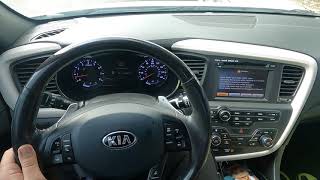
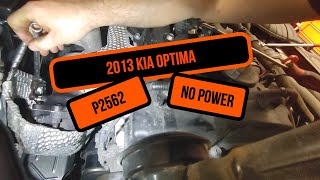
- Vehicle feels sluggish, as if the turbo is not working 🎬 See how this P2562 code causes a total loss of power.
- Inability to accelerate past a certain speed, like 60 mph
- Power may temporarily return after restarting the engine
- Problem may be more noticeable in very cold weather
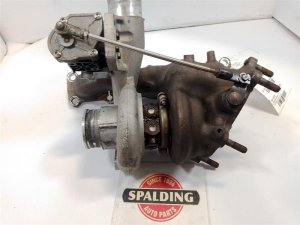
- Replacing the entire turbocharger assembly. The issue is almost always the separate electronic actuator, its adjustment, or the ECM software. Some shops may incorrectly state the whole turbo must be replaced, though some dealers claim Kia's policy requires it.
Most Likely Causes

- Outdated Engine Control Module (ECM) Software 🔴 High Probability Kia released multiple Technical Service Bulletins (TSBENG130, TSB-ENG130R1) specifically for this issue on 2011-2012 Sportage 2.0L T-GDI models, indicating a known software problem that can misinterpret sensor data.
How to confirm: A Kia dealership can check your vehicle's software version (ROM ID) against the TSB to see if the update is needed. This is the first step recommended by the manufacturer.
Typical fix: The ECM must be 'reflashed' with the updated software by a Kia dealer or a qualified shop with Kia's GDS tool.
Est. part cost: $0 - Electronic Wastegate Actuator (EWGA) Rod Out of Adjustment 🔴 High Probability Over time, the control rod can stretch or the linkage can wear, causing the sensor's baseline voltage to drift out of the acceptable range. The TSBs mention this as a required check and potential adjustment.
How to confirm: Using a scan tool with live data or a multimeter, check the actuator's sensor voltage with the key on, engine off. The TSBs specify that if the voltage is 4.3V or higher, an adjustment is needed. The target is typically between 4.0V and 4.2V.
Typical fix: Loosen the 10mm locknut on the actuator rod and turn the rod end to change its length until the voltage is within specification. Shortening the rod (turning clockwise) lowers the voltage. 🎬 Watch: Step-by-step guide to adjusting the wastegate sensor voltage. This is a precise adjustment, often requiring only a few turns.
Est. part cost: $0 - Faulty Electronic Wastegate Actuator (EWGA) 🟡 Medium Probability The electronic motor or the integrated position sensor can fail internally. This becomes the likely cause if a software update and rod adjustment do not resolve the code, or if the code returns shortly after adjustment. Internal wear can also cause inconsistent voltage readings that cannot be stabilized by adjustment.
How to confirm: If the voltage reading is erratic, does not change with adjustment, or if the actuator fails to move when commanded by a high-end scan tool, the part is likely bad. Some owners report that after an initial successful adjustment, the code returns, pointing to an intermittently failing actuator.
Typical fix: Replace the electronic wastegate actuator. It is available as a separate part from the turbocharger.
Est. part cost: $130-$250 - Damaged Wiring or Connector ⚪ Low Probability
How to confirm: Visually inspect the wiring harness and connector going to the wastegate actuator for any signs of melting, corrosion, or physical damage. The harness is in a high-heat area near the turbo.
Typical fix: Repair the damaged section of the wiring harness or replace the connector pigtail.
Est. part cost: $15-$50
Rare But Worth Checking
- Worn Turbocharger Internals:
Diagnosis Steps
- Read the code with an OBD-II scanner to confirm P2562 is present. Note any other codes like P2565 or P2563.
- Check for TSBs: The first step should be to determine if your vehicle has had the ECM reflash performed as specified in Kia TSBs ENG130, ENG130R1, and PS240. A dealer can confirm this using your VIN.
- Inspect Wiring: Visually inspect the wiring and connector for the electronic wastegate actuator, located on the turbocharger. Look for any signs of heat damage, corrosion, or loose connections.
- Measure Actuator Voltage: With the ignition ON and engine OFF (KOEO), use a scan tool with live data or a multimeter to measure the 'Turbocharger Boost Control Position Sensor' voltage. On the Sportage, you need to probe the blue wire in the connector (bottom left pin when looking at the connector from the front of the vehicle). On platform mates like the Optima/Sonata, this is often a yellow wire.
- Analyze Voltage: According to Kia's TSB, if the voltage is 4.3V or higher, the actuator rod needs adjustment. The target is typically 4.1V-4.2V. Some sources aim for as close to 4.0V as possible. If the voltage is correct, the issue may be the ECM software or an intermittent actuator fault.
- Adjust Actuator Rod (if needed): If the voltage is high, let the turbo cool down. Remove the small C-clip from the rod end (be careful not to drop it!), loosen the 10mm locknut, and remove the rod from the wastegate arm. Turn the rod end clockwise to shorten it and lower the voltage. Make small adjustments (e.g., one full turn) and temporarily place the rod back on the arm to re-check the voltage.
- Cycle Ignition: After adjustment, the TSB specifies to cycle the ignition off for 5 seconds, then on for 5 seconds, a total of 5 times to allow the ECM to learn the new value.
- Finalize and Test Drive: Once the voltage is in spec (4.1-4.2V), tighten the locknut, reinstall the C-clip and heat shield. Clear the codes and perform a test drive. If the code returns and power is still low, and you have confirmed the software is up to date and the voltage is correct, the actuator itself is likely faulty and requires replacement.
Parts You'll Likely Need
- Electronic Wastegate Actuator
(OEM #39400-2G700)— This component's internal sensor or motor can fail, or it can go out of adjustment. It is the most commonly replaced part for this code if a software update and adjustment don't work. TSB 21-EM-009H confirms this part number for the 2011-2014 Sonata and 2013-2016 Santa Fe Sport, which are platform mates.
Trusted brands: Kia/Hyundai (Genuine), Mobis
OEM price range: $180-$250
Aftermarket price range: $130-$180 - Actuator Rod Retaining Clip (C-Clip)
(OEM #28231-2G411)— This small clip is very easy to drop and lose in the engine bay during the adjustment or replacement procedure. It is highly recommended to have a spare on hand before starting the job. TSB 21-EM-009H lists this part number.
Trusted brands: Kia/Hyundai (Genuine)
OEM price range: $2-$5
Aftermarket price range: $1-$3
Related Codes That Often Appear With This One
- P2565 — This code for 'Turbocharger Boost Control Position Sensor Circuit High' is mentioned in the same Kia TSBs as P2562, as both relate to the actuator's sensor voltage being out of range. P2565 often appears first or alongside P2562.
- P2563 — This code for 'Turbocharger Boost Control Position Sensor Circuit Range/Performance' is also related to the EWGA and is listed in the same Hyundai TSBs. It indicates a performance problem rather than a specific high/low voltage reading.
Technical Service Bulletins (TSBs) & Recalls
- TSBENG130 / SA149: Addresses MIL illumination with DTC P2562/P2565 on 2012 Sportage 2.0 T-GDI, recommending an ECM reflash and EWGA rod length adjustment. Specifies checking voltage and adjusting if >= 4.3V.
- TSB-ENG130R1: A revision of the above bulletin for 2011-2012 models, also detailing the inspection of the boost pressure actuator position voltage.
- PS240: Pre-TSB service action noting that the MIL may illuminate with P2562 on Sportage 2.0 T-GDI engines.
- Hyundai TSB 21-EM-009H / 22-EM-004H: A comprehensive guide for platform mates (Sonata, Santa Fe) that details diagnosis, adjustment, and replacement of the EWGA for P2562/P2563/P2565, confirming part numbers.
Platform-Specific Known Issues
- A known software issue prompted Kia to issue Technical Service Bulletin #TSBENG130, which instructs dealers to reflash the ECM and inspect/adjust the wastegate actuator rod length on affected 2011-2012 Sportage 2.0L T-GDI vehicles.
- Unlike its platform mate, the Kia Optima (which uses a yellow signal wire), the 2011-2012 Sportage uses a blue wire for the actuator position sensor signal that must be probed for voltage measurement.
Mechanic-Grade Diagnostic Values
- Electronic Wastegate Actuator (EWGA) Position Sensor Voltage (KOEO) — expected: 4.1V - 4.2V. Some sources suggest 4.0V is also acceptable.. Failure: A voltage of 4.3V or higher indicates the rod is out of adjustment and needs to be shortened. A reading of 4.5V or 4.6V is common when the code is active.
- Electronic Wastegate Actuator (EWGA) Position Sensor Operating Range — expected: Varies between approximately 0.5V (closed) and 4.5V (fully open) when commanded by a scan tool.. Failure: Voltage does not change when commanded, is erratic, or does not sweep through the full range, indicating a faulty actuator.
Scan Tool Commands That Help
- Kia GDS or equivalent professional scanner (e.g., Autel, Snap-on): Electronic Wastegate Valve Active Test / Actuation Test — This bidirectional command is used to force the actuator motor to move the wastegate rod. It helps confirm if the actuator motor is functional and if the wastegate arm itself is not physically stuck. A technician can observe the rod's movement while monitoring the sensor's voltage PID to see if it sweeps through its range smoothly.
Wiring & Ground Locations
- EWGA Connector Pin (Signal) — On the 2011-2012 Sportage 2.0T, the signal wire to probe for voltage is the BLUE wire. It is located on the bottom left of the connector when looking at it from the front of the vehicle.. This specific pin provides the sensor's position voltage to the ECM. Probing the correct wire is critical for an accurate diagnosis. Note that on platform mates like the Kia Optima and Hyundai Sonata, this wire is often YELLOW.
Real Owner Repair Stories
- YouTube channel 'Tom's Mechanical Videography' (2012 Kia Sportage 2.0L Turbo) — Check Engine Light with code P2562, vehicle was 'absolutely gutless' with no turbo boost.
❌ Tried (didn't work) The owner went straight to the adjustment, as it is the most common fix.
✅ What actually fixed it The initial voltage was 4.6V. The owner adjusted the actuator rod by shortening it (turning clockwise) approximately 1.5 turns to bring the Key-On-Engine-Off voltage down to 4.1V. This restored turbo function and cleared the code. - YouTube channel 'G Auto Repair' (2012 Kia Optima 2.0L Turbo (platform mate)) — Check Engine Light with P2562, no power, would not accelerate properly.
❌ Tried (didn't work) Initially, the problem was intermittent and cycling the key would temporarily fix it. The mechanic used a scan tool to command the actuator and confirmed it was moving, ruling out a completely seized part.
✅ What actually fixed it The mechanic found the sensor voltage was 4.5V. He adjusted the rod to bring the voltage to 4.2V. He noted that even after adjustment, the voltage fluctuated slightly when cycling the ignition, suggesting some internal wear, but the adjustment brought it within the acceptable range and resolved the code. He advised the customer that if the code returned, the actuator would need replacement.
OEM Part Supersession History
39400-2G700→39400-2G720 (in some aftermarket catalogs)— Unknown, likely a minor revision or change in supplier. Both are generally listed as compatible for the 2011-2016 Sportage 2.0T.
Heads up: While aftermarket suppliers list 39400-2G720 as a replacement, the primary OEM part number referenced in TSBs for this generation is 39400-2G700. It is safest to use the original part number.
Model Year Variations Within This Range
- 2011-2012: The official Kia TSB (ENG130) specifies slightly different production date ranges for affected vehicles. For 2012 models, it's May 20, 2011 to January 17, 2012. For 2011 models, another TSB (ENG130R1) lists May 1, 2011 to January 1, 2012. This indicates the software issue was resolved on the production line around mid-January 2012.
- 2011-2012 Sportage vs. Optima/Sonata: The wiring harness color for the actuator position sensor signal is different. On the Sportage, it is a BLUE wire. On the Optima and Sonata of the same era, it is a YELLOW wire. The pin position (bottom left) is the same.
Helpful Videos

Used OEM Parts in Stock
New Aftermarket Parts Available



The information in this article is provided for general reference and educational purposes only. Vehicle specifications, procedures, and part compatibility can vary by production date, trim level, and region. Always consult your vehicle's factory service manual and verify part numbers before purchasing or performing repairs. Safety-critical components such as airbags, seat belts, and braking systems should be installed by a qualified professional.
- Kia SPORTAGE:
- 🎬 Helpful Videos
- 🛍️ Shop This Part
- What's Unique About the 2011-2012 Kia SPORTAGE
- Diagnostic Flowchart
- Symptoms You May Notice
- Most Likely Causes
- Rare But Worth Checking
- Diagnosis Steps
- Parts You'll Likely Need
- Related Codes That Often Appear With This One
- Technical Service Bulletins (TSBs) & Recalls
- Platform-Specific Known Issues
- Mechanic-Grade Diagnostic Values
- Scan Tool Commands That Help
- Wiring & Ground Locations
- Real Owner Repair Stories
- OEM Part Supersession History
- Model Year Variations Within This Range
- 🎟️ Get 5% Off