

P2544 on 2006-2011 Cadillac STS: Torque Management Signal Fault Causes and Fixes
On a 2006-2011 Cadillac STS, code P2544 is most often caused by a wiring issue at the main transmission connector (X1). A GM Technical Service Bulletin (PIC4740E) specifically points to inspecting the terminals in this connector for damage, corrosion, or being unseated before replacing any expensive modules. This is a known failure point causing a loss of communication between the engine and transmission computers.
- P2544 on a Cadillac STS indicates a communication failure between the transmission and engine computers, specifically regarding torque requests for shifting.
- Before suspecting expensive control modules, ALWAYS inspect the transmission's main wiring connector (X1) for damaged or unseated pins, as this is a known issue documented in GM TSB PIC4740E.
- Symptoms include very harsh, banging shifts, a Check Engine Light, and potentially a no-start condition or cycling door locks.
- Driving with this condition is not recommended as it can cause significant stress and potential damage to the transmission.
What's Unique About the 2006-2011 Cadillac STS
For this specific generation of Cadillac STS and its platform mates, the P2544 code is strongly associated with a known issue documented by General Motors. A Technical Service Bulletin (PIC4740E) directs technicians to a specific wiring connector (X1) as the likely point of failure, rather than immediately suspecting a bad control module. This makes diagnosis more direct than on other vehicles where this code might appear.
Diagnostic Flowchart
Tap your situation to follow the diagnostic path that matches what you're seeing on this vehicle.
Symptoms You May Notice
- Harsh, abrupt, or banging gear shifts. 🎬 See how to diagnose and fix transmission drive shaft clunking
- Check Engine Light is on.
- Traction Control or StabiliTrak warning light may be on.
- Vehicle may enter a 'limp mode' with reduced engine power.
- Transmission may not shift properly or may feel like it's slipping.
- In some cases, a complete loss of communication with the TCM, preventing shifting.
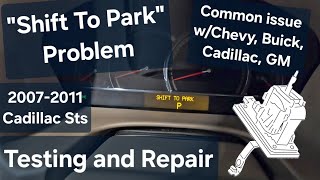
- Vehicle may not crank over or may be a no-start condition. 🎬 Watch: How to fix common shift to park and starting issues
- Door locks may cycle intermittently while driving.
- Replacing the Transmission Control Module (TCM) without first thoroughly inspecting the wiring harness and the X1 connector as specified in TSB PIC4740E.
- Replacing the entire transmission valve body when the issue is external to the transmission at the X1 connector.
Most Likely Causes
- Damaged Wiring or Unseated Terminals at Transmission Connector X1 🔴 High Probability As identified in GM TSB #PIC4740E, the terminals within the main transmission harness connector (X1) are a known failure point. Vibration, heat, and moisture can lead to poor contact, corrosion, or unseated pins, disrupting CAN bus communication.
How to confirm: Visually inspect the X1 connector on the transmission. Disconnect it and check for any bent, spread, or corroded male and female terminals. Perform a 'pull test' by gently tugging on each wire going into the connector to ensure they are securely seated. The TSB notes that applying a side load on the wires may reveal a false positive lock, so be thorough.
Typical fix: Repairing the specific wire or replacing the affected terminal(s). In some cases, a new connector pigtail may need to be spliced in. Use of dielectric grease on the connector after repair is recommended to prevent future moisture intrusion.
Est. part cost: $10-$75 - Faulty Transmission Control Module (TCM) 🟡 Medium Probability The TCM is located inside the transmission on many of these models, where it is subjected to heat and vibration. However, this should be considered a secondary cause after ruling out the much more common wiring issue.
How to confirm: This should only be considered after the wiring and connectors have been proven to be in perfect condition. Requires advanced diagnostics with a scan tool capable of communicating with the TCM to verify its operational status and check for internal faults.
Typical fix: Replacement and programming of the Transmission Control Module. This requires dropping the transmission pan.
Est. part cost: $200-$600 - Faulty Engine Control Module (ECM) ⚪ Low Probability
How to confirm: This is the least likely cause. It is diagnosed by exclusion, after confirming the wiring, connectors, and TCM are all functioning correctly. A professional scan tool may be able to command a self-test of the ECM.
Typical fix: Replacement and programming of the Engine Control Module.
Est. part cost: $300-$800
Rare But Worth Checking
- Outdated Control Module Software:
Diagnosis Steps
- Scan all vehicle modules for stored Diagnostic Trouble Codes (DTCs). Note all codes, especially any 'U' (communication) codes, as they point towards a network fault.
- According to service literature, P2544 is an informational DTC. Diagnose all other engine and transmission DTCs first. If only P2544 and U-codes are present, proceed with CAN circuit diagnosis.
- Prioritize diagnosis based on TSB #PIC4740E. Locate the transmission X1 connector, which is the large, round main connector on the side of the transmission case.
- Disconnect the battery before proceeding with connector inspection.
- Carefully disconnect the X1 connector. Thoroughly inspect both the male and female sides for corrosion (green crust), moisture, or bent/damaged pins.
- Gently tug on each wire entering the back of the connector to ensure it is properly seated and crimped. The TSB specifically warns to apply a side load to the wires, as a loose terminal can feel secure (a 'false positive lock') when pulled straight back.
- If any terminals are suspect, they should be professionally repaired or replaced using the correct terminal removal tools.
- If the connector and wiring are confirmed to be in perfect condition, the next step is to diagnose the CAN bus wiring, termination resistors, and the health of the TCM and ECM, which typically requires a professional-grade scan tool and an oscilloscope.
- Clear all codes and perform a test drive to see if the P2544 code returns.
Parts You'll Likely Need
- Transmission Harness Connector Terminals/Pigtail
(OEM #24232175 (Connector from 2005 model, may fit others), or service pigtails like ACDelco PT1595)— This is the most common failure point according to GM's own service bulletin for this code on this vehicle.
Trusted brands: ACDelco, Dorman
OEM price range: $15-$75
Aftermarket price range: $10-$50 - Transmission Control Module (TCM)
(OEM #Varies by year and transmission (e.g., 24256861))— If the wiring is confirmed to be good, the module that sends the signal may have failed internally. This is the second most likely cause.
Trusted brands: ACDelco
OEM price range: $350-$600
Aftermarket price range: $200-$450
Related Codes That Often Appear With This One
- P0700 — This is a generic code indicating the TCM has stored a fault. It often appears with P2544 because the underlying communication issue is detected by both the ECM and TCM.
- U0073, U0100, U0101, U0109, U0121, U0140 — These are all communication (U-series) codes. Their presence alongside P2544 strongly indicates a network or wiring problem, as multiple modules are losing communication. TSB PIC4740E specifically lists these as related codes stemming from the same X1 connector issue.
- C0561 — This code is for the StabiliTrak system. The traction and stability control systems rely on torque data from the engine and transmission, so a communication failure can disable them and set this code, as noted in TSB PIC4740E.
Technical Service Bulletins (TSBs) & Recalls
- PIC4740E: Warns that various modules may not communicate and numerous DTCs, including P2544, C0561, and multiple U-codes can be stored. It directs technicians to inspect the transmission X1 connector terminals as a primary diagnostic step before replacing any modules. It covers 2006-2011 STS models with the 6-speed automatic transmission.
Platform-Specific Known Issues
- GM Technical Service Bulletin #PIC4740E explicitly identifies a potential for communication loss between the TCM and ECM due to unseated pins or corrosion in the transmission X1 connector, leading to code P2544 among many others.
- Symptoms related to this TSB are not limited to the check engine light and harsh shifts, but can also include a no-start condition and door locks cycling while driving.
Mechanic-Grade Diagnostic Values
- GMLAN Bus Resistance — expected: 60 Ohms (± 5 Ohms). Failure: A reading of 120 Ohms indicates an open circuit or missing terminating resistor. A reading below 55 Ohms can indicate a short between the CAN lines or a faulty module.
- CAN High (Pin 6 at DLC) Voltage — expected: ~2.5V at rest (recessive), pulsing to ~3.5V when active (dominant). Average reading on a multimeter should be ~2.7V.. Failure: Voltage stuck high, low, or not changing indicates a circuit fault or failed driver in a module.
- CAN Low (Pin 14 at DLC) Voltage — expected: ~2.5V at rest (recessive), pulsing to ~1.5V when active (dominant). Average reading on a multimeter should be ~2.2V.. Failure: Voltage stuck high, low, or not changing indicates a circuit fault or failed driver in a module.
Scan Tool Commands That Help
- GDS2 / Tech2: Module Communication Status — This is not a bidirectional command, but a primary diagnostic function. If multiple U-codes are present, a technician will view the network status to see which modules are not communicating. If communication is lost, the technician will physically disconnect modules one by one (e.g., by pulling fuses) while observing the scan tool to see when communication with other modules is restored, thereby isolating the faulty module or circuit branch.
Wiring & Ground Locations
- DLC (Data Link Connector) — Under the driver's side dashboard, to the left of the steering column.. This is the primary access point for network diagnostics. The High-Speed GMLAN bus can be tested for resistance and voltage at Pin 6 (CAN High) and Pin 14 (CAN Low).
- X1 Transmission Connector — The large, round main electrical connector on the side of the transmission case.. This is the specific connector identified in TSB PIC4740E as the most common point of failure for code P2544 and related communication issues on this vehicle.
- ECM/TCM Engine Grounds (e.g., G101, G106, G131) — Typically heavy gauge cables bolted from the engine block to the chassis/frame. Common locations on similar GM platforms are the front or rear of the engine block/cylinder heads and the main frame crossmember.. A poor ground connection for the ECM or TCM can create a floating ground, causing unpredictable communication errors on the CAN bus that mimic a wiring or module failure.
- Driveshaft Area Harness Routing — The main vehicle harness that runs along the transmission tunnel, above the driveshaft.. On some GM vehicles, this harness can sag or its clips can break, allowing it to rub against the spinning driveshaft, eventually chafing through wires and causing shorts on the CAN bus.
Real Owner Repair Stories
- YouTube channel 'The Angry Mechanic' (2007 Cadillac Escalade (similar GM platform, engine, and wiring architecture)) — A long list of communication and sensor codes, including P2544 and a persistent P0341.
❌ Tried (didn't work) Replacing the Engine Control Module (ECM), Replacing the camshaft position sensor
✅ What actually fixed it Found the main wiring harness had rubbed through on the driveshaft, causing a short in one of the wires. Repairing the damaged wire resolved all the codes.
Helpful Videos
We Have This Part in Stock

The information in this article is provided for general reference and educational purposes only. Vehicle specifications, procedures, and part compatibility can vary by production date, trim level, and region. Always consult your vehicle's factory service manual and verify part numbers before purchasing or performing repairs. Safety-critical components such as airbags, seat belts, and braking systems should be installed by a qualified professional.
- Cadillac STS:
- 🎬 Helpful Videos
- 🛍️ Shop This Part
- What's Unique About the 2006-2011 Cadillac STS
- Diagnostic Flowchart
- Symptoms You May Notice
- Most Likely Causes
- Rare But Worth Checking
- Diagnosis Steps
- Parts You'll Likely Need
- Related Codes That Often Appear With This One
- Technical Service Bulletins (TSBs) & Recalls
- Platform-Specific Known Issues
- Mechanic-Grade Diagnostic Values
- Scan Tool Commands That Help
- Wiring & Ground Locations
- Real Owner Repair Stories
- 🎟️ Get 5% Off