

P2544 on 2007-2009 Cadillac SRX: Torque Management Signal Causes and Fixes
P2544 on a 2007-2009 SRX almost always means there's a bad connection at the main transmission wiring harness connector, known as X1. This causes a loss of communication between the engine and transmission computers, resulting in harsh, banging shifts. The most common fix is inspecting and repairing the connector terminals for corrosion or being unseated, as documented in GM TSB #PIC4740F (superseding PIC4740E).
- P2544 on a 2007-2009 SRX indicates a communication failure between the engine and transmission computers, resulting in harsh, damaging shifts.
- Before suspecting expensive control modules, ALWAYS inspect the main transmission wiring connector (X1) for loose or corroded pins, as this is the most common cause documented in GM TSB #PIC4740E.
- Driving with this code is not recommended due to the stress placed on the transmission.
- The presence of other communication codes (U-codes) strongly supports a wiring or connector problem rather than a failed module.
What's Unique About the 2007-2009 Cadillac SRX
For this specific generation of Cadillac SRX and its platform mates, General Motors has issued a Technical Service Bulletin (TSB #PIC4740F, which supersedes previous versions) that directly addresses the most common cause of P2544. The bulletin points to unseated, spread, or corroded terminal pins within the main 20-pin transmission wiring harness connector (X1). This makes a simple wiring or connector fault a much higher probability than a failed control module, which might be the primary suspect on other vehicles. The connector's location on the side of the transmission exposes it to the elements, making this failure common.
Diagnostic Flowchart
Tap your situation to follow the diagnostic path that matches what you're seeing on this vehicle.
Symptoms You May Notice
- Harsh, banging, or slamming gear shifts
- Check Engine Light (MIL) is on
- Vehicle may enter 'limp mode' with reduced power
- Traction Control or StabiliTrak warning lights may illuminate
- Delayed or failed shifting
- No crank condition in some cases
- Loss of communication with TCM/ECM via scan tool
- Replacing the Transmission Control Module (TCM) or the entire transmission without first thoroughly inspecting the X1 connector and wiring harness. The TSB clearly indicates the connector is the most common point of failure, making this a costly and often unnecessary repair.
Most Likely Causes
- Unseated or Corroded Pins in Transmission Connector (X1) 🔴 High Probability This is a well-documented failure point identified by GM in Technical Service Bulletin #PIC4740F. The 20-pin round connector is on the driver's side of the transmission and its seals can fail over time, allowing moisture intrusion. Vibration and heat cycles can also cause the female terminals to spread or the male pins to back out.
How to confirm: Disconnect the large X1 connector on the side of the transmission. Perform a thorough visual inspection of both the male and female sides for any green/white corrosion, moisture, or bent pins. Gently tug on each individual wire on the harness side to ensure the terminal is fully seated and locked in the connector. A side load on the wires during this test may cause a false positive, so be thorough.
Typical fix: Clean the connector and pins with electrical contact cleaner and a small brush. Use a terminal pick tool to tighten any female terminals that may have spread. Reseat any loose pins. If corrosion is severe, the connector pigtail or individual terminals may need to be replaced. Applying a small amount of dielectric grease upon reassembly can help prevent future moisture intrusion.
Est. part cost: $10-$75 - Damaged or Chafed Wiring Harness 🟡 Medium Probability The wiring harness can rub against the transmission case, crossmembers, or its own securing brackets, eventually wearing through the insulation and causing a short or open circuit. TSB #PIC4740F specifically mentions checking the harness for chafing near its securing bracket.
How to confirm: Visually inspect the entire length of the wiring harness between the TCM and ECM for any signs of chafing, melting, or rodent damage. Pay close attention to where the harness is secured or makes sharp bends. Use a multimeter to perform a continuity test on the relevant CAN bus wires (typically a twisted pair).
Typical fix: Repair the damaged section of wire using a weatherproof butt connector with heat shrink. Re-route or protect the harness with loom to prevent future damage.
Est. part cost: $5-$100 - Faulty Transmission Control Module (TCM) ⚪ Low Probability The TCM for the 6L50/6L80 transmissions used in this SRX is located inside the transmission oil pan, where it is subjected to constant heat and vibration. While less common than the connector issue, internal electronic failure is possible.
How to confirm: This is a diagnosis of exclusion. If the wiring, connectors, and ECM have all been verified as good, the TCM is the likely culprit. This requires advanced diagnostic tools to confirm communication status and internal faults.
Typical fix: Replace the Transmission Control Module (often called a TEHCM). This part is inside the transmission and requires draining the fluid and removing the pan. The new module must be programmed by a dealer or a qualified shop with the correct GM tools (SPS).
Est. part cost: $400-$800
Rare But Worth Checking
- Faulty Engine Control Module (ECM): While less common than a TCM failure for this specific code, it's possible for the ECM's internal circuits that receive the torque request signal to fail. This is very rare and should only be considered after all other possibilities are exhausted.
- Incorrect Tire Size: A significant change in tire size without recalibrating the vehicle's control modules can cause discrepancies between wheel speed sensor data and expected torque values, potentially triggering a P2544 code.
Diagnosis Steps
- Scan the vehicle for all stored Diagnostic Trouble Codes (DTCs). Note P2544 and any accompanying P, C, or U codes, especially communication codes like U0100 or U0101.
- Obtain and review GM Technical Service Bulletin #PIC4740F. This bulletin is the roadmap for this specific issue.
- Raise and safely support the vehicle.
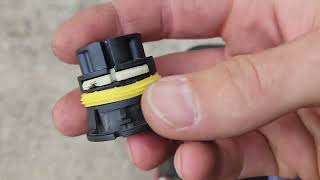
- Locate the main wiring harness connector (labeled X1) on the driver's side of the transmission. It is a large, round, 20-pin connector. 🎬 Watch: How to properly disconnect and inspect the 6L80e connector.
- Disconnect the X1 connector. This is often a lever-lock style connector. Perform a thorough visual inspection of both the male and female sides for corrosion (green/white powder), bent pins, or signs of water intrusion.
- Gently tug on each of the 20 wires leading into the harness-side of the connector to ensure the terminal pin is fully seated and locked in place. A loose pin may look fine but will pull out with a light tug.
- If any issues are found (corrosion, loose pins), clean the connector with contact cleaner and a small brush. Reseat any loose pins. If terminals are spread, a special tool may be needed to tighten them. 🎬 See how to depin and repair the wiring harness connector. If damage is severe, replace the connector pigtail (e.g., ACDelco PT729).
- If the connector appears perfect, meticulously inspect the wiring harness for any signs of physical damage, chafing, or melting, especially where it is clamped to the vehicle or runs near exhaust components.
- If no physical faults are found, advanced diagnostics using a multimeter to check for continuity and shorts on the CAN bus wires (pins 6 & 14 on the OBD-II port) is the next step. You should see approximately 60 ohms of resistance across the two CAN lines with the battery disconnected.
- Only after confirming the wiring and connectors are 100% intact should you consider a faulty TCM or ECM as the cause. TCM replacement requires removing the transmission pan.
Parts You'll Likely Need
- Transmission Harness Connector Pigtail
(OEM #ACDelco PT729 (supersedes GM 12126459))— This is the most common point of failure, as identified in TSB #PIC4740F. If corrosion is severe, cleaning is not enough and the connector must be cut off and a new pigtail spliced in.
Trusted brands: ACDelco, Dorman, Fleece Performance
OEM price range: $40-$70
Aftermarket price range: $25-$50 - Transmission Control Module (TCM/TEHCM) — If the wiring and connector are confirmed to be in perfect condition, the internal TCM may have failed due to heat and vibration. This is a less common but possible cause. Requires programming.
Trusted brands: ACDelco (GM Genuine)
OEM price range: $500-$800
Aftermarket price range: $300-$600
Related Codes That Often Appear With This One
- P0700 — This is a generic code indicating the TCM has stored a fault and has requested the MIL to be turned on. It frequently appears with P2544 because the underlying communication issue is detected by the TCM first.
- U0073, U0100, U0101, U0121, U0140 — These are network communication (CAN bus) fault codes. Their presence alongside P2544 strongly reinforces the diagnosis of a wiring or connector issue, as a physical fault like a corroded pin in the main transmission connector can disrupt communication for multiple modules at once.
Technical Service Bulletins (TSBs) & Recalls
- PIC4740F: Supersedes PIC4740E. Addresses 'No Crank - Multiple Warning Telltales On - Trans Shifts Hard' and lists P2544. Instructs technicians to inspect the transmission X1 connector terminals for being unseated or spread. Also mentions checking for harness chafing.
Platform-Specific Known Issues
- A known issue, documented in GM TSB #PIC4740F, points to unseated pins in the transmission X1 connector as a primary cause for this code and other related communication DTCs. This TSB has been updated multiple times, indicating the persistence of the problem across several GM platforms.
- Owner forums for the SRX and its platform-mates are filled with accounts of technicians or owners replacing entire transmissions, only to find the problem was the inexpensive X1 connector. The symptoms are severe enough to mimic a catastrophic internal transmission failure.
Mechanic-Grade Diagnostic Values
- GMLAN Bus Resistance — expected: 60 Ohms (± 5 Ohms) when measured across pins 6 and 14 of the DLC with the battery disconnected.. Failure: A reading of ~120 Ohms indicates an open circuit or one of the two terminating resistors is offline. A reading near 0 Ohms indicates a short between the CAN High and CAN Low wires.
- GMLAN CAN High Voltage (Key On, Engine Off) — expected: Fluctuates between 2.5V and 3.5V, averaging ~2.7V on a multimeter, measured between DLC pin 6 and ground.. Failure: Voltage is stuck at 0V, battery voltage, or a static 2.5V, indicating a short or open circuit.
- GMLAN CAN Low Voltage (Key On, Engine Off) — expected: Fluctuates between 2.5V and 1.5V, averaging ~2.2V on a multimeter, measured between DLC pin 14 and ground.. Failure: Voltage is stuck at 0V, battery voltage, or a static 2.5V, indicating a short or open circuit.
Scan Tool Commands That Help
- Tech 2 / GDS2 / High-End Aftermarket: Module Setup / SPS Programming — This is required when a new Transmission Control Module (TCM/TEHCM) is installed. The function uses GM's Service Programming System (SPS) to flash the module with the correct VIN-specific calibration files. Failure to program a new module will result in a no-start or no-communication condition.
- Tech 2 / GDS2 / High-End Aftermarket: Fast Learn Adapts / Transmission Service Learn — After replacing and programming a new TCM, or after major transmission service, this procedure must be run to reset and quickly relearn the transmission clutch apply pressures and shift timing. Skipping this step will result in poor shift quality, harsh shifts, or slipping.
Wiring & Ground Locations
- X1 Connector — Large, 20-pin round electrical connector on the driver's side of the transmission case.. This is the primary failure point identified in TSB #PIC4740F. It carries all communication and power between the vehicle harness and the internal TCM. Corrosion or unseated pins here directly cause P2544 and related U-codes.
- G103 — On the front of the passenger side cylinder head.. This is a primary engine ground point. A poor connection here can affect the Engine Control Module's (ECM) ground reference, potentially causing it to misinterpret data from the TCM and set communication codes.
- G107 (per forum data) — On a stud at the transmission, located down and to the right of the oil filter housing.. This is a critical ground point for the transmission itself. A loose or corroded ground here can cause the TCM to malfunction or create a ground potential difference between it and the ECM, leading to communication errors like P2544.
- CAN Bus at DLC — Pins 6 (CAN High) and 14 (CAN Low) at the Data Link Connector (OBD-II port) under the driver's side dashboard.. These pins provide a direct access point to the entire high-speed GMLAN network, allowing for network-wide resistance and voltage tests without having to access individual modules.
Real Owner Repair Stories
- CadillacForums user (via summary article) (2008 Cadillac CTS (platform mate covered by same TSB)) — Harsh shifting, Check Engine Light with codes P0700 and U0100 (Lost Communication with TCM).
❌ Tried (didn't work) Replacing the Transmission Control Module (TCM).
✅ What actually fixed it Found and repaired a broken/chafed wire in the transmission wiring harness near the bell housing, a location specifically mentioned as a potential issue in TSB #PIC4740F.
"I Checked Everything" — The Actual Cause
- The electrical equivalent of this pattern is when wiring passes a basic continuity test but fails under real-world conditions. A wire may show continuity when tested with a multimeter but have an intermittent open or short when subject to engine vibration or heat. This is common in cases of harness chafing, where only a few strands of copper remain. The real repair story, where a TCM replacement failed to fix the issue but a harness repair did, is a perfect example of this. The fault was likely intermittent, leading to the initial misdiagnosis of the module itself.
When the Usual Fixes Don't Work
- A documented repair on a platform-mate vehicle (2008 CTS) showed that replacing the Transmission Control Module (TCM) did not resolve the P2544 and associated communication codes. The problem was only resolved after a damaged wire in the main harness was located and repaired, confirming that even when symptoms seem severe, the root cause is far more likely to be the wiring or connectors, as stated in TSB PIC4740F, rather than the module itself.
OEM Part Supersession History
GM 12126459→ACDelco PT729— Standard part lifecycle update.
Heads up: PT729 is the correct service replacement pigtail for the 20-pin female transmission harness connector (X1).
Helpful Videos

We Have This Part in Stock


The information in this article is provided for general reference and educational purposes only. Vehicle specifications, procedures, and part compatibility can vary by production date, trim level, and region. Always consult your vehicle's factory service manual and verify part numbers before purchasing or performing repairs. Safety-critical components such as airbags, seat belts, and braking systems should be installed by a qualified professional.
- Cadillac SRX:
- 🎬 Helpful Videos
- 🛍️ Shop This Part
- What's Unique About the 2007-2009 Cadillac SRX
- Diagnostic Flowchart
- Symptoms You May Notice
- Most Likely Causes
- Rare But Worth Checking
- Diagnosis Steps
- Parts You'll Likely Need
- Related Codes That Often Appear With This One
- Technical Service Bulletins (TSBs) & Recalls
- Platform-Specific Known Issues
- Mechanic-Grade Diagnostic Values
- Scan Tool Commands That Help
- Wiring & Ground Locations
- Real Owner Repair Stories
- "I Checked Everything" — The Actual Cause
- When the Usual Fixes Don't Work
- OEM Part Supersession History
- 🎟️ Get 5% Off