

OBD-II Code P2507: ECM/PCM Power Input Signal Low
What P2507 means, why it triggers, and how to fix it
- Code P2507 indicates the Powertrain Control Module (PCM) is receiving less than 12 volts, usually due to a dying battery or corroded ground wire.
- Do not drive the vehicle, as the low-voltage condition causes unexpected engine stalling at highway speeds.
- Start diagnosis by testing the battery and alternator; a healthy system must show 12.4+ volts resting and 13.5+ volts running.
- Never replace the PCM ($1,000+ repair) without first performing a dynamic voltage drop test to rule out a $20 faulty relay or blown fuse.
What Does P2507 Mean?
Code P2507 means the Powertrain Control Module (PCM) detects its power supply has dropped below the minimum required voltage. The PCM constantly monitors its dedicated power input circuit. If voltage falls below the manufacturer's threshold (e.g., under 6 volts for 5 seconds), it triggers this code. This unstable power severely disrupts engine management, transmission control, and safety systems.
Technical definition: The SAE/OBD-II definition is: ECM/PCM Power Input Signal Low. This signifies the engine control module receives voltage on its constant 'keep-alive' or ignition-switched power supply circuits below specified parameters for a predetermined time. This power is crucial for retaining memory for fuel trims, idle values, and internal timers 🎬 See how a low voltage signal causes rough idling in Mazdas. when the vehicle is off.
Can I Drive With P2507?
No — Do Not Drive. Do not drive. The core risk is an unexpected engine stall at any time, including highway speeds, which causes serious accidents. Unstable voltage also triggers unpredictable behavior in safety systems like ABS and airbags. Continuing to drive guarantees being stranded with a no-start condition, requiring a $100-$200 tow.
Common Causes
- Weak or failing battery (Very Common) — An aging or discharged battery shows 12 volts at rest but drops significantly under load (like starting the engine), falling below the PCM's required threshold. On diesel trucks with dual batteries, a single weak battery drains the healthy one, causing system-wide low voltage.
- Corroded or loose battery terminals and ground connections (Very Common) — Corrosion on battery posts, cable ends, or main chassis/engine ground straps creates high resistance. This resistance causes a voltage drop, preventing full battery voltage from reaching the PCM, even with a perfectly good battery.
- Faulty charging system (alternator) (Common) — A failing alternator fails to recharge the battery while the engine runs. The battery's voltage steadily drops as you drive, eventually triggering P2507 and stalling the vehicle.
- Faulty PCM power relay, fuse, or fuse box (Common) — The PCM is protected by a dedicated relay and fuse. Pitted relay contacts, a blown fuse (like the 15A 'ROOM' fuse on Mazdas), or hidden internal corrosion within the fuse box itself restricts voltage flow to the computer.
- Parasitic electrical drain (Less Common) — An aftermarket accessory, a faulty module, or a shorted wire causes a constant drain on the battery when the car is off. This slowly discharges the battery, leading to a low voltage state on the next startup.
- Damaged wiring or connectors (Less Common) — The wiring harness supplying power to the PCM suffers from fraying, shorts, or heat damage. A single compromised wire, a bent pin, or water intrusion inside the connector causes an intermittent voltage drop.
- Faulty ignition switch (Rare) — The ignition switch sends the 'wake-up' signal and power to the PCM's switched circuits. Worn or burnt internal contacts provide intermittent or low voltage to the PCM when the key turns on.
- Failing Powertrain Control Module (PCM) (Very Rare) — The PCM's internal voltage regulator fails, or water intrusion corrodes the internal circuit board. This is the least common cause; exhaustively rule out all wiring and battery issues first.
Symptoms
- Engine stalls unexpectedly — The engine stalls while driving or idling because the computer loses the power required to control fuel and ignition.
- No-start or hard-start condition — The vehicle cranks slowly, clicks, or fails to crank entirely because battery voltage is too low to power the starter and PCM simultaneously.
- Erratic electrical behavior and multiple warning lights — Dashboard lights flicker, infotainment screens go blank, and ABS/Airbag lights illuminate as the computer's power supply destabilizes and communication drops.
- Check Engine Light is on — The primary indicator that the PCM has stored a diagnostic trouble code.
- Transmission shifting issues — Low voltage causes harsh shifting, delayed engagement, or forces the transmission into a 'limp-home' mode stuck in one gear.
- Auto Start/Stop System Disabled — Vehicles with auto start/stop disable the feature as a fail-safe when battery voltage is unstable.
- Low PCM Voltage Reading (scan-tool only — no driver-felt sign) — An advanced scan tool shows the PCM's reported voltage is significantly lower than the voltage measured directly at the battery.
Diagnostic Flowchart
Tap your situation to follow the diagnostic path that matches what you're seeing on this code.
Common Fixes & Costs
- Replace Battery — Parts: $150-$350, Labor: $50-$100, ~0.5 hr book time (DIY)
- Clean or Replace Battery Terminals/Cables — Parts: $5-$20, Labor: $50-$100, ~0.5 hr book time (DIY)
- Replace Alternator — Parts: $250-$600, Labor: $150-$400, ~1.5 hr book time (Intermediate)
- Replace PCM Power Relay or Fuse — Parts: $10-$30, Labor: $40-$70, ~0.2 hr book time (DIY)
- Repair Wiring Harness or Connector — Parts: $10-$100, Labor: $150-$600, ~2.5 hr book time (Pro)
- Replace TIPM / Fuse Box — Parts: $500-$1200, Labor: $150-$300, ~1.2 hr book time (Pro)
- Replace PCM — Parts: $800-$1500+, Labor: $150-$300, ~1.5 hr book time (Pro)
DIY vs Professional
- Replace Battery — Beginner:
Tools: Socket/wrench set, battery terminal cleaner, memory saver. - Clean or Replace Battery Terminals/Cables — Beginner:
Tools: Wrench set, wire brush or dedicated terminal cleaning tool, corrosion protection spray. - Replace Alternator — Beginner:
Tools: Socket/wrench set, serpentine belt tool, multimeter, torque wrench. - Replace PCM Power Relay or Fuse — Beginner:
Tools: Fuse puller or small pliers. - Repair Wiring Harness or Connector — Beginner:
Tools: Professional multimeter, wiring diagrams, wire strippers, crimpers, soldering iron, heat shrink tubing, depinning tools. - Replace TIPM / Fuse Box — Beginner:
Tools: Socket set, trim removal tools, manufacturer-specific diagnostic scan tool. - Replace PCM — Beginner:
Tools: Socket set, manufacturer-specific diagnostic scan tool for programming.
Used vs. New Parts: Buying Guide
When a used part is worth it: A used OEM alternator from a low-mileage vehicle (under 60,000 miles) is a cost-effective option for older, high-mileage vehicles. It is often more reliable than a cheap aftermarket part.
Donor-vehicle mileage cap: roughly under 60000 miles for the part to have meaningful remaining life.
Donor quality checklist:
- Verify the donor vehicle was scrapped for reasons unrelated to electrical failure (e.g., collision).
- Match the part number exactly. Amperage ratings vary even on the same model year.
- Favor donors from dry climates to avoid hidden corrosion.
Decision logic:
- If Vehicle is less than 5 years old or has under 80K miles → Buy a new OEM or high-quality remanufactured alternator. Long-term reliability is worth the cost.
- If The cost of a used part plus labor is more than 60% of a new part → Buy new. Savings are not worth the risk of premature failure and paying labor twice.
- If You are selling the car soon and need a budget-friendly fix → A tested, used alternator from a reputable salvage yard is a reasonable choice.
Warranty tradeoff: Used parts typically come with a 30-90 day warranty covering only the part. New and quality remanufactured alternators offer 1-year to lifetime warranties.
Worst-case if a used part fails: $300-$700. If a used alternator fails, you pay for a second part plus labor again.
What Happens If You Wait — Timeline
- 0-2 weeks: Check Engine Light illuminates. Vehicle exhibits a slow crank on cold starts but runs normally. (MPG impact: 0-1%% · Added cost: $0)
- 2 weeks - 2 months: Vehicle stalls intermittently at idle. Dash lights flicker during cranking. Hard-start conditions become frequent. (MPG impact: 1-3%% · Added cost: $100-$300 (Potential tow and diagnostic fee))
- 2-6 months: Chronically low voltage damages the battery. The overworked alternator suffers accelerated wear on bearings and regulators. Stalling happens at any speed. (MPG impact: 3-5%% · Added cost: $400-$1000 (Cost of new battery and alternator))
- 6+ months: Sustained unstable voltage and spikes from a failing alternator cause permanent damage to the PCM's internal circuits. The vehicle is unsafe to drive. (MPG impact: 5-10%% · Added cost: $1500-$3000+ (Cost of battery, alternator, and PCM))
Cost of Not Fixing It
- Immediate: High risk of unexpected engine stalling in traffic, leading to an accident. Vehicle fails to start, requiring a tow. (Added cost: $100-$300 for towing and diagnostic fee.)
- 1-3 months: A chronically weak battery forces the alternator to work harder, accelerating its wear and leading to premature failure. Repeated deep discharges permanently damage the battery. (Added cost: $400-$1000 for a new alternator and battery.)
- 3+ months: Sustained low or fluctuating voltage damages sensitive electronics, including the Powertrain Control Module (PCM). (Added cost: $1000-$1800+ for PCM replacement and programming.)
Diagnosis Steps
- Check and Load Test the Battery
Use a digital multimeter to test battery voltage with the engine off. A healthy battery reads 12.4-12.6 volts. Take the vehicle to an auto parts store for a free professional load test, which definitively proves if the battery fails under starting demand.
Tools: Digital Multimeter, Professional battery load tester (Beginner) - Inspect Power and Ground Connections
Visually inspect battery terminals, cable ends, and main ground straps from the battery to the chassis and engine block. Look for white/green corrosion. Use a wrench to confirm all connections are physically tight to bare metal.
Tools: Wrench set, battery terminal cleaner or wire brush (Beginner) - Test the Charging System (Alternator)
Start the engine and check the battery voltage again with a multimeter. It must read between 13.5 and 14.5 volts. A reading below 13.5V indicates a faulty alternator failing to charge the system.
Tools: Digital Multimeter (Beginner) - Inspect the PCM Fuse and Relay
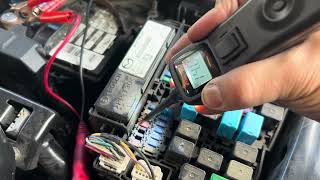
Locate the PCM fuse and relay in the fuse box. Pull the fuse and inspect for damage. Temporarily swap the PCM relay with an identical one from a non-critical system (like the horn). Pay close attention to Mazda's 15A 'ROOM' fuse.
Tools: Fuse puller, owner's manual (Intermediate) - Perform a Dynamic Voltage Drop Test
Connect the multimeter's positive lead to the battery positive post and the negative lead to the PCM power input pin. With the key on, the reading must be less than 0.2 volts. For the ground side, connect the positive lead to the PCM ground pin and the negative lead to the battery negative post. The reading must be less than 0.1 volts. Higher readings confirm high resistance in that wire.
Tools: Digital Multimeter, vehicle-specific wiring diagram, back-probe kit (Advanced) - Check for Parasitic Draw
Use a DC low-amp clamp meter around the negative battery cable. With the vehicle off for 30 minutes, a healthy vehicle draws less than 50-85 milliamps (0.050-0.085A). A higher reading indicates a parasitic draw draining the battery.
Tools: Low-amp DC clamp meter (Advanced) - Check Live Data PIDs and Wiggle Test
Monitor the live data PID for PCM voltage ('VPWR') on a scan tool. It must mirror the battery terminal voltage. While monitoring, gently wiggle sections of the wiring harness near the fuse box, battery, and PCM. If voltage fluctuates, you found the faulty connection.
Tools: OBD-II Scan Tool with Live Data (Advanced) - Inspect the PCM and Connector
Disconnect the battery, then carefully disconnect the PCM connector. Look for bent, corroded, or water-damaged pins. Inspect the PCM housing for physical damage or water intrusion indicating internal failure.
Tools: Wrench set, flashlight, electrical contact cleaner (Intermediate)
When This Code Triggers (Freeze-Frame Conditions)
- DTC that caused freeze frame: P2507 (Confirms the specific fault that triggered the data snapshot.)
- Engine RPM: 0 or <500 RPM (Triggers during engine start-up (cranking) when a weak battery's voltage drops significantly.)
- System Voltage: < 9.0 Volts (Shows a voltage reading below the PCM's minimum threshold, confirming the low voltage event.)
- Engine Coolant Temp: Ambient Temperature (Occurs during a 'cold start' after sitting, as a weak battery has less power in colder conditions.)
- Vehicle Speed: 0 MPH (Consistent with the code setting during a failed or difficult start attempt.)
Related Codes
- P2610 — ECM/PCM Internal Engine Off Timer Performance. A direct companion to P2507 on Mazdas. The PCM's timer requires constant battery power. When P2507 sets due to power loss, the timer fails, logging P2610 simultaneously.
- P0562 — System Voltage Low. Indicates low voltage across the entire electrical system. If present with P2507, the issue is systemic (battery, alternator). If P2507 appears alone, the fault is isolated to the PCM's specific circuit.
- U0100 — Lost Communication With ECM/PCM. Appears when voltage drops so low the PCM shuts down completely, causing other modules to lose network communication with it.
- P0882 — TCM Power Input Signal Low. Specific to the Transmission Control Module. Seeing this with P2507 proves a widespread power supply issue affecting multiple units.
Climate & Environmental Factors
- Cold Weather: Cold temperatures reduce a battery's chemical efficiency and power output by up to 60%. Cold also thickens engine oil, increasing starter demand. This combination forces a weak battery below the PCM's voltage threshold during startup.
- Hot Weather: High under-hood temperatures accelerate the degradation of a battery's internal components, causing permanent capacity loss. A heat-damaged battery is highly likely to fail during the next cold snap.
- High Humidity and Road Salt: Salt-laden moisture from coastal air or winter roads attacks battery terminals and ground straps. It seeps into unprotected connectors, creating high resistance that causes voltage drops.
How to Talk to a Mechanic About This Code
Say this: "I have a P2507 code, and I need a diagnostic for a 'PCM Power Input Signal Low' fault. Please start by load testing the battery and checking the charging system output. If those pass, please perform voltage drop tests on the PCM's power and ground circuits."
This directs the mechanic to perform fundamental electrical tests in the correct order, preventing them from jumping to expensive conclusions like replacing the PCM. It shows you expect a logical diagnostic process.
Avoid saying:
- 'My check engine light is on, can you just fix it?'
- 'The code is P2507, just replace the computer.'
- 'I think the battery is weak, can you put a new one in?'
Questions to ask before authorizing the repair:
- What was the battery's voltage at rest, during cranking, and with the engine running?
- Did you perform a voltage drop test on the PCM power and ground circuits? What were the readings?
- If recommending a part replacement, how did you confirm the original part failed?
- Is this repair covered by a warranty, and what does it include?
Where to Take It: Dealer vs Independent vs Chain
- Dealer:
Recommended only if a known TSB applies or after an independent shop definitively condemns the PCM.
Best for: Vehicles under warranty, Known manufacturer-specific issues covered by a TSB or recall, Repairs confirmed to require PCM replacement and programming
Downsides: Highest labor rates, Defaults to replacing entire assemblies when a simple wiring repair suffices. (Typical cost: +50% vs. baseline) - Independent Shop:
Best fit. P2507 is a classic electrical fault that a competent independent shop diagnoses effectively and affordably.
Best for: Out-of-warranty vehicles, Fundamental electrical diagnostics (battery, alternator, wiring, grounds), Getting a second opinion on a costly dealer recommendation.
Downsides: Quality varies; look for ASE-certified technicians specializing in electrical diagnostics., Lacks access to the latest manufacturer software updates. (Typical cost: +0% vs. baseline) - Chain Shop:
Acceptable for a free battery load test, but AVOID for initial diagnosis of P2507.
Best for: Simple battery replacement if you already confirmed it failed a load test.
Downsides: Technicians lack deep electrical diagnostic experience., Incentivized to sell parts rather than perform detailed wiring diagnostics. (Typical cost: -10% vs. baseline)
When to Walk Away From the Repair
If the estimated repair cost exceeds 50% of the car's private-party value, seriously consider selling or trading in the vehicle.
- Car worth $4000, fix is $350: Fix it. A battery or alternator replacement is well below the threshold.
- Car worth $4000, fix is $1800: Borderline. Approaches 50% of the car's value. Get a second opinion first.
- Car worth $2500, fix is $1600: Walk away. The repair cost is over 60% of the car's value.
What Scan Tool You Need for This Code
Minimum: A scanner that reads and displays live data, specifically the PCM/ECM input voltage PID.
A basic $20 code reader only shows the P2507 code. It cannot show the live voltage the PCM sees, which is essential to determine if the voltage drop is real or intermittent.
Budget: BlueDriver Pro (~$100) — Connects to a smartphone and graphs the PCM's voltage in real-time. You can watch voltage during cranking or wiggle wires to see if it drops.
Mid-range: Foxwell NT510 Elite (~$200) — Offers detailed live data and supports bi-directional controls, allowing you to command relays to function and isolate faults in the PCM power circuit.
Professional: Autel MaxiCOM MK808S (~$450) — Provides full bi-directional control to test any circuit part. Displays vehicle battery voltage on screen to correlate with live data from the PCM.
Rent vs buy: Auto parts stores loan basic OBD-II scanners for free. This reads the code, but lacks the live data capability needed for a full diagnosis of P2507. Buying a tool like the BlueDriver is a worthwhile investment.
How to Clear the Code After You Fix It
- Ensure the new battery is fully charged and connections are secure.
- Use an OBD-II scan tool to formally clear the Diagnostic Trouble Codes (DTCs).
- Perform a complete drive cycle to allow readiness monitors to run.
Drive cycle (~30 minutes): Begin with a cold start (engine off for 6+ hours). Idle for 2-3 minutes with electrical loads on (A/C, defroster). Drive for 15 minutes in mixed city/highway conditions. Include 5 minutes of steady cruising at 55-60 mph. Allow the vehicle to cool down completely.
Readiness monitors affected: Catalyst (CAT) monitor, Evaporative (EVAP) System monitor, Oxygen (O2) Sensor monitor
Before emissions retest: drive at least 50 miles to fully set monitors.
Watch out for:
- Disconnecting the battery clears the code but resets all readiness monitors, causing an immediate emissions test failure.
- The code returns immediately if the underlying cause (weak battery, bad alternator) was not repaired.
Will This Fail Emissions / State Inspection?
Yes — this code typically fails an OBD-II emissions inspection.
- California: An illuminated Check Engine Light results in an automatic failure. After repairs, a full drive cycle must be completed to set all readiness monitors to 'Ready' before a re-test.
- New York: An active P2507 code causes an immediate failure. Readiness monitors must also be set, requiring a proper drive cycle after clearing the code.
- Texas: In emissions-testing counties, an active P2507 fails the OBD inspection. Clearing the code without fixing the issue results in a 'Not Ready' status, also leading to failure.
Most Commonly Affected Vehicles
- Mazda CX-5, Mazda3, Mazda6, CX-9, MX-5 (2013-2021) — Extremely common. TSB 01-003/19 states codes P2507 and P2610 trigger if the engine starts with the 15A 'ROOM' fuse removed. Reinstall the fuse and clear codes. Otherwise, it is typically a weak battery.
- Ford F-150, Focus, Fusion, Escape (2004-2018) — Often related to a failing alternator or corroded main body grounds near the battery tray. On the Focus, a cracked PCM housing allows water intrusion.
- Dodge/Ram/Jeep Ram 1500/2500, Grand Cherokee, Wrangler (2005-2018) — Commonly caused by internal failures within the Totally Integrated Power Module (TIPM). For Cummins diesels, check for mismatched or failing dual batteries.
- Hyundai/Kia Santa Fe, Sorento, Optima, Sonata (2007-2018) — Frequently traced to poor ground connections on the inner fender or an internal fault in the main relay within the engine bay fuse box.
- Chevrolet/GMC Silverado, Sierra, Tahoe, Suburban (2007-2014) — Linked to poor battery ground connections to the chassis or a failing alternator. Check the main ground cable bolting to the engine block for corrosion.
- Subaru Outback, Forester, Impreza, Crosstrek (2010-2020) — Often caused by a weak OEM battery. Check the main ground connection on the strut tower, which loosens or corrodes over time.
- Honda Accord, Civic, CR-V (2008-2017) — Usually points to a failing battery or alternator. Inspect main power and ground cables for internal corrosion requiring a voltage drop test.
- Mazda CX-90 (2024-2025) — P2507 is a known symptom of a software fault causing a no-start condition and blank infotainment screen. The fix is a dealer software update, not parts replacement.
Manufacturer-Specific Notes
- Mazda: TSB 01-003/19 states P2507 and P2610 set if the engine starts with the 15A 'ROOM' fuse removed (common during shipping/storage). The fix is reinstalling the fuse and clearing codes. A 2018 CX-9 recall (19V453000) also addressed a wiring harness issue causing similar symptoms.
- Chrysler/Dodge/Jeep: Internal failures in the Totally Integrated Power Module (TIPM) cause P2507 by providing intermittent power to the PCM. The TIPM itself requires replacement, not just the fuses it contains.
- Ford: Older models suffer from cracked ECU/PCM housings that allow water to enter and corrode the circuit board, triggering P2507. This occurs frequently when the ECU is located near the windshield cowl.
- Ram (Cummins): On dual-battery trucks, both batteries must be replaced simultaneously with identical models. A weak battery constantly drains a new one, leading to chronic low voltage and P2507.
Real Owner Stories
2017 Mazda CX-5 at 60K miles
Check Engine Light and 'Charging System Malfunction' message appeared. The car started and ran fine.
Outcome: The owner found Mazda TSB 01-003/19 regarding the 15A 'ROOM' fuse. A mechanic had recently pulled the fuse during service. After confirming the fuse was seated and clearing codes, the light stayed off.
Lesson: On modern Mazdas, if P2507 appears with P2610 and no other symptoms, suspect a procedural issue related to the 15A 'ROOM' fuse before replacing parts.
2012 Dodge Ram 2500 Cummins at 135K miles
Truck experienced intermittent no-start conditions in the cold. P2507 was the primary code.
Outcome: Replacing the second battery with a matching new one resolved the issue.
Lesson: On dual-battery vehicles, always replace both batteries simultaneously with identical models. A weak battery drains a new one.
2015 Ford F-150 at 110K miles
Engine stalled while driving. Check Engine Light illuminated with P2507. The truck restarted but had flickering dash lights.
Outcome: The low running voltage proved the alternator was failing. Replacing the alternator permanently fixed the issue.
Lesson: A new battery temporarily masks a failing alternator. Always test charging system voltage with the engine running to confirm the alternator works.
How to Prevent This Code From Triggering
- Clean battery terminals and cable ends annually (Once per year) — Removes corrosion that creates electrical resistance. A baking soda/water solution neutralizes acid, and a wire brush cleans the surface.
- Apply a battery terminal protectant spray (After every cleaning) — Creates a barrier against moisture and acidic fumes, preventing future corrosion on posts and clamps.
- Test battery health every six months (Twice per year) — A professional load test reveals a battery's true health and ability to perform under load, catching failures before they happen.
- Ensure regular, longer drives (At least once a week) — Short trips under 20 minutes fail to give the alternator enough time to fully recharge the battery.
- Inspect and tighten main ground straps (Every 2 years or 30,000 miles) — Vibrations loosen main engine and chassis ground connections. A loose ground is a common source of high resistance.
Frequently Asked Questions
What is the most common mistake when diagnosing P2507?
The most expensive mistake is replacing the PCM before performing basic electrical checks. The actual cause is almost always a weak battery, corroded ground, or faulty relay. Always rule out the battery and charging system first.
Can I get a P2507 code after replacing the battery?
Yes, this happens if the new battery wasn't fully charged or the terminals weren't cleaned properly. The brief power loss during the swap also causes the PCM to log a temporary fault. Clear the codes after replacement and see if it returns.
Will replacing the battery fix code P2507?
Often yes, as a weak battery is the most common cause. However, if a bad alternator or parasitic draw drains the battery, a new one is only a temporary fix. You must verify the charging system is working.
What is the difference between P2507 and P0562?
P0562 indicates the entire vehicle's electrical system has low voltage, usually pointing to the battery or alternator. P2507 specifically means the PCM's dedicated power input circuit is low. If you only have P2507, the problem is likely isolated to the PCM's wiring, fuse, or relay.
Can aftermarket accessories cause a P2507 code?
Yes. Improperly installed accessories like remote starters or dash cams create a parasitic draw that drains the battery overnight. This leads to low starting voltage, triggering P2507. Inspect recently installed electronics first.
How much does it cost to fix P2507?
A shop diagnostic fee runs $120-$180. Fixing it ranges from $20 for cleaning terminals to $150-$350 for a new battery, or $400-$1,000 for an alternator. A PCM replacement exceeds $1,000 but is rarely the actual solution.
What does the ':00' mean after P2507 on some scan tools?
The ':00' is a failure type sub-code meaning 'No additional failure information'. It is the most common variant of P2507 and does not change the diagnostic approach. It simply means the OBD-II system has no further specific data to provide.
Key Takeaways
- Code P2507 indicates the Powertrain Control Module (PCM) is receiving less than 12 volts, usually due to a dying battery or corroded ground wire.
- Do not drive the vehicle, as the low-voltage condition causes unexpected engine stalling at highway speeds.
- Start diagnosis by testing the battery and alternator; a healthy system must show 12.4+ volts resting and 13.5+ volts running.
- Never replace the PCM ($1,000+ repair) without first performing a dynamic voltage drop test to rule out a $20 faulty relay or blown fuse.
Helpful Videos

The information in this article is provided for general reference and educational purposes only. Vehicle specifications, procedures, and part compatibility can vary by production date, trim level, and region. Always consult your vehicle's factory service manual and verify part numbers before purchasing or performing repairs. Safety-critical components such as airbags, seat belts, and braking systems should be installed by a qualified professional.
- 🎬 Helpful Videos
- What Does P2507 Mean?
- Can I Drive With P2507?
- Common Causes
- Symptoms
- Diagnostic Flowchart
- Common Fixes & Costs
- DIY vs Professional
- Used vs. New Parts: Buying Guide
- What Happens If You Wait — Timeline
- Cost of Not Fixing It
- Diagnosis Steps
- When This Code Triggers (Freeze-Frame Conditions)
- Related Codes
- Climate & Environmental Factors
- How to Talk to a Mechanic About This Code
- Where to Take It: Dealer vs Independent vs Chain
- When to Walk Away From the Repair
- What Scan Tool You Need for This Code
- How to Clear the Code After You Fix It
- Will This Fail Emissions / State Inspection?
- Most Commonly Affected Vehicles
- Manufacturer-Specific Notes
- Real Owner Stories
- 2017 Mazda CX-5 at 60K miles
- 2012 Dodge Ram 2500 Cummins at 135K miles
- 2015 Ford F-150 at 110K miles
- How to Prevent This Code From Triggering
- Frequently Asked Questions
- What is the most common mistake when diagnosing P2507?
- Can I get a P2507 code after replacing the battery?
- Will replacing the battery fix code P2507?
- What is the difference between P2507 and P0562?
- Can aftermarket accessories cause a P2507 code?
- How much does it cost to fix P2507?
- What does the ':00' mean after P2507 on some scan tools?
- Key Takeaways
- 🎟️ Get 5% Off