

P2463 on 2009-2014 Volkswagen Jetta TDI: DPF Restriction Causes & Fixes
On a 2009-2014 VW Jetta TDI, code P2463 almost always points to a clogged Diesel Particulate Filter (DPF). The most common culprit is a faulty DPF pressure sensor giving false readings, a relatively inexpensive fix (~$60-$150). If the filter is genuinely clogged, a forced regeneration using a tool like VCDS or professional cleaning may be required. Ignoring the code can lead to limp mode and costly DPF replacement ($2000+).
- P2463 means your Jetta's Diesel Particulate Filter is restricted with soot.
- Before considering an expensive DPF replacement, always diagnose the DPF pressure sensor first; it's a common and much cheaper failure point.
- Your driving habits matter. Frequent short trips prevent the DPF from cleaning itself. Ensure the car gets regular highway-speed drives.
- Check your tailpipe. If you find black soot, the DPF is likely cracked and will need to be replaced.
- This code is often linked to P0401 (EGR flow). If both are present, follow the VW TSB diagnostic procedure carefully.
What's Unique About the 2009-2014 Volkswagen JETTA

On these Jetta TDI models (with CBEA and CJAA engines), the DPF system is sensitive to driving habits. Frequent short trips prevent the exhaust from getting hot enough for passive regeneration, leading to soot buildup. Furthermore, the DPF pressure sensor is a very common failure point, often tricking the ECM into thinking the DPF is clogged when it isn't. Lastly, as noted in multiple Volkswagen Technical Service Bulletins (including 01-14-11 and its revisions), this code can appear alongside a P0401 (EGR Insufficient Flow) code. This often points to a more complex issue where a cracked DPF allows soot to escape and clog the downstream low-pressure EGR filter, necessitating replacement of both components.
Diagnostic Flowchart


Tap your situation to follow the diagnostic path that matches what you're seeing on this vehicle.
Generation note: This range covers the end of the Jetta Mk5 (2009-2010) and the start of the Mk6 (2011-2014). Both generations used a 2.0L TDI common-rail diesel engine (engine codes CBEA and CJAA) with a similar DPF system. The causes and fixes for P2463 are largely the same across these models and their platform mates like the VW Golf and Audi A3 TDI.
Symptoms You May Notice

- Check Engine Light is on
- DPF warning light is illuminated on the dashboard
- Flashing glow plug light
- Vehicle enters a reduced power state, known as 'limp mode'
- Noticeable decrease in engine performance and acceleration
- Increased fuel consumption
- Engine may be difficult to start
- Excessive black smoke from the exhaust
- Replacing the entire Diesel Particulate Filter (DPF) assembly when only the inexpensive DPF pressure sensor was faulty.
- Assuming the DPF is clogged without first checking for underlying causes like failed sensors, air leaks, or faulty injectors that prevent proper regeneration.
- Clearing the code without performing the necessary DPF sensor adaptation or forced regeneration, leading to the code's immediate return.
Most Likely Causes

- Faulty DPF Differential Pressure Sensor 🔴 High Probability These sensors (often called G450) are a known high-failure item on VW TDI engines of this era. They can fail internally, sending incorrect pressure readings to the ECM even when the DPF is clear. This is often the first part to check. 🎬 Watch: How to diagnose and fix a faulty DPF sensor.
How to confirm: Use a VW-specific scan tool (like VCDS) to monitor the DPF pressure sensor readings. With the key on but engine off, the reading should be 0 hPa or very close (e.g., under 5 hPa). At idle, it should be a low single-digit number (e.g., 3-10 hPa). Illogical values (e.g., high pressure with engine off) or readings that don't change with RPM point to a bad sensor.
Typical fix: Replace the DPF pressure sensor. The new sensor must be adapted to the ECU using a scan tool.
Est. part cost: $60 - $150 - Insufficient DPF Regeneration Due to Driving Habits 🔴 High Probability The DPF requires sustained highway speeds (e.g., over 60 km/h for 15-20 minutes) to reach temperatures high enough for passive regeneration (burning off soot). A pattern of exclusively short, low-speed trips prevents this, causing soot to accumulate.
How to confirm: Review the vehicle's typical usage. If it's primarily used for short city drives, this is a likely contributor. The soot load value can be checked with a scan tool like VCDS in the engine module's advanced measuring blocks. A calculated soot mass over 40g will typically trigger limp mode and prevent normal regeneration.
Typical fix: Perform a forced regeneration using a diagnostic tool (like VCDS). If successful, advise the owner to incorporate longer, higher-speed drives into their routine to allow for automatic regeneration.
Est. part cost: $0 - Clogged or Cracked DPF Pressure Sensor Hoses 🟡 Medium Probability The rubber hoses running from the DPF to the pressure sensor can become brittle from heat, crack, or get clogged with soot/moisture, preventing the sensor from getting an accurate pressure reading. This can mimic a failed sensor.
How to confirm: Visually inspect the hoses for cracks, brittleness, or loose connections. Remove them and check for blockages by blowing compressed air through them.
Typical fix: Replace the damaged or clogged hoses. They are inexpensive and easy to access.
Est. part cost: $20 - $50 - Faulty Exhaust Gas Temperature Sensor(s) ⚪ Low Probability The ECM relies on accurate temperature readings to initiate and control DPF regeneration. If a temperature sensor fails, the ECM will block regeneration to protect the system, leading to soot buildup. A user on a Reddit forum fixed a P2463 code that appeared after an exhaust gas temp sensor failed.
How to confirm: Monitor live data from all exhaust gas temperature sensors with a scan tool. Compare readings to see if one is out of line with the others or not reading at all.
Typical fix: Replace the faulty exhaust gas temperature sensor.
Est. part cost: $100 - $200
Rare But Worth Checking
- Cracked Diesel Particulate Filter (DPF): As noted in VW TSB 01-14-11, a cracked DPF can lead to a P0401 code by clogging the low-pressure EGR filter. This can sometimes be accompanied by P2463. A key symptom is black soot inside the tailpipe, which should normally be clean on a DPF-equipped vehicle. If this is the case, both the DPF and the low-pressure EGR filter must be replaced together.
- Faulty EGR System or Throttle Body: The provided NHTSA TSB V011609_2034898 explicitly states that P2463 can accompany a P0401 EGR flow code. A malfunctioning EGR system can cause poor combustion and lead to excessive soot production, overloading the DPF. In one documented case on a VW Golf with a similar engine, a faulty throttle body that wasn't closing properly caused a mass airflow fault during regeneration, which in turn triggered the P2463 code.
Diagnosis Steps
- Scan for all stored fault codes. Pay special attention to any EGR (P0401), DPF efficiency (P2002), or sensor-related codes.
- Using a scan tool (VCDS is highly recommended), check live data. Key parameters are 'Particle filter: soot mass calculated' and 'Particle filter: soot mass measured'. For 2.0L TDI engines, a calculated mass over 40g will cause limp mode.
- Check the DPF differential pressure sensor reading with the key on, engine off. It should read close to 0 hPa. If it shows a significant value, the sensor is faulty.
- Inspect the rubber hoses connected to the DPF pressure sensor. Check for cracks, heat damage, kinks, or blockages.
- If the sensor and hoses are good, but the soot load is confirmed to be high (e.g., >25g), attempt a forced DPF regeneration using a compatible scan tool. This requires driving the vehicle under specific conditions (e.g., 1500-2500 RPM in 4th/5th gear) as prompted by the tool.
- If forced regeneration fails or the code returns quickly, inspect for boost leaks between the turbo and the engine, as this can cause excessive smoke and soot.
- Check the tailpipe for black soot. A clean finger swiped inside the tailpipe should come out clean. If it's covered in black, wet soot, the DPF is likely cracked internally and needs replacement.
- If the DPF is confirmed to be cracked (soot in tailpipe) and a P0401 code is present, the DPF must be replaced along with the low-pressure EGR filter, as per VW TSB 01-14-11. 🎬 Watch: Diagnosing complex P0401 and DPF issues on a TDI.
Parts You'll Likely Need
- DPF Differential Pressure Sensor
(OEM #076906051A / 076906051C)— This is the most common failure point for a P2463 code on this platform. It provides the primary data used by the ECM to determine DPF soot load. The part may have been superseded.
Trusted brands: Bosch, Volkswagen Genuine
OEM price range: $100-$150
Aftermarket price range: $60-$100 - Diesel Particulate Filter (DPF)
(OEM #1K0254708GX (Remanufactured))— If the filter is internally cracked (evidenced by soot in the tailpipe) or so clogged that forced regeneration and chemical cleaning fail, it must be replaced. This is the most expensive component in the system.
Trusted brands: Volkswagen Genuine
OEM price range: $2000-$2500
Aftermarket price range: $800-$1500
Related Codes That Often Appear With This One
- P0401 — As per VW TSB 01-14-11 (and its successors), an EGR insufficient flow code is frequently seen with P2463. The root cause is often a cracked DPF shedding soot particles that clog the low-pressure EGR filter located downstream.
- P2002 — This code indicates 'Particulate Trap Efficiency Below Threshold'. It often appears when the DPF is either physically damaged (cracked) or so severely clogged that the pressure differential is out of its expected range, which can be related to the conditions that trigger P2463.
Technical Service Bulletins (TSBs) & Recalls
- V011609_2034898 / 01-14-11 / TPI 2034898: Links P2463 with P0401, details the diagnostic procedure of checking for soot in the tailpipe to identify a cracked DPF, and mandates replacing both the DPF and EGR filter if soot is present.
Platform-Specific Known Issues
- TSB V011609_2034898 (also listed as 01-14-11 or TPI 2034898) is a critical document for this issue. It explicitly links P2463 with P0401 (EGR Insufficient Flow) and instructs technicians to check for a cracked DPF by swiping the inside of the exhaust pipe for soot. If soot is found, both the DPF and EGR filter must be replaced.
- Owner experiences on forums like TDIClub and Reddit frequently cite the DPF pressure sensor (G450) as the first and most successful part to replace for P2463, often solving the problem for under $100.
- The 'Dieselgate' emissions warranty extension may cover DPF replacement on some of these vehicles. Owners on Reddit have reported getting free DPF replacements from dealers even on high-mileage cars, so it is crucial to check warranty status with a VW dealer before paying for repairs.
Mechanic-Grade Diagnostic Values
- DPF Differential Pressure (G450 Sensor) with VCDS — expected: Key On, Engine Off: 0-5 hPa. Engine at Idle: 5-20 hPa. Engine at 3000 RPM (no load): < 100 hPa.. Failure: A high reading with the engine off points to a faulty sensor. A reading that maxes out (e.g., 255 hPa) during driving indicates a severe blockage.
- DPF Soot Mass with VCDS — expected: Calculated soot mass should ideally be below 24g. 'Soot Mass Measured' should be close to 'Soot Mass Calculated' on a healthy system.. Failure: A 'Calculated' value over 40g will trigger limp mode and prevent automatic regeneration. A large discrepancy between 'Measured' and 'Calculated' can point to a sensor issue.
- DPF Pressure Sensor (G450) Voltage — expected: Pin 1: 5V reference from ECU. Pin 3: Ground. Pin 2 (Signal): Varies with pressure. Some sensors use a 0.5V reference, while later ones use 1.0V.. Failure: No 5V reference or a signal voltage that is constant or doesn't correlate with engine RPM/load indicates a wiring or sensor fault.
Scan Tool Commands That Help
- VCDS (VAG-COM): Service Regeneration while Driving — Used to clear a moderately clogged DPF when soot load is too high for automatic regeneration but below the ECU's hard limit (typically <40-45g). Found under [Engine-01] -> [Security Access - 16] -> Enter Code -> [Adaptation - 10] -> Select 'Service regeneration of particulate filter'.
- VCDS (VAG-COM): Adaptation of Differential Pressure Sensor — This is mandatory after replacing the DPF pressure sensor (G450). It resets the ECU's learned offset for the old sensor. Found under [Engine-01] -> [Security Access - 16] -> [Basic Settings - 04] -> Select 'Adaptation of differential pressure sensor'.
- VCDS (VAG-COM): Reset Learned Values for Particle Filter — This is required after replacing the entire DPF assembly. It resets the 'Ash Load' value in the ECU. Found under [Engine-01] -> [Adaptation - 10] -> Select 'Carbon Mass (DPF Replacement)' and save a new value of 1.
Wiring & Ground Locations
- G450 DPF Differential Pressure Sensor — On CBEA and CJAA engines, this sensor is located in a foil pouch just behind the oil filler cap on the top of the engine.. This is the primary sensor for P2463. It has a 3-pin connector: Pin 1 is 5V supply, Pin 2 is signal output, and Pin 3 is ground. Incorrect readings due to internal failure or wiring issues are the most common cause of the code.
- Engine Block Ground — A primary ground point for the engine wiring harness is located on the driver's side, on the transmission or near the engine block, below the battery tray.. A corroded or loose main engine ground can cause erratic behavior and incorrect readings from various sensors, including the DPF pressure sensor, leading to misdiagnosis.
Real Owner Repair Stories
- Reddit user /u/dukeboy1996 (2014 Jetta TDI (CJAA)) — Flashing glow plug light, check engine light, limp mode, and codes for P2463 and a faulty EGT sensor.
❌ Tried (didn't work) Replaced the faulty EGT sensor., Performed a manual regeneration with a Snap-On diagnostic tool until the DPF showed as empty.
✅ What actually fixed it The P2463 code would not clear despite the DPF being clean. The issue was resolved by using a different, more capable Snap-On scanner to successfully clear the persistent fault code after the regeneration. - YouTube channel 'ADPTraining' (2010 VW Golf 2.0 TDI (similar CFFB engine)) — Check Engine, Glow Plug, and DPF lights on. Car in limp mode, won't rev over 2500 RPM. Codes P2463 and P145F (Mass Air Flow in Regeneration Operation Too High).
❌ Tried (didn't work) The previous mechanic had already replaced the Mass Airflow (MAF) sensor, which did not fix the issue.
✅ What actually fixed it Using a scan tool's actuation test, the technician discovered the throttle body was not closing to its specified position during the regeneration check. This caused excessive airflow, which aborted the regeneration process and led to soot buildup. Replacing the faulty throttle body and then performing a chemical DPF clean and forced regeneration solved the problem. - Ross-Tech Forums user (2010 Jetta TDI) — P2463 code returned immediately after clearing.
❌ Tried (didn't work) Replacing the DPF pressure sensor (G450) and performing the adaptation procedure with VCDS did not resolve the issue.
✅ What actually fixed it A thorough inspection of the two small rubber hoses running from the DPF to the pressure sensor revealed one had a small split near the connection point. Replacing the inexpensive hose fixed the code permanently.
OEM Part Supersession History
076906051A (or 03G906051A)→076906051B, then 076906051C— The original 'A' revision sensor was a high-failure part. The later revisions are more robust.
Heads up: The 'A' and 'B'/'C' sensors have different voltage references (0.5V vs 1.0V). Using the wrong sensor for the vehicle's model year and ECU software can cause immediate fault codes even if the part is new. 2009 models typically use the 'A' version, while 2010 and newer models use the 'B' or 'C' version.
Model Year Variations Within This Range
- 2009-2014: The 2009-2010 models primarily used the CBEA engine, while 2011-2014 models used the CJAA engine. While very similar, they have differences in the oil pump/balance shaft module and thermostat location. Critically, they may use different DPF pressure sensors ('A' vs 'B'/'C' revisions), and swapping them will cause faults.
- 2009-2014 (North America): All 2.0L TDI engines in this range (CBEA, CJAA) are considered 'CR140' for their 140 horsepower rating. This is relevant when ordering performance parts or tunes, as later 2015+ engines were different ('CR150').
Helpful Videos
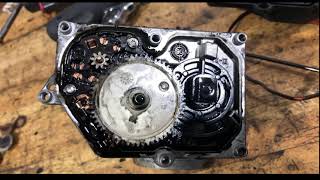
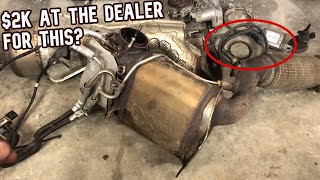
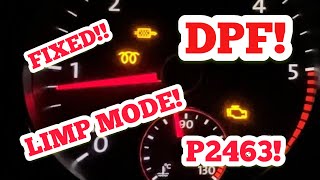
Used OEM Parts in Stock
New Aftermarket Parts Available



The information in this article is provided for general reference and educational purposes only. Vehicle specifications, procedures, and part compatibility can vary by production date, trim level, and region. Always consult your vehicle's factory service manual and verify part numbers before purchasing or performing repairs. Safety-critical components such as airbags, seat belts, and braking systems should be installed by a qualified professional.
- Volkswagen JETTA:
- 🎬 Helpful Videos
- 🛍️ Shop This Part
- What's Unique About the 2009-2014 Volkswagen JETTA
- Diagnostic Flowchart
- Symptoms You May Notice
- Most Likely Causes
- Rare But Worth Checking
- Diagnosis Steps
- Parts You'll Likely Need
- Related Codes That Often Appear With This One
- Technical Service Bulletins (TSBs) & Recalls
- Platform-Specific Known Issues
- Mechanic-Grade Diagnostic Values
- Scan Tool Commands That Help
- Wiring & Ground Locations
- Real Owner Repair Stories
- OEM Part Supersession History
- Model Year Variations Within This Range
- 🎟️ Get 5% Off