

P2463 on 2012-2023 Mazda 6 SkyActiv-D: DPF Soot Accumulation Causes & Fixes
This code means the Diesel Particulate Filter (DPF) is severely clogged with soot. The most common causes are frequent short trips preventing DPF regeneration, or a faulty exhaust pressure sensor. A forced regeneration may work, but often the underlying cause, like a bad sensor, worn exhaust camshaft, or intake carbon buildup, must be fixed to prevent a recurrence.
- P2463 means your DPF is critically clogged with soot, most likely because the car isn't being driven on the highway enough for it to self-clean.
- Before considering an expensive DPF replacement, investigate cheaper and more common root causes like a faulty exhaust pressure sensor or clogged intake manifold.
- Check your engine oil level immediately. If it's high and smells like fuel, do not drive the car. The oil is diluted and must be changed to prevent engine damage.
- A forced regeneration using a scan tool is a common first step, but it won't fix the problem if a component has failed.
What's Unique About the 2012-2023 Mazda 6
The Mazda 2.2L SkyActiv-D engine (SH01 and variants) is notoriously sensitive to DPF issues. These engines can generate significant amounts of soot, particularly if not driven on long, high-speed journeys necessary for passive regeneration. Furthermore, several related components are well-documented failure points that cascade into DPF problems. These include a prematurely wearing exhaust camshaft, leaking fuel injector seals, and severe carbon buildup in the intake manifold, all of which disrupt combustion and overwhelm the DPF system. Owners often find P2463 is a recurring symptom of these deeper, systemic engine issues.
Symptoms You May Notice
- Check Engine Light is on
- DPF warning light is illuminated or flashing
- Drastically reduced engine power (limp mode)
- Poor acceleration and sluggish response
- Increased fuel consumption
- Vehicle may fail to restart once shut off
- White or black smoke from the exhaust
- Engine oil level is abnormally high and smells of diesel (due to failed regeneration cycles diluting the oil)
- Replacing the DPF without diagnosing the root cause. A new DPF will quickly clog again if the underlying problem (bad sensor, worn camshaft, driving habits, clogged intake) is not resolved.
- Blaming driving habits alone when a mechanical fault (like a worn camshaft or clogged sensor pipe) is preventing regeneration.
Most Likely Causes
- Driving habits (frequent short trips) 🔴 High Probability The DPF requires sustained highway speeds to reach the high temperatures (around 600°C / 1112°F) needed to burn off soot. City driving cycles often don't meet these conditions, causing soot to accumulate faster than it can be burned off.
How to confirm: Review the vehicle's typical usage pattern. If it's primarily used for short-distance, low-speed driving, this is a likely contributor. A scan tool may show a high number of interrupted regenerations or a long distance since the last successful one.
Typical fix: Perform a forced DPF regeneration with a diagnostic tool. If successful, advise the owner to incorporate regular highway driving (e.g., 20-30 minutes at over 50 mph / 80 km/h) weekly.
Est. part cost: $0 - Faulty or Clogged Exhaust Pressure Sensor 🔴 High Probability The primary exhaust pressure sensor (pre-turbo) is a very common failure point on the 2.2L SkyActiv-D. It has been updated by Mazda multiple times. A faulty sensor provides incorrect data to the ECU, preventing it from properly managing DPF regeneration and often triggering other codes like P0471.
How to confirm: Use a scan tool to monitor the exhaust pressure sensor readings. The reading should rise and fall almost instantly with engine RPM. A slow or delayed response indicates a clogged sensor pipe or a failing sensor. A key test is to check the reading with Key-On-Engine-Off (KOEO); it should read atmospheric pressure (~100 kPa). A reading significantly lower (e.g., 86 kPa) at KOEO or idle indicates a bad sensor.
Typical fix: Replace the exhaust pressure sensor and thoroughly clean its pipe leading to the exhaust manifold. Given the high failure rate and multiple part revisions, using the latest OEM part kit (which includes an adapter harness) is critical.
Est. part cost: $80-$250 - Worn Exhaust Camshaft Lobes 🟡 Medium Probability Early versions of the SH01 engine (approx. 2012-2018) are known for premature wear on the exhaust camshaft lobes. This alters valve timing and lift, leading to inefficient combustion, which in turn creates excessive soot and clogs the DPF. The wear is often attributed to a combination of material softness and oil contamination issues.
How to confirm: A physical inspection is required. Remove the valve cover and inspect the exhaust camshaft lobes for visible scoring, pitting, or a flattened profile compared to the new part. 🎬 See how to perform an exhaust camshaft inspection procedure. This is often done after other, simpler causes are ruled out.
Typical fix: Replace the exhaust camshaft, rocker arms, and lifters. This is a significant, labor-intensive repair. It is critical to use the updated, more durable camshaft part. After replacement, DPF data must be reset.
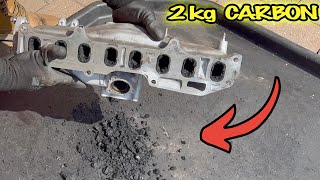
Est. part cost: $300-$600 for cam and associated parts - Clogged Intake Manifold / MAP Sensor 🟡 Medium Probability The SkyActiv-D engine's EGR system can cause severe carbon buildup in the intake system. This buildup restricts airflow and can clog the manifold absolute pressure (MAP) sensor port, giving false readings that affect the air-fuel mixture and lead to excess soot production.
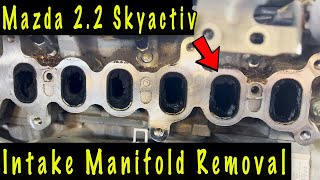
How to confirm: Visually inspect the intake manifold and MAP sensor. 🎬 Watch this step-by-step video on removing the intake manifold for carbon cleaning. If the sensor and intake runners are coated in thick, hard carbon deposits, the intake is restricted.
Typical fix: Remove and physically clean the intake manifold, EGR passages, and MAP sensor. This is a labor-intensive job, often requiring specialized tools like walnut blasting for effective cleaning.
Est. part cost: $20-$50 for gaskets - Leaking Fuel Injector Seals (Washers) 🟡 Medium Probability The copper washers that seal the fuel injectors to the cylinder head are a known weak point. They can fail, allowing combustion gases to leak into the crankcase and oil, and potentially altering fuel delivery. This creates carbon sludge in the oil and contributes to poor combustion, increasing soot.
How to confirm: Inspect for a 'chuffing' sound from the engine bay or black soot around the base of the fuel injectors. An oil analysis may show high levels of soot and fuel. The definitive test is to remove the injectors and inspect the seals. A common secondary effect is a clogged oil pickup strainer in the sump.
Typical fix: Replace all four fuel injector copper seals/washers (Part No. SH01-13-H51). While the injectors are out, clean the injector bores and check the oil pickup strainer in the sump for carbon sludge. 🎬 Watch a full tear-down covering carbon cleaning, camshafts, and the oil strainer.
Est. part cost: $20-$40 for seals - Faulty or Clogged DPF Differential Pressure Sensor 🟡 Medium Probability This sensor tells the ECM how full the DPF is by measuring pressure before and after the filter. The sensor itself or its connecting pipes can fail or get clogged with soot, sending incorrect readings that prevent the ECM from starting a regeneration cycle.
How to confirm: Use a scan tool to monitor DPF differential pressure at idle (should be low, <10 mbar) and under load (should increase with RPM). If it's stuck, erratic, or reads extremely high at idle (e.g., 90+ mbar), the sensor or its hoses are suspect. Visually inspect hoses for cracks or blockages.
Typical fix: Replace the DPF differential pressure sensor and ensure its pipes are clear. Aftermarket sensors are available, but OEM is often recommended for reliability.
Est. part cost: $50-$150 - Incorrect Engine Oil ⚪ Low Probability Diesel engines with a DPF require low-SAPS (Sulphated Ash, Phosphorus, and Sulphur) oil (e.g., ACEA C3). Using the wrong oil introduces non-combustible materials into the exhaust that permanently clog the DPF with ash, not just soot.
How to confirm: Check service records or oil type used during the last oil change. The oil must meet Mazda's specification for DPF-equipped vehicles (Mazda Original Oil Supra DPF 5W-30 or equivalent).
Typical fix: Change the oil and filter with the correct low-SAPS specification oil. If the DPF is clogged with ash, it will require professional off-car cleaning or replacement. This is often accompanied by code P242F.
Est. part cost: $70-$120 for oil and filter
Rare But Worth Checking
- Leaking Fuel Injectors: A faulty injector can over-fuel a cylinder, leading to incomplete combustion and the production of excessive soot, which quickly overwhelms the DPF.
- Failed Exhaust Gas Temperature (EGT) Sensor: The ECM relies on EGT sensors to confirm the exhaust is hot enough for regeneration. If a sensor fails, the ECM may not initiate or sustain the process, leading to soot buildup.
- Turbocharger Failure: A failing turbocharger, especially the small, low-pressure turbo in the twin-turbo setup, can lead to poor combustion and excessive smoke/soot, contributing to DPF blockage.
Diagnosis Steps
- Connect a diagnostic scan tool and confirm P2463 is the primary code. Note any other codes present, especially for pressure sensors (P0471, P2454) or regeneration duration (P2458).
- View live data. Check 'PM_ACC_DSD' (Calculated Soot Mass) and 'PM_GEN_DSD' (Measured Soot Mass). High values confirm the clog. A healthy DPF should have differential pressure readings between 0-10 mbar at idle. Readings of 90+ mbar indicate a severe blockage.
- Monitor the primary Exhaust Pressure Sensor (pre-turbo) and the DPF Differential Pressure Sensor. The primary sensor's pressure should rise and fall sharply with RPMs; sluggishness points to a clogged pipe. The differential sensor should be low at idle and rise smoothly.
- Check the engine oil level and smell. A level that is overfull and smells strongly of diesel indicates that multiple regeneration attempts have failed, causing fuel to dilute the oil. This is a critical issue that requires an immediate oil change to prevent engine damage.
- If sensor readings appear plausible and oil is okay, attempt a 'forced' or 'stationary' DPF regeneration using the scan tool. This will run the engine at high RPM for 30-60 minutes. Monitor exhaust temperatures to ensure the process is working.
- If regeneration fails or the P2463 code returns quickly, investigate deeper mechanical causes. Remove the valve cover to physically inspect the exhaust camshaft lobes for wear.
- Inspect the intake system for carbon buildup, especially the MAP sensor port and throttle body.
- Inspect fuel injector seals for leaks (soot buildup around the base).
- If the oil was sludgy, consider dropping the oil pan to inspect the oil pickup strainer for blockage, which is a symptom of leaking injector seals and can lead to oil starvation.
- If all else fails, the DPF may be physically damaged or clogged with ash, requiring professional off-car cleaning or replacement.
Parts You'll Likely Need
- Exhaust Pressure Sensor
(OEM #SH01-182B2)— This is a very common failure point on the 2.2L SkyActiv-D engine and has been updated by Mazda multiple times. A faulty sensor prevents the system from correctly managing DPF regeneration.
Trusted brands: Mazda (OEM), Bosch
OEM price range: $150-$250
Aftermarket price range: $80-$150 - Exhaust Camshaft
(OEM #SH01-12-440B)— Premature wear of the exhaust camshaft is a known design flaw in earlier engines (pre-2019) that causes excessive soot production, leading to DPF issues. Replacement with the updated part is often necessary for a permanent fix.
Trusted brands: Mazda (OEM)
OEM price range: $300-$500
Aftermarket price range: $250-$400 - Fuel Injector Seal / Washer
(OEM #SH01-13-H51)— These copper seals fail, allowing combustion byproducts to contaminate the engine oil, creating sludge that can block the oil pickup strainer and causing poor combustion that clogs the DPF.
Trusted brands: Mazda (OEM)
OEM price range: $5-$10 per seal
Aftermarket price range: $2-$5 per seal - DPF Differential Pressure Sensor
(OEM #R2BF-18-2B2 (example, verify by VIN))— This sensor directly measures the soot load in the DPF. If it fails or its pipes clog, the ECM has no way of knowing when to perform a regeneration.
Trusted brands: Bosch, Denso, Mazda (OEM)
OEM price range: $100-$200
Aftermarket price range: $50-$100 - Diesel Particulate Filter (DPF) — This is the last resort. If the DPF is physically cracked or so clogged with ash (from using wrong oil or extreme mileage) that it cannot be cleaned, it must be replaced. This is extremely expensive.
Trusted brands: Mazda (OEM), Walker Exhaust
OEM price range: $2000-$3000
Aftermarket price range: $800-$1500
Related Codes That Often Appear With This One
- P2458 — DPF Regeneration Duration. This often appears with P2463, indicating that regeneration attempts are taking too long or failing.
- P242F — DPF Restriction - Ash Accumulation. This indicates the filter is clogged with non-burnable material, often from incorrect oil or extreme age, a more permanent problem than soot.
- P0471, P0473 — These codes relate to the Exhaust Pressure Sensor (pre-turbo), a known failure point on this engine that directly impacts the ECU's ability to manage the DPF system.
- P2452, P2453, P2454 — These codes relate to the DPF differential pressure sensor circuit, indicating it may be the root cause of the incorrect backpressure reading.
Technical Service Bulletins (TSBs) & Recalls
- Mazda TSB R087/14b - Relates to early software updates for DPF logic and oil dilution issues, involving a software update and a revised dipstick.
- Mazda TSB 01-012/21 / MC-10203724-0001 - While for a later 2.5T engine, it details issues with oil consumption due to valve stem seals, a problem also noted on the diesel engines, leading to oil contamination and combustion issues.
Platform-Specific Known Issues
- Excessive carbon buildup in the intake manifold is a well-documented problem that can choke airflow and cause sensors to fail, leading to increased soot production.
- Engine oil dilution is a serious side effect of repeated, failed DPF regeneration cycles. Fuel intended to be injected into the exhaust to raise temperatures instead gets past the piston rings and contaminates the engine oil, reducing its lubricating properties and potentially leading to severe engine damage.
- The original-spec exhaust pressure sensor is a known weak point, with Mazda issuing several revised parts to improve reliability.
Mechanic-Grade Diagnostic Values
- DPF Differential Pressure at Idle — expected: 0-10 mbar (ideally below 7 mbar). Failure: Readings consistently above 10 mbar at idle suggest a blockage. Readings of 60-90+ mbar indicate a severe clog.
- DPF Differential Pressure for Forced Regen — expected: Below 150 mbar at ~2000 RPM. Failure: Readings of 300+ mbar indicate it is unsafe to perform a forced regeneration as it can be a fire hazard or damage the DPF.
- Exhaust Pressure Sensor No. 1 (Pre-Turbo) at KOEO — expected: Should match Barometric Pressure (BARO), typically ~100 kPa (1 bar) at sea level.. Failure: A reading significantly below atmospheric pressure (e.g., 74-86 kPa) with the engine off points to a faulty sensor. Per Mazda, the reading must be within +/- 12.6% of the BARO value.
- Exhaust Pressure Sensor No. 1 (Pre-Turbo) Voltage — expected: KOEO: ~0.8V; Idle (KOER): ~0.9V; Wide Open Throttle (WOT): ~3.5V. Failure: Voltage that is stuck, does not correspond to engine load, or is out of this range indicates a sensor or wiring fault.
- DPF Differential Pressure Sensor Voltage (KOEO) — expected: ~0.5V with no pressure applied.. Failure: Voltage outside of spec or that doesn't increase smoothly as pressure is applied with a hand pump indicates a faulty sensor.
Scan Tool Commands That Help
- Mazda IDS, FORScan, Autel, Launch: DPF Regeneration / Service Regeneration — To attempt to clear a moderately soot-clogged DPF. This is often the first step after confirming sensors are working. It must be done in a safe, outdoor area as exhaust temperatures will exceed 600°C.
- Mazda IDS, FORScan, Autel, Launch: DPF Related Parts Replacement / DPF Data Reset — This is CRITICAL after replacing the DPF, cleaning the DPF, or replacing sensors. It resets the learned soot and ash values in the ECU, effectively telling the car the filter is 'new' and preventing it from immediately re-triggering the fault.
- Mazda IDS, FORScan: Injector Correction Value Reset / Injector Calibration — Required if fuel injectors are replaced. While not a direct fix for P2463, it's essential if injector issues are suspected as the root cause of soot production.
Real Owner Repair Stories
- Dodgy Garage Mobile DPF Cleaning YouTube Channel (Mazda 6 2.2L SkyActiv-D) — P2463 and P2458 codes, DPF restriction, high backpressure.
❌ Tried (didn't work) A chemical DPF cleaning was performed, but the differential pressure remained too high after the procedure (14-16 mbar at idle, where 0-10 is expected).
✅ What actually fixed it The root cause was severe carbon buildup in the intake manifold, a common issue on this engine. The manifold was removed and physically cleaned. After reassembly, a second DPF cleaning was successful, and differential pressure dropped to a healthy 1-2 mbar at idle.
OEM Part Supersession History
SH02-18-211B, SH02-18-211C, SHYG-18-781→SHY6-18-W00 (Kit)— The original plastic L-shaped exhaust pressure sensors had a high failure rate. The new part is a metal, I-shaped sensor that is more durable.
Heads up: The new sensor (SHY6-18-W00) has a different connector and requires an adapter harness, which is included in the OEM kit. The new sensor will not plug into the old harness directly. It is critical to buy the full kit.
Model Year Variations Within This Range
- 2012-2018: Engines in this period are more susceptible to the premature exhaust camshaft wear and leaking fuel injector seal issues that are known root causes for excessive soot production leading to P2463.
Diagnostic Flowchart
Other Known Issues on This Vehicle
Issues unrelated to this code that are worth knowing about as an owner of this generation:
- Premature Exhaust Camshaft Wear 🔴 High — Common on 2012-2018 models, typically appearing between 70,000-120,000 miles. Can lead to a cascade of other failures. (Ref: No official recall, but Mazda released an updated part (SH01-12-440B).)
- Fuel Injector Seal (Washer) Failure 🔴 High — Widespread issue. Failure allows combustion gases into the oil, creating sludge that blocks the oil pickup strainer, leading to oil starvation.
- Engine Oil Dilution 🔴 High — Very common, especially for vehicles used for short trips. Caused by incomplete DPF regeneration cycles dumping fuel into the oil sump. (Ref: Early TSBs (like R087/14b) involved software updates and new dipsticks to manage the issue.)
- Oil Pump Chain Failure 🔴 High — Less common than other issues but catastrophic. Often a result of oil starvation/contamination caused by injector seal failure and a blocked oil pickup. Can cause sudden engine seizure.
- Turbocharger Failure 🟠 Medium — The twin-turbo setup can experience failures, often linked to oil starvation or contamination from the other systemic engine issues.
- Excessive Intake Carbon Buildup 🟠 Medium — Affects most engines over 50,000 miles due to the EGR system design. Requires periodic, labor-intensive cleaning to prevent performance loss and related sensor faults.
Used vs. New Parts: Buying Guide for This Vehicle
When a used part is the smart pick: A complete, low-mileage intake manifold from a donor vehicle can be a cost-effective option, but it is absolutely essential that it be professionally cleaned (e.g., walnut blasted) to remove all internal carbon buildup before installation.
Donor-vehicle mileage cap: roughly under 60000 miles for the part to have meaningful remaining life.
What to inspect on the donor part:
- For an intake manifold, check for any external cracks or damage to mounting points.
- Verify the donor vehicle's mileage and, if possible, its service history.
- Assume any used intake requires a deep cleaning regardless of appearance.
OEM-only on this vehicle (don't cheap out):
- Exhaust Pressure Sensor: Due to multiple revisions and the requirement for a specific adapter harness, only the latest genuine Mazda OEM kit (SHY6-18-W00) should be used to guarantee compatibility and reliability.
- DPF Differential Pressure Sensor: While aftermarket options exist, many owners report issues with cheap sensors failing quickly or providing inaccurate readings. Given the sensor's critical role in DPF management, OEM is strongly advised.
- Fuel Injector Seals: These copper washers are inexpensive and absolutely critical for preventing catastrophic engine oil sludging. Only use genuine Mazda seals (SH01-13-H51).
Brands owners have reported issues with on this vehicle:
- Unbranded, low-cost 'Made in China' DPF and exhaust pressure sensors are frequently reported on forums and in videos as being inaccurate out of the box or failing shortly after installation.
Related OBD-II Codes
Frequently Asked Questions
Why is my Mazda 6 2.2L SkyActiv-D oil level increasing and smelling like diesel?
Is there a specific part I should use to fix the exhaust pressure sensor issue?
Can my driving habits cause the P2463 code on my Mazda 6?
What part number do I need if my fuel injector seals are leaking?
How can I tell if my P2463 code is caused by a mechanical engine issue like the camshaft?
What should the DPF differential pressure sensor read at idle?
Helpful Videos
We Have This Part in Stock


The information in this article is provided for general reference and educational purposes only. Vehicle specifications, procedures, and part compatibility can vary by production date, trim level, and region. Always consult your vehicle's factory service manual and verify part numbers before purchasing or performing repairs. Safety-critical components such as airbags, seat belts, and braking systems should be installed by a qualified professional.
- Mazda 6:
- 🎬 Helpful Videos
- 🛍️ Shop This Part
- What's Unique About the 2012-2023 Mazda 6
- Symptoms You May Notice
- Most Likely Causes
- Rare But Worth Checking
- Diagnosis Steps
- Parts You'll Likely Need
- Related Codes That Often Appear With This One
- Technical Service Bulletins (TSBs) & Recalls
- Platform-Specific Known Issues
- Mechanic-Grade Diagnostic Values
- Scan Tool Commands That Help
- Real Owner Repair Stories
- OEM Part Supersession History
- Model Year Variations Within This Range
- Diagnostic Flowchart
- Other Known Issues on This Vehicle
- Used vs. New Parts: Buying Guide for This Vehicle
- Related OBD-II Codes
- Frequently Asked Questions
- 🎟️ Get 5% Off