

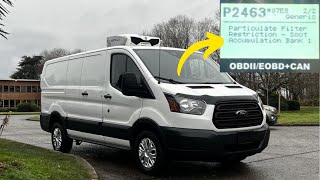
P2463 on 2015-2019 Ford Transit 3.2L: DPF Soot Accumulation Causes and Fixes
This code means the Diesel Particulate Filter (DPF) is clogged with soot, often due to short-trip driving. The most common fix is a 'forced regeneration' using a scan tool before replacing any parts. Ignoring it can lead to reduced power and expensive DPF replacement.
- P2463 on a 3.2L Ford Transit almost always means the Diesel Particulate Filter is clogged with soot, usually because driving conditions don't allow for automatic cleaning.
- Do not immediately replace the DPF. The first step is a forced regeneration with a professional scan tool.
- Check for Ford Technical Service Bulletins (TSBs). A simple software update or enabling the 'Operator Commanded Regeneration' feature may be the permanent solution.
- If a forced regeneration doesn't work, the next most likely culprits are a faulty DPF pressure sensor or a clogged DPF fuel vaporizer.
- Ignoring this code will keep the van in a low-power limp mode and can lead to permanent, and very expensive, damage to the DPF.
What's Unique About the 2015-2019 Ford TRANSIT

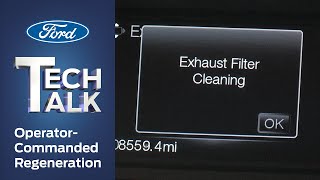
The 3.2L Power Stroke I-5 engine (also known as the Duratorq) in the Ford Transit is highly susceptible to this issue, particularly in vehicles used for local delivery, stationary work, or other low-speed applications with frequent stops and starts. This driving style prevents the exhaust from getting hot enough for a complete automatic DPF regeneration cycle. Ford has acknowledged this tendency with multiple Technical Service Bulletins (TSBs) that recommend software updates and enabling an 'Operator Commanded Regeneration' (OCR) feature, allowing the driver to manually start a cleaning cycle 🎬 Watch: How to use the Operator Commanded Regeneration feature. while parked.
Diagnostic Flowchart

Tap your situation to follow the diagnostic path that matches what you're seeing on this vehicle.
Symptoms You May Notice

- Check Engine Light illuminated
- "Drive To Clean Exhaust Filter" or "Exhaust Overloaded Drive to Clean Now" message on the dashboard
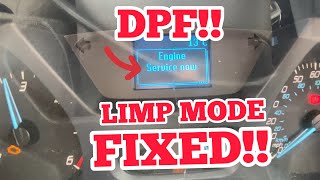
- Vehicle enters "limp mode" with significantly reduced engine power 🎬 See how to fix limp mode and DPF restriction codes. and acceleration
- Poor fuel economy
- Engine may run rough or have difficulty maintaining RPMs
- Frequent attempts by the vehicle to perform automatic regeneration
- A change in engine and cooling fan sound as the system repeatedly tries to initiate regeneration
- Immediately replacing the DPF. The DPF is extremely expensive. P2463 indicates a restriction, which is often due to a software, sensor, or operational issue, not necessarily a failed filter. A forced regeneration and proper diagnosis of sensors and the vaporizer should always be the first steps.
Most Likely Causes

- Driving Style (Short Trips / Extended Idling) 🔴 High Probability Transits are often used for commercial purposes involving city driving or stationary power, which prevents the DPF from reaching the high temperatures needed for passive regeneration. This is explicitly mentioned in Ford TSB 19-2061.
How to confirm: Review the vehicle's typical usage pattern. If it rarely sees sustained highway driving (e.g., 30+ mph for over 20 minutes), this is a highly likely cause.
Typical fix: Perform a forced static regeneration using a compatible scan tool. For long-term prevention, enable Operator Commanded Regeneration (OCR) per TSB 19-2061 and educate the driver on its use.
Est. part cost: $0 - Failed DPF Pressure Sensor 🟡 Medium Probability These sensors and their connecting hoses are exposed to extreme heat and vibration, making them a common failure point. A faulty sensor can incorrectly report high soot levels by being stuck on a high reading, triggering the code even if the filter is clean.
How to confirm: Use a scan tool to monitor the DPF pressure sensor's live data. With the Key On, Engine Off (KOEO), the reading should be near zero (0 kPa/psi). If it shows a significant pressure reading with the engine off, the sensor is faulty. Inspect the sensor's hoses for cracks, melting, or blockages.
Typical fix: Replace the DPF pressure sensor and/or its hoses. After replacement, a DPF parameter reset must be required with a scan tool.
Est. part cost: $50-$150 - Outdated PCM Software 🟡 Medium Probability Ford issued TSB 18-2064 for 2016-2018 models built before Feb 13, 2018, which specifically addresses P2463 with a PCM software update as part of the official repair procedure. The update likely adjusts the parameters for triggering regeneration.
How to confirm: A Ford dealer or a shop with a Ford-specific scan tool (like IDS or FJDS) can check the current software calibration against the latest available version.
Typical fix: Reprogram the PCM to the latest calibration after performing a manual DPF regeneration and DPF parameter reset.
Est. part cost: $0 (if part of a TSB/warranty), $100-$250 (shop labor for programming) - Clogged DPF Vaporizer / Fuel Injector ⚪ Low Probability The Transit uses a dedicated fuel vaporizer (sometimes called a 9th injector or fuel vapour valve) in the exhaust to spray diesel fuel into the DPF during active regeneration. This component can become clogged with carbon, preventing it from raising the exhaust temperature high enough to burn off soot. A blown fuse for the vaporizer circuit can also cause this issue.
How to confirm: If a forced regeneration fails to start or complete due to low temperatures (often setting a P244C code), the vaporizer is a prime suspect. It can be removed and inspected for blockage. Check the fuse for the vaporizer circuit in the under-hood fuse box.
Typical fix: Clean or replace the DPF fuel vaporizer and replace the associated fuse if blown.
Est. part cost: $150-$450
Rare But Worth Checking
- Exhaust Leaks: A leak in the exhaust system before or near the DPF pressure sensor can cause incorrect pressure readings, leading to a false P2463 code.
- DPF Reached End-of-Life: Over many miles (typically 100,000+), the DPF accumulates non-burnable ash. Eventually, it becomes so full of ash that even a successful regeneration cannot clear enough space, and the filter must be professionally cleaned off-vehicle or replaced.
- Wiring Issues: Damage to the wiring harness for the DPF pressure sensor can cause short circuits or open circuits, leading to incorrect readings and triggering the code.
Diagnosis Steps
- Verify the code with a quality OBD-II scanner. Note any other codes present, especially P246C, P2459, or P244C.
- Check for relevant Technical Service Bulletins (TSBs) for your vehicle's VIN. TSBs 19-2061 and 18-2064 are highly relevant.
- Using a scan tool, check the DPF soot load percentage (PID). A reading of 100% or higher confirms the clog. Some tools may show over 200%.
- Test the DPF pressure sensor. With the Key On, Engine Off (KOEO), the live data reading should be 0 psi/kPa. If it's not, the sensor is likely faulty.
- Inspect the DPF pressure sensor hoses for any signs of melting, cracks, or blockages.
- If sensors and hoses are good, attempt a 'Forced DPF Regeneration' (also called a static regeneration) using a bi-directional scan tool like Ford IDS. This is a stationary procedure that commands the engine to run at high RPMs (2000-2400 RPM) for 10-30 minutes to burn out the soot.
- If regeneration fails or the code returns quickly, investigate the DPF fuel vaporizer. Check the fuse in the under-hood fuse box and inspect the vaporizer itself for 🎬 Watch: Step-by-step guide to DPF cleaning and vaporizer replacement. carbon blockage.
- If all else fails, the DPF may be at the end of its service life and require professional off-vehicle cleaning or replacement.
Parts You'll Likely Need

- DPF Pressure Sensor
(OEM #Motorcraft DPFE-29)— This sensor is a common failure point and provides the primary data for triggering P2463. A faulty sensor can make the computer think the DPF is clogged when it isn't.
Trusted brands: Motorcraft, Bosch, Standard Motor Products (DPS135)
OEM price range: $100-$180
Aftermarket price range: $50-$120 - DPF Fuel Vaporizer / Glow Plug
(OEM #CK4Z-9B593-B / AB39-9T540-AF)— A critical component for active regeneration. It can get clogged with carbon, preventing the DPF from getting hot enough to clean itself, leading to soot accumulation.
Trusted brands: Motorcraft
OEM price range: $350-$450
Aftermarket price range: $150-$300 - Diesel Particulate Filter (DPF) Assembly — This is the last resort if the filter is physically damaged, melted, or so full of ash from normal use that it can no longer be regenerated or cleaned. This is a very expensive part.
Trusted brands: Motorcraft, Walker Exhaust
OEM price range: $2000-$3000+
Aftermarket price range: $800-$1500
Related Codes That Often Appear With This One
- P246C — This code, 'Diesel Particulate Filter Restriction - Forced Limited Power', almost always appears with P2463. It indicates the PCM has restricted engine power because the DPF is too clogged. Ford TSBs list these codes together.
- P2459 — 'Diesel Particulate Filter Regeneration Frequency' indicates the regeneration process is happening too often. This is a precursor to P2463, as the system tries and fails to keep the DPF clean.
- P244C — 'Exhaust Temperature Too Low For Particulate Filter Regeneration' can point to a faulty or clogged DPF fuel vaporizer, which prevents the system from getting hot enough to burn soot, leading to the P2463 accumulation code.
Technical Service Bulletins (TSBs) & Recalls
- source — Supersedes TSB 18-2223. For 2015-2019 Transits with the 3.2L engine used in stationary or low-speed applications. Addresses DTCs P2459, P2463, and P246C by enabling the Operator Commanded Regeneration (OCR) feature using a Ford scan tool, allowing the driver to perform a stationary regen.
- source — For 2016-2018 Transits built on or before Feb 13, 2018, with DTCs P246C and/or P2463. The service procedure requires performing a forced static DPF regeneration, followed by a DPF parameter reset, and finally reprogramming the PCM to the latest calibration.
Platform-Specific Known Issues
- TSB 19-2061 / 18-2223: Addresses frequent 'Drive To Clean' messages and codes P2459, P2463, and/or P246C on 2015-2019 models due to stationary or low-speed use. The fix involves enabling Operator Commanded Regeneration (OCR) so the driver can manually start a cleaning cycle.
- TSB 18-2064: For 2016-2018 models built before Feb 13, 2018, this TSB outlines a fix involving a forced static regeneration, a DPF parameter reset, and a PCM software update to correct the logic that triggers P2463 and P246C.
Mechanic-Grade Diagnostic Values
- DPF Pressure Sensor Reading (Key On, Engine Off) — expected: ~0 kPa / ~0 mbar. Failure: Any significant pressure reading (e.g., 130 mbar) indicates a faulty sensor that is stuck with a high reading.
- DPF Pressure at Idle (Clean Filter) — expected: ~0.7 mbar to ~7 mbar. Failure: Pressure significantly higher than 7 mbar at idle suggests a blockage. Pressure can rise to ~1.6 mbar before regeneration is triggered.
- DPF Soot Load PID (after successful regeneration) — expected: Closed Loop: ~1%, Open Loop: ~3%. Failure: Values significantly higher than this after a regeneration cycle indicate the regen was not successful or the sensor readings are inaccurate.
- DPF Pressure Sensor Voltage Range — expected: 0.5V to 4.5V. Failure: Voltage below 0.10V or above 4.90V will set a circuit fault code (P2454/P2455).
Scan Tool Commands That Help
- Ford IDS / FORScan / High-End Aftermarket (Autel, Launch): Particulate Filter Static Regeneration — Used to command a stationary regeneration cycle when the DPF is clogged and automatic regeneration is not occurring. This is the primary first step to clearing a genuine P2463 code.
- Ford IDS / FORScan / High-End Aftermarket: Reset the Diesel Particulate Filter Learned Values — This must be performed after replacing the DPF assembly or the DPF pressure sensor to tell the PCM that the component is new and its baseline values have changed.
- Ford IDS / FORScan / High-End Aftermarket: Reset the DPF pressure sensor learned values — This specific reset should be performed after replacing the DPF pressure sensor. It recalibrates the PCM to the new sensor's baseline.
Wiring & Ground Locations
- DPF Pressure Sensor Connector — On the 3.2L Transit, the sensor is typically located at the side of the battery box.. This is the primary electrical connection for the sensor that triggers P2463. Damage or corrosion at this 3-wire connector (Motorcraft WPT-1202) can cause incorrect readings.
- DPF Fuel Vaporizer Fuse — In the under-hood fuse box (specific location may vary by year).. The fuel vaporizer has a dedicated fuse. If this fuse blows, the vaporizer cannot function to raise exhaust temperatures, preventing regeneration and leading to soot buildup.
Real Owner Repair Stories
- Ford Transit Forum user (2012 Ford Transit 2.2L (similar system)) — P2463 code and soot load of nearly 200% on a brand new DPF.
❌ Tried (didn't work) Replacing the DPF., Replacing the differential pressure sensor., Checking sensor wiring and pipes for leaks/blockages.
✅ What actually fixed it The issue was identified by another user as a likely failed DPF fuel vaporizer, which is a common failure point that prevents regeneration and causes a new DPF to clog quickly. - YouTube channel 'Speed Tweaks' (Ford 2.2L Diesel (Galaxy, but same DPF system principle)) — P2463 and P246B, regeneration failing to start, exhaust not getting hot enough.
❌ Tried (didn't work) Attempting a forced regeneration which failed because the temperature would not rise.
✅ What actually fixed it The technician diagnosed a failed DPF fuel vaporizer. The internal glow plug had failed (tested with an ohms test) and the fuel nozzle was completely blocked with carbon. Replacing the vaporizer assembly allowed the vehicle to regenerate properly. - YouTube channel 'O'Rileys Autos' (Ford Transit RWD Tipper) — Persistent DPF faults after a cheap, aftermarket fuel vaporizer was installed.
❌ Tried (didn't work) The previous shop had installed a low-quality aftermarket vaporizer which failed due to poor water sealing, causing corrosion and failure of the internal circuit.
✅ What actually fixed it The technician replaced the faulty aftermarket vaporizer with a genuine Ford part, which had superior wiring and seals. After installation, they reset the DPF learned values and performed a successful regeneration, which resolved the fault codes.
OEM Part Supersession History
BK31-9T540-AD, BK31-9T540-AE→BK31-9T540-AF, BK31-9T540-AG, 2039911— Standard part revision and improvement over time for the DPF Fuel Vaporizer.
Heads up: While multiple part numbers exist, it is critical to verify fitment with the vehicle's VIN. Aftermarket versions are available but some have been shown to have poor quality seals, leading to premature failure from water ingress.
Model Year Variations Within This Range
- 2018-2019: TSB 18-2064 specifically calls out a PCM software update for vehicles built on or before Feb 13, 2018, to address P2463 and P246C, indicating a change in the software logic for DPF management around this time.
- 2019+: Later model year Transits may be equipped with a security gateway module (SGW) that can prevent some aftermarket scan tools from performing critical service functions like 'Reset DPF Learned Values', which is required after a filter replacement. This can cause the P2463 code to persist even with a new DPF.
Helpful Videos

We Have This Part in Stock


The information in this article is provided for general reference and educational purposes only. Vehicle specifications, procedures, and part compatibility can vary by production date, trim level, and region. Always consult your vehicle's factory service manual and verify part numbers before purchasing or performing repairs. Safety-critical components such as airbags, seat belts, and braking systems should be installed by a qualified professional.
- Ford TRANSIT:
- 🎬 Helpful Videos
- 🛍️ Shop This Part
- What's Unique About the 2015-2019 Ford TRANSIT
- Diagnostic Flowchart
- Symptoms You May Notice
- Most Likely Causes
- Rare But Worth Checking
- Diagnosis Steps
- Parts You'll Likely Need
- Related Codes That Often Appear With This One
- Technical Service Bulletins (TSBs) & Recalls
- Platform-Specific Known Issues
- Mechanic-Grade Diagnostic Values
- Scan Tool Commands That Help
- Wiring & Ground Locations
- Real Owner Repair Stories
- OEM Part Supersession History
- Model Year Variations Within This Range
- 🎟️ Get 5% Off