

P2463 on 2012-2019 Ford Kuga 2.0L TDCi: DPF Soot Accumulation Causes and Fixes
On a 2012-2019 Ford Kuga 2.0L TDCi, code P2463 almost always points to a clogged DPF due to a failed regeneration. The most common culprits are a faulty DPF pressure sensor or a clogged fuel vaporizer, not necessarily a bad DPF. Expect to spend $50-$150 for a sensor or $100-$250 for a vaporizer. Diagnosis should start with these two components before considering DPF replacement.
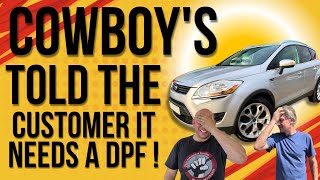
- Do not immediately assume the DPF needs replacement. The P2463 code is most often caused by a component that is preventing the DPF from cleaning itself.
- The two most likely culprits on a 2.0L Duratorq TDCi are a clogged fuel vaporizer or a faulty DPF pressure sensor.
- Always check the small rubber hoses connected to the DPF pressure sensor for cracks or blockages, as this is a simple and cheap potential fix.
- A diagnostic tool capable of reading Ford-specific live data and performing a forced regeneration is essential for proper diagnosis and repair.
- After replacing a DPF pressure sensor or performing a major cleaning, you must reset the learned values in the ECU for the system to function correctly.
What's Unique About the 2012-2019 Ford Kuga

The 2.0L Duratorq TDCi engine in the Kuga, like many Ford diesels of this era, uses a dedicated fuel vaporizer (sometimes called a 7th or 5th injector) to initiate DPF regeneration. This component injects diesel directly into the exhaust to generate the high temperatures needed to burn off soot. This vaporizer is a known failure point; it frequently clogs with carbon or its internal glow plug element fails, preventing regeneration and directly causing the P2463 code. While many diesels have DPF issues, troubleshooting on this specific platform must prioritize checking the vaporizer and the DPF pressure sensor, which are the most common points of failure.
Generation note: The 2012-2019 year range covers the second generation (C520) of the Ford Kuga, which is known as the Ford Escape in North America. The 2.0L Duratorq TDCi engine and its DPF system design are consistent across this generation, so the causes and fixes are generally applicable to all vehicles in this range. This issue is also common on platform-mates like the Ford Mondeo, Focus, and S-Max with the same engine.
Symptoms You May Notice

- Check Engine Light is on
- DPF warning light or "Engine Service Now" message on the dashboard
- Vehicle enters 'limp mode' with drastically reduced engine power and acceleration 🎬 Watch this step-by-step guide to diagnosing and fixing limp mode
- Poor fuel economy
- Engine may run rough or have a hesitant throttle response
- Frequent or failed attempts at DPF regeneration (you might notice the engine idle speed is higher or cooling fans run constantly)
- Black smoke from the exhaust in severe cases
- Immediately replacing the DPF. The DPF is expensive and often not the root cause. The problem is usually what's *preventing* the DPF from regenerating, such as a bad sensor or vaporizer.
- Performing a forced regeneration without fixing the underlying cause. If the vaporizer is clogged or a sensor is bad, the P2463 code will return quickly.
Most Likely Causes

- Clogged or Failed Fuel Vaporizer 🔴 High Probability This component is a known weak point on Ford's Duratorq engines. Its small nozzle is prone to clogging with carbon, and the internal glow plug element can burn out, preventing it from injecting fuel to start the DPF regeneration process. This is considered the most likely cause for regeneration failure on this platform.
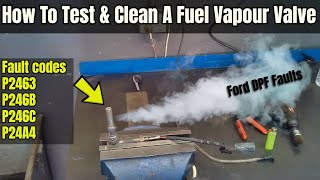
How to confirm: Disconnect the fuel line to the vaporizer and attach a hand-held vacuum pump. If the pump builds and holds vacuum, the vaporizer is blocked internally. You can also test the resistance of the internal glow plug with a multimeter; an open circuit indicates failure. Check fuses related to the vaporizer fuel pump and glow plug.
Typical fix: Replace the fuel vaporizer assembly. In some cases, it can be removed and cleaned with a blowtorch and carb cleaner, but this is not always successful. After replacement, the system must be primed using a diagnostic tool (like FORScan) to get fuel to the new unit.
Est. part cost: $100 - $250 - Faulty DPF Differential Pressure Sensor 🔴 High Probability These sensors are exposed to harsh conditions and can fail over time, either by providing no reading, an erratic reading, or a reading that is stuck high. This is a very common failure on modern diesels and can trick the ECU into thinking the DPF is clogged when it isn't.
How to confirm: Use a diagnostic scanner (like FORScan) to view live data for the DPF pressure sensor ('DP_DPF'). At idle with a clean DPF, the pressure should be very low (typically under 10 mbar or ~1 kPa). If the reading is stuck at a high value, zero, or doesn't increase when you rev the engine, the sensor is likely faulty.
Typical fix: Replace the DPF pressure sensor. It's usually mounted on the firewall or a bracket in the engine bay, connected by two hoses to the DPF. After replacement, the new sensor's learned values must be reset in the PCM using a diagnostic tool. This is a critical step.
Est. part cost: $50 - $150 - Cracked, Split, or Blocked DPF Pressure Sensor Hoses 🟡 Medium Probability The rubber or silicone hoses that connect the DPF to the pressure sensor can become brittle from heat and age, leading to cracks or splits that cause pressure leaks. This will cause the sensor to report inaccurate readings to the ECU.
How to confirm: Visually inspect the entire length of both hoses running from the DPF to the pressure sensor. Check for cracks, holes, kinks, or signs of melting. Remove them and blow through them to check for blockages from soot or moisture.
Typical fix: Replace the damaged hoses with new, high-temperature rated silicone or rubber tubing. First Line Ltd. is one aftermarket company that provides replacement hose kits specifically for this issue.
Est. part cost: $15 - $40 - Restrictive Driving Cycle ⚪ Low Probability This affects all modern diesels. Frequent short trips, city driving, and low-speed operation do not allow the exhaust to get hot enough for a complete DPF regeneration, leading to gradual soot buildup. The Kuga is often used as a family vehicle for school runs, exacerbating this issue.
How to confirm: Review the vehicle's typical usage pattern. If it rarely sees highway speeds for extended periods (20+ minutes), this is a likely contributing factor.
Typical fix: After addressing any mechanical faults, perform a forced (static) regeneration with a diagnostic tool or take the vehicle for a long drive at sustained highway speeds (e.g., 60-70 mph in a lower gear to keep revs up) to allow a dynamic regeneration to complete.
Est. part cost: $0
Rare But Worth Checking
- Terminally Clogged or Cracked DPF: While the code often points to other faults, it's possible the DPF is genuinely full of non-burnable ash (from high mileage or incorrect oil) or has cracked internally. This should be the last item to suspect after all sensors, hoses, and the vaporizer have been confirmed to be working. A finger swipe inside the tailpipe showing black soot (not just grey dust) is a strong indicator of a cracked DPF.
- Faulty Exhaust Gas Temperature (EGT) Sensor: The ECM relies on EGT sensors to monitor temperatures for regeneration. If a sensor provides an incorrect reading, the ECM may not initiate or may abort the regeneration process. This would typically be accompanied by other fault codes related to the EGT sensor circuit.
- PCM Software Glitch: In some cases, particularly after a DPF has been cleaned or replaced, the learned values in the Powertrain Control Module (PCM) can get 'stuck' at a high soot reading. This may require a PCM software update from a Ford dealer or a capable independent shop to resolve.
Diagnosis Steps

- Connect a Ford-capable scanner (like FORScan) and read all DTCs from the PCM. Note any codes accompanying P2463.
- Check live data for 'DPF_SOOT_LD' (soot load percentage) and 'DP_DPF' (differential pressure). Extremely high values (e.g., over 150% or 150 mbar at idle) confirm a severe restriction. Note: A healthy DPF should have <10 mbar at idle.
- With the engine at idle, observe the DPF pressure sensor reading. It should be near zero. Rev the engine to 2500 RPM; the pressure should rise. If it's stuck high, low, or doesn't change, suspect the sensor or its hoses.
- Turn off the engine. Visually inspect the two rubber hoses running from the DPF to the pressure sensor for any cracks, splits, or blockages.
- Locate the fuel vaporizer in the exhaust pipe, upstream of the DPF. Disconnect its fuel line and test for blockage using a hand vacuum pump. If it holds vacuum, it's clogged.
- Check fuses for the DPF fuel vaporizer system (both the pump and the glow plug element).
- If all sensors and the vaporizer appear to be working, attempt a 'Static DPF Regeneration' using your scan tool. This must be done outdoors in a safe area, as the exhaust will get extremely hot.
- If regeneration fails or the P2463 code returns quickly, the DPF may require professional off-car cleaning or replacement. Before replacing, ensure the PCM DPF values are reset by telling the ECU a 'new' DPF has been fitted.
Parts You'll Likely Need

- DPF Fuel Vaporizer
(OEM #CV61-9T540-AH (supersedes AB, AC, AD, AE, AF, AG))— This is a primary cause of regeneration failure on this engine. The part has been revised multiple times, indicating an acknowledged design issue. - DPF Differential Pressure Sensor
(OEM #AV61-5L200-AB)— A common failure point that provides critical data for DPF regeneration calculations. - DPF Pressure Sensor Hoses — Hoses are prone to heat damage and cracking, leading to incorrect sensor readings.
Related Codes That Often Appear With This One
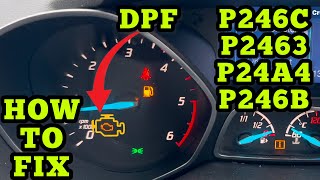
- P246C — Indicates that the DPF is so restricted that it requires a forced regeneration, and engine power is limited. It's a more severe stage of the P2463 condition.
- P246B — Means 'Vehicle Conditions Incorrect for Particulate Filter Regeneration'. This often appears when the fuel vaporizer or a temperature sensor has failed, preventing the right conditions from being met.
- P24A4 — A more specific code for 'Diesel Particulate Filter Restriction – Soot Accumulation Too High'. It often appears alongside P2463 as confirmation of the blockage.
- P244C — Indicates the exhaust temperature is too low for regeneration, often pointing directly to a failed fuel vaporizer or its internal glow plug.
Technical Service Bulletins (TSBs) & Recalls
- 21-2052 (For F-Super Duty, but relevant): Discusses P2463 in vehicles with low-speed use cycles and enabling operator-commanded regeneration.
- 18-2271 (For F-650/F-750, but relevant): Addresses P2463 where a PCM update is required to allow manual regeneration via scan tool.
Mechanic-Grade Diagnostic Values
- DPF Differential Pressure (DP_DPF) at idle — expected: 2-5 mbar (0.2-0.5 kPa). Must be under 10 mbar.. Failure: A reading of 150 mbar or higher at idle indicates a severe blockage.
- DPF Differential Pressure Sensor Voltage (KOEO - Key On Engine Off) — expected: ~0.5V. Failure: Voltage significantly different from 0.5V with the engine off suggests a biased or failed sensor.
- DPF Differential Pressure Sensor Voltage (Engine Idling) — expected: ~0.6V. Failure: A reading that is stuck high (e.g., >1.5V) or does not respond when revving the engine points to a sensor or blockage issue.
- Fuel Vaporizer Internal Glow Plug Resistance — expected: 0.4 - 2.0 Ohms. Failure: An open circuit (infinite resistance) or a dead short (zero resistance) indicates the internal heating element has failed.
Scan Tool Commands That Help

- FORScan: DPF Static Regeneration — To command the vehicle to perform a forced regeneration while stationary. Use this after a repair to clear existing soot, but not as a fix itself. The process can take up to 50 minutes.
- FORScan: Reset the Diesel Particulate Filter learned values — This is a critical step after cleaning or replacing the DPF. It tells the PCM to treat the filter as new/clean, resetting the calculated soot load. Failure to do this will cause the P2463 code to return immediately.
- FORScan: Reset the DPF pressure sensor learned values — This must be performed after replacing the DPF differential pressure sensor. It resets the sensor's stored calibration and offset values in the PCM.
- FORScan: Prime DPF Fuel Vaporizer System — After replacing the fuel vaporizer or its dedicated fuel line, this function runs the vaporizer's fuel pump to purge air and ensure fuel is present for the next regeneration cycle.
Wiring & Ground Locations

- Engine Block to Firewall Ground Strap — Typically a braided metal strap running from the engine block (often near the cylinder head) to a bolt on the vehicle's firewall in the engine bay.. A corroded or loose main engine ground can cause floating voltages and erratic readings from engine-mounted sensors, including the DPF pressure sensor and EGT sensors, leading to false codes.
- Battery Negative to Chassis Ground — A primary ground cable runs from the battery's negative terminal to a dedicated grounding point on the chassis, often located on the fender or frame rail near the battery.. This is the master ground for all vehicle electronics. Poor connection here can cause widespread, unpredictable electrical issues, including PCM malfunctions related to DPF monitoring.
- DPF Pressure Sensor Connector — The sensor is usually on a bracket on the firewall or side of the engine bay. The connector is a 3-pin oval plug.. The pins are typically: Pin 1 (5V Reference), Pin 2 (Signal Output), Pin 3 (Sensor Ground). Verifying 5V and a good ground at the connector is essential for diagnosing a faulty sensor vs. a wiring issue.
Real Owner Repair Stories
- JustAnswer user report (2013 Ford Kuga 2.0L TDCi) — P246B, P2463, and P24A4 codes present, vehicle in limp mode.
❌ Tried (didn't work) Removed and thoroughly cleaned the DPF., Replaced the DPF pressure sensor.
✅ What actually fixed it The user checked the fuel vaporizer and found it was completely blocked. Replacing the fuel vaporizer resolved the non-regeneration issue and allowed the codes to be cleared. - Reddit user r/mechanic (Ford Kuga Mk2 (2012-2019)) — Limp mode with codes P246B, P24A4, and P2463.
❌ Tried (didn't work) Forced regeneration attempts., Off-car DPF cleaning with Wynn's DPF cleaner and a pressure washer.
✅ What actually fixed it After cleaning the DPF and reinstalling it, the codes remained. The backpressure reading was near zero, confirming the DPF was clean. The fix was using a professional diagnostic tool to perform the "Reset DPF learned values" or "tell the car I had fitted a New DPF" service function. The PCM's stored soot value was stuck high and needed to be reset manually.
OEM Part Supersession History
1748653, 1693636→1860939, 1877097, CV619T540AB— Revisions to improve reliability and prevent clogging of the fuel vaporizer.3M5A-5L200-AB, AV61-5L200-AB→BK21-5H295-AC, 1786775— Updated sensor design for improved accuracy and durability.
Heads up: While physical fitment is often the same, using the correct part number for the vehicle's specific year and emissions standard (Euro 5/6) is critical for accurate readings.
Model Year Variations Within This Range
- 2016-2019 (facelift models): Later models (Euro 6) may have more sensitive PCM software logic for DPF monitoring. While the hardware (sensors, vaporizer) is largely the same, the thresholds for triggering fault codes may be stricter. Some later 1.5L TDCi engines may use a single pressure sensor instead of a differential one, but the 2.0L TDCi retained the differential setup.
Diagnostic Flowchart
Other Known Issues on This Vehicle
Issues unrelated to this code that are worth knowing about as an owner of this generation:
- Powershift Transmission Failure 🔴 High — Common, especially on earlier models in the generation, sometimes before 100,000 km. Issues include shuddering, hesitation, and complete failure.
- Tailgate Wiring Harness Failure 🟠 Medium — Common issue where wires in the flexible boot between the body and tailgate break from repeated opening/closing, causing failure of the lock, lights, or power tailgate function.
- Engine Overheating / Coolant Loss 🔴 High — Some 2.0 TDCi models within this range were noted for overheating issues, sometimes leading to cracked cylinder heads or oil sumps. (Ref: Recalls were issued, but primarily focused on EcoBoost engines. However, the issue is documented on diesels as well.)
- Premature Battery Drain 🟡 Low — Multiple owner reports of batteries draining unexpectedly, sometimes due to software glitches or faulty modules in the electrical system.
- Panoramic Roof Detachment/Leaks 🟠 Medium — Reports of the panoramic glass roof panel detaching or the seals failing, leading to water leaks into the cabin. (Ref: A recall was issued for some model years related to the roof panel adhesion.)
Used vs. New Parts: Buying Guide for This Vehicle
When a used part is the smart pick: Used parts are generally not recommended for this specific repair due to the nature of the components. However, if on a strict budget, a used DPF pressure sensor from a low-mileage, verified-running donor vehicle could be considered, but it carries a high risk of being faulty or having a short service life.
Donor-vehicle mileage cap: roughly under 50000 miles for the part to have meaningful remaining life.
What to inspect on the donor part:
- For a DPF sensor, ensure the plastic housing is not brittle or cracked.
- Check that the hose connection nipples are intact and not blocked.
- Verify the donor vehicle did not have DPF-related fault codes prior to being dismantled.
OEM-only on this vehicle (don't cheap out):
- Fuel Vaporizer: This is a wear item with an internal glow plug and a nozzle prone to clogging. A used part has an unknown remaining lifespan and is very likely to be clogged or failed. Always buy new.
- DPF (Diesel Particulate Filter): A used DPF will have accumulated non-burnable ash, reducing its capacity. Its remaining life is unknown. Only a professionally cleaned and flow-tested DPF or a new unit should be installed.
Aftermarket brands forum-validated for this vehicle:
- DPF Pressure Sensor: Bosch, Hella, Delphi, FEBI Bilstein.
- Fuel Vaporizer: Hajus, D2P Autoparts.
Brands owners have reported issues with on this vehicle:
- Unbranded 'no-name' sensors from online marketplaces. These are frequently reported by forum users to be inaccurate out of the box, fail quickly, or have incorrect voltage ranges, leading to persistent diagnostic problems.
Real Owner Stories
Aggregated from forums and TSBs cited above. Mileages and costs reflect what owners reported in those sources.
Ford Kuga Mk2 2.0L TDCi
Symptoms: The owner experienced persistent error codes P246B, P24A4, and P2463. Despite cleaning the DPF, the vehicle remained in limp mode with the codes returning immediately.
What fixed it: The issue was resolved by using a professional diagnostic tool to perform a 'New DPF' reset in the ECU, which cleared the persistent soot load memory.
Source hint: Reddit - FORD Kuga Mk2 DPF problem resolved Error codes P246B, P24A4 and P2463
Ford Kuga 2.0L TDCi
Symptoms: The vehicle was stuck with a P2463 code and a soot loading reading of 302% that would not reset through standard diagnostic procedures.
What fixed it: The eventual solution was a PCM software update to fix a known software glitch that prevented the DPF soot load from being reset.
Source hint: MHH AUTO - Ford KUGA dpf reset issues
Ford Kuga 2.0L Duratorq TDCi
Symptoms: Fault codes P2456, P2463, and P246B were present. The mechanic noted soot in the tailpipe and tested the fuel vaporizer system.
What fixed it: The fuel vaporizer was tested with a hand vacuum pump and found to be clogged; replacing the vaporizer and checking the associated fuses resolved the regeneration failure.
Source hint: YouTube - ford dpf fault P2456 P2463 P246b fixed!!!
Related OBD-II Codes
Frequently Asked Questions
My Ford Kuga 2.0L TDCi is stuck in limp mode with P2463 even after I cleaned the DPF. Why won't the code clear?
How can I tell if my Kuga's fuel vaporizer is the reason for the P2463 soot accumulation?
Is there a specific software issue I should be aware of for the Ford Kuga regarding DPF resets?
What live data values should I look for on my Kuga to confirm a faulty DPF pressure sensor?
Are there specific replacement hoses recommended for the Kuga's DPF pressure sensor?
Does TSB 21-2052 apply to my 2.0L TDCi Kuga?
Helpful Videos

We Have This Part in Stock


The information in this article is provided for general reference and educational purposes only. Vehicle specifications, procedures, and part compatibility can vary by production date, trim level, and region. Always consult your vehicle's factory service manual and verify part numbers before purchasing or performing repairs. Safety-critical components such as airbags, seat belts, and braking systems should be installed by a qualified professional.
- Ford Kuga:
- 🎬 Helpful Videos
- 🛍️ Shop This Part
- What's Unique About the 2012-2019 Ford Kuga
- Symptoms You May Notice
- Most Likely Causes
- Rare But Worth Checking
- Diagnosis Steps
- Parts You'll Likely Need
- Related Codes That Often Appear With This One
- Technical Service Bulletins (TSBs) & Recalls
- Mechanic-Grade Diagnostic Values
- Scan Tool Commands That Help
- Wiring & Ground Locations
- Real Owner Repair Stories
- OEM Part Supersession History
- Model Year Variations Within This Range
- Diagnostic Flowchart
- Other Known Issues on This Vehicle
- Used vs. New Parts: Buying Guide for This Vehicle
- Real Owner Stories
- Ford Kuga Mk2 2.0L TDCi
- Ford Kuga 2.0L TDCi
- Ford Kuga 2.0L Duratorq TDCi
- Related OBD-II Codes
- Frequently Asked Questions
- 🎟️ Get 5% Off