

P2459 on 2014-2020 Ram 3500: Causes and Fixes for Frequent DPF Regeneration
This code means the Diesel Particulate Filter (DPF) is cleaning itself (regenerating) too often. The most common cause is a faulty DPF differential pressure sensor or its hoses. A sensor replacement is typically under $100 for the part and is a straightforward DIY fix. However, always check with a dealer for software updates first, as multiple TSBs address this code with a PCM reflash. Also, be aware that these trucks are highly sensitive to the type of engine air filter used.
- P2459 means your truck's exhaust filter is trying to clean itself too often.
- Before buying any parts, contact a Ram dealer to see if your truck needs a software update, as multiple TSBs exist to fix this exact problem.
- The most likely failed parts are the DPF differential pressure sensor and its rubber hoses; inspect the hoses for cracks and clogs first.
- Your driving habits matter. These trucks need regular highway driving (20-30 minutes at 55+ mph) to keep the DPF healthy.
- Do not ignore this code. It will decrease your fuel mileage and can lead to a very costly DPF replacement if the filter becomes permanently clogged.
What's Unique About the 2014-2020 Ram 3500

On the 6.7L Cummins engine in this generation of Ram trucks, the emissions system is complex and sensitive. While P2459 can be triggered by common part failures, this platform is also known to be extremely sensitive to driving habits (too many short trips, excessive idling), air filter type, and even software logic. Critically, Ram has issued multiple Technical Service Bulletins (TSBs) that involve updating the PCM software to correct faulty regeneration logic. TSB #18-042-20 explicitly states the update is to "prevent or reduce MIL illumination when no defect is present for...P2459", confirming the problem can be in the truck's programming, not just a physical part.
Diagnostic Flowchart
Tap your situation to follow the diagnostic path that matches what you're seeing on this vehicle.
Generation note: The 2014-2020 range covers the end of the fourth generation (2014-2018) and the start of the fifth generation (2019-2020). Both generations use versions of the 6.7L Cummins with a DPF system. The common causes and the provided TSBs from Ram cover vehicles across this generational divide, indicating the issue and potential software fixes are relevant to the entire 2014-2020 model year range. Technicians note seeing this issue frequently on 2022+ models as well, with TSB 25-005-24 REV. B being released for them.
Symptoms You May Notice
- Check Engine Light is on
- Noticeably worse fuel economy due to frequent regeneration cycles
- Message on the instrument cluster indicating DPF is full or in regeneration
- Reduced engine power or 'limp mode' if the DPF becomes severely restricted
- Excessive black smoke from the exhaust if regeneration is failing
- Engine running rough or noisy during unexpected regeneration cycles
- Replacing the entire DPF assembly before ruling out faulty sensors, clogged hoses, or software issues. The DPF itself is expensive and often not the root cause.
- Replacing NOx sensors. While part of the emissions system, a faulty NOx sensor is not a primary cause of P2459. A user on the Turbo Diesel Register forum noted their dealer mistakenly replaced NOx sensors before finding the actual issue.
Most Likely Causes

- Faulty DPF Differential Pressure Sensor 🔴 High Probability This sensor is exposed to harsh exhaust conditions and is a common failure point. It provides the primary data used by the PCM to estimate soot load.
How to confirm: Use a scan tool to monitor the sensor's voltage or pressure readings with the key on, engine off (should be zero). If it's not zero, the sensor is bad. Then, check readings at idle and under load. Unresponsive or erratic readings indicate a bad sensor. A user on Turbo Diesel Register confirmed their dealer replaced this sensor to fix the code.
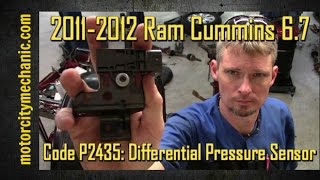
Typical fix: Replace the DPF differential pressure sensor. 🎬 See a walkthrough on replacing the differential pressure sensor. OEM Mopar part numbers include 68085750AB (for 2013-2018 models) and 68312096AB (for 2019+ models).
Est. part cost: $50-$150 - Clogged or Damaged DPF Pressure Sensor Hoses 🔴 High Probability
How to confirm: Visually inspect the rubber hoses connected to the DPF pressure sensor for cracks, melting, or kinks. Remove the hoses and check for blockages from soot buildup. Ensure the metal ports on the exhaust pipe are also clear.
Typical fix: Clean the hoses and their ports with a small wire or compressed air, or replace the hoses if they are damaged.
Est. part cost: $20-$60 - Outdated Powertrain Control Module (PCM) Software 🟡 Medium Probability Ram has released multiple TSBs to update the PCM software, which adjusts the logic for DPF regeneration and can fix erroneous P2459 codes. TSB #18-042-20 specifically aims to prevent this code when no physical defect is present.
How to confirm: A dealership must check the current software version against the latest available updates mentioned in TSBs like #18-042-20, #18-028-16 REV. A, and #25-005-24 REV. B for newer trucks.
Typical fix: Have a Ram dealership reflash the PCM with the latest software. One owner on the Ram Heavy Duty Forum reported a dealer reflash was the attempted fix, though it didn't solve their specific issue.
Est. part cost: $0-$200 - Driving Habits (Short Trips / Excessive Idling) 🟡 Medium Probability These heavy-duty trucks are designed for highway use. Constant short trips or long idle times prevent the exhaust from getting hot enough for a full, passive DPF cleaning, forcing more frequent active regenerations. One owner on YouTube documented his recurring P2459 code, which he attributed to short trips and idle time, and resolved it by changing his driving habits and using a fuel additive.
How to confirm: Analyze your driving patterns. If the truck rarely sees sustained highway speeds (e.g., over 50 mph for 20+ minutes), this is a likely contributor.
Typical fix: Take the truck for a sustained highway drive to allow a full regeneration cycle. Adjust driving habits to include longer trips and reduce idle time.
Est. part cost: $0 - Faulty Exhaust Gas Temperature (EGT) Sensor ⚪ Low Probability
How to confirm: Use a scan tool to monitor live data from all EGT sensors with the engine cold (key on, engine off). They should all read ambient temperature and be within a few degrees of each other. A sensor that is stuck or reads illogically needs to be replaced.
Typical fix: Replace the faulty EGT sensor.
Est. part cost: $70-$180
Rare But Worth Checking
- DPF at End-of-Life (Ash Accumulation): Regeneration burns soot into ash, but ash does not burn off. Over many miles (typically 150,000+), the DPF can become so full of ash that it's permanently restricted, triggering frequent (and failed) regeneration attempts. This often sets code P242F as well and may require professional cleaning or DPF replacement.
- Incorrect Engine Air Filter: The 6.7L Cummins is extremely sensitive to the air filter. Aftermarket filters, especially those with glue beads on the pleats, can create air turbulence and disrupt the PCM's calculations, triggering P2459 and sometimes P0299 (Turbo Underboost). A Reddit user resolved a recurring P2459 by switching to an OEM-style filter without glue straps. The correct OEM filter for 2019+ trucks is Mopar 53034051AB or Fleetguard AF27684.
- Faulty Temperature Manifold Absolute Pressure (TMAP) Sensor: In a documented case on the Turbo Diesel Register forum, a faulty TMAP sensor was the root cause of a persistent P2459 on a Ram 4500. The sensor was reading 205°F when the ambient temperature was 60°F. Replacing the sensor resolved the code and improved fuel economy.
- Exhaust Leak: A leak in the exhaust system anywhere between the exhaust manifold and the DPF can throw off pressure and temperature sensor readings, confusing the PCM into requesting unnecessary regenerations.
Diagnosis Steps
- Read all fault codes with an OBD-II scanner. Note any other codes present, as they can provide valuable clues (e.g., P2453, P0299).
- Check with a Ram dealer if your vehicle's VIN has any open recalls or TSBs, specifically mentioning PCM updates for emissions systems (like TSB #18-042-20 or #25-005-24 REV. B). This should be a primary step.
- Analyze your recent driving habits. If you primarily drive short distances or idle frequently, take the truck for a 30-45 minute drive at highway speeds (above 55 mph) to initiate a full DPF regeneration.
- Inspect the engine air filter. Ensure it is an OEM or equivalent filter without glue beads on the pleats. A common fix is replacing a problematic aftermarket filter with Mopar part #53034051AB (or Fleetguard AF27684).
- Perform a thorough visual inspection of the DPF differential pressure sensor hoses. Look for any signs of cracks, melting, kinks, or loose connections. Remove them and ensure the hoses and their metal ports on the exhaust pipe are also clear.
Parts You'll Likely Need

- DPF Differential Pressure Sensor — This sensor is the most common hardware failure to cause P2459. It provides the primary data the PCM uses to determine how full the DPF is.
Trusted brands: Mopar, Bosch, Standard Motor Products
OEM price range: $100-$180
Aftermarket price range: $50-$120 - DPF Pressure Sensor Hoses — These rubber hoses are prone to cracking from heat or getting clogged with soot, leading to inaccurate pressure readings.
Trusted brands: Mopar, Dorman
OEM price range: $40-$80
Aftermarket price range: $20-$50
Related Codes That Often Appear With This One
- P242F — This code for 'DPF Restriction - Ash Accumulation' often appears with P2459 when the filter is nearing the end of its service life and is physically clogged with unburnable ash. Both are listed in TSB #18-042-20 and #18-028-16.
- P2453 — This code indicates a performance issue with the DPF Differential Pressure Sensor circuit itself. It points directly to the sensor or its wiring as the problem, which is a primary cause of P2459.
- P0299 — This code for 'Turbocharger Underboost' can be caused by the same restrictive, incorrect aftermarket air filters that are known to trigger P2459. The turbulent airflow affects both systems.
- P2002 — This code for 'DPF Efficiency Below Threshold' is closely related. It can mean the DPF isn't cleaning effectively, which can lead the PCM to trigger more frequent regenerations, thus setting P2459.
Technical Service Bulletins (TSBs) & Recalls
- 18-042-20: Released May 27, 2020, this TSB involves a PCM reflash to correct the logic for multiple emissions codes, including P2459, to prevent false check engine lights.
- 18-028-16 REV. A: Released August 19, 2016, this is an earlier PCM software update that also addresses P2459 among other emissions-related codes.
- 25-005-24 REV. B: A newer TSB released for 2022-2023 trucks that also addresses the P2459 frequent regeneration issue.
Platform-Specific Known Issues
- Air Filter Sensitivity: Multiple owners and even dealer technicians have confirmed that the 6.7L Cummins is extremely particular about the engine air filter. Using an aftermarket filter, especially one with glue beads along the pleats, can disrupt airflow enough to trigger a P2459 code, even if the filter is new. A Reddit user had a dealer replace the DPF and sensor under warranty, but the code returned until they personally replaced the aftermarket air filter with an OEM-style one.
- Dealer Parts-Swapping Before Diagnosis: A recurring theme in owner forums is dealers replacing expensive components before proper diagnosis. One owner on the Turbo Diesel Register forum reported their dealer replaced NOx sensors and then the entire DPF for a recurring P2459, only for the code to return 600-800 miles later, suggesting the root cause was missed.
- Software vs. Hardware: There is a clear divide between P2459 being caused by a true hardware failure (like a sensor) and a software logic issue. TSB #18-042-20 directly states the reflash is to prevent the code when 'no defect is present,' indicating the PCM can be too sensitive. This makes checking for software updates a critical first step before replacing parts.
Mechanic-Grade Diagnostic Values
- DPF Differential Pressure Sensor Signal Voltage (Key On, Engine Off) — expected: 0.5V - 0.77V DC. Some service data specifies ranges based on ambient temperature, such as 0.61 - 0.77 VDC below 77°F (25°C).. Failure: A reading of 0V, or one that is significantly higher (e.g., 4.5V or more), points to a faulty sensor or a circuit issue. Any pressure reading other than zero with the engine off indicates a biased sensor.
- DPF Differential Pressure Sensor 5V Reference — expected: A steady 5.0V DC at the sensor connector.. Failure: A reading significantly lower than 5.0V indicates a wiring issue or a problem with the PCM's 5V reference circuit, not the sensor itself.
- DPF Differential Pressure Sensor Signal Circuit Resistance — expected: Below 10.0 ohms between the sensor harness connector and the ECM harness connector.. Failure: Resistance above 10.0 ohms indicates an open or high-resistance wire in the signal circuit.
- Fuel Rail Pressure Sensor Voltage (Key On, Engine Off) — expected: Approximately 0.5 volts.. Failure: Incorrect voltage may indicate a sensor issue that could contribute to improper fueling and excess soot, although it is not a direct cause of P2459.
Scan Tool Commands That Help

- wiTECH, Autel, AlfaOBD, or equivalent professional scan tool: Stationary Desoot / Forced DPF Regeneration — This is used to manually command a DPF cleaning cycle while the vehicle is parked. It's necessary when the soot load is too high for a normal driving regen to occur, or to verify the system can complete a regen after a repair. The process can take 20-60 minutes.
- wiTECH or equivalent: Reset DPF Learned Values / Aftertreatment Maintenance Reset — This function must be performed after replacing the DPF or a critical sensor like the differential pressure sensor. It clears the PCM's stored data about soot and ash levels, allowing the system to re-learn and calibrate with the new components.
- Cummins INSITE: Enable 'DPF Stay Warm' Feature — For vehicles that frequently operate at low speeds or in stop-and-go traffic, this feature can be enabled in the ECM to help maintain DPF temperatures, promoting more effective passive regeneration even when vehicle speed drops.
Wiring & Ground Locations
- DPF Differential Pressure Sensor Connector — The sensor is typically mounted on a bracket on the transmission or frame rail, away from direct exhaust heat, connected by two hoses to the DPF pipes.. This connector provides the 5V reference, ground, and signal return to the PCM. The three key wires are the 5V supply (often violet/white), the sensor ground/return (brown/violet), and the signal wire (brown/white).
- Connector C108 / Harness Chafe Point — On some 3rd and 4th generation trucks, a wiring harness connector (C108) located on the passenger side of the transmission bell housing can be a chafe point.. A metal grounding strap in this area has been documented to rub through the insulation of the DPF pressure sensor signal wire (brown with a white stripe), causing it to short to ground. This can trigger sensor-related codes and lead to incorrect DPF soot calculations.
Real Owner Repair Stories
- YouTube user 'Adventure Rocks' (2021 Ram 3500 HO Cummins Dually) — Recurring P2459 check engine light at approximately 400-mile intervals, with no other codes present.
❌ Tried (didn't work) Initially just clearing the code, but it returned consistently.
✅ What actually fixed it The owner made two changes: 1) Altered driving habits to minimize idle time and ensure more frequent, longer trips. 2) Started using a diesel fuel additive (Hot Shot's Secret Diesel Extreme and Everyday Diesel Treatment). The code did not return for over 1,500 miles after these changes. - Turbo Diesel Register forum user (2022 RAM 3500 DRW 6.7L HO) — P2459 code appeared four times after a long trip where the air filter became clogged with grasshoppers.
❌ Tried (didn't work) The dealer first replaced the fore and aft NOx sensors, but the code returned., The dealer then replaced the entire Diesel Particulate Filter assembly, which also did not resolve the issue.
✅ What actually fixed it The final resolution was not posted in the thread, but the story is a valuable example of misdiagnosis where expensive components like NOx sensors and the DPF itself were replaced unsuccessfully before addressing simpler potential causes like the air filter or sensor readings.
OEM Part Supersession History
68085750AA→68085750AB— Standard part revision by the manufacturer for improvements or supplier changes.
Heads up: 68085750AB is a direct replacement for 68085750AA. No known incompatibility issues.
Model Year Variations Within This Range
- 2019-2020 (5th Gen) vs 2014-2018 (4th Gen): The 2019+ models feature a redesigned, larger, and more integrated aftertreatment system where the Diesel Oxidation Catalyst (DOC) and DPF are housed closer to the turbo. This design helps the system stay hotter, promoting more effective passive regeneration. While the operating principle is the same, the physical components and their layout are different from the 2014-2018 models.
- 2019+: The DPF differential pressure sensor for 2019+ models is a different part number (e.g., 68312096AB) than the one used on 2013-2018 trucks (68085750AB).
Helpful Videos
We Have This Part in Stock


The information in this article is provided for general reference and educational purposes only. Vehicle specifications, procedures, and part compatibility can vary by production date, trim level, and region. Always consult your vehicle's factory service manual and verify part numbers before purchasing or performing repairs. Safety-critical components such as airbags, seat belts, and braking systems should be installed by a qualified professional.
- Ram 3500:
- 🎬 Helpful Videos
- 🛍️ Shop This Part
- What's Unique About the 2014-2020 Ram 3500
- Diagnostic Flowchart
- Symptoms You May Notice
- Most Likely Causes
- Rare But Worth Checking
- Diagnosis Steps
- Parts You'll Likely Need
- Related Codes That Often Appear With This One
- Technical Service Bulletins (TSBs) & Recalls
- Platform-Specific Known Issues
- Mechanic-Grade Diagnostic Values
- Scan Tool Commands That Help
- Wiring & Ground Locations
- Real Owner Repair Stories
- OEM Part Supersession History
- Model Year Variations Within This Range
- 🎟️ Get 5% Off