

P2459 on 2015-2019 Ford Transit 3.2L Diesel: DPF Regeneration Frequency Causes and Fixes
On a 2015-2019 Ford Transit with the 3.2L diesel, code P2459 means the Diesel Particulate Filter (DPF) is trying to clean (regenerate) itself too often. This is frequently caused by short-trip driving habits or high-idle time, but can also indicate a faulty DPF pressure sensor, a clogged DPF, or a failed fuel vaporizer.
- P2459 on a 3.2L Transit is a warning that the DPF is trying to self-clean too often.
- The most common cause is a driving style with too much idling or too many short trips, which can be fixed by driving at highway speeds for 30 minutes or having a dealer enable manual regeneration (OCR).
- Before considering an expensive DPF replacement, thoroughly test the DPF pressure sensor, its hoses, and the fuel vaporizer, as these are common, less-expensive failure points.
- This code is almost always seen with P2463 (Soot Accumulation) and can lead to P246C (Limp Mode) if ignored.
What's Unique About the 2015-2019 Ford TRANSIT

The 3.2L Power Stroke diesel engine in the Ford Transit, also known globally as the Duratorq 3.2, is particularly sensitive to usage patterns. As highlighted by Ford's own Technical Service Bulletins (TSBs), these vans are often used for applications with high amounts of stationary idling or low-speed driving (e.g., local delivery, service vans). This type of use prevents the exhaust from getting hot enough for normal, passive regeneration, leading to soot buildup and forcing frequent, often unsuccessful, active regeneration attempts, which triggers the P2459 code. To address this, Ford provides a dealer-activated 'Operator Commanded Regeneration' (OCR) feature that allows the driver to manually start a stationary regen cycle.
Diagnostic Flowchart

Tap your situation to follow the diagnostic path that matches what you're seeing on this vehicle.
Symptoms You May Notice

- Check Engine Light (Malfunction Indicator Lamp) is on.
- A 'Drive To Clean Exhaust Filter' message appears on the dashboard.
- Noticeably frequent automatic regeneration attempts (you may hear the engine note change to 2000-2400 RPM or the cooling fan run loudly).
- Reduced engine power or acceleration, potentially entering 'limp mode'.
- Poor fuel economy.
- Strong diesel odor from the exhaust due to partially burned soot.
- Excessive black smoke from the exhaust, especially during forced regen attempts.
- Replacing the entire DPF assembly when only the DPF pressure sensor or its hoses were faulty.
- Repeatedly clearing the code without addressing the underlying cause, such as driving habits or a failed vaporizer, leading to a completely blocked DPF that can no longer be regenerated.
- Assuming the DPF is bad when a clogged fuel vaporizer is preventing it from getting hot enough to clean itself.
Most Likely Causes

- Driving Habits (High Idle/Short Trips) 🔴 High Probability As confirmed by Ford TSBs 19-2061 and 18-2223, these vans are often used in ways (like stationary work or local delivery) that prevent the DPF from completing its cleaning cycle. This is the most common trigger for P2459.
How to confirm: Review the vehicle's typical usage. If it rarely sees sustained highway speeds (over 40-50 mph) for 20-30 minutes continuously, this is the likely cause.
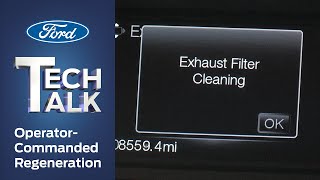
Typical fix: Drive the vehicle at sustained highway speeds for at least 20-30 minutes to allow a full regeneration. For vehicles that cannot be driven this way, a Ford dealer can use their scan tool to enable Operator Commanded Regeneration (OCR), which allows a manual, stationary regen to be initiated by the driver through the instrument cluster menus. 🎬 Watch: Ford's official guide to using the OCR feature.
Est. part cost: $0 (for driving) or 0.5-1.0 hours labor for dealer OCR activation. - Faulty DPF Pressure Sensor 🟡 Medium Probability These sensors and their connecting rubber hoses are exposed to extreme heat and vibration. They can fail by giving incorrect pressure readings (e.g., reporting high pressure when the filter is clear) or the hoses can crack, melt, or get blocked with soot, tricking the PCM into thinking the DPF is full.
How to confirm: Use a diagnostic scan tool (like FORScan) to monitor the DPF_DP (Differential Pressure) PID. At idle with a clean filter, it should be near 0.7 mbar (0.01 psi). A high reading at idle or one that doesn't change with RPM suggests a sensor or hose issue. Visually inspect the sensor and its hoses for damage.
Typical fix: Replace the DPF pressure sensor and its associated hoses. Ensure the metal pipes leading to the hoses are clear.
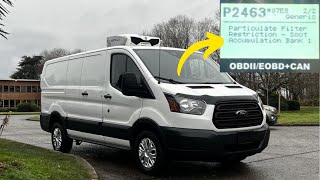
Est. part cost: $50-$150 - Clogged Diesel Particulate Filter (DPF) 🟡 Medium Probability If frequent regeneration cycles are commanded but fail to complete due to driving habits or other system faults (like a bad vaporizer), the DPF will eventually become overloaded with soot and non-burnable ash, a condition often confirmed by code P2463. 🎬 Watch: A walkthrough on diagnosing and fixing the P2463 code.
How to confirm: After confirming sensors are working, a high pressure reading that does not decrease after a successful forced regeneration indicates a clogged filter. The DPF may need to be removed for inspection and weighing to check ash load.
Typical fix: Perform a forced regeneration with a professional scan tool. If that fails, the DPF requires professional off-car cleaning (baking and blowing out) or, in severe cases, complete replacement.
Est. part cost: $250-$500 (for professional cleaning), $1000-$3000+ (for replacement) - Faulty Fuel Vaporizer ⚪ Low Probability The fuel vaporizer (also called a doser or the 9th injector) injects diesel directly into the exhaust stream ahead of the DPF to generate heat for active regeneration. These units contain a small glow plug and are known to clog with carbon or have their glow plug fail, preventing the regeneration from starting or completing effectively.
How to confirm: A diagnostic scan tool may show codes related to the vaporizer circuit (e.g., P26A1). A technician can command the vaporizer to activate and check for proper function, fuel spray, and current draw on its glow plug. A blown 20A fuse (yellow, position 20 in engine bay fuse box) can indicate a failed vaporizer glow plug.
Typical fix: Replace the fuel vaporizer assembly. The part is often located on the exhaust downpipe.
Est. part cost: $200-$400
Rare But Worth Checking
- Exhaust Gas Temperature (EGT) Sensor Failure: The PCM relies on multiple EGT sensors to monitor the regeneration process. If a sensor provides an inaccurate reading (e.g., reading too low), the PCM may think the regen failed and will try again, triggering P2459. Ford has a Customer Satisfaction Program (23N04) for the EGT sensor (Bank 1, Sensor 1) on these vehicles, extending the warranty to 11 years or 120,000 miles.
- Exhaust Leaks: A leak in the exhaust system before or near the DPF can alter the pressure readings, causing the DPF pressure sensor to report incorrect values and trigger unnecessary regenerations.
- PCM Software Issue: The existence of TSB 19-2061, which instructs dealers to enable Operator Commanded Regeneration (OCR), implies a logic-based issue where the original software is not suited for all driving patterns. In some cases, a PCM reflash to the latest calibration can resolve logic-related regeneration problems.
Diagnosis Steps
- Read all diagnostic trouble codes (DTCs) with a capable OBD-II scanner (e.g., FORScan). Note if P2463 or P246C are present.
- Analyze the vehicle's driving patterns. Discuss with the owner if the van is used for short trips or has high idle time. If so, a long highway drive or enabling OCR may be the first step.
- Use a scan tool to view live data for DPF soot load (DPF_SOOT_LOAD), DPF differential pressure (DPF_DP), and exhaust gas temperatures (EGT11, EGT12, etc.).
- If soot load is high, attempt to perform a stationary/forced regeneration using the scan tool. Monitor EGTs to ensure they reach the target of ~1200°F (600°C) and watch the DPF_DP and DPF_SOOT_LOAD values to see if they drop significantly.
- If regeneration fails to start or temperatures don't rise, suspect the fuel vaporizer. Test the vaporizer circuit and command it on with a scan tool to ensure it's working.
- If the code returns quickly after a successful regen, inspect the DPF pressure sensor's rubber hoses for cracks, melting, or blockages. Check the metal pipes for soot buildup.
- Test the DPF pressure sensor. With the engine off, the DPF_DP value should be 0. If it's not, the sensor is likely faulty. Replace it.
- Check for any exhaust leaks between the turbocharger and the DPF assembly. A leak can cause incorrect pressure readings.
- If all sensors and components are functional but the DPF remains clogged (high DPF_DP value) after a forced regen, it likely requires professional off-car cleaning or replacement.
Parts You'll Likely Need
- DPF Pressure Sensor
(OEM #Motorcraft DPFE-29)— This sensor is a common failure point and provides the primary data used by the PCM to determine DPF soot load. An incorrect reading directly causes regeneration frequency issues.
Trusted brands: Motorcraft, Bosch, Standard Motor Products
Related Codes That Often Appear With This One
- P2463 — Stands for 'Diesel Particulate Filter Restriction - Soot Accumulation'. This code often appears with P2459 because the frequent, unsuccessful regenerations (P2459) are a direct result of the filter being clogged with soot (P2463).
- P246C — Stands for 'Diesel Particulate Filter Restriction - Forced Limited Power'. This code indicates the soot accumulation is so severe that the PCM has reduced engine power ('limp mode') to prevent damage. It's the final stage of the problem that starts with P2459.
Technical Service Bulletins (TSBs) & Recalls
- TSB 19-2061: Supersedes 18-2223. Covers 2015-2019 Transits with 3.2L diesel exhibiting P2459, P2463, P246C due to stationary/low-speed use. The official action is to enable Operator Commanded Regeneration (OCR) via a dealer scan tool.
- Customer Satisfaction Program 23N04: Not a TSB, but a Ford program extending warranty coverage for a one-time replacement of the EGT sensor (Bank 1, Sensor 1) to 11 years or 120,000 miles for 2015-2019 Transits.
Platform-Specific Known Issues
- Ford issued TSB 19-2061, superseding 18-2223, specifically for 2015-2019 Transits with the 3.2L diesel. It states that vehicles used in 'stationary or off-highway, low speed applications' are prone to P2459, P2463, and P246C due to soot accumulation from failed regeneration attempts. The recommended action is to enable 'Operator Commanded Regeneration' (OCR) in the vehicle's software, allowing the driver to manually start a cleaning cycle while parked.
Mechanic-Grade Diagnostic Values
- DPF Differential Pressure (DPF_DP) at idle with a clean filter — expected: ~0.7 mbar. Failure: A value of 0, a value that is high at idle, or a value that does not change with RPM may indicate a faulty sensor, blocked hose, or blocked sensor port.
- DPF Differential Pressure (DPF_DP) threshold for regeneration — expected: Increases to ~1.6 mbar before the ECU initiates a regeneration.. Failure: If pressure exceeds this without a regen starting, it may indicate a software or sensor issue.
- DPF Differential Pressure (DPF_DP) during a forced service regeneration — expected: 150 to 200 mbar is a safe range to initiate the procedure.. Failure: Pressure from 250 mbar, and especially over 300 mbar, is considered an unsafe range to start a forced regeneration and risks damaging the DPF.
- DPF Pressure Sensor Voltage — expected: 0.5V to 4.5V output range is typical.. Failure: A reading stuck at the high end, such as 4.99V, indicates a sensor or circuit fault.
- Soot Load Percentage after successful regeneration — expected: Closed loop: ~1%; Open loop: ~3%. Failure: If soot load PIDs do not drop to near these values after a regen, the cleaning was unsuccessful or the learned values need to be reset.
- Engine RPM during Operator Commanded Regeneration (OCR) — expected: ~2,000 - 2,400 RPM. Failure: If the engine does not reach or maintain this RPM range during OCR, the process may fail.
Scan Tool Commands That Help
- Ford IDS (or equivalent): Operator Commanded Regeneration (OCR) Enable — To enable the manual regeneration option for drivers whose usage pattern (high idle, short trips) prevents automatic regens. This is the official fix described in TSB 19-2061.
- FORScan: Enable DPF % in Menu (IPC Module 720-07-02) — To allow the driver to monitor the DPF soot load directly from the instrument cluster, helping them anticipate when a highway drive or OCR is needed. The common change is setting the second digit of the value to 8 (e.g., x0xx -> x8xx).
- FORScan: Activate Manual Regeneration (PCM Module 7E0-03-01) — This is the FORScan equivalent of the dealer OCR activation, enabling the manual regen option in the vehicle's menu.
- Ford IDS / FORScan / Autel: DPF Static/Forced Regeneration — To manually command a stationary regeneration cycle when the DPF is moderately clogged and driving is not an option. This is a primary diagnostic step to see if the filter can be cleaned.
- Ford IDS / FORScan / Autel: Reset DPF Learned Values — This should be performed after a successful forced regeneration or after replacing the DPF. It tells the PCM that the filter is now clean. Resetting these values on a clogged filter can cause issues as the PCM will operate based on incorrect assumptions.
- Ford IDS: Vaporiser prime — This service function runs the fuel pump for the vaporizer to push fuel through it, used to test the vaporizer's fuel delivery circuit.
Wiring & Ground Locations
- Fuse F20 (Engine Bay) — In the fuse box located in the engine compartment.. This is a 20A yellow fuse for the fuel vaporizer. A blown fuse here indicates a fault in the vaporizer circuit, often a shorted glow plug, which will prevent active regeneration and can lead to P2459.
Real Owner Repair Stories
- O'Rileys Autos YouTube (2016 Ford Transit Custom 2.0 EcoBlue) — Multiple DPF-related warning lights, code P2455 (Particulate Filter Pressure Sensor Circuit). Live data showed 4.99V and 6554 hPa from the sensor.
❌ Tried (didn't work) Previous garages refused to work on it. The sensor had been tampered with (silicone, zip ties).
✅ What actually fixed it The metal port on the DPF where the pressure sensor hose connects was completely blocked with solid carbon. The fix involved drilling out the carbon blockage, cleaning the pipe with a pressure gun, and installing a new sensor. An intermittent wire in the connector was also repaired. - Ford Transit Forum user 'nick:l' (Ford Transit Euro 5) — Codes P2463, P246C, P24A4 (soot accumulation, forced limited power).
❌ Tried (didn't work) Considering cleaning the DPF.
✅ What actually fixed it A master tech advised on how to test the fuel vaporizer, which was found to be coked up. The diagnostic advice was to use a Mityvac on the vaporizer's spigot; if it holds any vacuum, it is blocked and cannot inject fuel for regeneration. The final plan was to replace the faulty vaporizer and have the DPF professionally cleaned. - Reddit user 'Roboosto' in r/FORScan (2012 Ford Transit Custom with 245,000km) — DPF related DTC.
❌ Tried (didn't work) A long drive at high RPM and a FORScan static regeneration both failed to lower the DPF soot load PID, which remained at 101%.
✅ What actually fixed it The community consensus was that the DPF was too clogged for a software-based regeneration to work. The recommended and necessary next step was to remove the DPF for professional, off-car manual cleaning.
"I Checked Everything" — The Actual Cause
- A common diagnostic path is to check for exhaust leaks, which can alter pressure readings. However, a system can be leak-free but still provide bad data if the sensor's pressure port itself is physically blocked. In one documented case, the metal pipe leading from the DPF to the sensor hose was completely clogged with a plug of solid carbon, which would not be found by a smoke test. The fix required drilling the blockage out.
OEM Part Supersession History
Motorcraft DPFE-29→GK4Z-9J460-A— Part number update or revision.
Heads up: GK4Z-9J460-A is listed for 2016-2019 models, while DPFE-29 may apply more broadly. Always verify the correct part number for the specific vehicle's VIN.
Model Year Variations Within This Range
- 2015-2019: The 3.2L Power Stroke I-5 diesel engine was an optional engine for the Ford Transit during this period.
- 2020 and later: For the 2020 model year, the 3.2L diesel was discontinued and replaced with a new, smaller 2.0L Bi-Turbo diesel engine to meet changing emissions regulations. Therefore, information specific to the 3.2L DPF system does not apply to 2020+ models.
Helpful Videos
We Have This Part in Stock


The information in this article is provided for general reference and educational purposes only. Vehicle specifications, procedures, and part compatibility can vary by production date, trim level, and region. Always consult your vehicle's factory service manual and verify part numbers before purchasing or performing repairs. Safety-critical components such as airbags, seat belts, and braking systems should be installed by a qualified professional.
- Ford TRANSIT:
- 🎬 Helpful Videos
- 🛍️ Shop This Part
- What's Unique About the 2015-2019 Ford TRANSIT
- Diagnostic Flowchart
- Symptoms You May Notice
- Most Likely Causes
- Rare But Worth Checking
- Diagnosis Steps
- Parts You'll Likely Need
- Related Codes That Often Appear With This One
- Technical Service Bulletins (TSBs) & Recalls
- Platform-Specific Known Issues
- Mechanic-Grade Diagnostic Values
- Scan Tool Commands That Help
- Wiring & Ground Locations
- Real Owner Repair Stories
- "I Checked Everything" — The Actual Cause
- OEM Part Supersession History
- Model Year Variations Within This Range
- 🎟️ Get 5% Off