

OBD-II Code P2442: Secondary Air Injection System Switching Valve Stuck Open (Bank 2)
The Ultimate Guide to P2442: Causes, Symptoms, and Pro-Level Fixes
- Code P2442 triggers when the Bank 2 Air Switching Valve gets physically jammed open, most often by black, sticky debris from a disintegrated air pump filter.
- Driving with an active P2442 code forces the vehicle into a dangerous 'limp mode' that caps your speed at 40 mph and risks melting your catalytic converters.
- Dealerships typically quote $2,500 to $4,000+ for this repair because the official fix requires replacing both air pumps and both valves, which are buried under the intake manifold.
- Never replace a stuck switching valve without also inspecting the air pumps; installing a $300 new valve into a contaminated system guarantees it will fail again within weeks.
- Installing a $300-$500 electronic bypass kit is the most popular permanent fix for out-of-warranty Toyota and Subaru vehicles, though it is restricted to off-road use.
What Does P2442 Mean?

Your car's computer detected a serious emissions system failure: the Secondary Air Injection Switching Valve on engine bank 2 is stuck open. This system pumps fresh air into the exhaust for the first 30-90 seconds after a cold start to burn excess fuel and heat the catalytic converter. When stuck open, exhaust flows backward into the system.
Technical definition: The SAE/OBD-II definition is "Secondary Air Injection System Switching Valve Stuck Open Bank 2." The Powertrain Control Module (PCM) detected the air switching valve for engine bank 2 failed to close. The PCM verifies this using a pressure sensor; if exhaust pressure is detected when the valve should be closed, it triggers P2442.
Can I Drive With P2442?

Yes, But With Caution. You can drive, but it is highly discouraged. Your vehicle will likely enter 'limp mode,' severely limiting speed to 40 mph or less, making highway driving dangerous. Continuing to drive with the valve stuck open allows hot exhaust gases to flow backward, destroying the air pumps and potentially melting the catalytic converters. This adds $800-$2,500+ per converter to your final repair bill.
Common Causes

- Failed Air Switching Valve (Bank 2) 🎬 Watch: Step-by-step guide to replacing the Bank 2 switching valve. (Very Common) — The valve flap gets stuck open due to internal corrosion, carbon buildup, or wear. Moisture or debris from a failing pump is the primary trigger.
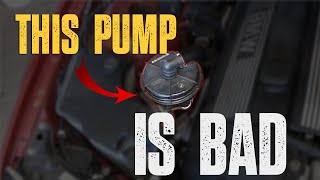
- Failed Secondary Air Injection Pump(s) (Very Common) — The air pump's internal foam filter disintegrates over time, sending black, sticky debris through the hoses to physically jam the switching valves open.
- Moisture Intrusion (Common) — Water from exhaust condensation or ingested by fender-mounted pumps enters the system. In freezing weather, this moisture turns to ice, jamming the valves or seizing the pump.
- Poor-Quality Aftermarket Parts (Common) — Cheap aftermarket valves and pumps fail quickly, often within months, because inferior materials cannot withstand exhaust heat and moisture.
- Leaking Vacuum Lines (Less Common) — On older vacuum-actuated systems, cracked or oil-soaked rubber hoses cause a loss of vacuum, preventing the valve from closing.
- Wiring and Electrical Issues (Less Common) — Frayed wires, corroded connectors, or a bad ground prevent the valve's solenoid from receiving the close command.
- Failed Pressure Sensor (Rare) — The integrated pressure sensor fails and sends a false high-pressure reading to the computer, triggering the code even if the valve is physically closed.
- Corrupted ECM Software (Rare) — Overly sensitive Engine Control Module (ECM) software triggers false codes during freezing temperatures. Manufacturers often release TSBs with software updates to fix this.
Symptoms

- Vehicle Enters 'Limp Mode' — The vehicle suddenly loses power and restricts acceleration to 25-45 mph. This fail-safe prevents engine damage but is dangerous in traffic.
- Loud Whining Noise on Cold Start — A loud whine or vacuum-cleaner sound under the hood for 30-90 seconds after a cold start indicates a failing air pump motor. 🎬 See common air pump symptoms and estimated replacement costs.
- Sluggish Acceleration & Rough Idle — Unmetered air disrupts the intended air-fuel ratio, causing the engine to hesitate, struggle on hills, or idle roughly immediately after startup.
- Check Engine Light & Warning Lights (also visible on scanner) — The Check Engine Light illuminates. On Toyota/Lexus models, the traction control (TRAC/VSC) and 4LO lights also flash, disabling those systems.
Diagnostic Flowchart

Tap your situation to follow the diagnostic path that matches what you're seeing on this code.
Common Fixes & Costs
- Install a Secondary Air Injection System Bypass Kit — Parts: $300-$500, Labor: $150-$400, ~1.5 hr book time (DIY)
- Replace Both Air Switching Valves and Both Air Pumps
— Parts: $800-$2000+, Labor: $800-$2000+, ~8 hr book time
(Professional)
: OEM - Replace Air Switching Valve Assembly (Bank 2)
— Parts: $200-$700, Labor: $300-$1500+, ~6 hr book time
(Intermediate)
: OEM
: OEM - Replace Secondary Air Pump(s)
— Parts: $400-$1200, Labor: $150-$300, ~1.5 hr book time
(Intermediate)
: OEM - Replace Air Pump Fuses and Relays — Parts: $10-$50, Labor: $0-$100, ~0.2 hr book time (Beginner)
Used vs. New Parts: Buying Guide
When a used part is worth it: Buying used air pumps or switching valves is highly discouraged due to the near-100% failure rate from internal contamination. Only consider used parts on a high-mileage vehicle with an extremely tight budget.
Donor-vehicle mileage cap: roughly under 50000 miles for the part to have meaningful remaining life.
Donor quality checklist:
- Verify the donor vehicle was not scrapped for engine or emissions problems.
- Avoid parts from high-humidity or rust-belt regions.
- Match the OEM part number exactly; internal components differ despite visual similarity.
Decision logic:
- If The part is an air pump or switching valve. → Buy new OEM or reputable aftermarket (Dorman, Bosch). Used parts carry a massive risk of rapid failure.
- If Vehicle is > 150K miles AND budget is the primary constraint. → A used part under 50K miles is acceptable, but acknowledge the risk of repeat labor costs.
- If The part is an electronic ECM. → Used is viable, but it requires professional reprogramming to match your VIN.
Warranty tradeoff: Used parts offer a 30-90 day warranty. New aftermarket parts offer 1-year to lifetime warranties. New OEM parts carry a 1-year warranty.
Worst-case if a used part fails: $800-1500. This is the cost of repeating the labor-intensive valve replacement if a used part fails.
What Happens If You Wait — Timeline
- 0-1 month: Code P2442 sets, warning lights illuminate, and the vehicle enters intermittent limp mode. Resetting the code temporarily restores function. (MPG impact: 0-5%% · Added cost: $0)
- 1-4 months: Limp mode becomes frequent. Hot exhaust flowing backward damages the valve's internal plastic components and integrated pressure sensor. (MPG impact: 5-10%% · Added cost: $200 - $800)
- 4-8 months: The pressure sensor is destroyed by heat exposure, guaranteeing the code cannot be cleared. Air pumps seize or melt. (MPG impact: 5-15%% · Added cost: $800 - $2000)
- 8+ months: Catastrophic failure. Constant exposure to improper temperatures melts catalytic converters and damages the Engine Control Module (ECM). (MPG impact: 10-20%% · Added cost: $2500 - $5000+)
Cost of Not Fixing It
- Immediate: Vehicle enters 'limp mode,' creating a safety hazard. Guaranteed emissions test failure and a 5-10% reduction in fuel economy. (Added cost: Negligible, besides increased fuel usage.)
- 1-6 Months: Hot exhaust gas flowing continuously through the open valve destroys the secondary air pumps and internal pressure sensors. (Added cost: $400 - $1200)
- 6+ Months: Prolonged exposure to hot exhaust melts catalytic converters and nearby wiring harnesses, or damages the Engine Control Module (ECM). (Added cost: $1200 - $4000+)
Diagnosis Steps
- Read the Trouble Codes
Use an OBD-II scanner to confirm P2442. Note any related codes like P2440 (Bank 1), P2445 (Pump Stuck Off), or P0418 (Pump Relay Circuit), as they pinpoint the root cause.
Tools: OBD-II Scanner (Beginner) - Listen to the Air Pump
Have an assistant start the cold engine. The air injection pump must run for 30-90 seconds and shut off. If it doesn't run, runs continuously, or grinds, the pump or circuit is faulty.
Tools: None (Beginner) - Visual Inspection of Hoses and Pumps
Inspect the air injection pump and hoses. Look for melted lines or disconnected vacuum hoses. Remove the main hose from the pump to check for disintegrated black foam debris.
Tools: Flashlight, Screwdriver (Beginner) - Check Fuses and Relays
Locate the secondary air injection fuse and relay. A seized pump blows the fuse immediately. Swap the AIR relay with an identical one (like the horn relay) to test it.
Tools: Fuse puller (Intermediate) - Command Valve with a Bi-Directional Scanner
Use an active test to command the switching valve and air pump on and off. Listen for a sharp click from the valve's solenoid. No click means a stuck valve or dead circuit.
Tools: Bi-Directional Scan Tool (Advanced) - Test Switching Valve Coil Resistance
Disconnect the switching valve connector. Measure resistance across the solenoid pins. A good valve reads 30-70 Ω. Infinity (OL) means an open circuit; near zero means a short.
Tools: Multimeter (Advanced) - Test Pressure Sensor Signal Voltage
Back-probe the pressure sensor signal wire. With Key On, Engine Off, voltage should be ~0.2V. If voltage is stuck high (>1.0V) with the system off, the sensor is dead or the valve is stuck open.
Tools: Multimeter, Back-probe kit (Advanced) - Monitor Live O2 Data
Watch the upstream O2 sensor (O2S11) during a cold start. When the air pump activates, the extra oxygen forces the O2 voltage to drop below 0.15V. If voltage doesn't drop, air isn't reaching the exhaust.
Tools: Advanced Scan Tool (Advanced) - Load Test the Power and Ground Circuits
Connect a headlamp bulb to the power and ground pins of the valve connector. If the bulb doesn't light brightly, the circuit has high resistance and cannot supply enough current.
Tools: Headlamp bulb with wires (Advanced) - Inspect Valve Internals
Remove the valve assembly (often requires intake manifold removal). Inspect the ports for rust, moisture, or black sticky debris from a failed pump filter.
Tools: Advanced hand tools (Professional)
When This Code Triggers (Freeze-Frame Conditions)
- Engine Coolant Temp: 175-210°F (Logged after the initial cold-start phase when the engine is fully warmed up and the air injection system is commanded off.)
- RPM: 1200-2500 (The monitor runs during steady-state driving, not at idle or heavy acceleration.)
- Engine Load: 25-60% (Light to moderate engine load, consistent with city or highway cruising.)
- Vehicle Speed: 30-60 mph (The ECU checks the sensor reading when the vehicle maintains a steady speed after the air pump completes its cycle.)
Related Codes
- P2440 — Identical code for Bank 1. Both codes usually appear together because a single root cause (failing pumps) contaminates both valves simultaneously.
- P2443 — Indicates the Bank 2 valve is stuck closed. Seeing P2442 and P2443 together confirms a severe mechanical failure of the valve assembly.
- P2445 — Indicates the air pump is stuck off. A failed pump causes valve failure; if you have P2445, the pump or its relay is the primary suspect.
- P0418 — Points to an electrical malfunction in the Pump Relay Circuit. Diagnosing this requires electrical testing of the relay and wiring, not mechanical inspection.
Climate & Environmental Factors
- Freezing Temperatures: Moisture collected in the valves or pumps freezes, physically jamming the flap or seizing the motor. Toyota and Lexus issued TSBs with ECM updates to make monitoring less sensitive during cold snaps.
- High Humidity / Heavy Rain: Humid climates or heavy rain increase moisture ingested by fender-mounted pumps. This accelerates corrosion of valve internals and pump bearings.
- Short-Trip Driving: Frequent short trips prevent the exhaust from reaching temperatures high enough to evaporate condensation, leaving residual moisture that promotes rust.
How to Talk to a Mechanic About This Code
Say this: "I have an active P2442 code. I need a diagnostic to confirm if the valve is physically jammed by debris, if the air pump failed, or if it's an electrical issue before authorizing parts replacement."
This directs the mechanic to perform a thorough diagnosis (inspecting pumps, lines, and valves) rather than just replacing the first part that matches the code, preventing repeat failures.
Avoid saying:
- 'My check engine light is on, can you look at it?'
- 'The truck is in limp mode, just fix it.'
- 'I think I need a new air valve.'
Questions to ask before authorizing the repair:
- Did you inspect the air pump filter and lines for debris? Can you show me?
- How did you confirm the valve was stuck? Did you use a bi-directional scanner?
- If the valve needs replacement, what is your plan to address the air pumps?
- What is the warranty on the parts and labor for this specific repair?
Where to Take It: Dealer vs Independent vs Chain
- Dealer:
Recommended only if covered by warranty or a specific TSB is needed. Otherwise, it is the most expensive option.
Best for: Vehicles under the manufacturer's original or extended emissions warranty., Repairs requiring a specific Technical Service Bulletin (TSB) for an ECU software update.
Downsides: Highest labor rates., Will always recommend the full $2,500-$4,000+ 'by-the-book' repair. (Typical cost: +75% vs. baseline) - Independent Shop:
Best fit for most owners. An experienced independent shop offers precise diagnosis and cost-effective repair options.
Best for: Out-of-warranty vehicles where cost is a major factor., Owners who want alternative repairs, like installing a bypass kit or targeted parts replacement.
Downsides: Quality varies. Look for a shop specializing in your specific make. (Typical cost: +0% vs. baseline) - Chain Shop:
AVOID. The complexity of the SAIS and labor-intensive repairs are a poor match for chain shops.
Best for: Simple maintenance like oil changes or tires.
Downsides: Technicians lack the diagnostic equipment for complex, systemic issues like P2442., High risk of misdiagnosis or incomplete repairs. (Typical cost: -10% vs. baseline)
When to Walk Away From the Repair
If the estimated repair cost exceeds 40-50% of the car's private-party value, seriously consider selling the vehicle as-is.
- Car worth $15000, fix is $3500: Fix it. The repair cost is ~23% of the vehicle's value, well below the threshold.
- Car worth $8000, fix is $4000: Borderline. At 50% of the vehicle's value, a lower-cost bypass kit makes it worth fixing.
- Car worth $4000, fix is $3000: Walk away. The repair cost is 75% of the car's value. It is not financially sensible to proceed.
What Scan Tool You Need for This Code
Minimum: A tool that reads live data streams (O2 sensor voltage) and views freeze-frame data. Basic code readers are insufficient.
A $20 reader only gives the 'P2442' code. You need live data to confirm if the pump runs and bi-directional control to command components on/off.
Budget: BlueDriver Pro (~$90) — Reads the code, views freeze-frame data, and graphs live O2 sensor voltage. Lacks bi-directional control.
Mid-range: Foxwell NT510 Elite (~$160) — Provides full system diagnostics and bi-directional control to command the air pump and switching valve solenoids directly.
Professional: Autel MaxiCOM MK808 / Launch X431 CRP919XBT (~$450-600) — Offers professional-level bi-directional control, advanced data graphing, and ECU coding functions identical to dealership tools.
Rent vs buy: For a one-time read, use a free auto parts store scanner. To diagnose P2442 yourself, buying a mid-range tool with bi-directional control is mandatory.
How to Clear the Code After You Fix It
- Clear the diagnostic trouble codes using an OBD-II scanner.
- Reconnect the battery if disconnected during repair.
- Perform a complete drive cycle to reset emissions readiness monitors.
Drive cycle (~30 minutes): A full drive cycle requires: 1) Cold start after 8+ hours off. 2) Idle for 5-9 minutes. 3) Drive steadily at 40-65 mph for 15-20 minutes. 4) Perform several cycles of steady driving followed by coasting.
Readiness monitors affected: Secondary Air System, Catalyst, Oxygen (O2) Sensor
Watch out for:
- Clearing the code without fixing the mechanical problem guarantees it returns on the next cold start.
- Disconnecting the battery resets all readiness monitors, causing an automatic emissions test failure.
- Failing to complete the specific drive cycle leaves monitors 'Not Ready'.
Will This Fail Emissions / State Inspection?
Yes — this code typically fails an OBD-II emissions inspection.
- California: An active P2442 code is an automatic failure. After repair, nearly all readiness monitors must be 'Ready' to pass.
- New York: Any active emissions code illuminating the Check Engine Light results in an automatic OBD-II inspection failure.
- Texas: Emissions testing is mandatory in 17 populous counties. A vehicle with code P2442 fails this test immediately.
Most Commonly Affected Vehicles
- Toyota Tundra (2007-2021) — Extremely common. Fender-mounted air pumps ingest moisture and debris, contaminating valves under the intake manifold. Toyota issued a warranty extension for 2007-2010 models.
- Toyota Sequoia (2008-2022) — Shares the V8 engines and failure-prone SAIS design with the Tundra. Covered by the same warranty extension for 2008-2010 models.
- Lexus GX 460 (2010-2023) — Identical failure pattern to the Tundra. The air pump's foam filter disintegrates and jams the switching valves.
- Lexus LX 570 (2008-2021) — Uses the same system architecture as the Tundra/Sequoia, making it highly susceptible to moisture and debris failures.
- Toyota Tacoma (2012-2015) — Common on 4.0L V6 engines due to moisture intrusion. Toyota issued Special Service Campaign 20TC01 for 2012 models to replace pumps and valves.
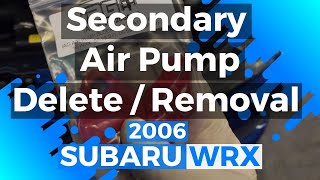
- Subaru Impreza WRX/STI (2008-2014) — Valves seize due to moisture corrosion. Owners overwhelmingly opt for an 'Air Pump Delete Kit' and ECU tune for a permanent off-road fix.
- Chevrolet / GMC Silverado / Sierra / Tahoe (1999-2013) — The exhaust manifold check valve fails, allowing hot exhaust to melt rubber hoses and destroy the air pump.
- BMW 3-Series / 5-Series (1999-2006) — Fender-mounted pumps ingest water from deep puddles. The plastic check valve also becomes brittle and cracks.
- Audi / Volkswagen A4 / Jetta / GTI (2000-2008) — Caused by failing vacuum lines to the 'Kombi' valve, carbon buildup in the cylinder head, or a failing air pump.
Manufacturer-Specific Notes
- Toyota/Lexus: The failure is systemic: moisture enters fender-mounted air pumps, shredding the internal filter. Debris blows into valves buried under the intake manifold. Dealerships quote $2,500-$4,000+ for the full repair.
- Subaru: On turbocharged models, moisture corrodes and seizes the valves. The community standard fix is removing the system with an 'Air Pump Delete Kit' and disabling codes via a custom ECU tune.
- General Motors (Chevrolet/GMC): The primary failure point is the exhaust manifold check valve. It fails to close, allowing hot exhaust to melt rubber hoses and destroy the air pump.
- BMW: The secondary air pump sits low in the front fender, making it highly susceptible to water ingestion from deep puddles, which destroys the motor.
Real Owner Stories
2013 Toyota Tacoma with P2440 & P2442
Bought the truck used, and within two weeks it threw P2440 and P2442 codes, entering limp mode.
What they tried:
- Declined a $2,800 mechanic quote to replace the pump and valves.
- Bought a new valve and had a mobile mechanic install it for $100.
- The codes returned less than a month later.
Outcome: The owner realized driving with stuck valves destroyed the internal pressure sensors. The successful fix required a full bypass kit with a pressure sensor add-on.
Lesson: Replacing a stuck valve is a temporary fix. If the code returns, the root cause is debris from the air pumps or a heat-damaged pressure sensor.
2011 Toyota Tundra 5.7L with P2442
Check Engine Light, flashing 4LO, and Traction Control lights illuminated, forcing the truck into limp mode.
What they tried:
- Cleared the code repeatedly, but it kept returning.
- Sought a cost-effective alternative to a massive dealer repair bill.
Outcome: Forum members advised that the entire system fails from moisture. The owner installed a full bypass kit as a permanent solution.
Lesson: On Tundras, failure of one component indicates the entire system is compromised. Addressing only the triggered part leads to repeat failures.
2010 Subaru WRX STI with P2442
At 67,000 miles, the car threw a P2442 code. The owner reset it with a Cobb AccessPort, but it returned in days.
What they tried:
- Researched the issue and found dealership repair estimates exceeded $1,000.
Outcome: The owner installed air pump block-off plates and used Cobb AccessTuner software to permanently disable the codes in the ECU.
Lesson: For Subaru WRX/STI models, a 'delete and tune' solution is far more cost-effective and durable than replacing failure-prone factory parts.
2012 Toyota Tundra with P2440 after water exposure
Truck threw a P2440 code immediately after driving through deep water. Repair estimates ranged from $1,500 to $3,000.
What they tried:
- Dealer held the truck for two days attempting to get a warranty extension, which was denied.
Outcome: When the owner picked up the truck, it ran perfectly. The system had simply dried out over 48 hours.
Lesson: If the code appears immediately after heavy rain or deep puddles, park the vehicle in a dry place for 48 hours before authorizing expensive repairs.
How to Prevent This Code From Triggering
- Install a pre-filter on the air pump intake (Once) — Adding a hydrophobic foam filter (like Uni-Filter UP-107) to the intake snorkel prevents moisture from entering fender-mounted pumps.
- Clean the air pump's internal foam filter (Every 30,000 miles) — Cleaning or replacing the internal filter prevents it from disintegrating and clogging the expensive switching valves.
- Avoid driving through deep standing water (Daily habit) — Air pumps sit low in the fender wells. Submerging them forces water into the system, leading to corrosion and freezing.
- Ensure one-way check valves are functional (During exhaust work) — Leaking check valves allow hot, moist exhaust gas to flow backward, causing condensation to settle and seize the pump.
Frequently Asked Questions
Can I just clear the P2442 code and keep driving?
You can clear the code, but it returns on the next cold start. Repeatedly clearing it allows hot exhaust to flow backward, destroying the pressure sensor, air pump, and ECM. This turns a moderate repair into a multi-thousand dollar disaster.
I replaced the switching valve, but the code came back. What's wrong?
This is a classic misdiagnosis where the stuck valve was just a symptom. The root cause is usually the secondary air pump's filter disintegrating and sending debris to jam your new valve. You must inspect and replace contaminated air pumps when replacing a valve.
What is the difference between Bank 1 and Bank 2?
On a V-shaped engine, the banks are the two rows of cylinders. 'Bank 1' contains cylinder #1, while 'Bank 2' is the opposite side. For most Toyota/Lexus and GM V8s, Bank 2 is the passenger side, whereas on Subaru flat engines, it is the driver's side.
Why is the repair so expensive at the dealership?
The official dealership procedure requires replacing both air pumps and both switching valves to prevent repeat failures, with parts alone exceeding $1,000. Furthermore, on trucks like the Tundra, the valves are buried under the intake manifold. This requires 6-10 hours of intensive labor.
Is it safe to drive in 'limp mode'?
No, driving in limp mode is unsafe for normal traffic. Your speed and acceleration are severely limited, making merging or climbing hills dangerous. Only drive the vehicle slowly to a safe location or directly to a repair shop.
What is a bypass kit and is it legal?
A bypass kit is an electronic module that tricks the ECU into thinking the injection system works perfectly, preventing limp mode. While cost-effective, it disables a required emissions device and is illegal for on-road use in most jurisdictions. It will also cause you to fail a visual emissions inspection.
Can a weak battery cause a P2442 code?
A weak battery causes low system voltage (below 11V), which triggers spurious codes in the ECM. While not the primary cause of P2442, it contributes to electrical anomalies. Always test your battery and charging system before replacing expensive emissions components.
Key Takeaways
- Code P2442 triggers when the Bank 2 Air Switching Valve gets physically jammed open, most often by black, sticky debris from a disintegrated air pump filter.
- Driving with an active P2442 code forces the vehicle into a dangerous 'limp mode' that caps your speed at 40 mph and risks melting your catalytic converters.
- Dealerships typically quote $2,500 to $4,000+ for this repair because the official fix requires replacing both air pumps and both valves, which are buried under the intake manifold.
- Never replace a stuck switching valve without also inspecting the air pumps; installing a $300 new valve into a contaminated system guarantees it will fail again within weeks.
- Installing a $300-$500 electronic bypass kit is the most popular permanent fix for out-of-warranty Toyota and Subaru vehicles, though it is restricted to off-road use.
Helpful Videos



The information in this article is provided for general reference and educational purposes only. Vehicle specifications, procedures, and part compatibility can vary by production date, trim level, and region. Always consult your vehicle's factory service manual and verify part numbers before purchasing or performing repairs. Safety-critical components such as airbags, seat belts, and braking systems should be installed by a qualified professional.
- 🎬 Helpful Videos
- What Does P2442 Mean?
- Can I Drive With P2442?
- Common Causes
- Symptoms
- Diagnostic Flowchart
- Common Fixes & Costs
- Used vs. New Parts: Buying Guide
- What Happens If You Wait — Timeline
- Cost of Not Fixing It
- Diagnosis Steps
- When This Code Triggers (Freeze-Frame Conditions)
- Related Codes
- Climate & Environmental Factors
- How to Talk to a Mechanic About This Code
- Where to Take It: Dealer vs Independent vs Chain
- When to Walk Away From the Repair
- What Scan Tool You Need for This Code
- How to Clear the Code After You Fix It
- Will This Fail Emissions / State Inspection?
- Most Commonly Affected Vehicles
- Manufacturer-Specific Notes
- Real Owner Stories
- 2013 Toyota Tacoma with P2440 & P2442
- 2011 Toyota Tundra 5.7L with P2442
- 2010 Subaru WRX STI with P2442
- 2012 Toyota Tundra with P2440 after water exposure
- How to Prevent This Code From Triggering
- Frequently Asked Questions
- Can I just clear the P2442 code and keep driving?
- I replaced the switching valve, but the code came back. What's wrong?
- What is the difference between Bank 1 and Bank 2?
- Why is the repair so expensive at the dealership?
- Is it safe to drive in 'limp mode'?
- What is a bypass kit and is it legal?
- Can a weak battery cause a P2442 code?
- Key Takeaways
- 🎟️ Get 5% Off