

P2440 on 2018-2020 Volkswagen Golf 1.4T: Secondary Air Valve Stuck Open Causes and Fixes
For the 2018-2020 VW Golf 1.4T, code P2440 usually points to a cracked plastic hose in the Secondary Air Injection (SAI) system or a faulty SAI pressure sensor. The corrugated hose becomes brittle from engine heat and is the most common failure point. A replacement hose is a common DIY fix, and an OEM part costs around $70-$100.
- P2440 on your Golf 1.4T means the secondary air injection valve is thought to be stuck open.
- Before buying any expensive parts, carefully inspect the corrugated plastic hose (part # 1K0-131-128-D) for cracks, as this is the most common and cheapest fix.
- The vehicle is safe to drive, but you will fail an emissions test and should repair it to maintain long-term engine health.
- Other common causes include a faulty pressure sensor or a carbon-clogged switching valve.
- A proper diagnosis involves listening for the pump on a cold start and checking for air leaks before testing electrical components.
What's Unique About the 2018-2020 Volkswagen GOLF
While many modern small-displacement turbo engines have done away with traditional Secondary Air Injection (SAI) systems, the 1.4T EA211 engine in the Mk7.5 Golf retains it to meet stringent emissions standards. On this platform, the system's components, particularly the corrugated plastic hoses, are known to become brittle and crack over time due to engine bay heat cycles. This leads to pressure leaks that the engine computer misinterprets as a stuck-open valve. This makes checking the hoses the most critical first step, often before suspecting the more expensive valve itself. Some aftermarket intake systems for this engine even require a separate breather filter for the SAI system.
Diagnostic Flowchart
Tap your situation to follow the diagnostic path that matches what you're seeing on this vehicle.
Symptoms You May Notice
- Check Engine Light is on
- Vehicle will not pass an emissions inspection
- Audible vacuum cleaner-like noise from the SAI pump for a minute after a cold start (this is normal operation, but its absence could indicate a pump or fuse problem)
- Slightly rough running or altered engine note during the first minute after a cold start
- A faint hissing or air rushing sound from the engine bay if a hose is cracked
- Replacing the switching (combi) valve when the actual problem is a simple cracked hose. The leak causes a pressure reading that mimics a stuck valve, leading to 🎬 Watch: How to diagnose and fix the P2440 code unnecessary replacement of the more expensive component.
- Replacing the SAI pump when the issue is a clogged passage or a leak elsewhere in the system.
- Installing an incorrect sensor, such as a MAP sensor, that has the same physical connection but different operating characteristics as the correct SAI pressure sensor.
Most Likely Causes
- Cracked Secondary Air Injection Hose 🔴 High Probability The corrugated plastic hose connecting the SAI pump to the combi valve is exposed to high engine bay temperatures, causing it to become brittle and crack over time, creating a leak. This is the most common point of failure for the P2440 code on this platform.
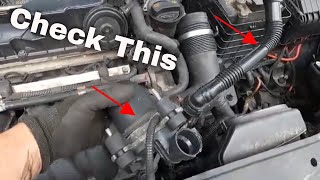
How to confirm: With the engine cool, visually inspect the plastic hose that runs from the SAI pump (a black, round, fan-like unit) to the engine. Flex the hose gently to reveal any hidden cracks, especially at the bends and connection points. A smoke machine test is the definitive way to find leaks. You can also run the pump via a scan tool and listen/feel for escaping air.
Typical fix: Replace the cracked hose. This is typically a straightforward repair requiring minimal tools.
Est. part cost: $70-$100 - Faulty Secondary Air Injection Pressure Sensor 🟡 Medium Probability The pressure sensor reports the system's performance to the PCM. An incorrect reading from a failed sensor can trick the computer into thinking the valve is stuck open. VW has issued updated versions of this sensor for various models, suggesting the original designs were prone to failure. Sometimes, the replacement sensor is a different design and comes with a jumper harness. 🎬 See how to replace and verify the SAI pressure sensor
How to confirm: Test the sensor's voltage output using a multimeter and compare it to the manufacturer's specifications. A professional scan tool can also read the live data from the sensor to check for plausible values during pump operation. For example, with the key on and engine off, the voltage might be ~2.9V, rise to ~3.3V-3.5V when the pump runs, and change when the valve opens.
Typical fix: Replace the SAI pressure sensor. Some replacement kits may include an updated wiring harness adapter.
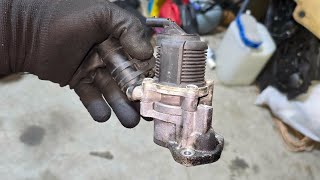
Est. part cost: $50-$90 - Stuck or Clogged SAI Switching Valve (Combi Valve) 🟡 Medium Probability Carbon deposits from the exhaust can build up in the valve, causing it to stick open mechanically. Moisture in the system, often from a failed pump allowing water ingress, can also lead to corrosion and failure.
How to confirm: Remove the valve and inspect it for carbon buildup and free movement. You can try to clean it, but replacement is often necessary if it's seized. The valve's solenoid can also be tested by applying power and ground with a tool like a Power Probe and listening for a distinct click. The solenoid resistance should be between 3 and 6 ohms.
Typical fix: Clean or replace the secondary air injection switching valve.
Est. part cost: $150-$250 - Failed Secondary Air Injection Pump ⚪ Low Probability The pump motor can fail, but this usually results in 'insufficient flow' codes (like P0491) rather than a 'stuck open' code. However, if the pump fails to create the expected pressure change, it can sometimes be misinterpreted by the PCM. The pump housing itself can also crack and leak.
How to confirm: On a cold start, listen for the pump running for the first 60-90 seconds. It should sound like a loud vacuum cleaner. If there is no sound, check the fuse (S131, 50A), relay (J299), and wiring to the pump. If it runs but sounds weak or rattles, the pump may be failing.
Typical fix: Replace the secondary air injection pump.
Est. part cost: $200-$400
Rare But Worth Checking
- Wiring or Connector Issue: A damaged wire or corroded connector for the switching valve, pressure sensor, or pump can cause an incorrect signal or lack of power, leading to the P2440 code. Always inspect the wiring harness when replacing a component.
- Powertrain Control Module (PCM) Fault: In very rare cases, the fault may lie within the PCM itself. This should only be considered after all other possibilities have been thoroughly exhausted and confirmed with professional diagnostic tools.
Diagnosis Steps
- Read the code with an OBD-II scanner and confirm P2440 is present. Note any other stored codes.
- On a cold engine (left overnight), start the car and listen for the SAI pump. It should run for about 60-90 seconds and sound like a vacuum cleaner.
- If the pump runs, visually inspect the corrugated plastic hose (Part No. 04E-131-128-F or similar) for any cracks or breaks. Pay close attention to the bends and the connection point at the combi valve.
- If a leak is suspected but not visible, use a smoke machine to pressurize the system and see where smoke escapes. This is the most effective method.
- If hoses are intact, inspect the wiring and connectors for the SAI switching valve and pressure sensor for any damage or corrosion.
- Using a scan tool with live data (like VCDS), monitor the SAI pressure sensor (G609) voltage. Key on, engine off should be around 2.9V. With the pump activated via an output test, it should rise to ~3.3V-3.5V.
- Test the Combi Valve (N112) solenoid. With the connector unplugged, measure resistance across the two pins. It should be 3-6 ohms. Check for battery voltage (~12V) at one pin of the connector with the key on.
- If the valve is suspected, remove it to inspect for heavy carbon buildup that could cause it to stick. Test the solenoid by applying 12V to see if it actuates with a click.
- If all other components check out, verify the correct part number is installed for the SAI pressure sensor. An incorrect but physically compatible sensor can cause this code.
Parts You'll Likely Need
- Secondary Air Injection Pump Hose
(OEM #04E-131-128-F)— This plastic hose is the most common failure point. It becomes brittle from engine heat and cracks, causing a leak that the system interprets as a stuck valve.
Trusted brands: Volkswagen Genuine
OEM price range: $70-$100
Aftermarket price range: $40-$60 - Secondary Air Injection Pressure Sensor
(OEM #06L-906-052-A)— This sensor provides the pressure reading to the computer. A faulty sensor can send an incorrect signal, triggering the code. An updated version may be available.
Trusted brands: Bosch, Volkswagen Genuine
OEM price range: $60-$90
Aftermarket price range: $30-$50 - Secondary Air Injection Switching Valve (Combi Valve)
(OEM #04E-131-823-C)— The valve itself can fail mechanically due to carbon buildup or electrically due to a failed solenoid.
Trusted brands: Pierburg, Volkswagen Genuine
OEM price range: $200-$300
Aftermarket price range: $100-$180
Related Codes That Often Appear With This One
- P0491 — P0491 (Secondary Air Injection System Insufficient Flow) can appear if the SAI pump is weak or there's a major leak, which can sometimes be related to the conditions that trigger P2440.
- P0411 — Similar to P0491, this code indicates incorrect flow in the SAI system and points to a general system fault that could be related to a stuck valve or a leak.
- P04F0 — P04F0 (EVAP System Incorrect Purge Flow) has been noted in VW service documents alongside other emissions codes, including P2440, for the 1.4T engine, suggesting a potential related diagnostic path.
Technical Service Bulletins (TSBs) & Recalls
- VIN4APIN20200617 - Confirms that P2440 is a fault code that can be reported on this vehicle.
- VIN4APIN20200413 - Also confirms P2440 as a possible reported fault on Jetta/Golf family vehicles with the 1.4T engine.
Platform-Specific Known Issues
- The TSBs VIN4APIN20200617 and VIN4APIN20200413 issued by Volkswagen list P2440 among a large group of other potential trouble codes for a 'MIL-on' customer complaint on this vehicle, indicating it is a known fault code for this platform.
Mechanic-Grade Diagnostic Values
- SAI Switching Valve (Combi Valve / N112) Solenoid Resistance — expected: 3 to 6 Ohms. Failure: An infinite reading (open circuit) or zero ohms (short circuit) indicates a failed solenoid.
- SAI Switching Valve (Combi Valve / N112) Connector Voltage — expected: ~12V (Battery Voltage) at one pin with Key On, Engine Off. Failure: No voltage suggests a wiring break, blown fuse, or faulty relay upstream.
- SAI Pressure Sensor (G609) Signal Voltage — expected: Approximately 2.9 VDC with engine off/SAI pump off. Voltage should rise to 3.3V - 3.5V when the pump runs.. Failure: Voltage that is stuck at 0V or 5V, or does not change when the pump is activated, suggests a failed sensor or wiring issue.
Hidden / Shadow Codes Worth Checking
- 18872: This is the VAG-specific fault code that corresponds to the generic OBD-II code P2440. (see via This code is visible using VW/Audi specific diagnostic tools like VCDS (VAG-COM) by Ross-Tech.)
Scan Tool Commands That Help
- VCDS (VAG-COM) or ODIS: Output Tests (or Functional Tests / Actuator Tests) — Use this function to command the Secondary Air Pump and Switching Valve (Combi Valve) to activate independently of a cold start. This allows a technician to listen for pump operation, feel for air leaks, and check for the valve's clicking sound to confirm mechanical function.
- VCDS (VAG-COM) or other advanced scanner: Basic Settings > Readiness Codes > End of Line Check — This function forces the vehicle to run through its entire emissions self-check cycle while stationary (with foot on brake and accelerator). This can be used to verify a fix and confirm the SAI system runs as expected without having to wait for a natural cold start.
Wiring & Ground Locations
- J299 — This is the relay for the Secondary Air Injection pump. On many VW platforms, it is located in the engine bay, under a cover near the bulkhead (firewall) on the left side.. If the SAI pump does not run at all (no vacuum cleaner sound on cold start), this relay could be faulty. A stuck-closed relay prevents the pump from turning on, while a stuck-closed relay could cause it to run continuously.
- S131 — This is the 50A fuse for the SAI pump circuit, typically located in the main fuse box on or near the battery.. A blown fuse will prevent the SAI pump from running, leading to 'insufficient flow' codes, but should be checked as part of a full system diagnosis if the pump is inoperative.
- N112 — This is the VAG component identifier for the Secondary Air Injection Switching Valve (Combi Valve) solenoid.. This is the solenoid that is commanded by the ECU to open and close the valve. P2440 directly relates to the state of this valve.
Real Owner Repair Stories
- YouTube user 'Bahador T', video on VW 2.0T (2012 Volkswagen (2.0T engine)) — Check Engine Light with code P2440.
❌ Tried (didn't work) Initially found a cracked hose and attempted a temporary repair with glue and tape, but the code likely remained.
✅ What actually fixed it The final fix involved removing and cleaning the combi valve of carbon deposits. The user also tested the valve's solenoid, which measured 6 ohms, and confirmed it clicked when 12V was applied, proving the valve was functional after cleaning. - YouTube user 'Piston FPV' (Volkswagen Jetta) — Check Engine Light with secondary air system codes.
❌ Tried (didn't work) The previous owner or mechanic had replaced the SAI pressure sensor, but the code returned.
✅ What actually fixed it The technician discovered that the replacement sensor, while physically identical and fitting perfectly, was actually a Manifold Absolute Pressure (MAP) sensor for a different VW engine. It had the wrong part number and operating parameters. Installing the correct SAI pressure sensor resolved the issue.
"I Checked Everything" — The Actual Cause
- A known misdiagnosis pattern occurs when a technician replaces the SAI pressure sensor with a visually identical but incorrect part, such as a standard MAP sensor. A smoke test on the system would show no leaks, and the wiring would check out, but the P2440 code would persist because the incorrect sensor sends plausible but inaccurate pressure data to the ECU, tricking it into thinking the valve is stuck open.
OEM Part Supersession History
6e906052, 6k906052, 6l906052→06L-906-052-A— Part number consolidation and potential design revision for the Secondary Air Injection Pressure Sensor.
Heads up: While these part numbers are superseded, VW has also been known to release service kits for other models that include a new sensor design AND an adapter harness, indicating a connector change. Always verify the part number and connector type for your specific vehicle.
Helpful Videos
Used OEM Parts in Stock

New Aftermarket Parts Available


The information in this article is provided for general reference and educational purposes only. Vehicle specifications, procedures, and part compatibility can vary by production date, trim level, and region. Always consult your vehicle's factory service manual and verify part numbers before purchasing or performing repairs. Safety-critical components such as airbags, seat belts, and braking systems should be installed by a qualified professional.
- Volkswagen GOLF:
- 🎬 Helpful Videos
- 🛍️ Shop This Part
- What's Unique About the 2018-2020 Volkswagen GOLF
- Diagnostic Flowchart
- Symptoms You May Notice
- Most Likely Causes
- Rare But Worth Checking
- Diagnosis Steps
- Parts You'll Likely Need
- Related Codes That Often Appear With This One
- Technical Service Bulletins (TSBs) & Recalls
- Platform-Specific Known Issues
- Mechanic-Grade Diagnostic Values
- Hidden / Shadow Codes Worth Checking
- Scan Tool Commands That Help
- Wiring & Ground Locations
- Real Owner Repair Stories
- "I Checked Everything" — The Actual Cause
- OEM Part Supersession History
- 🎟️ Get 5% Off