

P2440 on 2010-2017 Volkswagen Golf: Secondary Air Valve Stuck Open Causes & Fixes
On a 2010-2017 VW Golf, code P2440 almost always points to a problem with the Secondary Air Injection (SAI) system. The most common fixes are replacing a cracked plastic air hose or replacing the SAI combi valve itself. In some cases, an ECM software update may be required. Expect to pay $50-$400 for parts, with DIY being a manageable task for many owners.
- P2440 means the secondary air injection valve is stuck open.
- Before buying any expensive parts, thoroughly inspect all plastic hoses connected to the air pump and valve for cracks or breaks.
- The most common fixes are replacing a cracked hose or the combi valve itself.
- In some cases, the problem may be a software glitch that requires a dealer to perform an ECM update.
- The vehicle is safe to drive in the short term, but the issue should be addressed to prevent future damage to emissions components and to pass inspections.
What's Unique About the 2010-2017 Volkswagen GOLF

On the Mk6 and Mk7 Golf generations with the 2.0T and 2.5L engines, the P2440 code is a relatively common issue. The components, particularly the corrugated plastic hoses and the combi valve, are known to become brittle and fail over time due to constant heat cycles. Forum discussions frequently point to cracked or disconnected hoses as a primary, and often overlooked, cause. Additionally, Volkswagen has issued Technical Service Bulletins (TSBs) that involve software updates for the Engine Control Module (ECM) to address erroneous P2440 faults, indicating that the issue can sometimes be software-related rather than a purely mechanical failure.
🎬 Watch: A complete diagnostic and repair walkthrough for code P2440.Diagnostic Flowchart
Tap your situation to follow the diagnostic path that matches what you're seeing on this vehicle.
Generation note: This range covers the Golf Mk6 (2010-2014) and the Golf Mk7 (2015-2017). The fundamental design of the Secondary Air Injection system is similar across these generations, particularly on the 2.0T and 2.5L engines, but specific part numbers for valves and hoses may differ. The failure modes (cracked hoses, faulty valves) are common to both. However, not all Mk7 models are equipped with an SAI system, as its inclusion can depend on the specific engine and market.
Symptoms You May Notice
- Check Engine Light is on
- Audible vacuum leak or 'whooshing' sound from the engine bay, especially when cold.
- A noise similar to a vacuum cleaner running for an extended period (or being louder than usual) after a cold start.
- Rough idle or hesitation, especially when the engine is cold.
- Vehicle may enter a reduced power "limp mode" in some cases.
- Failing a state emissions inspection.
- Replacing the oxygen sensor because of the effect on air/fuel readings.
- Replacing the catalytic converter when the issue is upstream in the SAI system.
- Confusing the SAI combi valve with the intake manifold runner control valve, which can look similar and be located nearby.
Most Likely Causes

- Cracked or Disconnected Secondary Air Injection Hose 🔴 High Probability The corrugated plastic hoses used in the SAI system become brittle from engine heat and age, leading to cracks and leaks. This is a very common failure point mentioned by owners in forums as the first thing to check.
How to confirm: Visually inspect the plastic hose that runs from the SAI pump (often located near the front of the engine bay, sometimes behind the passenger side fog light) to the combi valve on the cylinder head. Look for obvious cracks, especially at bends and connection points. Wiggling the hose while the pump is running (using a scan tool to activate it) can help reveal leaks.
Typical fix: Replace the damaged hose. A temporary repair with high-temperature tape may work but is not a permanent solution.
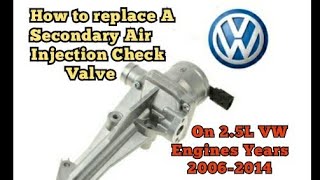
Est. part cost: $50-$100 - Faulty Secondary Air Injection (Combi) Valve 🟡 Medium Probability The valve can get stuck open due to carbon buildup or internal diaphragm failure. If it remains open, it can allow hot exhaust gases and moisture to flow backward into the SAI pump, causing pump failure as well.
How to confirm: With the engine cold, start the car and listen for the SAI pump. After the pump shuts off (60-90 seconds), check if air is still being drawn through the system or if exhaust is flowing back out of the pump's intake. A vacuum pump can be used to test if the valve holds vacuum when commanded closed. You can also test the solenoid's resistance with a multimeter (should be around 3-6 ohms) and apply 12V to see if it clicks.
Typical fix: Replace the Secondary Air Injection valve and gasket. Cleaning the valve with carburetor cleaner is sometimes successful but often a temporary fix.
Est. part cost: $150-$300 - Failed Secondary Air Injection Pump ⚪ Low Probability The pump can fail, often due to moisture getting inside from a faulty combi valve or check valve, leading to corrosion and seizure. While it can cause SAI system codes, it's more often associated with 'insufficient flow' codes (P0411, P0491) rather than 'stuck open' (P2440).
How to confirm: Listen for the pump to run during the first 30-90 seconds of a cold start. It should sound like a small vacuum cleaner. If it doesn't run, check the fuse (often a 40A fuse in the engine bay fuse box, such as F27) and relay before condemning the pump.
Typical fix: Replace the SAI pump.
Est. part cost: $200-$450 - Erroneous ECM Software ⚪ Low Probability
How to confirm: This can only be confirmed by a Volkswagen dealer or a qualified shop with access to VW's service bulletins. If no mechanical or electrical faults are found, checking for an available software update is the next step. TSB V011514 (NHTSA ID 10058097) specifically mentions that P2440 (especially with P0491) should not be diagnosed by replacing parts until after the ECM update is performed.
Typical fix: Update the Engine Control Module (ECM) software to the latest version. This must be done by a dealer or authorized specialist.
Est. part cost: $0-$200
Rare But Worth Checking
- Wiring or Connector Issue: A damaged wire or corroded connector for the SAI combi valve's solenoid can prevent it from receiving the signal to close. Check for 12V at the connector with the key on before replacing the valve.
- Faulty SAI Pressure Sensor: The ECM uses a pressure sensor to verify the operation of the SAI system. If this sensor provides an incorrect reading (e.g., showing pressure when there is none), it can falsely trigger a P2440 code. This sensor is often located on the SAI valve or nearby plumbing.
Diagnosis Steps
- Read the fault codes with an OBD-II scanner to confirm P2440 is present.
- On a completely cold engine, start the car and listen for the SAI pump. It should run for 30-90 seconds and sound like a vacuum cleaner. If it doesn't, check the associated fuse (e.g., F27 in engine bay fuse box) and relay before proceeding.
- If the pump runs, carefully inspect all corrugated plastic hoses connected to it and the combi valve for cracks, brittleness, or disconnection. This is a very common failure point. Pay close attention to bends and connection points.
- After the pump has shut off, check if air is still flowing into the combi valve or if exhaust is leaking back out. If flow is detected in either direction, the valve is stuck open.
- Test the combi valve's solenoid. Unplug the connector and check for 12V power at the harness with the key on. Use a multimeter to check the resistance across the valve's two pins; a reading of 3-6 ohms is typical. Applying 12V directly to the pins should produce an audible click.
- If the valve clicks but is still suspected of being stuck internally, remove it for inspection. It is held on by three or four bolts (often T30 Torx). Check for carbon buildup preventing the valve from seating.
- If all mechanical and electrical parts seem to work correctly, consult a dealer or specialized shop about a potential ECM software update as mentioned in VW TSB V011514 (NHTSA ID 10058097), which advises performing this update before replacing any parts for a P2440 code.
Parts You'll Likely Need

- Secondary Air Injection (Combi) Valve
(OEM #06J131120B (For 2.0T TSI, check VIN for exact fitment))— This valve is the component identified by the code itself. It fails by sticking open due to carbon buildup or internal wear.
Trusted brands: Bosch, Pierburg (often the OEM supplier), Genuine Volkswagen
OEM price range: $200-$350
Aftermarket price range: $120-$250 - Secondary Air Injection Hose/Pipe
(OEM #1K0131128D (Common for Mk6 2.0T, check VIN for exact fitment))— The plastic material becomes brittle with age and heat cycles, leading to cracks that cause the system to register a fault.
Trusted brands: Genuine Volkswagen
OEM price range: $50-$100
Aftermarket price range: $30-$70 - Combi Valve Gasket
(OEM #06J131120B (Often included with a new valve))— This gasket seals the combi valve to the cylinder head. It is critical to replace this whenever the valve is removed to prevent exhaust leaks.
Trusted brands: Genuine Volkswagen, Victor Reinz
OEM price range: $10-$25
Aftermarket price range: $5-$15
Related Codes That Often Appear With This One
- P0491 — This code means 'Secondary Air Injection System Insufficient Flow'. It can appear alongside P2440 if there's a combination of a leak (causing incorrect pressure readings that might trigger P2440) and a weak pump or other restriction. A VW TSB specifically links these two codes to a potential software issue that should be addressed before replacing parts.
- P0411 — This is another 'Incorrect Flow Detected' code for the SAI system and can be triggered by the same underlying faults as P2440, such as major leaks or a faulty valve.
- P0300-P0304 — Misfire codes can occasionally accompany P2440, especially if the unmetered air from the stuck valve is significantly disrupting the air/fuel mixture during closed-loop operation. VW TSB 01-19-02 lists P2440 along with multiple misfire codes as being potentially resolved by an ECM software update.
Technical Service Bulletins (TSBs) & Recalls

- VIN4APIN20200617: Mentions P2440 as a possible code for a MIL-on complaint on Volkswagen models.
- NHTSA ID 10163623 (VW 01-19-02 / 2054615): Lists P2440 as a fault that can be caused by erroneous ECM software on 2018 Tiguan models with the 2.0T DGUA engine, recommending a software update. This shows the issue's relevance on the newer EA888 engine platform.
- NHTSA ID 10058097 (VW V011514): Addresses P0491 and P2440 being stored in ECM memory due to a software issue, requiring an update.
- NHTSA ID 10161711 (VW V011901_2054613): Another TSB for 2019 Tiguans linking P2440 with other codes to an erroneous software fault requiring an update.
Platform-Specific Known Issues
- Volkswagen has released Technical Service Bulletins (TSBs) for certain models/years where an ECM software update is required to fix an erroneously triggered P2440 fault.
- On the 2.5L 5-cylinder engine, the combi valve is located in a similarly accessible position on the cylinder head, and replacement follows a similar procedure of removing hoses and mounting bolts.
- For off-road use, some owners opt to install an SAI block-off plate and have the system coded out of the ECU to prevent future issues, though this will cause an emissions test failure.
Mechanic-Grade Diagnostic Values
- Combi Valve Solenoid Resistance — expected: 3 to 6 Ohms. Failure: A reading of 0 Ohms (short circuit) or infinite/OL (open circuit) indicates a failed solenoid.
- Combi Valve Solenoid Connector Voltage — expected: 12V (battery voltage) on the power wire with Key On, Engine Off.. Failure: No voltage suggests a wiring issue or a blown fuse.
Scan Tool Commands That Help
- VCDS (VAG-COM) / ODIS: Engine -> Output Tests (03) — To individually command the Secondary Air Injection pump and the Combi Valve solenoid to activate. This confirms if the components are capable of being controlled by the ECM and helps isolate an electrical vs. mechanical failure.
- VCDS (VAG-COM) / ODIS: Engine -> Basic Settings (04) -> Group 077 — To initiate the SAI system's self-test sequence. This forces the system to run and allows the tech to observe its operation and see if it passes or fails the readiness monitor test.
Wiring & Ground Locations
- Engine Bay Fuse Box — Located in the engine compartment, typically on the right side (driver's side in LHD vehicles) near the battery.. This box contains the main fuse and relay for the Secondary Air Injection pump. For a 2012 Golf, fuse F27 (a 40A fuse) is often designated for the SAI pump.
- SAI Pump Relay — Located within the engine bay fuse box alongside the main fuses.. A failed relay will prevent the SAI pump from running at all, which can sometimes be misdiagnosed or lead to other SAI system codes.
Real Owner Repair Stories
- Reddit user on r/GolfGTI (2011 VW GTI Autobahn) — P2440 code appearing intermittently.
❌ Tried (didn't work) Initial diagnosis was uncertain.
✅ What actually fixed it The hose coming off the secondary air pump was completely disconnected due to a broken clip. Reconnecting the hose resolved the code. - YouTube channel 'THE EASIEST WAY TO FIX' (2012 Volkswagen (model appears to be a Jetta/Golf family vehicle with 2.0T engine)) — Check Engine Light with code P2440.
❌ Tried (didn't work) A smoke test revealed a cracked SAI hose, which was taped as a temporary repair, but the code returned.
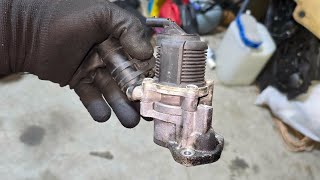
✅ What actually fixed it The combi valve was removed (3 bolts) and found to be stuck with carbon. The valve and passages were thoroughly cleaned with carburetor cleaner. The solenoid was tested and found to be good (6 Ohms). After cleaning and reinstallation, the code was fixed without replacing the expensive valve.
"I Checked Everything" — The Actual Cause
- In some cases, a smoke test of the secondary air hoses will show no leaks, yet the system fails. This can happen when the combi valve itself is mechanically stuck open internally due to carbon buildup; it's not leaking to the atmosphere, but it's allowing air to pass through when it shouldn't. The fix is to remove and clean or replace the valve.
- A more severe and harder-to-diagnose scenario is when all external components pass tests (no leaks, pump runs, valve clicks), but flow codes persist. The root cause can be clogged air passages (ports) inside the cylinder head itself, which a smoke test will not reveal.
When the Usual Fixes Don't Work
- While part failure is common, VW issued a Technical Service Bulletin (V011514 / NHTSA 10058097) that strongly advises against replacing any components for a P2440 code (especially when paired with P0491) until an ECM software update has been performed. This suggests that in a significant number of cases, the fault logic within the computer is the root cause, not a mechanical failure. This contradicts the immediate impulse to replace the combi valve or look for cracked hoses.
Model Year Variations Within This Range
- 2015-2017 (Mk7): The Mk7 Golf is based on the new MQB platform and is lighter than the Mk6. While many North American 2.0T engines continued to use a Secondary Air Injection system, its presence is not guaranteed across all trims and markets for the Mk7 generation. Some models, like the Golf R, may not have an SAI system at all. General reliability is considered to be improved on the Mk7 platform.
Helpful Videos
We Have This Part in Stock



The information in this article is provided for general reference and educational purposes only. Vehicle specifications, procedures, and part compatibility can vary by production date, trim level, and region. Always consult your vehicle's factory service manual and verify part numbers before purchasing or performing repairs. Safety-critical components such as airbags, seat belts, and braking systems should be installed by a qualified professional.
- Volkswagen GOLF:
- 🎬 Helpful Videos
- 🛍️ Shop This Part
- What's Unique About the 2010-2017 Volkswagen GOLF
- Diagnostic Flowchart
- Symptoms You May Notice
- Most Likely Causes
- Rare But Worth Checking
- Diagnosis Steps
- Parts You'll Likely Need
- Related Codes That Often Appear With This One
- Technical Service Bulletins (TSBs) & Recalls
- Platform-Specific Known Issues
- Mechanic-Grade Diagnostic Values
- Scan Tool Commands That Help
- Wiring & Ground Locations
- Real Owner Repair Stories
- "I Checked Everything" — The Actual Cause
- When the Usual Fixes Don't Work
- Model Year Variations Within This Range
- 🎟️ Get 5% Off