

OBD-II Code P2437: Secondary Air Injection System Air Flow/Pressure Sensor Circuit Low (Bank 2)
The Ultimate Guide to P2437: What It Means, In-Depth Diagnosis, and Pro-Level Fixes
- P2437 triggers when the Bank 2 air pressure sensor sends a voltage below 0.5V, guaranteeing an automatic emissions test failure.
- Always inspect the one-way check valve first; a failed $50 valve allows corrosive exhaust moisture to destroy the $300+ air pump and sensor.
- Check for manufacturer-specific recalls and warranties, such as the Subaru relay fire-risk recall (WTM-73) or the Toyota 10-year extended warranty (ZLA).
- Confirm a short to ground by testing the sensor signal wire with a multimeter; a reading near 0V with the key on, engine off confirms the circuit low fault.
What Does P2437 Mean?

P2437 means the Powertrain Control Module (PCM) detects a problem with the secondary air injection (AIR) system. Specifically, the pressure sensor for the engine's second bank of cylinders (Bank 2) sends a voltage signal lower than the specified range, typically under 0.5V. The AIR system pumps fresh air into the exhaust for 30-90 seconds on a cold start to burn off unburnt fuel and heat the catalytic converter faster.
Technical definition: The SAE/OBD-II definition is "Secondary Air Injection System Air Flow/Pressure Sensor Circuit Low Bank 2". The PCM registers a voltage from the Bank 2 AIR pressure sensor below its calibrated threshold (usually <0.5V). This strongly indicates a short to ground, an internal sensor failure, or a wiring harness issue.
Can I Drive With P2437?
Yes, But With Caution. Yes, you can typically drive with P2437, as it primarily affects emissions during the first 90 seconds of a cold start. However, ignoring it guarantees a failed emissions test. In recalled Subarus, a related relay failure causes the air pump to run continuously, creating a significant fire risk. For other makes, a continuously running pump melts nearby plastic or wiring. Over the long term, a non-functional AIR system accelerates catalytic converter aging, a repair costing up to $2,500.
Common Causes

- Failed or stuck-open one-way check valve (Very Common) — The check valve prevents hot exhaust gas from flowing backward. When it fails, corrosive exhaust soot and moisture enter the air pump and pressure sensor, causing electrical shorts and physical lockups. This is the root cause of most AIR system component failures.
- Damaged wiring or corroded connectors (Common) — Wires leading to the pressure sensor fray, break, or short to ground due to engine vibration. Connector pins corrode from moisture, preventing a connection and causing a permanent low voltage reading.
- Faulty Secondary Air Injection Pressure Sensor (Common) — The sensor fails from age, internal shorts, or moisture contamination from a bad check valve, sending an incorrect low voltage signal to the PCM.
- Failed Air Pump Relay or Fuse (Common) — A blown fuse disables the AIR circuit. A faulty relay sticks in the 'on' position, causing the pump to run continuously, burning out the motor and creating a fire hazard.
- Failed Secondary Air Injection Pump (Less Common) — The air pump motor seizes due to water intrusion. While this frequently triggers flow codes, the resulting high current draw or internal short triggers sensor circuit faults.
- Faulty Air Control/Switching Solenoid (Less Common) — The solenoid directing airflow gets stuck or suffers an internal electrical failure. On many vehicles, the pressure sensor is integrated into this valve assembly, triggering a sensor code when the valve fails.
- PCM or Software Failure (Rare) — The PCM's firmware has a glitch, or the internal circuit reading the sensor signal fails. Consider this only after exhaustively testing all wiring and sensors.
Symptoms
- Check Engine Light is on 🎬 See these expert tips for troubleshooting the secondary air system — The light illuminates after the system fails its self-test, which runs during a cold start.
- Failed emissions test — The secondary air injection system is a critical emissions control device. A malfunction automatically fails the OBD-II portion of an emissions inspection.
- Loud noise on cold start — A failing air pump makes a loud whining sound for 30-90 seconds after a cold start. A continuously running pump indicates a stuck relay.
- Hesitation, rough idle, or stalling on cold start — The engine runs rough, hesitates, or stalls at idle during the first minute of a cold start due to an incorrect air/fuel mixture.
Diagnostic Flowchart

Tap your situation to follow the diagnostic path that matches what you're seeing on this code.
Common Fixes & Costs
- Replace the Secondary Air Injection Check Valve — Parts: $50-$150, Labor: $50-$125, ~1.2 hr book time (DIY)
- Repair or Replace Damaged Wiring/Connector — Parts: $10-$50, Labor: $150-$400, ~2.5 hr book time (Intermediate)
- Replace the Air Flow/Pressure Sensor — Parts: $80-$300, Labor: $75-$200, ~1.5 hr book time (Intermediate)
- Replace the Secondary Air Injection Pump Assembly — Parts: $250-$800, Labor: $150-$500, ~2 hr book time (Intermediate)
- Replace Air Pump and Switching Valve Assembly (Toyota/Lexus) — Parts: $600-$1200, Labor: $800-$1500, ~8.5 hr book time (Advanced)
DIY vs Professional
- Replace the Secondary Air Injection Check Valve — Beginner: True
- Replace the Air Flow/Pressure Sensor — Beginner: False
- Repair or Replace Damaged Wiring/Connector — Beginner: False
- Replace the Secondary Air Injection Pump Assembly — Beginner: True
- Replace Air Pump and Switching Valve Assembly (Toyota/Lexus) — Beginner: False
Used vs. New Parts: Buying Guide
When a used part is worth it: Buying used electronic parts like an air pump assembly is risky. It only makes sense if the part is from a verified low-mileage vehicle wrecked for non-engine reasons and includes a warranty.
Donor-vehicle mileage cap: roughly under 50000 miles for the part to have meaningful remaining life.
Donor quality checklist:
- Verify the donor vehicle was not scrapped due to emissions failure.
- Check photos for signs of corrosion or moisture damage.
- Match the OEM part number exactly.
- Buy from a salvage yard offering at least a 90-day warranty.
Decision logic:
- If The repair involves high labor (e.g., Toyota V8 under-intake assembly) → Buy new OEM or high-quality aftermarket. The risk of paying labor twice outweighs used part savings.
- If The part is external and easy to access → A used part from a trusted source is a reasonable budget option, but new is preferred.
- If The part is a simple, non-wear item like a relay → Used is acceptable if in good condition.
Warranty tradeoff: Used parts have a 30-90 day warranty covering the part only. New aftermarket parts carry a 1-year to lifetime warranty. New OEM parts have a 1-year warranty.
Worst-case if a used part fails: $800-$1500 if a used part fails after installation on a high-labor job.
What Happens If You Wait — Timeline
- 0-1 month: Code P2437 is set, and the Check Engine Light is on. The AIR system is disabled. No drivability symptoms occur, but the car fails an emissions test. (MPG impact: 0%% · Added cost: $0)
- 1-6 months (Scenario A: Stuck Relay): A stuck relay causes the air pump to run continuously. It overheats, melts its plastic housing, damages wiring, and burns out the motor. (MPG impact: 0%% · Added cost: $300-$900)
- 3-12 months (Scenario B: Bad Check Valve): Moisture enters the system. The pressure sensor fails from corrosion. The air pump motor seizes from water damage. Repair requires a new check valve, sensor, and pump. (MPG impact: 0%% · Added cost: $400-$1500)
- 12+ months: The catalytic converter heats up too slowly on cold starts. This leads to inefficient light-off and carbon fouling, triggering catalyst efficiency codes (P0420/P0430). (MPG impact: 0-5%% · Added cost: $1200-$3500)
Cost of Not Fixing It
- Immediate: Guaranteed failure of any OBD-II emissions test. Check Engine Light remains on, masking new problems. (Added cost: $0 (beyond failed test fees))
- 1-12 months: On recalled Subarus, a stuck relay causes the air pump to run continuously, creating a fire risk. On other cars, a continuously running pump burns out and melts wiring. (Added cost: $300-$900 for pump/relay replacement.)
- 12+ months: A non-functional AIR system forces the catalytic converter to heat up slowly, leading to carbon fouling and premature failure. (Added cost: $1200-$3500 for catalytic converter replacement.)
Diagnosis Steps

- Read Codes & Check Fuses
Use an OBD-II scanner to confirm P2437 and document freeze frame data. Locate and inspect all fuses related to the secondary air injection system.
Tools: OBD-II Scanner, Vehicle Fuse Diagram (Beginner) - CRITICAL: Inspect the One-Way Check Valve
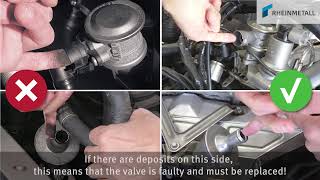
Locate the check valve between the air pump and Bank 2 exhaust manifold. Disconnect the hose. Moisture, rust, or black soot means the valve failed. Replace it before any other parts.
Tools: Pliers, Screwdriver (Intermediate) - Visually Inspect the System
Inspect the air pump, hoses, and Bank 2 sensor wiring. Look for melted hoses, loose connections, and chafed wires near hot exhaust components.
Tools: Flashlight, Inspection Mirror (Beginner) - Listen to the Air Pump
Start the engine completely cold. Listen for the air pump to run like a small vacuum for 30-90 seconds. A screeching noise means a failing pump; continuous running means a bad relay.
Tools: None (or a helper) (Beginner) - Test Pressure Sensor Circuit (KOEO)
Identify the signal, reference (5V), and ground wires. Back-probe the connector with Key On, Engine Off. A signal wire reading near 0V points directly to a short to ground or bad sensor.
Tools: Multimeter, Vehicle-specific wiring diagram (Advanced) - Check Wiring Continuity and Shorts
Disconnect the sensor and PCM. Check signal wire continuity to ground; it must read OL (Open Line). Any continuity indicates a short to ground requiring repair.
Tools: Multimeter, Vehicle-specific wiring diagram (Advanced) - Pro Tip: Command AIR Pump with Scan Tool
Bypass the cold start requirement and command the AIR pump on. Monitor live pressure sensor data; no pressure change indicates a dead pump, stuck valve, or major leak.
Tools: Bi-directional Scan Tool (Professional) - Pro Tip: Perform a Voltage Drop Test
Place one multimeter lead on the battery positive and the other on the sensor power pin with the circuit active. Readings above 0.2V indicate excessive resistance in the wiring.
Tools: Multimeter (Professional) - Advanced: Live Data PID Analysis
Monitor the 'AIR Pressure' PID. At KOEO, it should read atmospheric pressure (0 PSI gauge). When commanded on, pressure must rise quickly. Frozen or negative values confirm a circuit failure.
Tools: Advanced Scan Tool with Live Data (Advanced)
When This Code Triggers (Freeze-Frame Conditions)
- Engine Coolant Temp: 40-120°F (Cold or warming up)
- Time Since Engine Start: 10-120 seconds (Shortly after startup)
- Engine RPM: 700-1200 RPM (Idle or low RPM)
- Vehicle Speed: 0 mph (Stationary)
Related Codes
- P2432 — Identical fault (Sensor Circuit Low) for Bank 1. If both P2432 and P2437 are present, the problem is a shared component like the air pump, relay, or main power/ground.
- P0410 — General code for 'Secondary Air Injection System Malfunction'. P2437 gives a specific starting point for an electrical fault. Fixing P2437 resolves P0410.
- P0411 — Indicates a performance problem (weak pump, clogged passage). P2437 is an electrical fault. A physical blockage causing the pump to struggle triggers both.
- P2436 — Direct opposite of P2437, indicating the sensor circuit signal is too high. P2437 points to a short to ground, while P2436 points to an open circuit.
Climate & Environmental Factors
- Cold Climates: Moisture from exhaust freezes inside the air pump or lines, physically locking up the pump motor and causing it to burn out.
- High Humidity / Rust Belt: Constant moisture promotes corrosion of electrical connectors. Road salt exacerbates corrosion on check valves threaded into exhaust manifolds.
- Short Trip Driving: Short trips prevent the exhaust system from evaporating condensation. Excess water flows back past a weak check valve when the engine is off.
How to Talk to a Mechanic About This Code
Say this: "I have an OBD-II code P2437 on my [Make, Model, Year]. I'd like you to check for moisture in the air lines from the one-way check valve before recommending part replacements, and to test the sensor circuit for a short to ground."
This directs the technician to check the cheapest and most likely root cause (the check valve) first, preventing them from quoting an expensive air pump replacement without proper diagnosis.
Avoid saying:
- 'My check engine light is on, can you just fix it?'
- 'I think I need a new air pump.'
- 'Just do whatever you think is best.'
Questions to ask before authorizing the repair:
- Did you find any moisture, water, or black soot inside the air hoses when you inspected the check valve?
- If you are recommending a new sensor, did you confirm the wiring harness is not shorted to ground?
- If you are recommending a new air pump, what was the result of the check valve inspection?
- Can you provide a printout of the freeze-frame data stored with the code?
Where to Take It: Dealer vs Independent vs Chain
- Dealer:
Recommended for warranty/recall work or complex repairs. For out-of-warranty vehicles, compare quotes with an independent shop.
Best for: Vehicles under powertrain or emissions warranty., Vehicles with an active recall (Subaru relay) or warranty enhancement (Toyota Tundra)., Complex, high-labor repairs (Toyota V8 under-intake assembly).
Downsides: Highest labor rates., Often only offer full assembly replacements instead of diagnosing smaller failed components. (Typical cost: +50% vs. baseline) - Independent Shop:
Best overall fit for most P2437 repairs. They know the common failure points on domestic and Asian vehicles.
Best for: Most out-of-warranty vehicles., Diagnosing the root cause flexibly., Providing cost-effective repair options.
Downsides: Quality varies. Look for ASE-certified technicians with good electrical/emissions reviews. (Typical cost: +0% vs. baseline) - Chain Shop:
High risk, not recommended for initial diagnosis. Acceptable only if you have diagnosed the specific part and are just paying for labor.
Best for: Simple, high-volume jobs like brakes and oil changes.
Downsides: Technician skill in diagnosing electrical circuit faults is inconsistent., High risk of part-swapping at your expense. (Typical cost: -10% vs. baseline)
When to Walk Away From the Repair
If the estimated repair cost for the P2437 fault exceeds 40-50% of your car's private-party value, pause and consider alternatives.
- Car worth $9000, fix is $3500: Borderline. The repair is ~39% of the vehicle's value. Get a second opinion and investigate lower-cost options like a bypass kit before proceeding.
- Car worth $12000, fix is $800: Fix it. The repair cost is well below the threshold and keeps a valuable vehicle on the road.
- Car worth $3000, fix is $1800: Walk away. The repair cost is 60% of the car's value. It is not economical unless the car has significant sentimental value.
What Scan Tool You Need for This Code

Minimum: A scanner that reads live data PIDs, specifically the voltage from the AIR pressure sensor.
A basic $20 code reader only shows the P2437 code. It cannot show live sensor voltage to confirm the 'circuit low' condition or command the pump on.
Budget: BlueDriver Pro (~$100) — Connects via Bluetooth to display live data, allowing you to see the pressure sensor's voltage in real-time to confirm a sensor or wiring fault.
Mid-range: XTOOL D7 or Autel MK808S (~$350-450) — Offers bidirectional control. You can command the AIR pump to turn on from the scanner, watch the sensor's voltage, and verify component response.
Professional: Autel MaxiCOM MK900BT or Launch X431 Series (~$500-1200) — Provides full bidirectional control, advanced graphing, and OEM-level diagnostics. Supports newer security gateways and advanced functions.
How to Clear the Code After You Fix It
- Use an OBD-II scan tool to clear the diagnostic trouble codes.
- Reconnect the battery if disconnected.
- Perform a complete drive cycle to run readiness monitors.
Drive cycle (~20 minutes): 1. Cold start the engine and idle for 2-3 minutes. 2. Drive in mixed traffic for 5-10 minutes. 3. Drive at a steady highway speed (55-60 mph) for 5-10 minutes. 4. Let the vehicle cool down. The Secondary Air monitor completes its test within the first few minutes of a cold start.
Readiness monitors affected: Secondary Air System, Catalyst, EVAP System
Before emissions retest: drive at least 50 miles to fully set monitors.
Watch out for:
- Clearing the code resets readiness monitors to 'Not Ready', guaranteeing an emissions test failure until a drive cycle completes.
- The code returns on the next cold start if the root cause remains unfixed.
- Fuel tanks outside the 15%-85% range prevent the EVAP readiness monitor from running.
Will This Fail Emissions / State Inspection?
Yes — this code typically fails an OBD-II emissions inspection.
- California: An illuminated Check Engine Light is an automatic failure. Using an unapproved aftermarket bypass kit fails the visual inspection.
- New York: An active P2437 code causes an automatic failure. A proper drive cycle must be completed to set readiness monitors before re-inspection.
- Texas: An illuminated Check Engine Light is an automatic failure. The vehicle fails if readiness monitors are 'Not Ready'.
Most Commonly Affected Vehicles
- Toyota Tundra (2007-2014) — Extremely common. The official repair replaces the entire pump and valve assembly located under the intake manifold, leading to high labor costs. Many out-of-warranty owners opt for a system bypass kit.
- Toyota Sequoia (2008-2014) — Shares the same V8 engine and failure-prone AIR system as the Tundra. The failure pattern of a bad check valve leading to moisture damage is identical.
- Lexus GX470 / LX570 (2005-2013) — These SUVs use a similar system to the Toyota trucks and suffer from the same failure pattern. Lexus issued a Warranty Enhancement Program for some models.
- Subaru Impreza (WRX/STI), Forester (XT), Legacy (GT) (2007-2014) — A faulty air pump relay is the most common cause. Subaru issued a safety recall (NHTSA ID: 16V738000) because the relay sticks, causing the pump to run continuously and become a fire risk.
- BMW 3-Series, 5-Series, X3, X5 (2006-2013) — Issues stem from a failed secondary air pump, a clogged air passage in the cylinder head due to carbon buildup, or a faulty check valve.
- Volkswagen / Audi GTI, Jetta, A4 (2.0T & 2.5L) (2006-2014) — Failures point to the combination valve (combi valve), the air pump, or the relay. On 2.5L engines, brittle plastic vacuum lines crack and cause leaks.
- Chevrolet / GMC Silverado / Sierra / Tahoe (2007-2014) — GM trucks experience this code due to failed air pumps or issues with the air injection check valve located on the exhaust manifold.
- Mercedes-Benz C-Class, E-Class, ML-Class (2005-2012) — Susceptible to moisture intrusion from a failed check valve leading to pump and sensor failure.
Manufacturer-Specific Notes
- Toyota/Lexus: A failed check valve guarantees the destruction of the expensive air pump and valve assembly. The assembly sits under the intake manifold, requiring 8+ hours of labor. This led to a Warranty Enhancement Program (ZLA/L-WEP-POL17-01) extending coverage to 10 years/150,000 miles.
- Subaru: The air pump relay is a major weak point, leading to safety recall WTM-73 on turbocharged models. The relay sticks on, causing the pump to overheat and creating a fire risk. The OEM relay part number is 25232-AA090.
- General Motors (GM): The check valve threads directly into the exhaust manifold and seizes due to rust and heat cycling. Applying penetrating oil for days and using flare nut wrenches or heat is necessary for removal.
- Volkswagen/Audi: On the 2.5L engine, the plastic housing of the air pump becomes brittle and cracks, causing loud noises and fault codes. The combi valve is also a common failure point.
Real Owner Stories
2008 Subaru WRX - The Classic Relay Failure
Owner heard a loud 'vacuum cleaner' noise that wouldn't turn off. Check engine light came on with P2437. Smelled burning plastic.
What they tried:
- Stopped driving immediately due to the burning smell.
- Discovered the Subaru secondary air pump relay recall (WTM-73).
- Pulled the fuse for the AIR system to stop the pump and prevent a fire.
Outcome: Replaced the faulty relay (Part No. 25232AA090). The pump had not burned out. The system functioned normally on the next cold start.
Lesson: On a turbocharged Subaru, a continuous pump noise is a fire hazard. Replacing the $25 relay immediately prevents a $600 pump replacement.
2007 Toyota Tundra 4.7L V8 - Misdiagnosis and Bypass
Check Engine Light on with P2432 and P2437, plus flashing '4LO' and 'VSC Off' lights, putting the truck in limp mode.
What they tried:
- A mechanic replaced the Bank 1 check valve, but codes returned.
- Owner swapped Bank 1 and Bank 2 check valves; the code followed, confirming a bad valve.
- Installed an aftermarket bypass kit from Hewitt Technologies.
Outcome: Installed a Gen 1 bypass kit with a pressure sensor add-on for under $300. This permanently resolved the check engine light and limp mode.
Lesson: For older Toyota trucks, an aftermarket bypass kit is a cost-effective solution compared to OEM replacements, but it is illegal for on-road use in emissions-testing areas.
2007 Toyota Tundra 4.7L V8 - The Simple Root Cause
Check engine light came on with codes for a seized air bypass valve after the truck had air pumps replaced at 60,000 miles.
What they tried:
- Removed the air bypass valve and found it seized with rust.
- Used penetrating oil and vice grips to manually break the plunger free.
- Worked the valve back and forth to distribute lubricant.
Outcome: Reinstalled the original valve. The system passed its self-test on the next cold start. Cost was $0 in parts.
Lesson: A 'seized' component isn't always electrically failed. Physical binding from rust can be resolved with careful cleaning, saving hundreds of dollars.
How to Prevent This Code From Triggering
- Periodically inspect the one-way check valve. (Every 30,000 miles or every 2 years.) — Disconnecting the hose to check for moisture catches a failing valve before exhaust condensate destroys the expensive air pump and sensors.
- Listen for changes in the air pump sound at startup. (Weekly habit.) — A healthy pump has a smooth sound for 30-90 seconds. Grinding or continuous running is an early warning of bearing failure or a sticking relay.
- Ensure the engine air filter and housing are properly sealed. (At every air filter change.) — The AIR system draws fresh air from the engine air filter housing. A cracked housing allows dirty air into the AIR pump, accelerating wear.
- Avoid frequent short trips. (Daily habit.) — Short drives prevent the exhaust system from evaporating condensation. Excess moisture seeps back through a weak check valve, promoting corrosion.
Frequently Asked Questions
What is the most common mistake when fixing P2437?
Replacing the secondary air pump without first replacing the one-way check valve. A faulty check valve allows moisture into the system, destroying the new pump within months. Always check for moisture in the air lines first.
Can I bypass the secondary air injection system?
Aftermarket bypass kits trick the PCM into thinking the system works, extinguishing the Check Engine Light. However, this is illegal for on-road vehicles in emissions-testing jurisdictions. It also causes an automatic failure during visual smog inspections.
Is fixing P2437 urgent?
It will not leave you stranded, but it guarantees an emissions test failure. On certain Subaru models, a faulty relay poses an immediate fire risk. Long-term, a malfunctioning system reduces the life of your catalytic converters.
Can I clean the air pressure sensor to fix the code?
No, the sensor is a sealed electronic component. A 'circuit low' fault indicates an internal electrical short or a wiring issue, not a physical blockage. If the sensor is damaged by moisture, replacement is mandatory.
Will fixing P2437 improve my gas mileage?
No. The secondary air injection system only operates for about a minute at startup to reduce cold emissions. It has zero effect on engine performance or fuel economy during normal driving.
What is 'Bank 2'?
On a V-shaped engine, Bank 1 is the side containing cylinder #1, and Bank 2 is the opposite side. On flat engines like Subaru, the manufacturer designates the banks. Inline 4-cylinder engines do not have a Bank 2.
Why is the repair so expensive on my Toyota Tundra?
The official repair replaces a large assembly containing both the pump and switching valves. This assembly sits in the engine valley under the intake manifold. Accessing it requires 8+ hours of labor.
Key Takeaways
- P2437 triggers when the Bank 2 air pressure sensor sends a voltage below 0.5V, guaranteeing an automatic emissions test failure.
- Always inspect the one-way check valve first; a failed $50 valve allows corrosive exhaust moisture to destroy the $300+ air pump and sensor.
- Check for manufacturer-specific recalls and warranties, such as the Subaru relay fire-risk recall (WTM-73) or the Toyota 10-year extended warranty (ZLA).
- Confirm a short to ground by testing the sensor signal wire with a multimeter; a reading near 0V with the key on, engine off confirms the circuit low fault.
Helpful Videos


The information in this article is provided for general reference and educational purposes only. Vehicle specifications, procedures, and part compatibility can vary by production date, trim level, and region. Always consult your vehicle's factory service manual and verify part numbers before purchasing or performing repairs. Safety-critical components such as airbags, seat belts, and braking systems should be installed by a qualified professional.
- 🎬 Helpful Videos
- What Does P2437 Mean?
- Can I Drive With P2437?
- Common Causes
- Symptoms
- Diagnostic Flowchart
- Common Fixes & Costs
- DIY vs Professional
- Used vs. New Parts: Buying Guide
- What Happens If You Wait — Timeline
- Cost of Not Fixing It
- Diagnosis Steps
- When This Code Triggers (Freeze-Frame Conditions)
- Related Codes
- Climate & Environmental Factors
- How to Talk to a Mechanic About This Code
- Where to Take It: Dealer vs Independent vs Chain
- When to Walk Away From the Repair
- What Scan Tool You Need for This Code
- How to Clear the Code After You Fix It
- Will This Fail Emissions / State Inspection?
- Most Commonly Affected Vehicles
- Manufacturer-Specific Notes
- Real Owner Stories
- 2008 Subaru WRX - The Classic Relay Failure
- 2007 Toyota Tundra 4.7L V8 - Misdiagnosis and Bypass
- 2007 Toyota Tundra 4.7L V8 - The Simple Root Cause
- How to Prevent This Code From Triggering
- Frequently Asked Questions
- What is the most common mistake when fixing P2437?
- Can I bypass the secondary air injection system?
- Is fixing P2437 urgent?
- Can I clean the air pressure sensor to fix the code?
- Will fixing P2437 improve my gas mileage?
- What is 'Bank 2'?
- Why is the repair so expensive on my Toyota Tundra?
- Key Takeaways
- 🎟️ Get 5% Off