

OBD-II Code P2400: EVAP Leak Detection Pump Control Circuit/Open
The Ultimate Guide to Diagnosing and Fixing the P2400 Fault Code
- P2400 indicates an electrical open circuit—not a physical fuel leak—in the EVAP leak detection pump, preventing the vehicle from passing emissions.
- Always test the pump's electrical connector for 12V power and ground before spending $150+ on a replacement pump, as broken wiring is the most frequent culprit.
- On 2006-2013 Mini Coopers, a P2400 code paired with P1477 guarantees a chafed wiring harness rubbing against the right rear trailing arm.
- BMW and MINI extended the warranty on the DMTL pump to 10 years or 120,000 miles (bulletins SI M01 05 11 and SI B01 04 16), so check dealer coverage before paying for repairs.
What Does P2400 Mean?

Your car's Powertrain Control Module (PCM) detected an open circuit or loss of signal in the electrical path controlling the evaporative emission (EVAP) leak detection pump. This pump (called a DMTL on German vehicles) pressurizes or pulls a vacuum on the fuel system to check for leaks. The P2400 code sets when the PCM commands the pump on but receives no electrical response, indicating a broken wire, faulty pump motor, or blown fuse.
Technical definition: The SAE/OBD-II definition is "Evaporative Emission System Leak Detection Pump Control Circuit/Open". The PCM identified a complete loss of connection in the control circuit for the EVAP leak detection pump. The code triggers when the PCM sends an activation command but fails to see the expected electrical feedback.
Can I Drive With P2400?
Yes, But With Caution. Yes, you can drive your car. This fault does not cause immediate engine damage or critical safety issues. However, ignoring it guarantees an emissions test failure and potential registration issues. A faint fuel smell also indicates leaking hydrocarbon vapors, so address the issue within 1-2 months to remain compliant and safe.
Common Causes

- Damaged or Corroded Wiring/Connectors (Very Common) — The leak detection pump wiring harness sits under the vehicle near the fuel tank. Exposure to road salt, moisture, and debris causes corroded connectors, chafed insulation, or completely broken wires, creating an open circuit.
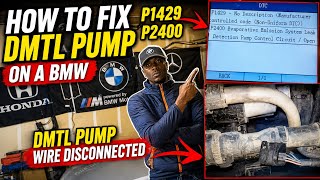
- Faulty EVAP Leak Detection Pump (DMTL) (Common) — The electric motor or internal switch inside the leak detection pump fails with age, resulting in an internal open circuit. This is a frequent point of failure, especially on European vehicles. 🎬 See this walkthrough for replacing a BMW DMTL pump.
- Blown Fuse or Faulty Relay (Less Common) — A blown fuse cuts power to the pump, immediately causing the PCM to detect an open circuit and log the P2400 code.
- Saturated Charcoal Canister (Rare) — Consistently overfilling the gas tank forces raw fuel into the charcoal canister. This liquid fuel gets drawn into the leak detection pump, causing it to short out or fail prematurely.
- Faulty Powertrain Control Module (PCM) (Rare) — The driver circuit within the PCM that sends the signal to the pump occasionally fails. Consider this only after exhaustively testing the wiring, fuses, and pump.
Symptoms
- Check Engine Light is On — The Malfunction Indicator Lamp (MIL) illuminates as soon as the PCM completes its self-test and detects the open circuit. Some vehicles also trigger a specific EVAP warning message.
- Failed Emissions Test — With an active P2400 code, the EVAP system monitor will not run to completion, resulting in an automatic failure of any state-mandated emissions inspection.
- Faint Fuel Smell — You occasionally notice a slight odor of gasoline vapor near the rear of the vehicle because the EVAP system is not properly sealing or testing itself.
- No Other Drivability Issues — This code does not affect engine performance, fuel economy, or acceleration. The vehicle runs normally.
- No Audible Pump Operation (also visible on scanner) — During a scan tool-commanded test of the EVAP system, you will not hear the typical faint whirring or clicking sound of the leak detection pump activating. 🎬 Watch: How to test the pump and wiring with a multimeter.
Diagnostic Flowchart
Tap your situation to follow the diagnostic path that matches what you're seeing on this code.
Common Fixes & Costs
- Repair Damaged Wiring — Parts: $10-$30, Labor: $150-$450, ~1.5 hr book time (Intermediate)
- Replace EVAP Leak Detection Pump (DMTL)
— Parts: $60-$200, Labor: $100-$250, ~1.2 hr book time
(DIY)
Mini Cooper (2006-2013): OEM 16137193479 (Alt: {"brand": "Bosch", "part_number": "0261222018", "price_comparison": "Significantly cheaper than the dealer-branded part.)
BMW 3-Series (E90, 2006-2011): OEM 16137193479 (Alt: {"brand": "Bosch", "part_number": "0261222018", "price_comparison": "Identical to the genuine part without the BMW logo.)
Audi A4 (B7, 2005-2008): OEM 8E0906201K (Alt: {"brand": "SMP", "part_number": "8E0906201K", "price_comparison": "Reliable alternative to genuine Audi parts."}) - Replace Blown Fuse — Parts: $1-$5, Labor: $0-$50, ~0.1 hr book time (DIY)
- Replace Charcoal Canister — Parts: $200-$500, Labor: $110-$161, ~1 hr book time (Intermediate)
- Replace Powertrain Control Module (PCM) — Parts: $400-$1000+, Labor: $200-$350, ~1.5 hr book time (Professional)
Used vs. New Parts: Buying Guide
When a used part is worth it: A used OEM unit from a low-mileage, non-corroded donor vehicle is a cost-effective alternative to a new aftermarket part.
Donor-vehicle mileage cap: roughly under 60000 miles for the part to have meaningful remaining life.
Donor quality checklist:
- Verify the donor vehicle was not scrapped due to extensive rust or electrical issues.
- Visually inspect the used pump's plastic housing for cracks and the electrical connector for corrosion.
- Match the OEM part number exactly.
Decision logic:
- If The vehicle is a BMW or MINI under 10 years/120k miles → Check with a dealer first; the part is likely covered by an extended warranty.
- If The cost of a new OEM or reputable aftermarket pump (e.g., Bosch) is under $100 → Buy new for the warranty and peace of mind.
- If The new part is over $200 and a low-mileage used part is available for under $75 → A used part is a reasonable choice, accepting the risk of a shorter lifespan.
Warranty tradeoff: Used parts from salvage yards typically offer a 30-90 day warranty. New aftermarket parts usually come with a 1-year to limited lifetime warranty.
Worst-case if a used part fails: $150 - $300 if a used pump fails shortly after installation, requiring repeat labor costs.
What Happens If You Wait — Timeline
- 0-1 month: Code P2400 is set, the Check Engine Light turns on. The EVAP system self-test is disabled. The car drives normally. (MPG impact: 0%% · Added cost: $0. You will fail an emissions test.)
- 1-6 months: The underlying electrical fault remains. The disabled EVAP monitor masks new, real leaks that develop in hoses from age or damage. (MPG impact: 0%% · Added cost: $0, but the risk of a secondary, undiagnosed problem increases.)
- 6-12 months: If an actual EVAP leak occurs and goes undetected, the system constantly draws in fresh air, overwhelming the charcoal canister. (MPG impact: 0-2% (if a separate vacuum leak develops)% · Added cost: $50-$150 in potential diagnostic complexity.)
- 12+ months: Long-term neglect leads to a completely fuel-saturated charcoal canister, causing fuel odor and hard starting after fill-ups. (MPG impact: 0-5%% · Added cost: $350 - $1500+ (Cost to replace a saturated charcoal canister and other damaged EVAP components).)
Cost of Not Fixing It
- 0-3 months: Guaranteed failure of any state emissions inspection and continued release of harmful hydrocarbon vapors. (Added cost: $0 - $50 (potential fines or failed inspection fees))
- 3-12 months: Ignoring the code masks other developing EVAP system problems. A small leak worsens, leading to more complex diagnostics later. (Added cost: $100 - $250)
- 12+ months: A persistently malfunctioning EVAP system leads to a saturated charcoal canister, ruining the part. (Added cost: $300 - $700)
Diagnosis Steps
- Check the Gas Cap
Ensure your gas cap is tightened until it clicks at least once and that its seal is not cracked. While a loose cap typically causes leak codes (like P0455), it is a free and necessary first check for any EVAP issue.
Tools: None (Beginner) - Inspect Fuses and Relays
Consult your owner's manual to locate the fuse for the EVAP system or leak detection pump. Visually inspect the fuse for a broken filament. If blown, replace it with a new one of the exact same amperage.
Tools: Fuse puller, flashlight (Beginner) - Visually Inspect Wiring and Connectors
Safely raise the vehicle and locate the leak detection pump near the fuel tank. Perform a thorough visual inspection of the wiring harness leading to the pump. Look for chafing, breaks, melting, or corrosion on the wires and connector pins.
Tools: Jack and jack stands, flashlight (Intermediate) - [PRO TIP] Command Pump Activation with a Scan Tool
Connect a bidirectional scan tool, navigate to the EVAP system active tests, and command the pump on. Listen for a click or whirring sound. If you hear nothing, the pump is not activating, confirming a hard fault in the pump or wiring.
Tools: Bidirectional OBD-II scan tool (Advanced) - Check for Power at the Pump Connector
Disconnect the electrical connector from the pump. Turn the ignition to the 'On' position (engine off). Using a multimeter set to DC volts, check for battery voltage (approx. 12V) at the power supply pin. No voltage points to a broken wire upstream or a blown fuse.
Tools: Multimeter, vehicle-specific wiring diagram (Intermediate) - Test the Pump's Internal Resistance
With the pump disconnected, switch your multimeter to Ohms. Measure the resistance across the power and ground terminals on the pump itself. If the meter reads 'OL' (Open Loop) or infinite resistance, the pump's internal motor failed and requires replacement.
Tools: Multimeter, vehicle-specific repair manual (Intermediate) - Check the Control Circuit for an Open
If power and the pump motor test good, the break is in the control wire running to the PCM. Check for continuity between the pump's connector and the corresponding pin at the PCM's connector.
Tools: Multimeter, vehicle-specific wiring diagram (Advanced) - [PRO TIP] Perform a Voltage Drop Test
Connect the positive multimeter lead to the battery's positive terminal and the negative lead to the power pin on the pump connector. Command the pump on with a scan tool. A reading above 0.5 volts indicates excessive resistance in the power-side wiring. Repeat on the ground side; a reading above 0.2 volts indicates a poor ground.
Tools: Multimeter, bidirectional scan tool, wiring diagram (Advanced) - [PRO TIP] Live Data Analysis
Use a scan tool to monitor the EVAP system's live data PIDs. On BMW systems, monitor the DMTL pump's current draw in milliamps (mA). During a commanded test, an out-of-range current draw indicates a clogged filter or failing pump motor.
Tools: Advanced OBD-II scan tool with live data (Advanced)
When This Code Triggers (Freeze-Frame Conditions)
- Fuel Level: 15-85% (The EVAP test will not run on a full or nearly empty tank.)
- Engine Coolant Temp: 40-95°F (at startup) (The test requires a 'cold soak,' where the engine starts at a temperature close to the ambient air.)
- Vehicle Speed: 45-65 mph (Part of the drive cycle involves a period of steady highway-speed cruising.)
- Engine Run Time: Varies (often post-shutdown) (The PCM triggers the P2400 code when it attempts to run the EVAP leak test and finds the pump's circuit is open.)
Related Codes
- P2401 — Indicates the leak detection pump control circuit is reading low (short to ground). P2400 signifies an open circuit (no connection).
- P2402 — Indicates the control circuit is reading high (short to power). A multimeter test on the control wire shows constant battery voltage for P2402.
- P1477 — A manufacturer-specific code for a fault with the pump's internal reed switch. When paired with P2400 on a Mini, it guarantees a chafed wiring harness.
Climate & Environmental Factors
- Road Salt and Moisture: In regions with salted roads, the wiring and connectors for the underbody-mounted leak detection pump are highly susceptible to corrosion. Saltwater intrusion is a leading cause of the P2400 open circuit fault.
- Extreme Cold: Extreme cold makes plastic wiring insulation and EVAP hoses brittle, causing a stressed wire to snap or a hose to crack.
How to Talk to a Mechanic About This Code
Say this: "I have an OBD-II code P2400, which points to an open circuit for the EVAP leak detection pump. I'd like to schedule a diagnostic that specifically tests the wiring and connector for power, ground, and signal before assuming the pump itself needs to be replaced."
This directs the technician to perform a proper electrical diagnosis to find the 'open' in the circuit, preventing them from immediately replacing the most expensive part when the fault is a simple broken wire.
Avoid saying:
- 'My check engine light is on, can you just fix it?'
- 'I think I need a new fuel pump.'
- 'Just do whatever you think is best.'
Questions to ask before authorizing the repair:
- Did you find the open circuit? Was it in the wiring harness, the connector, or internal to the pump?
- What were the voltage and resistance readings at the pump's connector and at the pump's pins?
- If it's a wiring issue, can you show me the location of the corrosion or break before you repair it?
- For my vehicle, is this pump covered under an extended emissions warranty?
Where to Take It: Dealer vs Independent vs Chain
- Dealer:
Best for: Vehicles under warranty, especially BMW and MINI models with known extended warranties for the DMTL pump., Complex wiring issues or manufacturer-specific problems.
Downsides: Significantly higher labor rates (1.5-2x) compared to independent shops., Defaults to replacing the entire pump and harness rather than performing an affordable wire repair. (Typical cost: +50% vs. baseline) - Independent Shop:
Best overall fit. A competent independent shop easily performs the necessary multimeter tests to isolate the open circuit and is more willing to perform a wiring repair.
Best for: Out-of-warranty vehicles where cost is a primary concern., Straightforward electrical diagnosis and repair by a trusted mechanic.
Downsides: Shop quality and diagnostic skill vary greatly. Vet the shop by checking for ASE certifications. (Typical cost: +0% vs. baseline) - Chain Shop:
Use with caution. They are likely to recommend replacing the pump by default. Acceptable only if you already confirmed the pump is the issue.
Best for: Simple jobs like tire changes or oil services.
Downsides: Technician skill varies dramatically, lacking in-depth electrical diagnostic training., High pressure to sell parts leads to a recommendation to replace the pump without proper testing. (Typical cost: -10% vs. baseline)
When to Walk Away From the Repair
If the estimated repair cost for the P2400 code exceeds 40-50% of your car's private-party value, and the car has other pending issues, consider selling.
- Car worth $4000, fix is $500: Fix it. The repair cost is low relative to the car's value.
- Car worth $12000, fix is $600: Fix it. This is a routine repair cost for a vehicle of this value.
- Car worth $2000, fix is $750: Borderline. The repair is nearly 40% of the car's value. Get a second opinion, and consider selling as-is if you don't need to pass an emissions test immediately.
What Scan Tool You Need for This Code

Minimum: A bidirectional scan tool capable of performing active tests on the EVAP system. A basic code reader is NOT sufficient for an efficient diagnosis.
A basic code reader only tells you the P2400 code exists. It cannot command the leak detection pump to turn on, which is the fastest way to confirm if the pump receives the signal.
Budget: Kingbolen Ediag Elite / XTOOL A30M (~$75-99) — These Bluetooth-based dongles offer basic bidirectional controls, including the ability to activate the EVAP pump.
Mid-range: Innova 5610 / XTOOL D7 (~$250-350) — These dedicated scanners reliably command the EVAP pump on/off, view live data streams, and access all vehicle modules.
Professional: Autel MaxiCOM MK808Z / Launch X431 CRP919E (~$450-600) — Provides full, professional-level bidirectional control, access to manufacturer-specific codes, and live data.
Rent vs buy: Free 'loaner tool' programs at auto parts stores provide basic code readers, not bidirectional scanners. For a one-time diagnosis, rent a full bidirectional scanner. If you repair vehicles frequently, buying a midrange tool is more cost-effective.
How to Clear the Code After You Fix It
- Use an OBD-II scan tool to clear the diagnostic trouble codes.
- Ensure fuel tank is between 1/4 and 3/4 full.
- Perform the specific EVAP drive cycle for your vehicle.
Drive cycle (~20 minutes): A typical EVAP drive cycle involves a cold start (after sitting 8+ hours), a few minutes of idling, followed by 10-15 minutes of steady driving at highway speeds (45-65 mph), and a cool-down period.
Readiness monitors affected: EVAP System Monitor, Catalyst Monitor, O2 Sensor Monitor
Before emissions retest: drive at least 50 miles to fully set monitors.
Watch out for:
- Disconnecting the battery clears the code but resets all readiness monitors, requiring a lengthy drive cycle before an emissions test.
- The EVAP monitor is notoriously difficult to set and requires several cold starts.
- Incorrect fuel levels (outside 15-85%) prevent the EVAP monitor from running.
Will This Fail Emissions / State Inspection?
Yes — this code typically fails an OBD-II emissions inspection.
- California: An active P2400 code results in an automatic smog check failure. The EVAP monitor will not complete with this fault present.
- New York: A Check Engine Light on due to P2400 is an automatic failure of the On-Board Diagnostics (OBD-II) portion of the annual state inspection.
- Texas: In the 17 counties requiring emissions testing, a vehicle fails the OBDII test if the Malfunction Indicator Lamp (MIL) is commanded on for any reason.
Most Commonly Affected Vehicles
- Mini Cooper (2006-2013) — The pump's wiring harness routes incorrectly, rubbing against the rear trailing arm. This chafes the wires, causing an open circuit and triggering P2400 alongside P1477.
- BMW 1-Series, 3-Series, 5-Series (2006-2014) — These vehicles use a DMTL pump which is a frequent failure item. Severed wires in the rear wheel well area are also a known cause.
- Audi A4, Q7 (2002-2008) — Known for failures of the leak detection pump (LDP) itself. Check for a signal voltage greater than 4.4-5.6V at the pump connector.
- Volkswagen Jetta, Golf, GTI (2008-2016) — Frequently experience failures of the leak detection pump and related wiring issues in the harness near the fuel tank.
- Toyota Yaris, Camry (2000-2008) — The pump fails and triggers a cluster of related EVAP codes (P2400, P043E, P043F, P2401, P2402, P2419), addressed in TSB T-SB-0034-11.
- Ford Transit (2015-2023) — Typically points to a standard fault in the EVAP leak detection pump or its associated wiring circuit.
- Subaru Forester, Outback (2008-2018) — Usually indicates a failure of the leak detection pump itself or a wiring problem underneath the vehicle.
- Hyundai / Kia Sonata, Optima (2006-2015) — Requires the standard diagnostic procedure of checking the pump, its wiring, and the associated fuse.
Manufacturer-Specific Notes
- Mini: The wiring harness rubs against the rear trailing arm, causing wires to break and triggering P2400 and P1477. MINI extended the warranty on the DMTL pump to 10 years or 120,000 miles under bulletin SI M01 05 11.
- BMW: BMW extended the warranty on the DMTL pump to 10 years or 120,000 miles (bulletin SI B01 04 16). Before replacing the pump, inspect the wiring in the rear driver-side wheel well, as broken wires are a frequent cause.
- Audi/Volkswagen: The leak detection pump (LDP) is a high-failure item. Diagnosis often leads directly to replacing the pump after confirming power and ground are present at the connector.
- Toyota: A failure within the pump assembly triggers P2400 along with P043E, P043F, P2401, P2402, and P2419. This cluster strongly points to a failed pump assembly (TSB T-SB-0034-11).
Real Owner Stories
2009 BMW 335i with 44k miles - The Misdiagnosis
Check Engine Light appeared with code P2400. The code returned one or two days after being cleared.
What they tried:
- Dealer suggested a loose gas cap and cleared the code.
- Independent shop replaced the DMTL pump with a used one and repaired damaged wires for $200.
- Code returned after aggressive driving or on a cold start.
Outcome: The owner suspected the used replacement pump was faulty and planned to replace it with a brand new OEM pump. Using used electronic parts is a gamble, and wiring issues are a common companion to this code.
Lesson: A recurring P2400 after a pump replacement strongly points to a persistent wiring problem or a faulty replacement part. Always inspect wiring thoroughly.
2006 Mini Cooper S - The Classic Chafe
Check Engine Light on with codes P2400 and P1477, causing a failed emissions test.
What they tried:
- Technician checked the fuse (F04, 15A), which was good.
- Located the leak detection pump in the right rear wheel well and inspected the wiring harness.
Outcome: The technician found multiple wires in the harness chafed through their insulation where they rubbed against a suspension component. The wires were repaired and rerouted, fixing the open circuit.
Lesson: On a Mini Cooper, P2400 combined with P1477 guarantees a wiring harness chafe in the rear wheel well. This pattern failure saves you from buying an unnecessary pump.
2008 BMW 335xi - The Severed Wire
Persistent P2400 code for over 6 months, preventing the car from passing inspection.
What they tried:
- Replaced the DMTL pump.
- Replaced the gas cap.
- The code remained.
Outcome: The owner removed the driver's side rear wheel liner and discovered a completely severed wire in the harness leading to the pump. Splicing the wire resolved the code.
Lesson: If replacing the pump doesn't fix P2400, the problem is in the wiring. A visual inspection is critical.
Audi A4 - The Unusual Cause
P2400 code persisted after multiple parts were replaced.
What they tried:
- Replaced the purge valve, gas cap, and EVAP hoses.
- Tested the pump for voltage and confirmed it was receiving power.
Outcome: The owner discovered a bent pin on the main computer (ECU) connector from a previous repair. Straightening the pin fixed the open circuit and cleared the code.
Lesson: Always consider recent repairs. If a new code appears after other work, a connector was left loose or a pin was accidentally damaged.
How to Prevent This Code From Triggering
- Do Not Overfill Your Gas Tank (Every fill-up) — Consistently topping off the tank forces liquid fuel into the charcoal canister, saturating it and potentially damaging the leak detection pump.
- Apply Dielectric Grease to Connectors (During any under-vehicle maintenance) — Applying a non-conductive dielectric grease to the leak detection pump's electrical connector seals it from moisture and road salt, stopping corrosion.
- Perform Periodic Undercarriage Washes (Seasonally, especially after winter) — Washing the vehicle's underbody removes road salt and grime that accelerates corrosion on exposed wiring harnesses.
- Inspect Exposed Wiring Harnesses (During tire rotations or oil changes) — Visually inspect the wiring harness near the rear wheels and fuel tank to catch signs of chafing before a wire breaks.
Frequently Asked Questions
What is the most common mistake when fixing a P2400 code?
The most common and costly mistake is immediately replacing the leak detection pump without performing proper electrical tests. Technicians and DIYers often find the code returns because the actual problem was a simple broken wire or blown fuse. Always use a multimeter to verify power, ground, and circuit integrity before buying parts.
My mechanic replaced the pump, but the P2400 code came back. What now?
If a new pump did not fix the code, the problem is almost certainly in the wiring between the pump and the PCM. The next step is to perform a continuity and voltage drop test on the power, ground, and control wires to find the break. In extremely rare cases, the PCM itself has failed.
What does DMTL mean on a BMW or Mini?
DMTL stands for "Diagnostic Module for Tank Leakage." It is the specific name used by BMW and Mini for their EVAP leak detection pump. Functionally, it serves the exact same purpose as a standard leak detection pump on other vehicles.
Can a loose gas cap cause a P2400 code?
It is highly unlikely. A loose gas cap causes a large leak in the EVAP system, triggering codes like P0455, whereas P2400 specifically points to an electrical circuit fault. However, checking the cap is a free and easy first step for any EVAP issue.
Is it safe to drive my car with the P2400 code?
Yes, it is safe to drive. This emissions-related code will not affect your car's engine performance, reliability, or fuel economy. The primary consequences are releasing harmful fuel vapors into the atmosphere and failing a state emissions test.
How much does it cost to fix a P2400 code?
A professional diagnostic check typically costs between $150 and $165. If the fix is a simple blown fuse, it costs less than $20, while a wiring repair ranges from $150 to $450. Replacing the leak detection pump costs between $200 and $620 for parts and labor combined.
Can I fix the P2400 code myself?
A DIY repair is straightforward if the issue is a blown fuse, a visibly broken wire, or a failed pump. However, accurately diagnosing the fault to avoid replacing unnecessary parts requires a multimeter and vehicle-specific wiring diagrams. If you lack electrical testing experience, take the vehicle to a professional diagnostic shop.
Will the check engine light go off by itself after the repair?
The light sometimes turns off on its own after several drive cycles once the onboard computer confirms the fault is gone. However, the quickest and most reliable method is to clear the code using an OBD-II scanner. Drive the vehicle afterward to verify the code does not return.
Does P2400 affect gas mileage?
Directly, no. The P2400 code indicates an electrical fault in the EVAP system, which prevents fuel vapors from escaping but does not impact engine operation. You will not notice any drop in your MPG figures.
Will clearing the P2400 code fix the problem?
No. Clearing the code with a scanner only turns off the check engine light temporarily. The PCM will run its EVAP system self-test again, detect the open circuit, and re-log the code within one or two drive cycles.
Key Takeaways
- P2400 indicates an electrical open circuit—not a physical fuel leak—in the EVAP leak detection pump, preventing the vehicle from passing emissions.
- Always test the pump's electrical connector for 12V power and ground before spending $150+ on a replacement pump, as broken wiring is the most frequent culprit.
- On 2006-2013 Mini Coopers, a P2400 code paired with P1477 guarantees a chafed wiring harness rubbing against the right rear trailing arm.
- BMW and MINI extended the warranty on the DMTL pump to 10 years or 120,000 miles (bulletins SI M01 05 11 and SI B01 04 16), so check dealer coverage before paying for repairs.
Helpful Videos

The information in this article is provided for general reference and educational purposes only. Vehicle specifications, procedures, and part compatibility can vary by production date, trim level, and region. Always consult your vehicle's factory service manual and verify part numbers before purchasing or performing repairs. Safety-critical components such as airbags, seat belts, and braking systems should be installed by a qualified professional.
- 🎬 Helpful Videos
- What Does P2400 Mean?
- Can I Drive With P2400?
- Common Causes
- Symptoms
- Diagnostic Flowchart
- Common Fixes & Costs
- Used vs. New Parts: Buying Guide
- What Happens If You Wait — Timeline
- Cost of Not Fixing It
- Diagnosis Steps
- When This Code Triggers (Freeze-Frame Conditions)
- Related Codes
- Climate & Environmental Factors
- How to Talk to a Mechanic About This Code
- Where to Take It: Dealer vs Independent vs Chain
- When to Walk Away From the Repair
- What Scan Tool You Need for This Code
- How to Clear the Code After You Fix It
- Will This Fail Emissions / State Inspection?
- Most Commonly Affected Vehicles
- Manufacturer-Specific Notes
- Real Owner Stories
- 2009 BMW 335i with 44k miles - The Misdiagnosis
- 2006 Mini Cooper S - The Classic Chafe
- 2008 BMW 335xi - The Severed Wire
- Audi A4 - The Unusual Cause
- How to Prevent This Code From Triggering
- Frequently Asked Questions
- What is the most common mistake when fixing a P2400 code?
- My mechanic replaced the pump, but the P2400 code came back. What now?
- What does DMTL mean on a BMW or Mini?
- Can a loose gas cap cause a P2400 code?
- Is it safe to drive my car with the P2400 code?
- How much does it cost to fix a P2400 code?
- Can I fix the P2400 code myself?
- Will the check engine light go off by itself after the repair?
- Does P2400 affect gas mileage?
- Will clearing the P2400 code fix the problem?
- Key Takeaways
- 🎟️ Get 5% Off