

OBD-II Code P2311: Ignition Coil 'D' Secondary Circuit Malfunction
An ASE-Certified Master Technician's In-Depth Guide to P2311
- P2311 flags a high-voltage failure in the ignition system for cylinder 4, directly causing an engine misfire.
- Over 80% of P2311 codes are solved by replacing the cylinder 4 ignition coil and its corresponding spark plug.
- A flashing Check Engine Light means raw fuel is melting your catalytic converter—pull over immediately to prevent a $2,500+ repair bill.
- Perform a 5-minute 'swap test' by moving the cylinder 4 ignition coil to cylinder 3; if the code changes to P2308, the coil is definitively bad.
What Does P2311 Mean?

P2311 means your Powertrain Control Module (PCM) detected a high-voltage failure in the ignition system for cylinder 'D' (cylinder 4). This 'secondary circuit' creates the 20,000+ volt spark needed to ignite the fuel-air mixture. When the PCM detects abnormal voltage or insufficient spark duration, it triggers this code and shuts down the cylinder to protect the engine.
Technical definition: The SAE/OBD-II definition is "Ignition Coil 'D' Secondary Circuit Malfunction". The PCM monitors the ignition coil's high-voltage output (secondary circuit), which includes the internal windings, boot, and spark plug. P2311 sets when the PCM detects an open circuit, short circuit, or insufficient ionization time during the spark event.
🎬 Watch: Expert breakdown of P2311 and ionization circuit faults.Can I Drive With P2311?
Yes, But With Caution. You can drive short distances, but do not exceed 45 mph or drive under heavy load. A flashing Check Engine Light means raw fuel is actively destroying your catalytic converter. Pull over immediately if it flashes to prevent a $2,500+ repair bill.
Common Causes


- Failed Ignition Coil 'D' or Boot (Very Common) — The ignition coil or its rubber boot is the most frequent failure point. Internal windings break from heat and vibration, or the rubber boot degrades and allows the 20,000-volt spark to arc to the engine block instead of the spark plug.
- Worn or Faulty Spark Plug (Very Common) — A worn-out, cracked, or fouled spark plug in cylinder 4 requires excessive voltage to fire. This extra resistance overworks the ignition coil, pushes the secondary circuit out of its normal voltage range, and triggers the code.
- Oil Leak into Spark Plug Tube (Common) — A leaking valve cover gasket or spark plug tube seal allows engine oil to pool around the spark plug. This oil saturates the rubber coil boot, shorts the spark to ground, and guarantees repeat coil failures until the leak is fixed. 🎬 See how to safely remove oil from a spark plug well.
- Wiring Harness or Connector Damage (Less Common) — The wiring harness providing power and signal to the ignition coil degrades from engine heat. A poor connection at the coil's electrical connector, often from a spread terminal pin, interrupts the PCM signal.
- Faulty Auto Shutdown (ASD) Relay or Fuse (Uncommon) — A main relay (often the ASD relay) supplies battery voltage to all ignition coils. A failing relay or blown fuse causes an intermittent loss of power, though this usually triggers multiple coil codes simultaneously.
- Failed Powertrain Control Module (PCM) (Rare) — The internal PCM driver circuit that controls the cylinder 4 ignition coil can burn out. A shorted ignition coil sometimes causes this secondary damage, requiring both the coil and the PCM to be replaced.
Symptoms

- Rough Engine Idle or Stalling — The engine shakes violently at a stop and stalls because cylinder 4 is dead, throwing off the engine's rotational balance.
- Engine Hesitates or Lacks Power — The vehicle feels sluggish and jerks during acceleration. The power loss is most obvious when climbing hills or merging onto the highway.
- Check Engine Light is On or Flashing (also visible on scanner) — A solid light indicates a stored fault. A flashing light signals a severe, active misfire dumping raw fuel into the exhaust, requiring immediate shutdown.
- Reduced Fuel Economy and Fuel Smell (also visible on scanner) — Gas mileage plummets as the engine dumps unburnt fuel into the exhaust. You will likely smell raw gasoline from the tailpipe.
Diagnostic Flowchart

Tap your situation to follow the diagnostic path that matches what you're seeing on this code.
Common Fixes & Costs
- Replace Ignition Coil 'D' — Parts: $40-$120, Labor: $80-$200, ~0.6 hr book time (DIY)
- Replace the Spark Plug(s) — Parts: $10-$30 per plug, Labor: $50-$200, ~0.8 hr book time (DIY)
- Replace Valve Cover Gasket & Spark Plug Tube Seals — Parts: $30-$80, Labor: $250-$600, ~2.5 hr book time (Professional)
- Repair Damaged Wiring or Connector — Parts: $10-$50, Labor: $150-$400, ~1.8 hr book time (Professional)
- Replace Powertrain Control Module (PCM) — Parts: $500-$1200, Labor: $150-$300, ~1.2 hr book time (Professional)
DIY vs Professional
- Replace Ignition Coil / Spark Plug — Beginner: Yes, if easily accessible.
Tools: Basic socket set, spark plug socket, torque wrench, dielectric grease. - Replace Valve Cover Gasket — Beginner: No, this is an intermediate to professional job.
Tools: Extensive socket/wrench set, torque wrench, gasket scraper, RTV sealant, inch-pound torque wrench. - Wiring/Connector Repair — Beginner: No.
Tools: Multimeter, wire strippers, crimpers, soldering iron, heat shrink, pin-fitment tools. - Replace PCM — Beginner: No.
Tools: Socket set, specialized scan tools for programming/relearning.
Used vs. New Parts: Buying Guide
When a used part is worth it: Buying used ignition coils and spark plugs is strongly discouraged. These are wear-and-tear items with a finite lifespan, and the minimal cost savings do not justify the risk of premature failure.
Donor-vehicle mileage cap: roughly under 10000 miles for the part to have meaningful remaining life.
Donor quality checklist:
- Avoid coils with any signs of cracking, corrosion, or heat damage.
- Never install used spark plugs; they are single-use items.
Decision logic:
- If The part is an ignition coil or spark plug → Always buy new from a reputable OEM or aftermarket brand.
- If Budget is extremely tight and the part is an ignition coil → A used coil from a very low-mileage wreck serves as a temporary solution, but expect a significantly shorter lifespan.
Warranty tradeoff: Salvage yard parts carry a 30-90 day warranty. New aftermarket parts offer a 1-year to limited lifetime warranty.
Worst-case if a used part fails: 200-500 if a used coil fails shortly after installation, requiring repeat labor costs.
What Happens If You Wait — Timeline
- 0-1 month: Solid Check Engine Light appears. Intermittent rough idle, especially when cold. Slight hesitation on acceleration. (MPG impact: 5-10%% · Added cost: $20-$60 in wasted fuel.)
- 1-3 months: Check Engine Light flashes under load. Misfire becomes consistent, engine shakes at stops. Raw fuel smell present at exhaust. (MPG impact: 10-20%% · Added cost: $250-$500 (Catalyst substrate begins to overheat and melt).)
- 3-6 months: Flashing Check Engine Light is frequent. Significant loss of power. The catalytic converter partially clogs, causing exhaust backpressure. (MPG impact: 20-30%+% · Added cost: $1,200-$2,500 (Catalytic converter requires replacement).)
- 6+ months: Vehicle fails to start or stalls frequently. The catalytic converter completely blocks, creating extreme backpressure that burns exhaust valves. (MPG impact: N/A (Vehicle undrivable)% · Added cost: $2,000-$4,500+ (Includes catalytic converter, O2 sensors, and engine repairs.))
Cost of Not Fixing It
- Immediate (0-1 Month): Noticeable drop in fuel economy (5-15%), rough idle, and poor acceleration. Risk of stalling in traffic. (Added cost: 50-150)
- Short Term (1-6 Months): A flashing check engine light indicates raw fuel is dumping into the exhaust, overheating and destroying the catalytic converter. (Added cost: 1200-3400)
- Long Term (6+ Months): Catastrophic catalytic converter failure, damage to the oxygen sensors, and potential engine damage from running in a constant misfire condition. (Added cost: 2000-4500)
Diagnosis Steps
- Read Diagnostic Trouble Codes (DTCs)
Use an OBD-II scanner to confirm P2311 and check for P0304 (Cylinder 4 Misfire). Document the freeze frame data to see the exact engine speed, load, and temperature when the fault occurred.
Tools: OBD-II Scanner (Beginner) - Swap Components (The 'Gold Standard' Test)
Label and swap ignition coil 'D' (cylinder 4) with the coil from adjacent cylinder 3. Clear the codes and drive. If the code changes to P2308 (coil 'C'), the coil is definitively bad. If P2311 returns, the coil is fine.
Tools: Basic socket set, Marker/Tape (Beginner) - Visually Inspect the Spark Plug and Tube
Remove the cylinder 4 spark plug. Check the tube for pooled oil, which indicates a leaking valve cover gasket. Inspect the plug for a worn electrode, cracked porcelain, or heavy carbon fouling.
Tools: Spark plug socket, Ratchet, Extension, Flashlight (Intermediate) - Test the Coil Control Circuit
Disconnect the coil and turn the key ON. Verify 12V power at the connector. Use a noid light on the signal wire while an assistant cranks the engine. A flashing light confirms the PCM and wiring are sending the trigger signal.
Tools: Digital Multimeter, Noid Light (Advanced) - Test Coil Secondary Resistance
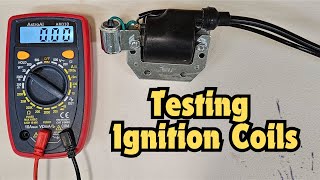
Use a digital multimeter set to Ohms (Ω). Measure resistance between the high-voltage output terminal and the primary connector pins. Readings outside the typical 5,000-20,000 Ohm range indicate an internal short or open circuit.
Tools: Digital Multimeter (Advanced) - Check Wiring and Pin Connections
If the noid light did not flash, inspect the wiring harness between the PCM and the coil. Check for loose or corroded pins at the main PCM connector, a known issue on Chrysler/Dodge vehicles that mimics a failed coil.
Tools: Digital Multimeter (continuity mode), Pin-fitment tools (Advanced) - Analyze Live Data for Misfire Clues
Use an advanced scan tool to monitor the 'MISFIRE_CYL4' counter. Watch Short Term Fuel Trims (STFT); a reading above +10% indicates the PCM is dumping fuel to compensate for the dead cylinder.
Tools: Advanced OBD-II Scanner (Advanced) - Analyze Secondary Ignition with an Oscilloscope
Connect an automotive oscilloscope with a secondary ignition probe. Look for a normal firing line of 10-15 kV and a spark duration of 1.0-1.8 ms. A firing line above 20 kV indicates high resistance from a worn plug.
Tools: Automotive Oscilloscope, Secondary Ignition Probe (Professional)
When This Code Triggers (Freeze-Frame Conditions)
- Engine Coolant Temp: 180-205°F (Fully warmed up, closed-loop operation.)
- Engine RPM: 1500-3000 RPM (Light acceleration or steady cruise speed.)
- Engine Load: 30-60% (Moderate load, such as climbing a slight incline.)
- Vehicle Speed: 45-65 mph (Occurs frequently during steady highway driving.)
Related Codes
- P0304 — This is the cylinder-specific misfire code. P0304 indicates the PCM detected a variation in crankshaft speed (the result), while P2311 indicates the electrical fault in the coil circuit (the cause).
- P2310 — Refers to a fault in the 'Primary' (low-voltage) circuit of the same ignition coil. If a noid light flashes on the coil connector while cranking, the primary circuit is working, confirming the issue is secondary (P2311).
- P2302, P2305, P2308, P2314, P2317 — Identical secondary circuit fault codes for different cylinders. Seeing multiple codes simultaneously suggests a systemic issue like a failing ASD relay, bad engine ground, or failing PCM.
- P0300 — The 'Random/Multiple Cylinder Misfire' code appears alongside P2311 if the issue is intermittent or if the underlying cause affects other cylinders.
Climate & Environmental Factors
- Cold Weather: Cold increases electrical resistance, forcing a weak ignition coil to work harder to produce a spark. This exposes marginal coils that function normally in warmer temperatures.
- High Humidity / Rain: Moisture provides an easy path for high-voltage electricity to escape. Humidity causes the spark to arc through cracked coil housings to the engine block, causing an immediate misfire.
- High Altitude: Less dense air makes it easier for the spark to jump the spark plug gap, slightly reducing the voltage required from the coil. This alters normal operating parameters but rarely causes direct failure.
How to Talk to a Mechanic About This Code
Say this: "I have an OBD-II code P2311, pointing to an ignition coil secondary circuit issue on cylinder 4. I'd like to schedule a diagnostic. Can you please start by swapping the coil from cylinder 4 with another cylinder to see if the fault follows the coil?"
This signals you understand the most common cause and the standard diagnostic test. It directs the mechanic to a specific, efficient first step and prevents expensive, unnecessary diagnostic paths.
Avoid saying:
- 'My check engine light is on, can you look at it?'
- 'The car is shaking, just fix whatever is wrong.'
- 'I think I need a tune-up.'
Questions to ask before authorizing the repair:
- What were the results of the coil swap test? Did the misfire code move to the other cylinder?
- If the coil wasn't the issue, what was the condition of the spark plug?
- Did you see any oil in the spark plug tube?
- Can you show me the old part and explain why it failed?
- What is the warranty on the new parts and your labor?
Where to Take It: Dealer vs Independent vs Chain
- Dealer:
Best for: Vehicles still under the powertrain or federal emissions warranty (8yr/80k miles for a PCM)., Known manufacturer-specific issues covered by a Technical Service Bulletin (TSB).
Downsides: Significantly higher labor rates, often 1.5-2x more than an independent shop., May replace parts based on pattern failures instead of pinpoint diagnostics. (Typical cost: +50% vs. baseline) - Independent Shop:
Best fit for most situations. P2311 is a routine diagnostic job for any competent independent technician. They offer the best balance of cost and quality.
Best for: Out-of-warranty vehicles where cost is a factor., Common, well-understood repairs like ignition coil and spark plug replacement., Building a long-term relationship with a trusted mechanic.
Downsides: Quality and expertise vary widely; vetting the shop through reviews and ASE certifications is crucial., May have less experience with complex PCM programming. (Typical cost: +0% vs. baseline) - Chain Shop:
Use with caution. Acceptable only if you are certain which part needs replacing. AVOID for initial diagnosis of a P2311 code.
Best for: Simple part replacement if you have already performed the diagnosis yourself.
Downsides: High pressure to upsell unnecessary services due to corporate targets., Technician skill is inconsistent; not ideal for diagnosing an electrical issue., Notorious for misdiagnosing issues and replacing unnecessary parts. (Typical cost: -10% vs. baseline)
When to Walk Away From the Repair
If the estimated repair cost exceeds 40-50% of the car's private-party value, seriously consider selling or trading it in instead of repairing it.
- Car worth $3000, fix is $1800: Walk away. The repair cost is over 50% of the car's value. It's not a sound financial decision.
- Car worth $10000, fix is $450: Fix it. This repair is well below the threshold and is necessary for the engine's health.
- Car worth $5000, fix is $2200: Borderline. The cost is approaching the 50% threshold. Get a second opinion before authorizing.
What Scan Tool You Need for This Code
Minimum: A basic OBD-II code reader that reads and clears codes. For P2311, the most powerful diagnostic is the physical 'coil swap test,' which doesn't require a sophisticated scanner.
An advanced scanner shows live data, specifically misfire counters per cylinder, confirming the misfire in real-time and verifying the repair was successful.
Budget: Ancel BD310 or Foxwell NT301 (~$60) — Reads and clears the P2311 and P0304 codes. Bluetooth models paired with an app display live data streams, including misfire counts.
Mid-range: BlueDriver Pro or Topdon TopScan (~$120) — Connects to your smartphone via Bluetooth and provides detailed diagnostic reports, freeze frame data, and access to live misfire data for each cylinder.
Professional: Autel MaxiCOM MK808S or Kingbolen K8 Pro (~$500-800) — Offers full system diagnostics and bidirectional control. Essential for diagnosing complex underlying causes like a faulty PCM driver.
How to Clear the Code After You Fix It
- Reconnect battery (if disconnected for repair).
- Use an OBD-II scan tool to select the 'Clear/Erase Codes' function.
- Perform a complete OBD-II drive cycle to allow readiness monitors to run.
Drive cycle (~30 minutes): A generic drive cycle includes a cold start (sit for 8+ hours), 2-3 minutes of idling, 10-15 minutes of mixed city/highway driving including steady speeds around 55 mph, and several stop-and-go periods.
Readiness monitors affected: Catalyst (CAT) Monitor, Oxygen (O2) Sensor Monitor, Misfire Monitor, Evaporative (EVAP) System Monitor
Before emissions retest: drive at least 100 miles to fully set monitors.
Watch out for:
- Disconnecting the battery clears the code but resets all emissions monitors to 'Not Ready', causing an automatic emissions test failure.
- The code returns immediately if the underlying mechanical or electrical fault remains unfixed.
Will This Fail Emissions / State Inspection?
Yes — this code typically fails an OBD-II emissions inspection.
- California: An active P2311 code is an automatic failure. A full drive cycle must be completed to set all readiness monitors to 'Ready' before a re-test.
- New York: The NYS DMV inspection includes an OBD-II scan. Any active Check Engine Light results in an immediate test failure.
- Texas: In counties requiring an emissions test, an illuminated Check Engine Light is an automatic failure. Registration renewal is blocked until repaired.
Most Commonly Affected Vehicles
- Chrysler/Dodge Town & Country, Grand Caravan (2015-2016) — Vehicles with the 3.6L V6 experience this code due to a PCM manufacturing defect. TSB #18-069-16 REV. A requires replacing and reprogramming the PCM.
- Jeep Compass, Renegade (2014-2020) — The 2.4L MultiAir engine frequently sets this code family due to ignition coil failure. TSB #18-033-19 notes that sometimes only the insulating boot fails.
- Ram ProMaster City (2015-2021) — Shares the 2.4L MultiAir engine with Jeep models and sets P2311 due to identical ignition coil issues.
- Dodge Caliber (2007-2012) — Known for wiring harnesses becoming brittle and failing around the engine, leading to open or shorted circuits for the coils.
- Ford F-150, Expedition (2004-2008) — The 5.4L 3V Triton engine is notorious for spark plugs breaking during removal. Special extraction tools are required.
- Ford F-150 (EcoBoost) (2011-2016) — The 3.5L EcoBoost engines experience this code due to bad coils, wiring issues, and intermittent PCM faults.
- Chevrolet Cruze, Sonic, Equinox (2011-2018) — The 1.4L and 1.8L Ecotec engines see regular ignition coil and spark plug failures past 80,000 miles.
- Hyundai Elantra, Sonata (2011-2019) — Ignition coil failure is a known pattern on these engines past 80,000 miles, triggering this fault code.
Manufacturer-Specific Notes
- Chrysler/Dodge/Jeep/Ram (Mopar): A poor pin connection at the main PCM harness connector is frequently misdiagnosed as a bad coil. A loose female pin for the coil control circuit causes an intermittent open circuit. Always check pin fitment before replacing the PCM.
- Chrysler/Dodge: TSB #18-069-16 REV. A addresses P23xx codes on 2015-2016 3.6L V6 models. The official fix replaces the PCM due to an improperly coated atmospheric vent, an internal hardware defect.
- Ford: On 3-valve Triton V8 engines (2004-2008), original two-piece spark plugs separate during removal, leaving the lower shield stuck in the cylinder head. Always attempt removal on a cold engine after applying a penetrating catalyst.
- Ford: Intermittent power loss to the PCM caused by a poor connection at the fuse box manifests as ignition circuit faults and 'no communication' errors with a scan tool.
Real Owner Stories
2015 Dodge Grand Caravan with 3.6L V6
Check Engine Light came on with codes P2311 and P0304. The engine had a noticeable rough idle and hesitated on acceleration.
What they tried:
- Swapped the ignition coil from cylinder 4 with cylinder 2.
- Cleared codes and drove. The code changed to P2305 (Ignition Coil 'B'), confirming the coil was bad.
Outcome: Replaced the faulty ignition coil and spark plug in cylinder 4 for $95. The repair was done DIY, and the codes did not return.
Lesson: The coil swap test is the most crucial first step. It definitively proves whether the coil is the problem before spending money on parts.
2012 Jeep Wrangler JK with 3.6L V6
Experienced an intermittent P2311 code. The Check Engine Light illuminated, but the Jeep ran fine most of the time.
What they tried:
- Visually inspected the wiring harness near the cylinder head.
- Found a wire with its insulation rubbed off, shorting against the engine block.
Outcome: Repaired the bare wire with electrical tape and secured the harness. The code cleared and did not return.
Lesson: A thorough visual inspection of the wiring harness for chafing or melting reveals the true cause of intermittent faults.
2008 Jeep Liberty with 3.7L V6
Engine ran rough with a P2311 code. The owner immediately installed a new ignition coil and spark plug.
What they tried:
- Replaced the coil and plug for cylinder 4, but the rough running persisted.
- Used an in-line spark tester and confirmed no spark reached the plug.
- Swapped the new coil with a known-good coil; the problem remained on cylinder 4.
Outcome: Traced the issue to a break in the signal wire between the PCM and the coil connector.
Lesson: Replacing parts without diagnosis wastes money. If a new part fails to fix the problem, verify power and signal at the connector.
How to Prevent This Code From Triggering
- Replace spark plugs at the recommended interval (Every 60,000 to 100,000 miles) — Worn spark plugs have a wider gap, forcing the ignition coil to produce a higher voltage. This extra strain is the primary cause of premature coil failure.
- Use high-quality ignition coils and spark plugs (During any replacement) — Cheap aftermarket coils lack the internal insulation of OEM parts, leading to a shorter lifespan and repeat failures. Stick to OEM or reputable brands like NGK or Denso.
- Fix oil leaks from the valve cover promptly (As needed) — Oil leaking into the spark plug tubes soaks the coil boot, causing the spark to short to ground. The oil degrades the rubber boot, guaranteeing future coil failure.
- Use Top Tier gasoline (Every fill-up) — Higher quality gasoline prevents carbon buildup on pistons and valves. A cleaner combustion chamber reduces pre-ignition events that stress the ignition system.
- Keep the engine bay clean (Periodically) — A clean engine runs cooler and allows for easier visual inspection of developing issues. Excessive dirt traps heat around ignition coils, shortening their life.
Frequently Asked Questions
What does ignition coil 'D' mean?
Manufacturers label engine cylinders with letters (A, B, C, D) or numbers (1, 2, 3, 4). 'D' refers to the fourth cylinder in the engine's firing order. Therefore, P2311 points directly to a problem with cylinder 4.
What is the most common mistake when diagnosing P2311?
The most common mistake is replacing the ignition coil without performing the 5-minute 'swap test'. Swapping the suspect coil with a known good one definitively confirms if the coil is the problem. If the code moves with the coil, the coil is bad.
My mechanic replaced the coil, and the code came back. What now?
If a new coil fails to fix the issue, the root cause was misdiagnosed. Inspect the spark plug for wear, check for oil in the spark plug well, and verify the wiring integrity between the coil and the PCM. Cheap aftermarket coils also fail prematurely.
Can I fix P2311 myself?
Yes, replacing a bad spark plug or an easily accessible ignition coil is a straightforward DIY job. However, if the coil is buried under the intake manifold or the problem is in the wiring, it requires professional tools and experience. Stop DIYing if the swap test fails to move the code.
My mechanic wants to replace all the ignition coils and plugs, not just one. Why?
Ignition coils and spark plugs degrade at the same rate. If one fails, the others will likely follow soon. Replacing them all at once prevents future breakdowns and saves on duplicate labor costs.
What's the difference between the 'primary' and 'secondary' circuit?
The primary circuit is the low-voltage (12V) side where the PCM sends a trigger signal to the coil. The secondary circuit is the high-voltage side where the coil steps up the power to 20,000+ volts. P2311 specifically points to a failure on the high-voltage output side.
Can a bad spark plug cause a P2311 code?
Absolutely. A worn or fouled spark plug increases electrical resistance, forcing the ignition coil to generate a much higher voltage. The PCM detects this abnormal voltage spike and triggers code P2311.
Key Takeaways
- P2311 flags a high-voltage failure in the ignition system for cylinder 4, directly causing an engine misfire.
- Over 80% of P2311 codes are solved by replacing the cylinder 4 ignition coil and its corresponding spark plug.
- A flashing Check Engine Light means raw fuel is melting your catalytic converter—pull over immediately to prevent a $2,500+ repair bill.
- Perform a 5-minute 'swap test' by moving the cylinder 4 ignition coil to cylinder 3; if the code changes to P2308, the coil is definitively bad.
Helpful Videos



The information in this article is provided for general reference and educational purposes only. Vehicle specifications, procedures, and part compatibility can vary by production date, trim level, and region. Always consult your vehicle's factory service manual and verify part numbers before purchasing or performing repairs. Safety-critical components such as airbags, seat belts, and braking systems should be installed by a qualified professional.
- 🎬 Helpful Videos
- What Does P2311 Mean?
- Can I Drive With P2311?
- Common Causes
- Symptoms
- Diagnostic Flowchart
- Common Fixes & Costs
- DIY vs Professional
- Used vs. New Parts: Buying Guide
- What Happens If You Wait — Timeline
- Cost of Not Fixing It
- Diagnosis Steps
- When This Code Triggers (Freeze-Frame Conditions)
- Related Codes
- Climate & Environmental Factors
- How to Talk to a Mechanic About This Code
- Where to Take It: Dealer vs Independent vs Chain
- When to Walk Away From the Repair
- What Scan Tool You Need for This Code
- How to Clear the Code After You Fix It
- Will This Fail Emissions / State Inspection?
- Most Commonly Affected Vehicles
- Manufacturer-Specific Notes
- Real Owner Stories
- 2015 Dodge Grand Caravan with 3.6L V6
- 2012 Jeep Wrangler JK with 3.6L V6
- 2008 Jeep Liberty with 3.7L V6
- How to Prevent This Code From Triggering
- Frequently Asked Questions
- What does ignition coil 'D' mean?
- What is the most common mistake when diagnosing P2311?
- My mechanic replaced the coil, and the code came back. What now?
- Can I fix P2311 myself?
- My mechanic wants to replace all the ignition coils and plugs, not just one. Why?
- What's the difference between the 'primary' and 'secondary' circuit?
- Can a bad spark plug cause a P2311 code?
- Key Takeaways
- 🎟️ Get 5% Off