

OBD-II Code P2307: Ignition Coil 'C' Primary Control Circuit High
What P2307 means, why it triggers, and how to fix it
- P2307 indicates excessively high voltage in the ignition coil 'C' control circuit, directly causing a cylinder 3 misfire (P0303).
- A shorted wiring harness or internally failed ignition coil causes 90% of P2307 codes, while PCM failures remain rare.
- Swap ignition coil 'C' with a neighboring cylinder to instantly determine if the coil is faulty or if the issue lies in the wiring.
- Driving with an active P2307 dumps unburned fuel into the exhaust, destroying a $900-$2,500 catalytic converter within 100 to 500 miles.
- Use a multimeter to test the coil connector's control pin; a reading of 12 volts with the key on confirms a short to power in the harness.
What Does P2307 Mean?

P2307 indicates your car's Powertrain Control Module (PCM) detects excessively high voltage in the control circuit for ignition coil 'C' (typically cylinder #3). When voltage remains high, the PCM cannot ground the circuit to fire the spark plug, causing an immediate engine misfire and noticeable performance drop.
Technical definition: Ignition Coil 'C' Primary Control Circuit High. The PCM detects voltage in the primary control circuit of ignition coil 'C' exceeding the manufacturer's specified range. The primary circuit is the low-voltage side used by the PCM to send a trigger signal. The PCM expects near-zero volts on this line when commanding the coil to fire (by grounding the circuit). P2307 sets when the PCM sees persistent high voltage (typically battery voltage) when it should be low, confirming a short to power or a failed coil driver circuit.
🎬 Watch: A quick breakdown of the P2307 code and its causes.Can I Drive With P2307?
Yes, But With Caution. You can drive short distances to reach a safe location, but doing so risks severe damage. Driving with P2307 causes a severe loss of power, rough engine operation, and terrible fuel economy. The primary risk is dumping unburned fuel into the exhaust, which destroys the catalytic converter—a $900 to $2,500 repair—within a few hundred miles. To prevent this, the vehicle's computer often disables the fuel injector to the affected cylinder, causing the sluggish performance.
Common Causes

- Damaged or shorted wiring harness to ignition coil 'C' (Very Common) — Wires damaged by engine heat, vibration, or rodents crack and short to a 12V power source, creating the 'circuit high' condition.
- Failed Ignition Coil 'C' (Common) — An internal short in the primary windings or the built-in driver transistor causes high voltage to feed back into the control circuit.
- Corroded or loose connector at the ignition coil (Common) — Moisture intrusion causes corrosion, or a broken locking tab prevents the connector from seating fully, creating abnormal voltage readings.
- Incorrect aftermarket ignition coil (Less Common) — Using a cheap aftermarket coil that does not meet the vehicle's specific resistance requirements causes the PCM to detect abnormally high voltage.
- Poor engine or PCM ground connection (Less Common) — A loose or corroded ground strap on the engine block causes floating voltages, triggering this code intermittently.
- Faulty Powertrain Control Module (PCM) (Rare) — The internal driver circuit within the PCM that controls the ignition coil fails. Consider this only after ruling out wiring and coil issues.
Symptoms

- Rough idle, hesitation, and severe loss of power — The engine shakes noticeably at a stop and feels sluggish or stumbles during acceleration because cylinder #3 is dead.
- Reduced fuel economy — Running on fewer cylinders forces the engine to work harder, consuming significantly more fuel.
- Engine enters 'limp mode' — The PCM limits engine speed and power to prevent catastrophic internal damage.
- Raw fuel smell from exhaust — Unburned fuel passes through the dead cylinder into the exhaust system, creating a strong gasoline odor.
- Check Engine Light illuminated or flashing (also visible on scanner) — The Malfunction Indicator Lamp (MIL) stays on. A flashing MIL indicates a severe misfire actively damaging the catalytic converter.
Diagnostic Flowchart
Tap your situation to follow the diagnostic path that matches what you're seeing on this code.
Common Fixes & Costs
- Replacing one ignition coil
— Parts: $50-$150, Labor: $50-$100, ~0.5 hr book time
(DIY)
Jeep Compass/Renegade (2.4L, 2014-2021): OEM
Ford F-150 (3.5L EcoBoost, 2011-2016): OEM
Ram 1500 (5.7L HEMI, 2011-2020): OEM - Repairing damaged wiring harness — Parts: $10-$50, Labor: $150-$300, ~1.5 hr book time (Intermediate)
- Replacing ignition coil connector pigtail
— Parts: $20-$50, Labor: $100-$200, ~1 hr book time
(Intermediate)
Jeep Compass/Renegade (2.4L, 2014-2021): OEM
Ford F-150 (2011-2018): OEM - Cleaning and securing engine/PCM ground points — Parts: $0-$5, Labor: $75-$150, ~0.5 hr book time (DIY)
- Replacing the Powertrain Control Module (PCM)
— Parts: $600-$1000, Labor: $150-$300, ~1.5 hr book time
(Professional)
All: OEM
DIY vs Professional
- Replacing one ignition coil — Beginner: True
- Repairing damaged wiring harness — Beginner: False
- Replacing ignition coil connector pigtail — Beginner: False
- Cleaning and securing engine/PCM ground points — Beginner: True
- Replacing the Powertrain Control Module (PCM) — Beginner: False
Used vs. New Parts: Buying Guide
When a used part is worth it: Never buy a used ignition coil. The labor to replace it often exceeds the part's cost, and its remaining lifespan is unknown. Always choose new OEM or reputable aftermarket parts.
Donor-vehicle mileage cap: roughly under 50000 miles for the part to have meaningful remaining life.
Donor quality checklist:
- Verify the donor vehicle's mileage.
- Avoid parts from vehicles scrapped due to engine fires or front-end collisions.
- Ensure the part number exactly matches the original.
Decision logic:
- If The cost of a new OEM or reputable aftermarket coil is less than $100. → Always buy new. The warranty and guaranteed performance outweigh the minimal savings of a used part.
- If You are choosing between a used OEM coil and a new, ultra-cheap, unknown brand coil. → The used OEM coil is the more reliable choice, as cheap aftermarket coils frequently have incorrect primary resistance.
Warranty tradeoff: Salvage yard parts carry a 30-90 day warranty. New aftermarket coils offer 1-year to limited lifetime warranties. New OEM parts carry a 1-year warranty.
Worst-case if a used part fails: $100-$250 if a used or cheap coil fails shortly after installation, requiring repeat labor.
What Happens If You Wait — Timeline
- 0-100 miles: Check Engine Light illuminates, engine runs rough with noticeable vibration, and power is significantly reduced. The PCM disables the fuel injector to the affected cylinder. (MPG impact: 15-25%% · Added cost: $20-$50 in wasted fuel.)
- 100-500 miles: Unburned fuel consistently enters the exhaust, causing the catalytic converter's internal temperature to spike. The ceramic honeycomb substrate begins to superheat and degrade. (MPG impact: 15-25%% · Added cost: $50+ in wasted fuel. Catalytic converter is now at high risk.)
- 500-1,000 miles: The catalytic converter's substrate melts, creating a partial exhaust blockage. Backpressure increases, further reducing engine power. A 'rotten egg' smell becomes noticeable. (MPG impact: 25-40%% · Added cost: $900-$1,500 for catalytic converter replacement.)
- 1,000+ miles: Complete catalytic converter meltdown. The internal honeycomb structure collapses, creating a severe exhaust blockage. The engine stalls and refuses to restart. (MPG impact: 40%+% · Added cost: $1,700-$3,000+ for a new catalytic converter, O2 sensors, and diagnostic labor.)
Cost of Not Fixing It
- Immediate (0-100 miles): 25% drop in fuel economy, rough engine performance, and an automatic emissions test failure. (Added cost: $20-$50 in wasted fuel.)
- Short-Term (100-1,000 miles): Unburned fuel entering the exhaust overheats and degrades the catalytic converter. The vehicle enters 'limp mode,' severely limiting speed. (Added cost: $900-$2,800 for catalytic converter replacement.)
- Long-Term (1,000+ miles): Complete catalytic converter meltdown, destroyed O2 sensors from overheating, and engine damage from fuel washing cylinder walls. (Added cost: $2,500+ for replacement of the catalytic converter, O2 sensors, and engine repairs.)
Diagnosis Steps

- Read Codes and Freeze Frame Data
Use an OBD-II scanner to confirm P2307 and check for related codes like P0303 (misfire). Analyze freeze frame data to identify engine conditions when the fault occurred.
Tools: OBD-II Scanner (Beginner) - Swap the Ignition Coil
Swap ignition coil 'C' (cylinder #3) with a neighboring coil (e.g., coil 'B'). Clear codes and run the engine. If the code changes to P2304 (coil 'B'), the coil is faulty. If P2307 returns, the problem is in the wiring or PCM.
Tools: Basic socket/wrench set (Beginner) - Visual Inspection
Inspect the wiring harness and connector for coil 'C'. Look for melted plastic, cracked wires, rodent chew marks, or green corrosion on the connector pins. Ensure the locking tab is fully engaged.
Tools: Flashlight (Beginner) - Test Connector Voltages (KOEO)
Disconnect the coil connector. With the key on, engine off (KOEO), probe the pins. One pin shows battery voltage (12V power). Another shows ground (<0.1V). The third is the PCM control wire; it must read near 0V. If the control pin shows 12V, the harness has a short to power.
Tools: Multimeter, Vehicle-specific wiring diagram (Intermediate) - Check Control Wire for Shorts
Turn ignition off. Disconnect the coil and PCM connectors. Measure resistance (Ohms) between the control wire pin at the coil and the corresponding PCM pin; it should be <0.5 Ohms. Measure resistance between the control pin and the battery positive terminal; a low reading confirms a short to power.
Tools: Multimeter, Vehicle-specific wiring diagram (Intermediate) - Test Ignition Coil Primary Resistance
Remove the coil. Measure resistance between the power and control terminals. Primary resistance should be 0.4 to 2.0 ohms. A reading of OL (Open Loop) indicates a failed coil. Note: Coils with internal drivers cannot be tested this way.
Tools: Multimeter (Advanced) - Check Engine Ground Points
Locate the main engine-to-chassis and PCM ground straps. Remove the connections, clean the contact surfaces with a wire brush until shiny, and re-tighten securely.
Tools: Wrench set, Wire brush (Intermediate) - Analyze Live Waveform (Advanced)
Back-probe the control wire at the coil with an oscilloscope. A good waveform shows 12V when off, dropping to near zero for 2-4ms when commanded to fire. For P2307, the voltage remains stuck at 12V with no drop, indicating a short to power or a failed PCM driver.
Tools: Oscilloscope, Back-probe kit (Advanced) - Test the PCM Driver (Advanced)
If wiring has no shorts, the coil is proven good, but the oscilloscope shows no ground pulse from the PCM, the PCM's internal ignition driver has failed. Replace and program the PCM.
Tools: Oscilloscope, Wiring diagram (Advanced)
When This Code Triggers (Freeze-Frame Conditions)
- Engine Coolant Temp: 180-200°F (The fault is often detected after the engine reaches full operating temperature, causing wiring insulation to expand and short.)
- RPM: 1500-2500 (Triggers under light to moderate acceleration or steady-state cruising, when the ignition system is under sustained load.)
- Engine Load: 30-60% (Common during highway cruising or climbing slight inclines.)
- Vehicle Speed: 35-55 mph (Occurs during city or suburban driving conditions, consistent with moderate RPM and load values.)
Related Codes
- P0303 — Cylinder 3 Misfire. This almost always appears with P2307 because the high voltage condition prevents the coil from firing, directly causing the misfire.
- P2306 — Ignition Coil C Primary Control Circuit Low. Indicates the opposite problem—a short to ground or an open in the power feed, pointing away from a short to power.
- P2308 — Ignition Coil C Secondary Circuit. P2307 points to the PCM's low-voltage control signal, whereas P2308 points to the high-voltage spark side. Seeing both together strongly suggests an internally destroyed ignition coil.
- P0353 — Ignition Coil C Primary/Secondary Circuit Malfunction. A generic code confirming a problem in cylinder 3's ignition circuit, but P2307 provides the specific clue to look for a short to voltage.
Climate & Environmental Factors
- High Heat: Prolonged exposure to high under-hood temperatures accelerates the breakdown of plastic wiring insulation and connector housings, making them brittle and prone to cracking and shorting.
- High Humidity / Moisture: Moisture causes corrosion on electrical connectors and ground points. Water seeping into failing weather seals causes high resistance or shorts, a known issue on 2014 GM trucks.
- Extreme Cold: Cold temperatures make old plastic and rubber components brittle. A degraded wire or connector cracks when flexed or vibrated in freezing weather, causing sudden faults on cold starts.
How to Talk to a Mechanic About This Code
Say this: "I have a P2307 code for ignition coil C. I've already swapped the coil with another cylinder, and the code did not move, so the coil itself is good. I need to book a diagnostic appointment to test the coil's wiring harness for a short to power."
This proves you are an informed customer. It directs the technician to the likely problem area (wiring) and prevents them from charging you for a simple coil swap you already performed.
Avoid saying:
- My check engine light is on.
- My car is shaking, can you fix it?
- Just replace ignition coil C.
Questions to ask before authorizing the repair:
- What were the results of the wiring continuity and voltage tests?
- Did you find a short to power, an open, or a bad connector?
- If the wiring is good, how did you rule out a PCM driver failure?
- What is the warranty on the wiring repair and the labor?
Where to Take It: Dealer vs Independent vs Chain
- Dealer:
Choose the dealer if the vehicle is under warranty or has a known TSB. For out-of-warranty vehicles, an independent shop is more cost-effective.
Best for: Vehicles under warranty, Known manufacturer-specific issues (like a TSB or recall for P2307), Complex electrical issues where a PCM replacement is likely
Downsides: Higher labor rates, More inclined to replace an entire expensive harness instead of repairing a single wire. (Typical cost: +50% vs. baseline) - Independent Shop:
Best fit for most P2307 cases. An experienced technician efficiently diagnoses and repairs the common causes (coil, connector, wiring) without the dealer markup.
Best for: Out-of-warranty vehicles, Diagnosing and repairing common electrical faults like wiring shorts or bad connectors, Customers seeking a better price-to-quality ratio
Downsides: Shop quality and diagnostic skill vary greatly; look for ASE certifications., May lack access to the latest manufacturer-specific software for PCM flashing. (Typical cost: +0% vs. baseline) - Chain Shop:
AVOID for initial diagnosis. A chain shop is likely to replace the ignition coil without testing the circuit, leading to wasted money when the wiring is actually at fault.
Best for: Simple part replacement AFTER a proper diagnosis has been made elsewhere.
Downsides: Technicians often lack deep electrical diagnostic experience and rely on just reading the code., High pressure to upsell parts; they may recommend replacing all coils and plugs instead of diagnosing the circuit fault. (Typical cost: -10% vs. baseline)
When to Walk Away From the Repair
If the estimated repair cost exceeds 40-50% of the car's private-party value, seriously consider selling or trading in the vehicle.
- Car worth $4000, fix is $350: Fix it. This is a minor repair cost compared to the car's value.
- Car worth $4000, fix is $1800: Walk away. The repair cost approaches 50% of the car's value. This only makes sense if the rest of the car is in perfect condition.
- Car worth $12000, fix is $1200: Fix it. Even a worst-case PCM replacement is well below the threshold for a car of this value.
What Scan Tool You Need for This Code

Minimum: A basic OBD-II code reader that reads and clears codes, and shows Freeze Frame data. For P2307, a multimeter is more important than a fancy scanner for initial DIY steps.
A simple code reader only tells you the code exists. A scanner with live data helps confirm the engine runs smoothly after the repair.
Budget: BlueDriver Pro (~$100) — Connects to your smartphone via Bluetooth. It reads and clears P2307, shows freeze frame data, and provides live data graphing to monitor engine RPM post-repair.
Mid-range: Foxwell NT510 Elite (~$180) — A dedicated handheld scanner offering access to manufacturer-specific codes and bi-directional capabilities useful for testing other vehicle systems.
Professional: Autel MaxiCOM MK808S (~$500) — A professional tablet scanner providing comprehensive diagnostics, data logging, and bi-directional control. Overkill for a simple P2307 fix but invaluable for serious DIYers.
Rent vs buy: For a one-time fix, auto parts stores read codes for free. However, owning a basic scanner like the BlueDriver is a worthwhile investment for future issues.
How to Clear the Code After You Fix It
- Use an OBD-II scan tool to erase P2307 and related codes (like P0303).
- Ensure the fuel tank is between 15% and 85% full for the EVAP monitor to run.
- Perform a complete OBD-II drive cycle to run all readiness monitors and confirm the fix.
Drive cycle (~30 minutes): From a cold start (engine off for 8+ hours), idle for 2-3 minutes with electrical loads on (A/C, defroster). Accelerate to 55 mph and hold a steady speed for 5-10 minutes. Coast down to 20 mph without braking, then accelerate back to 55 mph. Drive in stop-and-go city traffic for 10 minutes.
Readiness monitors affected: Misfire Monitor, Fuel System Monitor, Catalyst Monitor, Oxygen (O2) Sensor Monitor
Before emissions retest: drive at least 100 miles to fully set monitors.
Watch out for:
- Disconnecting the battery clears the code but resets all readiness monitors to 'Not Ready', guaranteeing an emissions test failure.
- The code returns immediately upon startup if the underlying electrical short or component failure remains unfixed.
- Failing to let the vehicle cool down for a true 'cold start' prevents the EVAP monitor from running during the drive cycle.
Will This Fail Emissions / State Inspection?
Yes — this code typically fails an OBD-II emissions inspection.
- California: An active P2307 code is an automatic failure. After repair, a full drive cycle must be completed to set all readiness monitors before re-testing.
- New York: Any active check engine light results in an automatic failure. Clearing the code without completing the drive cycle results in a failure due to 'Not Ready' monitors.
- Texas: In emissions-testing counties, an illuminated check engine light is an automatic fail. Inspection stations detect recently cleared codes, failing the vehicle until readiness monitors are set.
Most Commonly Affected Vehicles
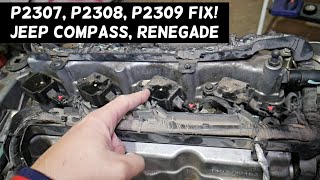
- Jeep Compass/Renegade/Cherokee (2014-2021) — Common on the 2.4L Multiair engine. Often caused by a bad coil or a loose connector; the red locking tab must be fully seated. The 2018 Compass had a PCM recall (18V524000) causing circuit faults.
- Ford F-150 (2004-2018) — EcoBoost engines are highly sensitive to aftermarket coil quality. On the 3.5L EcoBoost, passenger-side coils sit under the intake manifold, increasing labor time.
- Chrysler/Dodge/Ram Various with 3.6L/5.7L engines (2011-2020) — Wiring harnesses routed in tight, hot areas near the engine degrade rapidly, causing shorts that trigger P2307.
- Chevrolet/GMC Silverado 1500 / Sierra 1500 (2014-2015) — TSB PIP5147 addresses water intrusion into the ignition coil connector, requiring terminal repair and dielectric grease.
- Volkswagen Jetta/Golf/Passat (2005-2015) — Often related to a failed ignition coil or a short to voltage in the wiring harness. Using OEM-spec coils is critical.
- BMW M3 (E90/E92) (2008-2013) — On the S65 V8 engine, a single loose ground wire on the rear of the valve cover serving all four coils on one bank causes an intermittent P2307.
Manufacturer-Specific Notes
- Jeep/Fiat/Chrysler: On 2.4L Multiair engines, the ignition coil connector features a red safety locking pin. If not fully engaged, the connector vibrates loose and triggers this code intermittently.
- Chevrolet/GMC: TSB PIP5147 for 2014 Silverado/Sierra trucks notes water enters the coil connector, causing corrosion and P2307. The fix requires repairing terminals and applying dielectric grease to the weather seal.
- BMW: On V8 engines like the S65, a single loose ground wire on the valve cover serves all four coils on that bank, causing an intermittent P2307 for just one cylinder.
- Ford: EcoBoost engines are highly sensitive to ignition component quality. Using budget aftermarket ignition coils induces P2307 immediately after installation due to incorrect primary circuit resistance.
Real Owner Stories
2018 Jeep Compass (2.4L) at 65,000 miles
Check engine light illuminated with codes P2307 and P0303. The engine ran rough at idle.
What they tried:
- Swapped the ignition coil from cylinder #3 to cylinder #2.
- Cleared codes, but the original P2307 returned for cylinder #3, proving the coil was good.
Outcome: The owner noticed the red locking tab on the cylinder #3 coil connector was not fully seated. Pushing the connector until it clicked and engaging the lock permanently resolved the codes.
Lesson: Always verify physical connections before buying parts. Chrysler/Jeep connectors have secondary locks that must be fully engaged to prevent vibration-induced intermittent faults.
2015 Ford F-150 EcoBoost at 150,000 miles
The truck had a P0303 misfire code. The owner replaced the ignition coil on cylinder #3.
What they tried:
- After replacing the coil, the engine ran worse and barely accelerated.
- A new code, P2307, appeared, and the original P0303 vanished.
Outcome: The P2307 'circuit high' condition was caused by the new replacement coil having incorrect internal resistance. Replacing the cheap aftermarket coil with an OEM Motorcraft part fixed the issue.
Lesson: If a new circuit code appears immediately after replacing a part, the new part is the culprit. EcoBoost engines require high-quality OEM or equivalent ignition coils.
2011 BMW M3 (E92) at 38,000 miles
The car went into limp mode with a rough idle and threw a P2307 code intermittently.
What they tried:
- A shop swapped the coil, but the fault did not move.
- The shop investigated the wiring harness.
Outcome: The cause was a loose shared ground wire on the rear of the valve cover for that cylinder bank. Tightening the ground connection resolved the issue permanently.
Lesson: Intermittent electrical faults that don't follow a component swap point to wiring or grounds. A single ground point serving multiple components manifests faults in unexpected ways.
How to Prevent This Code From Triggering
- Apply dielectric grease to ignition coil boots and connector seals (Whenever replacing coils or spark plugs) — Dielectric grease seals out moisture, preventing corrosion on electrical connector pins and stopping high voltage from arcing down the outside of the spark plug boot.
- Periodically inspect and clean main engine ground straps (Every 30,000 miles or during major service) — A loose or corroded ground strap causes unstable voltages throughout the electrical system, leading to intermittent and hard-to-diagnose codes like P2307.
- Replace spark plugs at the manufacturer's recommended interval (Typically every 60,000 to 100,000 miles) — Worn spark plug electrodes widen the gap, increasing the voltage required to create a spark. This extra load overheats the ignition coil, causing premature failure.
- Protect wiring harnesses from excessive heat (During any under-hood repairs) — High temperatures break down plastic wire insulation. Ensure wiring is secured away from hot exhaust manifolds, using thermal protective sleeves if routing is tight.
- Avoid using cheap, no-name aftermarket ignition coils (When replacement is needed) — Cheap coils often have incorrect primary resistance, triggering circuit codes like P2307 immediately, and suffer from much higher failure rates than OEM parts.
Frequently Asked Questions
What does 'Ignition Coil C' mean?
Engines label cylinders in a specific order (e.g., A, B, C, D or 1, 2, 3, 4). 'Ignition Coil C' refers to the coil for the third cylinder in the firing sequence. Check your owner's manual to locate cylinder #3.
Can I just replace the ignition coil to fix P2307?
While a bad coil is common, the issue is frequently the wiring or connector. Swap the coil with a neighboring cylinder first. This free test saves you from buying an unnecessary part.
What does 'Primary Control Circuit' mean?
It is the low-voltage 'on-off switch' wiring that the car's computer uses to tell the ignition coil when to fire. The 'secondary' circuit is the high-voltage side that creates the actual spark.
What is a common misdiagnosis for P2307?
Immediately replacing the ignition coil without testing is a common mistake. If the actual problem is a short in the wiring harness, the new coil will not fix the issue and P2307 will return instantly.
I replaced the coil for a P0303 misfire and now I have a P2307, what happened?
The replacement coil is likely defective or an incorrect aftermarket part with the wrong internal resistance. Re-install the old coil; if the code reverts to P0303, the new part is the problem.
Can a bad spark plug cause P2307?
No. P2307 refers to a fault on the low-voltage primary control side of the coil. A bad spark plug exists on the high-voltage secondary side and sets a P030x or P2308 code.
How much does it cost to fix P2307?
A DIY ignition coil swap costs under $150. A professional wiring repair ranges from $150 to $350. A worst-case PCM replacement costs between $800 and $1,300.
Can a bad battery cause a P2307 code?
No. P2307 is an isolated fault in a single circuit where voltage is too high. A failing battery causes low system voltage across the entire vehicle, setting different codes.
Key Takeaways
- P2307 indicates excessively high voltage in the ignition coil 'C' control circuit, directly causing a cylinder 3 misfire (P0303).
- A shorted wiring harness or internally failed ignition coil causes 90% of P2307 codes, while PCM failures remain rare.
- Swap ignition coil 'C' with a neighboring cylinder to instantly determine if the coil is faulty or if the issue lies in the wiring.
- Driving with an active P2307 dumps unburned fuel into the exhaust, destroying a $900-$2,500 catalytic converter within 100 to 500 miles.
- Use a multimeter to test the coil connector's control pin; a reading of 12 volts with the key on confirms a short to power in the harness.
Helpful Videos

The information in this article is provided for general reference and educational purposes only. Vehicle specifications, procedures, and part compatibility can vary by production date, trim level, and region. Always consult your vehicle's factory service manual and verify part numbers before purchasing or performing repairs. Safety-critical components such as airbags, seat belts, and braking systems should be installed by a qualified professional.
- 🎬 Helpful Videos
- What Does P2307 Mean?
- Can I Drive With P2307?
- Common Causes
- Symptoms
- Diagnostic Flowchart
- Common Fixes & Costs
- DIY vs Professional
- Used vs. New Parts: Buying Guide
- What Happens If You Wait — Timeline
- Cost of Not Fixing It
- Diagnosis Steps
- When This Code Triggers (Freeze-Frame Conditions)
- Related Codes
- Climate & Environmental Factors
- How to Talk to a Mechanic About This Code
- Where to Take It: Dealer vs Independent vs Chain
- When to Walk Away From the Repair
- What Scan Tool You Need for This Code
- How to Clear the Code After You Fix It
- Will This Fail Emissions / State Inspection?
- Most Commonly Affected Vehicles
- Manufacturer-Specific Notes
- Real Owner Stories
- 2018 Jeep Compass (2.4L) at 65,000 miles
- 2015 Ford F-150 EcoBoost at 150,000 miles
- 2011 BMW M3 (E92) at 38,000 miles
- How to Prevent This Code From Triggering
- Frequently Asked Questions
- What does 'Ignition Coil C' mean?
- Can I just replace the ignition coil to fix P2307?
- What does 'Primary Control Circuit' mean?
- What is a common misdiagnosis for P2307?
- I replaced the coil for a P0303 misfire and now I have a P2307, what happened?
- Can a bad spark plug cause P2307?
- How much does it cost to fix P2307?
- Can a bad battery cause a P2307 code?
- Key Takeaways
- 🎟️ Get 5% Off