

P2299 on 2013-2017 Ram 1500: Brake & Accelerator Pedal Incompatible
On a 2013-2017 Ram 1500, code P2299 is most often caused by the driver resting their left foot on the brake while accelerating. Before suspecting parts, check for bunched-up floor mats. If driver error and obstructions are ruled out, the next most likely cause is a faulty brake light switch, an inexpensive part to replace.
- First, check your driving habits. This code is most often caused by resting your left foot on the brake pedal while driving.
- Second, check your driver-side floor mat. Make sure it is properly secured and not interfering with the accelerator pedal.
- If the issue persists, the most likely faulty part is the brake light switch, which is an affordable and relatively easy DIY replacement.
- Do not replace the expensive accelerator pedal assembly unless all other possibilities have been ruled out and other pedal-specific codes are present.
What's Unique About the 2013-2017 Ram 1500
For this generation of Ram 1500, Chrysler (now Stellantis) has issued multiple Technical Service Bulletins (TSBs) acknowledging this specific code. TSB #9003413 explicitly states that P2299 is "usually caused by a two footed driver and accelerator pedal should not be replaced for this fault." Another TSB, #53034160A, echoes this warning. This strong and repeated manufacturer guidance suggests that driver habit is a very common trigger for this code on these trucks, more so than on other vehicles where a part failure might be the immediate assumption.
Diagnostic Flowchart
Tap your situation to follow the diagnostic path that matches what you're seeing on this vehicle.
Symptoms You May Notice
- Check Engine Light is on
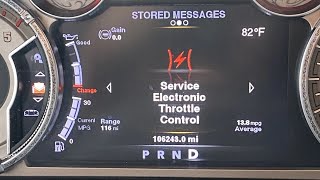
- "Service Electronic Throttle Control" message on the dash
- Reduced engine power or "limp mode"
- Unresponsive or sluggish accelerator pedal
- Cruise control may not work or disengages unexpectedly
- In some cases, especially with a floor mat obstruction, the engine may rev higher than expected when the brake is applied.
- Replacing the accelerator pedal assembly. TSB #9003413 and #53034160A specifically warn that this is usually not the correct fix for a P2299 code on its own.
Most Likely Causes
- Driver Habit (Two-Footed Driving) 🔴 High Probability Manufacturer TSB #9003413 directly identifies this as the usual cause. This can also happen unintentionally when towing, where a driver might cover the brake while still applying throttle.
How to confirm: Interview the driver. Ask if they rest their left foot on the brake pedal while driving or accelerating. This is the most common cause. One owner on a forum admitted it happened while using two feet to manage a trailer.
Typical fix: Change driving habits to keep the left foot off the brake pedal unless actively braking. Clear the code.
Est. part cost: $0 - Obstructed Accelerator or Brake Pedal 🟡 Medium Probability Thick or improperly placed floor mats can bunch up and hold the accelerator pedal down slightly, even when the driver is pressing the brake. There was a recall for this issue on 2019-2020 models, highlighting the sensitivity.
How to confirm: Visually inspect the area around the accelerator and brake pedals. Ensure the floor mat is properly secured and not interfering with pedal travel. A YouTube video by 'Dan the Fix it Man' shows this exact scenario on a 2015 Ram 1500 where a misplaced mat was the sole cause.
Typical fix: Reposition or replace the floor mat. Ensure it is the correct type for the vehicle and properly anchored.
Est. part cost: $0-$150 - Faulty Brake Light Switch (Brake Pedal Position Sensor) 🟡 Medium Probability
How to confirm: Use a scan tool to monitor live data for the brake pedal switch. The status should change from 'Off' to 'On' the instant the pedal is pressed and vice-versa. If the signal is stuck 'On' or intermittent, the switch is likely faulty.
Typical fix: Replace the brake light switch. It is typically located on the brake pedal support bracket under the dashboard and can be tricky to access. 🎬 Watch this walkthrough on how to replace the brake switch. A user on RamForumz.com confirmed a dealer replaced this switch to solve their P2299 and throttle control warnings.
Est. part cost: $25-$65 - Outdated PCM Software ⚪ Low Probability Multiple TSBs (e.g., #18-006-16 REV. B, #18-103-16 REV. B) were issued for this code, often bundled with software updates for the PCM. An older software version may have overly sensitive parameters for triggering the fault.
How to confirm: A dealership or qualified shop can check the current software calibration of the PCM against the latest available version from Ram using a tool like wiTECH.
Typical fix: Update or 'reflash' the Powertrain Control Module with the latest software. This is typically performed after confirming no physical faults exist.
Est. part cost: $0 if under warranty, otherwise $100-$250 for labor.
Rare But Worth Checking
- Wiring or Connector Issue: Corrosion or damage to the wiring or connectors for the brake pedal switch or accelerator pedal assembly can cause intermittent signals. The harness near the pedals can be stressed or kicked. A visual inspection of the harness for chafing or loose pins is a key diagnostic step.
- Failing Accelerator Pedal Position (APP) Sensor: While TSB #9003413 advises against replacing the pedal for P2299 alone, a failing sensor can still be the root cause, especially if other pedal-related codes like P2122 or P2127 are also present. A faulty APP sensor can send a signal indicating the throttle is open even when it is not.
Diagnosis Steps
- Check for other stored trouble codes. Address any other codes first, especially those related to the ABS or throttle system.
- Ask the primary driver about their driving habits, specifically if they use two feet to drive (one on gas, one on brake).
- Inspect the driver's side floor area. Remove the floor mat completely and check for any interference with the accelerator or brake pedal.
- Using a capable OBD-II scanner, view the live data streams for the Accelerator Pedal Position (APP) sensors and the Brake Pedal Switch.
- Verify that with both pedals at rest, the APP sensor reads 0% and the Brake Switch status reads 'Off' simultaneously.
- Verify that the brake switch status changes to 'On' immediately when the brake pedal is pressed and back to 'Off' when released.
- Verify that the APP sensor percentages increase smoothly from 0% as you press the accelerator pedal.
- With the engine off, press both pedals and observe the live data to see if the readings are logical.
- Inspect the wiring and connectors at the brake light switch and the accelerator pedal assembly for any signs of damage, corrosion, or looseness.
- If all else checks out, consult a dealer or qualified shop to check for available PCM software updates related to the TSBs for this code.
Parts You'll Likely Need
- Brake Light Switch / Brake Pedal Position Sensor
(OEM #68493444AA)— This sensor tells the computer when the brake is applied. If it sticks or sends a false signal, it can trigger P2299. It is a common failure point and an inexpensive part to replace. Note: Part number 68163996AA may be a superseded number; always verify with VIN.
Trusted brands: Mopar, Standard Motor Products (SMP)
OEM price range: $40-$65
Aftermarket price range: $25-$50
Related Codes That Often Appear With This One
- P0335 — TSB #18-006-16 REV. B notes that P2299 can appear alongside P0335 (Crankshaft Position Sensor Circuit) as part of a software-related issue that a PCM reflash may resolve.
- P2610 — TSB #18-006-16 REV. B also lists P2610 (PCM Internal Engine Off Timer Performance) as a code that may be set along with P2299, pointing towards a potential PCM software glitch.
- P0116 — TSB #18-103-16 REV. B links P2299 with P0116 (Engine Coolant Temperature Sensor Performance) for 2014-2015 models, suggesting a broader electronic issue that a software update may resolve.
Technical Service Bulletins (TSBs) & Recalls
- 9003413: States P2299 is usually caused by a 'two footed driver' and the accelerator pedal should not be replaced for this fault.
- 18-006-16 REV. B: Lists P2299 as a potential code that may be resolved with a PCM software update for 2016 models.
- 18-019-15 REV C: Identifies P2299 - Brake Pedal Position/Accelerator Pedal Position Incompatible as a possible diagnostic trouble code for diesel models.
- 18-103-16 REV. B: Notes P2299 as a code that may be set on 2014-2015 models, potentially related to a software issue.
- 53034160A: Also warns that P2299 is usually caused by a two-footed driver and not to replace the accelerator pedal.
Platform-Specific Known Issues
- A floor mat obstructing the accelerator pedal was shown to cause this exact code and symptom set on a 2015 Ram 1500.
- Multiple TSBs exist for this code, indicating it's a known software sensitivity or pattern failure on this platform.
- The code can be triggered during specific use cases like towing, where a driver might inadvertently apply both pedals to maintain control on a grade.
Mechanic-Grade Diagnostic Values
- Accelerator Pedal Position Sensor (APP) 5-Volt Supply Circuit — expected: 4.5 to 5.2 Volts at the APP sensor harness connector with ignition on, engine off.. Failure: Voltage outside this range indicates an open or short in the F855 supply circuit.
- Brake Pedal Position (BPP) Sensor Voltage — expected: Approximately 0.5V with pedal released to approximately 4.5V when fully pressed.. Failure: Voltage that is stuck, does not change smoothly, or is present without the pedal being pressed indicates a faulty switch or circuit.
- Accelerator Pedal Position Sensor (APP) Signal Voltage Sweep — expected: Voltage should start at approximately 0.45V at rest and increase smoothly to above 4.6V at wide-open throttle.. Failure: Gaps, spikes, or a voltage reading below 0.25V at rest can indicate a failing sensor.
- APP Sensor Resistance — expected: Typically between 1.5 kΩ and 3.5 kΩ, but varies by circuit.. Failure: Readings outside the manufacturer's specified range suggest a faulty sensor.
Scan Tool Commands That Help
- wiTECH (Dealer Scan Tool): PCM Reprogram/Flash — Used to apply software updates as specified in TSBs like 18-006-16 REV. B, which can resolve P2299 if it's caused by overly sensitive software parameters.
- wiTECH or equivalent professional scanner: ETC Relearn / Throttle Follower Test — After replacing the accelerator pedal assembly or throttle body, this function is used to relearn the new sensor's values.
- wiTECH or equivalent professional scanner: Brake Position Sensor Relearn — After replacing the brake light switch/BPP sensor, this function in the BCM (Body Control Module) resets the calibration parameters for the new sensor.
- Manual Procedure: Throttle Pedal Relearn — Can be attempted after cleaning a throttle body or disconnecting the battery. Turn ignition to ON (engine off), wait for dash lights to cycle, slowly press the accelerator to the floor, hold for 10 seconds, slowly release, then turn ignition off before starting the engine.
Wiring & Ground Locations
- APP Sensor Connector — At the top of the accelerator pedal assembly.. This is the primary connection point for testing APP sensor circuits. It contains the 5V supply (F855), ground, and two signal wires (e.g., K23, K29).
- Brake Pedal Position Sensor Connector — On the brake pedal support bracket under the dashboard.. This connector provides power and signal paths for the brake switch. A poor connection here can cause a false 'brake applied' signal, triggering P2299.
- Driver-Side Connector Panel — A white connector panel located against the driver-side firewall, behind the emergency brake pedal.. This area serves as a junction for various interior harnesses and is a potential point of failure or corrosion for circuits related to the pedals.
- F855 / K23 / K167 Circuits — These are circuit designators within the wiring harness running between the PCM and the accelerator pedal.. Knowing these specific circuit names from a wiring diagram (F855 is 5V Supply, K23 is Signal 1, K167 is Return 1) is essential for performing pinpoint electrical tests with a multimeter.
When the Usual Fixes Don't Work
- While multiple TSBs state that P2299 is 'usually caused by a two footed driver' and warn against replacing the accelerator pedal, this does not mean the pedal can never be the cause. The accelerator pedal assembly is a non-serviceable unit containing two separate Accelerator Pedal Position (APP) sensors. If one of these internal sensors fails, it can send an incorrect voltage signal (e.g., reporting the throttle is open when it is not), which will trigger P2299 when the brake is pressed. In this scenario, despite the TSB's advice, replacing the entire accelerator pedal assembly is the correct and necessary repair.
OEM Part Supersession History
68163996AA→68493444AA— Part update or manufacturer change.
Heads up: The Pass 2 data suggests this supersession. However, multiple parts suppliers list 68493444AA as fitting 2021-2024 Ram 1500 models, not the 2013-2017 range. This could indicate the new part is not backward compatible. Always verify the correct part number with the vehicle's VIN before ordering.
Model Year Variations Within This Range
- 2013+: Wiring configurations for the 2013-2018 models differ from the earlier 2009-2012 generation, affecting diagnostic procedures and harness connections. Pinouts for the Body Control Module (BCM) also vary between model years within the 2013-2017 range.
- 2014-2015: For these specific model years, TSB #18-103-16 REV. B notes that P2299 may be set along with P0116 (Engine Coolant Temperature Sensor Performance), pointing to a software issue addressed by a PCM update that may be unique to these years.
Helpful Videos
We Have This Part in Stock


The information in this article is provided for general reference and educational purposes only. Vehicle specifications, procedures, and part compatibility can vary by production date, trim level, and region. Always consult your vehicle's factory service manual and verify part numbers before purchasing or performing repairs. Safety-critical components such as airbags, seat belts, and braking systems should be installed by a qualified professional.
- Ram 1500:
- 🎬 Helpful Videos
- 🛍️ Shop This Part
- What's Unique About the 2013-2017 Ram 1500
- Diagnostic Flowchart
- Symptoms You May Notice
- Most Likely Causes
- Rare But Worth Checking
- Diagnosis Steps
- Parts You'll Likely Need
- Related Codes That Often Appear With This One
- Technical Service Bulletins (TSBs) & Recalls
- Platform-Specific Known Issues
- Mechanic-Grade Diagnostic Values
- Scan Tool Commands That Help
- Wiring & Ground Locations
- When the Usual Fixes Don't Work
- OEM Part Supersession History
- Model Year Variations Within This Range
- 🎟️ Get 5% Off