

P2271 on 2007-2008 Acura TSX: Causes for Stuck Rich O2 Sensor and Fixes
On a 2007-2008 Acura TSX, code P2271 points to the rear O2 sensor but is almost always caused by the Powertrain Control Module (PCM) misinterpreting the front Air/Fuel sensor. An official Acura Technical Service Bulletin (TSB) recommends a PCM software update or replacing both sensors as the primary fix. Do not replace only the rear sensor, as this is a common misdiagnosis that will not solve the issue.
- For a 2007-2008 Acura TSX, P2271 is most likely a PCM software issue, not a bad rear O2 sensor.
- The first and most important step is to have an Acura dealer or qualified shop update the PCM software.
- Do not simply replace the rear O2 sensor (Sensor 2); you will likely waste money as the code will return.
- The official fix from Acura, per TSB #BTS180603, is to replace both the primary A/F sensor and the secondary O2 sensor after ensuring the PCM is updated.
What's Unique About the 2007-2008 Acura TSX
The first-generation Acura TSX has a well-documented issue where the PCM's software incorrectly processes the signal from the primary (upstream) Air/Fuel Ratio Sensor. This leads the computer to mistakenly believe the secondary (downstream) O2 sensor is stuck rich, triggering the P2271 code. Acura released Technical Service Bulletins to address this specific logic flaw, making a PCM software update and/or replacement of both sensors a critical first step. This is a unique situation compared to other vehicles where P2271 usually points to a bad sensor, wiring issue, or exhaust leak.
Diagnostic Flowchart
Tap your situation to follow the diagnostic path that matches what you're seeing on this vehicle.
Symptoms You May Notice
- Check Engine Light (also called Malfunction Indicator Lamp or MIL) is on
- Decreased fuel economy, often by 5-15%
- Possible smell of gasoline or "rotten eggs" from the exhaust
- In some cases, no noticeable drivability issues other than the CEL
- Immediately replacing the secondary O2 sensor (Sensor 2) without first checking for a required PCM software update. A forum user on Revscene.net reported replacing the sensor three times with different brands (Denso, NTK, NGK), only for the code to return each time because the root cause was the PCM logic.
Most Likely Causes
- PCM Software Requires Update 🔴 High Probability Acura issued TSBs #B18100D and #BTS180603 specifically for this issue, stating the PCM misinterprets the primary A/F sensor (Sensor 1) signal, causing it to falsely flag Sensor 2.
How to confirm: Contact an Acura dealership or a qualified shop with OEM-level tools to check if the PCM software is up to date against the TSB. This is the most important first step. Dealerships may charge a diagnostic fee of $150-$250 for this service.
Typical fix: Perform a PCM software update (reflash). In many cases, the TSB also recommends replacing both sensors at the same time as the update.
Est. part cost: $0 - Failing Primary Air/Fuel (A/F) Ratio Sensor (Sensor 1) 🟡 Medium Probability The TSBs indicate the PCM misinterprets the signal from Sensor 1. A failing or degraded sensor can send erratic data that the old PCM software cannot handle correctly, triggering the false code for Sensor 2.
How to confirm: Use a scan tool to monitor the live data from Sensor 1. Look for slow response times or voltage/AFR values that don't change appropriately with engine load and throttle input. The heater resistance should be between 5.4-7.3 ohms.
Typical fix: Replace the primary (upstream) Air/Fuel Ratio Sensor. Per TSB #BTS180603, Acura's official fix is to replace both sensors to ensure compatibility with the updated software.
Est. part cost: $90-$200 - Failing Secondary Oxygen Sensor (Sensor 2) ⚪ Low Probability While the code directly names this sensor, it's often not the root cause due to the known PCM issue. However, sensors can fail, and the official TSB procedure involves replacing it along with the primary sensor.
How to confirm: After performing a PCM update and checking Sensor 1, if the code persists, test Sensor 2. A stuck high voltage between 0.8V-1.0V on a scan tool's live data points to a bad sensor.
Typical fix: Replace the secondary (downstream) oxygen sensor. This is often done along with the primary sensor as per the TSB.
Est. part cost: $50-$120 - Exhaust Leak ⚪ Low Probability
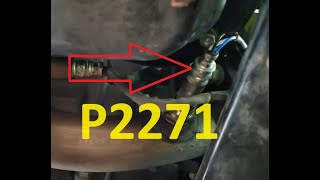
How to confirm: Visually inspect the exhaust system between the engine and the secondary O2 sensor for cracks or loose connections. A shop can perform a smoke test to find small leaks. This is a less likely cause for the TSX-specific issue but a common cause for P2271 on other vehicles. 🎬 Watch: Understanding the P2271 code and common causes
Typical fix: Repair the leak by replacing the gasket or welding the cracked component.
Est. part cost: $10-$100
Diagnosis Steps
- Check for TSBs: Confirm the applicability of Acura TSBs #B18100D and #BTS180603 for your vehicle's VIN. This is the most critical step.
- Update PCM Software: The highest priority is to have an Acura dealer or qualified shop update the PCM software to the latest version. This alone may fix the problem, though the TSB recommends sensor replacement as well. Expect a dealer cost of $150-$250 for this service if not covered by a warranty.
- Clear Codes and Test Drive: After the update, clear the P2271 code and drive the vehicle for at least 50km to see if it returns.
- Analyze Live Sensor Data: If the code returns, use an OBD-II scanner with live data capability. Observe the voltage/current from both the primary A/F sensor (Sensor 1) and the secondary O2 sensor (Sensor 2). Sensor 2 voltage should fluctuate but not remain stuck high (above ~0.8V).
- Inspect Primary A/F Sensor (Sensor 1): Look for lazy or erratic signals from Sensor 1. Given the TSB, this sensor is the next likely culprit if the PCM update alone was insufficient. Check that its heater resistance is within the 5.4-7.3 ohm specification.
- Replace Both Sensors: If the PCM is updated and the code persists, follow the TSB's advice and replace both the primary A/F sensor and the secondary O2 sensor. This ensures the entire system is operating to the new software's parameters.
- Inspect for Exhaust Leaks: As a secondary check, thoroughly inspect the exhaust system for any leaks between the two sensors.
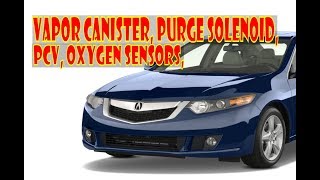
- Inspect Wiring: As a final step, inspect the wiring and connectors for both sensors for any damage, corrosion, or short circuits. Check continuity and verify the integrity of the main engine-to-chassis ground, G101, located at the top left rear of the engine. 🎬 Watch: Locate your oxygen sensors and other emission components
Parts You'll Likely Need
- Primary Air/Fuel Ratio Sensor (Upstream, Sensor 1)
(OEM #36531-RBB-003)— This sensor's signal is misinterpreted by the PCM, as stated in Acura TSBs. A failing sensor can provide faulty data, making it a primary cause. The TSB recommends replacing it.
Trusted brands: Denso (OEM supplier, Part #234-9066), NGK/NTK
OEM price range: $150-$220
Aftermarket price range: $90-$160 - Secondary Oxygen Sensor (Downstream, Sensor 2)
(OEM #36532-RAD-L12)— While often not the root cause, the official TSB fix involves replacing both sensors to ensure the system works correctly with the updated PCM software.
Trusted brands: Denso (OEM supplier, Part #234-4797), NGK/NTK
OEM price range: $100-$150
Aftermarket price range: $50-$120
Related Codes That Often Appear With This One
- P0139 — P0139 indicates 'O2 Sensor Circuit Slow Response (Bank 1 Sensor 2)'. A failing or confused secondary O2 sensor, or the PCM logic flaw itself, can trigger both codes simultaneously as the computer struggles to interpret the signals.
Technical Service Bulletins (TSBs) & Recalls
- B18100D: "Servicenews article - Is the MIL on with DTC P2271 (secondary HO2S [sensor 2] circuit signal stuck rich)? What's likely causing this is the PCM is misinterpreting the A/F sensor (sensor 1) signals..."
- BTS180603: "Tech line summary article - Is the MIL on with DTC P2271 (secondary HO2S [sensor 2] circuit signal stuck rich)? What's likely causing this is the PCM is misinterpreting the A/F sensor (sensor 1) signals, causing the PCM to think that sensor 2 is stuck rich. To fix this issue, replace both sensors."
Platform-Specific Known Issues
- PCM Logic Flaw: As per TSBs #B18100D and #BTS180603, the primary documented issue for P2271 on this vehicle is a PCM software problem where it misinterprets the signal from the upstream A/F sensor, leading to a false 'stuck rich' code for the downstream O2 sensor. The official fix is to replace both sensors and, if necessary, update the PCM software.
Mechanic-Grade Diagnostic Values
- Secondary O2 Sensor (Sensor 2) Voltage — expected: Slowly fluctuating voltage, typically between 0.1V and 0.9V.. Failure: A steady, non-fluctuating voltage between 0.8V and 1.0V indicates a stuck rich condition.
- Primary A/F Sensor (Sensor 1) Heater Resistance — expected: 5.4 - 7.3 ohms. Failure: A reading outside this range indicates a faulty heater circuit within the primary sensor, which can contribute to incorrect signals being sent to the PCM.
- Sensor Wiring Harness Continuity — expected: Less than 1.0 ohm. Failure: Resistance greater than 1.0 ohm suggests corrosion or a break in the wire, which can cause signal issues.
Scan Tool Commands That Help
- Professional Scan Tool (e.g., Acura HDS): PCM O2 Sensor Self-Test — After verifying wiring is intact, run this self-test. A failure here strongly suggests an internal PCM processing fault, pointing away from the sensor or wiring as the root cause.
Wiring & Ground Locations
- G101 — Located at the top left rear of the engine.. This is a primary ground termination point for the ECM/PCM and multiple engine sensors. A poor connection at G101 can cause erratic sensor readings and communication issues, potentially contributing to false trouble codes.
Helpful Videos

We Have This Part in Stock

The information in this article is provided for general reference and educational purposes only. Vehicle specifications, procedures, and part compatibility can vary by production date, trim level, and region. Always consult your vehicle's factory service manual and verify part numbers before purchasing or performing repairs. Safety-critical components such as airbags, seat belts, and braking systems should be installed by a qualified professional.
- Acura TSX:
- 🎬 Helpful Videos
- 🛍️ Shop This Part
- What's Unique About the 2007-2008 Acura TSX
- Diagnostic Flowchart
- Symptoms You May Notice
- Most Likely Causes
- Diagnosis Steps
- Parts You'll Likely Need
- Related Codes That Often Appear With This One
- Technical Service Bulletins (TSBs) & Recalls
- Platform-Specific Known Issues
- Mechanic-Grade Diagnostic Values
- Scan Tool Commands That Help
- Wiring & Ground Locations
- 🎟️ Get 5% Off