

P2269 on 2017-2018 Ford F-350 SD: Water in Fuel Causes and Fixes
This code almost always means water has been detected in the fuel. The most common cause on this specific truck is water getting into the Water in Fuel (WIF) sensor's electrical connector, as noted in Ford TSB 18-2133. Start by draining the fuel/water separator and inspecting the sensor connector (C3080) for moisture or corrosion before replacing any parts.
- P2269 on your F-350 means the truck thinks there is water in the fuel; this is a serious warning that should not be ignored.
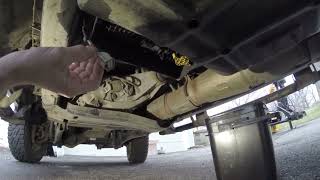
- The first and easiest step is to drain the fuel/water separator on the frame rail to check for actual water.
- The most likely culprit is not bad fuel, but a wet or corroded electrical connector at the Water in Fuel (WIF) sensor, a problem documented by Ford in TSB 18-2133.
- A simple fix of cleaning, drying, and applying dielectric grease to the WIF sensor connector resolves the issue in many cases.
- Driving with actual water in a modern diesel fuel system can lead to extremely expensive repairs to the high-pressure fuel pump and injectors.
What's Unique About the 2017-2018 Ford F-350 SD
The 2017-2018 Super Duty trucks with the 6.7L Power Stroke engine are known for a specific vulnerability that causes false P2269 codes. Ford issued Technical Service Bulletin (TSB) 18-2133, which points to water intrusion into the WIF sensor's electrical connector (C3080) as a common problem for vehicles built on or before March 15, 2018. This means that even if there is no water in the fuel, moisture wicking into the back of the connector itself can create a short or change in resistance, tricking the PCM into setting the code and illuminating the warning light.
Diagnostic Flowchart
Tap your situation to follow the diagnostic path that matches what you're seeing on this vehicle.
Symptoms You May Notice
- "Water in Fuel" warning light illuminated on the dashboard.
- Check Engine Light (Malfunction Indicator Lamp) is on.
- Reduced engine power or "limp mode".
- Engine may run rough, hesitate, or stall.
- Engine may be hard to start or fail to start.
- Replacing the entire fuel filter assembly (DFCM) when only the sensor or its connector is faulty.
- Assuming the fuel is contaminated without first draining the separator to verify the presence of water.
- Replacing the WIF sensor when the actual fault is moisture in the connector or a chafed wire further up the harness.
Most Likely Causes
- Water Intrusion at WIF Sensor Connector 🔴 High Probability Ford TSB 18-2133 specifically identifies this as a common issue on 2017-2018 models built before March 15, 2018, where water gets into connector C3080. The connector is in a location susceptible to road spray, and the original wiring harness seal was inadequate.
How to confirm: Unplug the WIF sensor connector and visually inspect for moisture, white or green corrosion, or damaged pins. Wiggling the harness near the connector may cause the warning light to flicker or the voltage reading on a scan tool to jump around. A normal voltage reading with no water is typically around 2.67V; a drop in voltage indicates water detection or a short.
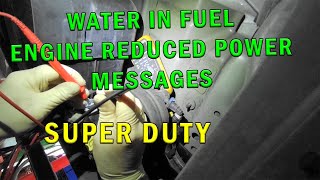
Typical fix: Thoroughly dry the connector with low-pressure air (under 25 psi per Ford). Clean any corrosion from the pins using electrical contact cleaner. Apply dielectric grease to the connector seal before reconnecting. TSB 18-2133 also advises wrapping the harness behind the connector with Coroplast electrical tape to prevent future water intrusion. If the connector or pins are heavily corroded, the connector pigtail will need to be replaced. 🎬 Watch: How to fix the water in fuel light issue.
Est. part cost: $5-$50 - Water in the Fuel 🟡 Medium Probability Can occur from a bad batch of fuel from a filling station, or condensation building up in the fuel tank, especially in humid climates.
How to confirm: Drain the fuel/water separator (located on the driver's side frame rail) into a clear container. Water is denser than diesel and will settle at the bottom as a distinct layer. If you see only clean diesel, the fuel is not the issue.
Typical fix: Drain the fuel/water separator until only clean diesel fuel comes out. If a large amount of water is found (more than a few ounces), the fuel tank may need to be drained and cleaned to prevent damage to the high-pressure fuel system.
Est. part cost: $0 - Faulty Water in Fuel (WIF) Sensor 🟡 Medium Probability The sensor can fail internally over time, or the sensing probes can become coated with sediment or biofilm, leading to false readings even after the fuel is drained.
How to confirm: If the connector is clean and dry, and there is no water in the fuel, the sensor is the next likely culprit. The TSB procedure involves testing the sensor's resistance with a multimeter. If the sensor shows continuity when dry, it is faulty. If the resistance test fails, the sensor is bad.
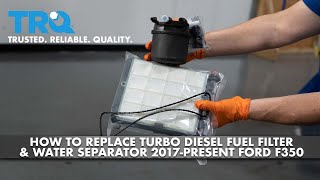
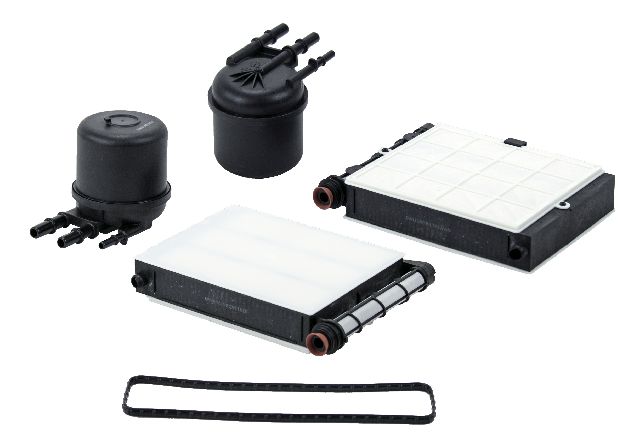
Typical fix: Replace the Water in Fuel (WIF) sensor. It is located on the bottom of the frame-mounted fuel filter housing and can be replaced without replacing the entire housing. 🎬 See this walkthrough for replacing the fuel filter and sensor. After replacement, some scan tools have a function to 'Reset Water in Fuel Counter', which may be necessary to clear the light.
Est. part cost: $45-$90 - PCM Software Glitch ⚪ Low Probability Ford TSB 21-2368 notes that P2269 (among many other codes) can be set erroneously due to PCM software logic on 2017 models. [NHTSA]
How to confirm: This is a diagnosis of exclusion. If all other physical causes (connector, wiring, sensor, fuel quality) are ruled out, a software issue may be the cause. This requires a scan tool to check the current PCM software calibration version against available updates from Ford.
Typical fix: Reprogram the Powertrain Control Module (PCM) with the latest software version at a Ford dealership or qualified shop with a Ford-compatible scan tool. [NHTSA]
Est. part cost: $0 (if under warranty) - $200
Rare But Worth Checking
- Chafed or Damaged Wiring Harness: The wiring harness leading to the WIF sensor can rub against the fuel tank shield, frame, or other components, wearing through the insulation and causing a short circuit that mimics the signal for water detection. This can happen a few inches away from the connector itself and may require careful inspection of the entire harness section.
Diagnosis Steps
- Check the dashboard for an active 'Water in Fuel' warning light and 'Reduced Engine Power' message.
- Drain the frame-mounted fuel/water separator into a clear jar. Look for a separate layer of water at the bottom. If water is present, drain until clear. If not, the problem is likely electrical.
- If no water is present, locate the WIF sensor on the bottom of the fuel filter housing (DFCM).
- Disconnect the electrical connector (C3080) and inspect it carefully for any signs of moisture, corrosion (white or green powder), or bent pins.
- If the connector is wet or corroded, clean it with electrical contact cleaner, dry it completely with low-pressure compressed air, and apply a small amount of dielectric grease to the seal before reconnecting. Consider wrapping the harness with electrical tape per TSB 18-2133.
- If the connector is clean and dry, inspect the wiring harness leading to the sensor for any signs of chafing or damage, especially where it might rub against the fuel tank shield.
- If the wiring and connector are good, the WIF sensor itself may be faulty. Test the sensor's resistance according to the service manual or TSB 18-2133. If it fails, replace it.
- After any repairs, clear the codes using an OBD-II scanner. If the sensor was replaced, use a capable scan tool to perform the 'Reset Water in Fuel Counter' function if available.
- If the code returns and all physical components are verified as good, consult a dealer about a potential PCM software update per TSB 21-2368. [NHTSA]
Parts You'll Likely Need
- Water in Fuel (WIF) Sensor
(OEM #HC3Z-9T321-B)— This sensor fails or gives false readings. It's the primary component responsible for detecting water. This part number supersedes the previous version HC3Z-9T321-A.
Trusted brands: Motorcraft, Dorman, Standard Motor Products
OEM price range: $60-$90
Aftermarket price range: $45-$65 - WIF Sensor Connector Pigtail
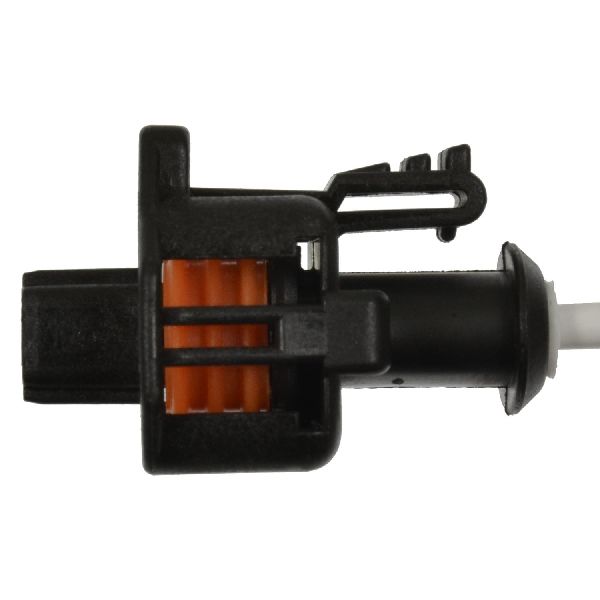
(OEM #WPT-1716)— Required if the original connector is damaged by water intrusion or corrosion, a common issue identified in TSB 18-2133.
Trusted brands: Motorcraft, Standard Motor Products
OEM price range: $30-$50
Aftermarket price range: $20-$40 - Dielectric Grease — Used to seal the electrical connector to prevent future moisture intrusion, which is the root cause of the problem in many cases.
Trusted brands: Permatex, CRC
OEM price range: $5-$10
Aftermarket price range: $5-$10
Related Codes That Often Appear With This One
- P1140 — Another 'Water in Fuel Detected' code often set alongside P2269, as mentioned in TSB 18-2133.
- P2266 — A code for 'Water in Fuel Sensor Circuit Low', also mentioned in TSB 18-2133 as being related to the same connector issue.
- P0088 — Indicates 'Fuel Rail/System Pressure - Too High'. This can sometimes occur with water contamination issues or the resulting engine stumbling and dying.
Technical Service Bulletins (TSBs) & Recalls
- TSB 18-2133: Addresses an illuminated Water In Fuel (WIF) indicator with DTCs P1140, P2266 and/or P2269 due to water intrusion into connector C3080.
- TSB 21-2368: Addresses multiple DTCs, including P2269, that may be resolved by a PCM software update. [NHTSA]
Platform-Specific Known Issues
- cause: TSB 18-2133: Ford explicitly acknowledges that on 2017-2018 models built before March 15, 2018, the WIF indicator can illuminate with code P2269 due to water getting into the sensor's electrical connector C3080. The fix involves inspecting, drying, and applying dielectric grease, and potentially replacing the sensor if a resistance test fails.
- cause: TSB 21-2368: Ford notes that on some 2017 models, code P2269 can be set as part of a larger group of codes caused by PCM software that needs updating. This is a diagnosis of exclusion after physical causes are ruled out. [NHTSA]
- cause: Harness Chafing: Owners and technicians have reported finding the WIF sensor harness worn through where it rubs against the fuel tank shield, causing a short to ground that triggers the P2269 code. This issue can occur even on newer models not covered by the TSB.
Mechanic-Grade Diagnostic Values
- WIF Sensor Signal Voltage (Dry) — expected: Approximately 2.67 Volts. Failure: Voltage significantly lower than 2.67V suggests a short or water detection.
- WIF Sensor Resistance (Dry) — expected: O.L. (Out of Limits / Open Circuit). Failure: Any continuity or measurable resistance reading indicates a faulty sensor that is internally shorted.
Scan Tool Commands That Help
- Ford IDS (or equivalent): Reset Water in Fuel Counter — This function should be performed after draining water from the separator or replacing the WIF sensor to clear the warning message and ensure the system properly recognizes the repair.
- Ford IDS (or equivalent): Fuel System - Low Pressure Side Procedure — TSB 18-2133 specifies running this procedure after completing repairs. It likely primes the low-pressure fuel system and resets related parameters in the PCM.
Wiring & Ground Locations
- C3080 — The electrical connector for the Water in Fuel (WIF) sensor, located on the bottom of the frame-mounted fuel filter housing (DFCM) on the driver's side.. This connector is the primary subject of TSB 18-2133, as it is prone to water intrusion, which directly causes false P2269 codes.
- C3080 Pin 1 (Blue wire) — Pin 1 of the WIF sensor connector.. This is the signal wire. A technician measured 2.67V on this wire during diagnosis, providing a key reference value.
- C3080 Pin 2 (Yellow/Violet wire) — Pin 2 of the WIF sensor connector.. This is the signal return wire, which is grounded in the PCM. It should have 0 volts.
Real Owner Repair Stories
- Reddit user 'beingsmartihope' on r/Diesel (2017 Ford 6.7L Power Stroke) — Truck choked for fuel on remote start, then died. Codes P2269 and P0088 appeared, followed by P2291 after clearing.
❌ Tried (didn't work) Clearing codes initially. The truck would not restart and showed a 'fuel pressure low' message.
✅ What actually fixed it The user drained water from the frame-mounted fuel filter and planned to replace the filter element to resolve the issue. The community confirmed this was the correct first step for the symptoms and codes.
OEM Part Supersession History
HC3Z-9T321-A→HC3Z-9T321-B— The -B revision is the updated part specified in TSB 18-2133 for replacement if the sensor fails its resistance test. This suggests the update may be related to durability or resistance to false readings.
Model Year Variations Within This Range
- 2018: The 2018 model year 6.7L Power Stroke engine received updated cylinder heads, contributing to a factory rating increase of +10 HP and +10 lb-ft of torque compared to the 2017 model. While not directly related to the WIF sensor, it is a notable mechanical difference within the specified vehicle range.
- 2017-Early 2018: Vehicles built on or before March 15, 2018, are specifically called out in TSB 18-2133 as being prone to the WIF sensor connector water intrusion issue. This implies that vehicles built after this date may have an improved harness or connector seal from the factory.
Helpful Videos
We Have This Part in Stock


The information in this article is provided for general reference and educational purposes only. Vehicle specifications, procedures, and part compatibility can vary by production date, trim level, and region. Always consult your vehicle's factory service manual and verify part numbers before purchasing or performing repairs. Safety-critical components such as airbags, seat belts, and braking systems should be installed by a qualified professional.
- Ford F-350 SD:
- 🎬 Helpful Videos
- 🛍️ Shop This Part
- What's Unique About the 2017-2018 Ford F-350 SD
- Diagnostic Flowchart
- Symptoms You May Notice
- Most Likely Causes
- Rare But Worth Checking
- Diagnosis Steps
- Parts You'll Likely Need
- Related Codes That Often Appear With This One
- Technical Service Bulletins (TSBs) & Recalls
- Platform-Specific Known Issues
- Mechanic-Grade Diagnostic Values
- Scan Tool Commands That Help
- Wiring & Ground Locations
- Real Owner Repair Stories
- OEM Part Supersession History
- Model Year Variations Within This Range
- 🎟️ Get 5% Off