

OBD-II Code P2269: Water in Fuel Condition
The Ultimate 2026 Guide to Diagnosing and Fixing P2269
- P2269 indicates water in your diesel fuel, a critical condition that destroys high-pressure fuel pumps if ignored.
- Stop driving immediately to prevent catastrophic fuel injection system damage that frequently exceeds $8,000 in repair costs.
- Always start diagnosis by draining the fuel-water separator into a clear glass jar to visually confirm water presence before buying parts.
- False alarms are extremely common on Ford and Ram trucks, typically caused by external moisture shorting the sensor connector rather than actual fuel contamination.
What Does P2269 Mean?

P2269 triggers when the Powertrain Control Module (PCM) detects water in the fuel via the Water in Fuel (WIF) sensor. This code primarily affects diesel vehicles. Because water displaces diesel's lubricating properties, it causes immediate friction, wear, and corrosion inside high-pressure injection components.
Technical definition: SAE/OBD-II defines P2269 as "Water in Fuel Condition - Sensor A". The PCM receives a voltage signal from the WIF sensor—typically located in the fuel filter housing—that exceeds the programmed threshold for water content. The sensor measures fluid resistance; water accumulation alters this resistance, setting the code.
Can I Drive With P2269?
No — Do Not Drive. You must stop driving immediately. Water destroys the lubricating properties of diesel fuel, causing rapid, catastrophic damage to the high-pressure fuel pump and injectors. Continuing to drive guarantees repairs frequently exceeding $8,000.
Common Causes

- Water or contaminants in the fuel. (Very Common) — The most frequent legitimate cause. Water enters the fuel through tank condensation, contaminated gas station pumps, or missing fuel caps.
- External moisture on the WIF sensor connector. (Very Common) — Rainwater or car wash spray frequently infiltrates the external electrical connector on the sensor, creating a short circuit that the PCM misinterprets as water inside the fuel filter.
- Clogged or saturated fuel filter. (Common) — The fuel filter separates water from diesel. Once it reaches maximum capacity or exceeds its service life, water bypasses the filter medium and triggers the sensor.
- Faulty Water in Fuel (WIF) sensor. (Common) — The sensor itself fails internally or becomes permanently fouled by debris, sending a false contamination signal to the PCM.
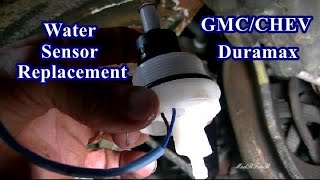
- Improper fuel filter service. (Less Common) — Mechanics sometimes forget to transfer the reusable WIF sensor 🎬 Watch: Duramax fuel filter and water sensor replacement walkthrough. from the old filter to the new one, leaving the connector unplugged and triggering a fault.
- Compromised fuel system seals or lines. (Less Common) — Cracked rubber hoses or rust holes in the fuel filler neck allow atmospheric moisture and rainwater to seep directly into the fuel supply.
- Faulty PCM or outdated software. (Rare) — The vehicle's main computer misinterprets sensor data due to a software glitch. Manufacturers occasionally release software updates specifically to fix hyper-sensitive WIF logic.
Symptoms

- Check Engine Light is on — The primary and sometimes only indicator of a problem.
- Water in Fuel warning light/chime — Diesel trucks feature a dedicated dashboard light and audible chime for this specific emergency.
- Engine runs rough, hesitates, or stalls — Combustion fails as water reaches the injectors, causing violent stumbling, poor acceleration, or complete stalling.
- Engine cranks but will not start — Severe water contamination prevents ignition entirely, or the PCM disables the starter circuit to save the engine.
- Reduced engine power (Limp Mode) (also visible on scanner) — The PCM intentionally limits RPM and turbo boost to protect the high-pressure fuel pump from catastrophic failure.
Diagnostic Flowchart
Tap your situation to follow the diagnostic path that matches what you're seeing on this code.
Common Fixes & Costs

- Drain water from the fuel/water separator — Parts: $0, Labor: $50 - $150, ~0.5 hr book time (DIY)
- Clean and seal WIF sensor connector — Parts: $10 - $20, Labor: $50 - $100, ~0.5 hr book time (DIY)
- Replace the fuel filter — Parts: $40 - $150, Labor: $80 - $200, ~0.8 hr book time (DIY)
- Replace the Water in Fuel (WIF) sensor — Parts: $30 - $160, Labor: $100 - $250, ~1.2 hr book time (Intermediate)
- Replace High-Pressure Fuel Pump & Injectors — Parts: $3,000 - $6,000, Labor: $2,000 - $4,000, ~15.0 hr book time (Professional)
DIY vs Professional
- Drain water from the fuel/water separator — Beginner:
Tools: Clear glass container, wrench, gloves, safety glasses. - Clean and seal WIF sensor connector — Beginner:
Tools: Electrical contact cleaner, dielectric grease, clean rag. - Replace the fuel filter — Beginner:
Tools: New fuel filter, filter wrench, socket set, drain pan. - Replace the Water in Fuel (WIF) sensor — Beginner:
Tools: New WIF sensor, socket set, pick tool, drain pan.
Used vs. New Parts: Buying Guide
When a used part is worth it: Buying a used WIF sensor is not recommended. However, sourcing a complete used fuel filter canister assembly from a low-mileage collision donor is viable if the OEM assembly is prohibitively expensive.
Donor-vehicle mileage cap: roughly under 60000 miles for the part to have meaningful remaining life.
Donor quality checklist:
- Verify the donor vehicle was not scrapped due to engine or fuel system failure.
- Inspect the sensor's electrical pins for green corrosion.
- Match the part number exactly to ensure correct resistance values.
Decision logic:
- If The WIF sensor is available new for under $100. → Always buy new. The risk of a faulty used sensor is not worth the minimal savings.
- If The sensor is only sold as part of a $300+ fuel filter housing assembly. → A used assembly from a verified low-mileage donor is a reasonable choice.
Warranty tradeoff: Used parts carry a 30-day warranty. New aftermarket sensors offer 1-year warranties. New OEM parts carry a 2-year warranty.
Worst-case if a used part fails: $200 - $400 if a used sensor fails, requiring repeat labor and a new part.
What Happens If You Wait — Timeline
- 0-100 miles: P2269 sets. Engine runs normally or hesitates slightly. Water begins displacing the lubricating diesel film on pump surfaces. (MPG impact: 0-2%% · Added cost: $0 if you stop and drain the separator immediately.)
- 100-500 miles: Engine idles rough. Microscopic corrosion and abrasion score the injector nozzles and high-pressure fuel pump (HPFP) plungers. (MPG impact: 5-10%% · Added cost: $2,000 - $4,000 (Injector replacement required).)
- 500-1,500 miles: Severe power loss. The HPFP cannot maintain rail pressure, triggering code P0087. Injector spray patterns fail. (MPG impact: 15-25%% · Added cost: $4,000 - $6,000 (Multiple injectors and HPFP replacement required).)
- 1,500+ miles: Catastrophic HPFP failure. The pump disintegrates, sending metal shavings throughout the entire fuel system, destroying all components instantly. (MPG impact: Engine will not run% · Added cost: $8,000 - $15,000+ (Requires complete replacement of the fuel system from tank to injectors).)
Cost of Not Fixing It
- Immediate (0-100 miles): Initial hesitation and reduced power as the engine ingests water. Risk of stalling in traffic. (Added cost: $0 if you stop immediately.)
- Short-Term (100-500 miles): Scoring and corrosion begins on injector nozzles and high-pressure fuel pump internal surfaces due to lack of lubrication. (Added cost: $2,000 - $4,000 (Injector replacement required).)
- Long-Term (500+ miles): Catastrophic failure of the high-pressure fuel pump. Metal debris destroys the fuel rails and all injectors. (Added cost: $8,000 - $15,000+ (Requires replacement of the entire high-pressure fuel system).)
Diagnosis Steps

- Drain the Fuel/Water Separator
Locate the fuel filter/water separator. Place a clear glass container under the drain valve and open it until clean fuel flows. Let the sample sit for 5 minutes. A distinct layer of water at the bottom confirms contamination. If the fuel is perfectly clean, you have an electrical false alarm.
Tools: Clear glass container, gloves, wrench (Beginner) - Check for Accompanying Codes
Connect an OBD-II scanner. If P2269 appears alongside P2264 or P2266, the issue is strictly electrical (wiring/sensor). If it appears with P0087 (Low Fuel Rail Pressure), water has already damaged the high-pressure fuel pump.
Tools: OBD-II Scanner (Beginner) - Inspect the WIF Sensor Connector
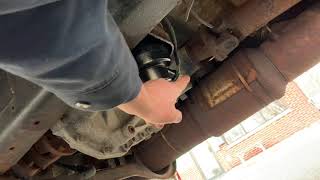
Unplug the electrical connector at the WIF sensor (usually under the vehicle on the filter housing). Inspect for water, mud, or green corrosion inside the plug. Clean it thoroughly with electrical contact cleaner, pack it with dielectric grease, and reconnect.
Tools: Flashlight, electrical contact cleaner, dielectric grease (Intermediate) - Replace the Fuel Filter
If you found water in Step 1, or if the filter has over 10,000 miles on it, replace it immediately. Transfer the WIF sensor to the new filter housing if it is a separate component.
Tools: New fuel filter, filter wrench, drain pan (Intermediate) - Perform Electrical Tests
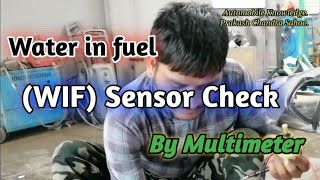
If the code persists with clean fuel, test the sensor. Unplug it and measure resistance across its pins with a multimeter; a dry sensor reads infinite resistance (Open Loop). Any low resistance reading means the sensor is internally shorted and requires replacement. Next, check the harness for a 5V reference signal from the PCM.
Tools: Multimeter, repair manual (Advanced) - Reset the Water in Fuel Counter
After repairs, clear the DTCs. On many Ford Power Stroke and GM Duramax engines, you must also use a bidirectional scan tool to reset the 'Water in Fuel Counter' in the PCM. Skipping this step keeps the warning light on permanently.
Tools: Bidirectional Scan Tool (Advanced)
When This Code Triggers (Freeze-Frame Conditions)
- Engine Coolant Temp: 180-200°F (82-93°C) (The engine is at full operating temperature.)
- RPM: 1500-2500 (The code often sets during steady-state cruising, not typically at idle.)
- Engine Load: 30-60% (Indicates moderate, consistent work, such as maintaining highway speeds.)
- Vehicle Speed: 45-65 mph (72-105 kph) (Consistent with highway driving where fuel flow is stable.)
Related Codes
- P2264 — Indicates a 'Water in Fuel Sensor Circuit Malfunction'. This proves the issue is an electrical fault (bad wiring or dead sensor) rather than actual fuel contamination.
- P2266 — Indicates 'Water in Fuel Sensor Circuit Low'. Often caused by a short to ground in the signal wire, frequently due to water inside the electrical connector.
- P1140 — A Ford-specific code that appears alongside P2269 on 2017-2018 Super Duty trucks. It confirms the issue is water intrusion at connector C3080.
- P0087 — Indicates 'Fuel Rail Pressure Too Low'. If seen with P2269, water has destroyed the high-pressure fuel pump. Stop driving immediately.
Climate & Environmental Factors
- High Humidity: Humid air drawn into the fuel tank condenses on the tank walls as temperatures drop. This water settles at the bottom of the tank, increasing contamination risk.
- Temperature Fluctuations: Warm days followed by freezing nights accelerate the condensation cycle inside the fuel tank. Keeping the tank full minimizes the air space where condensation forms.
- Heavy Rain or Car Washes: External water easily infiltrates the WIF sensor's electrical connector on frame-mounted filters, causing a short circuit that triggers a false P2269 code.
How to Talk to a Mechanic About This Code
Say this: "I have a P2269 'Water in Fuel' code on my [Vehicle]. Please start by draining a sample from the separator into a clear container to confirm if actual water is present before replacing any sensors."
This proves you understand the critical first step. It prevents the shop from immediately replacing a perfectly good sensor (a common misdiagnosis) and forces them to prove whether the issue is fuel contamination or an electrical fault.
Avoid saying:
- 'My Water in Fuel light is on, just replace the sensor.'
- 'My check engine light is on, can you look at it?'
- 'Just fix whatever's wrong, I trust you.'
Questions to ask before authorizing the repair:
- Did you find a visible layer of water in the fuel sample? Can you show it to me?
- If the fuel was clean, did you inspect the sensor's electrical connector for external moisture?
- What were the resistance and voltage test results on the old sensor?
- Does this repair require a 'Water in Fuel Counter' reset with a scan tool afterward?
Where to Take It: Dealer vs Independent vs Chain
- Dealer:
Best for: Vehicles under powertrain warranty., Known manufacturer issues covered by a TSB (Ford F-250 connector)., Repairs requiring proprietary PCM software updates.
Downsides: Highest labor rates., Tendency to replace entire assemblies rather than diagnosing a single wire. (Typical cost: +50% vs. baseline) - Independent Shop:
The best fit for out-of-warranty cases, provided you select a reputable diesel specialist.
Best for: Out-of-warranty diesel trucks., Shops specializing exclusively in diesel engines (Power Stroke, Cummins, Duramax).
Downsides: Expertise varies; you must verify they are diesel specialists., May lack access to the latest OEM software updates. (Typical cost: +0% vs. baseline) - Chain Shop:
AVOID. The risk of misdiagnosis and causing catastrophic engine damage is too high.
Best for: Simple maintenance like oil changes.
Downsides: Technicians lack specialized training for high-pressure diesel systems., High risk of misdiagnosis (selling a sensor when the filter just needs draining)., Cannot perform mandatory PCM counter resets. (Typical cost: -10% vs. baseline)
When to Walk Away From the Repair
If the estimated repair cost exceeds 50% of the vehicle's private-party value, carefully consider your options.
- Car worth $20000, fix is $500: Fix it. This covers a new sensor, filter, and labor, falling far below the threshold.
- Car worth $15000, fix is $9000: Walk away. The HPFP has failed. The repair cost is 60% of the truck's value.
- Car worth $35000, fix is $10000: Borderline. The repair is 28% of the value. If the truck is otherwise pristine, fix it. Get a second opinion first.
What Scan Tool You Need for This Code
Minimum: A scanner that displays live sensor data (PIDs). Basic code readers cannot diagnose a false alarm from a bad sensor.
A $20 reader confirms P2269 but cannot show live WIF sensor voltage to identify a wiring short. Crucially, basic readers cannot perform the mandatory 'Water in Fuel Counter' reset on Ford and GM trucks.
Budget: BlueDriver Pro (~$100) — Reads codes and views live data streams for WIF sensor voltage to confirm wiring shorts. Cannot perform manufacturer resets.
Mid-range: Autel MaxiCheck MX808S (~$350) — Offers bidirectional controls required to perform the critical 'Water in Fuel Counter' reset on Ford/GM trucks.
Professional: LAUNCH X431 V+ (~$800) — Full professional diagnostics, OEM-specific functions, and ECU coding. Overkill for DIYers but standard for diesel shops.
Rent vs buy: Rent a basic scanner to confirm the code. If your Ford/GM truck requires a counter reset, you must buy a mid-range bidirectional scanner or pay a shop.
How to Clear the Code After You Fix It
- Drain the water separator or replace the affected components.
- Use an OBD-II scan tool to clear the DTCs.
- On Ford and GM vehicles, use a bidirectional scanner to perform the 'Water in Fuel Counter' reset.
- Perform a complete drive cycle to reset readiness monitors.
Drive cycle (~20 minutes): Start the engine and idle for 3 minutes. Drive in mixed city/highway conditions, including 10 minutes of steady cruising above 45 mph. Allow the vehicle to cool down completely.
Readiness monitors affected: Comprehensive Component Monitor, Fuel System Monitor
Before emissions retest: drive at least 50 miles to fully set monitors.
Watch out for:
- Failing to perform the 'Water in Fuel Counter' reset on GM/Ford trucks guarantees the code will return immediately upon startup.
- Disconnecting the battery clears the code but resets all emissions monitors, causing an automatic smog test failure.
Will This Fail Emissions / State Inspection?
Yes — this code typically fails an OBD-II emissions inspection.
- California: An active P2269 results in an automatic smog check failure. You must drive 50-100 miles after repair to set readiness monitors before retesting.
- New York: An illuminated Check Engine Light is an automatic failure. Readiness monitors must be set before the vehicle can pass.
- Texas: Active codes trigger automatic failure. Inspectors check for recently cleared codes and will reject the vehicle until monitors are ready.
Most Commonly Affected Vehicles
- Ford F-250/F-350 Super Duty 6.7L Power Stroke (2017-2019) — Notorious for false codes caused by water entering the WIF sensor connector (C3080). Ford TSB 18-2133 dictates drying and greasing the connector.
- Dodge / Ram 2500/3500 6.7L Cummins (2013-2024) — Features two fuel filters (engine and frame). The frame-mounted sensor connector frequently shorts out after car washes, causing false alarms.
- Chevrolet / GMC Silverado / Sierra 2500HD Duramax (2011-2024) — Requires a mandatory 'Water in Fuel Counter' reset via scan tool after replacing the filter or sensor, otherwise the code remains permanent.
- Jeep Grand Cherokee 3.0L EcoDiesel (2014-2019) — Highly sensitive Bosch CP4 fuel pump. A single bad tank of fuel triggering P2269 can destroy the pump if not drained immediately.
- Land Rover Discovery / Range Rover 3.0L Diesel (2014-2020) — Off-road water crossings frequently soak the external sensor connector, triggering false codes. Waterproofing the connector prevents this.
Manufacturer-Specific Notes
- Ford: On 2017-2019 Super Duty trucks, P2269 is rarely actual water. It is almost always a wet electrical connector. TSB 18-2133 covers the fix: dry, grease, and tape the plug.
- General Motors (Chevy/GMC): Replacing the sensor or draining the water will not turn off the Check Engine Light. You must use a bidirectional scan tool to reset the PCM's internal 'Water in Fuel Counter'.
- Ram (Cummins): These trucks utilize two separate fuel/water separators. You must drain both the engine-mounted and frame-mounted filters during diagnosis.
- Jaguar / Land Rover: The WIF sensor is a separate, reusable part. Mechanics frequently throw it away with the old fuel filter, resulting in an immediate P2269 upon startup.
Real Owner Stories
2017 Ford F-250 6.7L Power Stroke - False Alarm
Owner reported a 'Water in Fuel' light and P2269 code immediately after driving through a heavy rainstorm. The engine ran perfectly.
What they tried:
- Drained the fuel/water separator, finding perfectly clean diesel.
- Replaced the fuel filter.
Outcome: A technician applied Ford TSB 18-2133. The WIF sensor's electrical connector (C3080) was packed with rainwater. Drying the connector and sealing it with dielectric grease permanently resolved the code.
Lesson: On 2017-2018 Ford Super Duty trucks, P2269 is almost always a false alarm caused by external moisture on the connector. Inspect the plug before replacing parts.
2014 Ram 2500 6.7L Cummins - Misdiagnosis
The 'Water in Fuel' light illuminated. Assuming a sensor failure, the owner immediately replaced the WIF sensor on the frame-mounted filter.
What they tried:
- Replaced the WIF sensor without draining the separator.
- Cleared the code, which returned in 5 miles.
Outcome: A diesel shop drained the separator and found 4 ounces of water. The actual problem was a bad tank of fuel. The system required a flush and two new filters.
Lesson: Never replace parts without diagnosing first. Always start by draining the separator into a clear container to prove whether water is actually present.
2015 Chevrolet Silverado 2500HD Duramax - The Forgotten Reset
A local lube shop replaced the fuel filter and WIF sensor to fix a P2269 code. The physical repair was correct, but the dashboard warning remained active.
What they tried:
- Replaced fuel filter.
- Replaced WIF sensor.
- Disconnected the battery to clear codes.
Outcome: The owner took the truck to a dealer. The technician used a GM scan tool to perform the required 'Water in Fuel Counter Reset' in the PCM. The light immediately turned off.
Lesson: On modern GM and Ford diesels, physical repairs are only half the job. You must reset the internal PCM counter using a bidirectional scan tool.
How to Prevent This Code From Triggering
- Drain the fuel/water separator monthly (Once per month) — Removing accumulated condensation prevents it from reaching the sensor threshold or bypassing the filter into the injection system.
- Replace fuel filters strictly on schedule (Every 10,000-15,000 miles) — A fresh filter has maximum water-holding capacity. A saturated filter allows water to pass directly into the high-pressure pump.
- Keep the fuel tank above half full (Daily habit) — A full tank minimizes the volume of air inside. Less air means less atmospheric moisture available to condense on the tank walls.
- Use a demulsifying diesel fuel additive (At every fill-up) — Demulsifiers force water to separate from the diesel and drop to the bottom of the separator, making it easy to drain.
Frequently Asked Questions
Can I just clear the code and keep driving?
Absolutely not. This code is a critical warning. Ignoring it allows water to destroy your high-pressure fuel pump, resulting in repairs exceeding $8,000.
What is the most common mistake when diagnosing P2269?
The biggest mistake is replacing the sensor before checking the fuel. Always drain the separator into a clear jar first to prove whether water is actually present.
My light comes on after a car wash. Is it a false alarm?
Yes, this is highly likely. High-pressure water easily infiltrates the external sensor connector on Ram and Ford trucks, creating a short circuit. Clean and pack the connector with dielectric grease.
I changed my fuel filter and now the code is on. Why?
You likely forgot to transfer the reusable sensor from the old filter to the new one. Alternatively, if you drive a GM or Ford, you must reset the PCM's 'Water in Fuel Counter' with a scan tool.
How does water get into a sealed fuel tank?
Water enters through condensation inside a partially empty tank, contaminated gas station pumps, or compromised seals like a missing fuel cap.
I drained the separator and the fuel is clean. What next?
The issue is electrical. Inspect the sensor's wiring connector for moisture or corrosion, then test the sensor's internal resistance with a multimeter.
What happens if I ignore this code?
Water provides zero lubrication, causing the high-pressure fuel pump to disintegrate internally. This sends metal shrapnel through the entire system, destroying all injectors and fuel lines.
Key Takeaways
- P2269 indicates water in your diesel fuel, a critical condition that destroys high-pressure fuel pumps if ignored.
- Stop driving immediately to prevent catastrophic fuel injection system damage that frequently exceeds $8,000 in repair costs.
- Always start diagnosis by draining the fuel-water separator into a clear glass jar to visually confirm water presence before buying parts.
- False alarms are extremely common on Ford and Ram trucks, typically caused by external moisture shorting the sensor connector rather than actual fuel contamination.
Helpful Videos


The information in this article is provided for general reference and educational purposes only. Vehicle specifications, procedures, and part compatibility can vary by production date, trim level, and region. Always consult your vehicle's factory service manual and verify part numbers before purchasing or performing repairs. Safety-critical components such as airbags, seat belts, and braking systems should be installed by a qualified professional.
- 🎬 Helpful Videos
- What Does P2269 Mean?
- Can I Drive With P2269?
- Common Causes
- Symptoms
- Diagnostic Flowchart
- Common Fixes & Costs
- DIY vs Professional
- Used vs. New Parts: Buying Guide
- What Happens If You Wait — Timeline
- Cost of Not Fixing It
- Diagnosis Steps
- When This Code Triggers (Freeze-Frame Conditions)
- Related Codes
- Climate & Environmental Factors
- How to Talk to a Mechanic About This Code
- Where to Take It: Dealer vs Independent vs Chain
- When to Walk Away From the Repair
- What Scan Tool You Need for This Code
- How to Clear the Code After You Fix It
- Will This Fail Emissions / State Inspection?
- Most Commonly Affected Vehicles
- Manufacturer-Specific Notes
- Real Owner Stories
- 2017 Ford F-250 6.7L Power Stroke - False Alarm
- 2014 Ram 2500 6.7L Cummins - Misdiagnosis
- 2015 Chevrolet Silverado 2500HD Duramax - The Forgotten Reset
- How to Prevent This Code From Triggering
- Frequently Asked Questions
- Can I just clear the code and keep driving?
- What is the most common mistake when diagnosing P2269?
- My light comes on after a car wash. Is it a false alarm?
- I changed my fuel filter and now the code is on. Why?
- How does water get into a sealed fuel tank?
- I drained the separator and the fuel is clean. What next?
- What happens if I ignore this code?
- Key Takeaways
- 🎟️ Get 5% Off