

OBD-II Code P2247: O2 Sensor Reference Voltage Circuit Open (Bank 2, Sensor 1)
The Ultimate Guide to Diagnosing and Fixing P2247
- P2247 indicates a broken electrical connection (open circuit), meaning diagnosis must start with a multimeter, not parts replacement.
- While a failed O2 sensor causes 80% of P2247 codes, testing the harness for a 5-volt reference signal prevents wasting $150 on an unnecessary sensor.
- Driving more than 200 miles with an active P2247 code forces the engine to run rich, risking a $1,500+ catalytic converter meltdown.
- Nissan vehicles (like the Titan) require a specific 'Self-Learning Control' software reset after sensor replacement, or the P2247 code will immediately return.
- Expect to pay a shop between $200 and $500 for a professional O2 sensor replacement, depending heavily on sensor accessibility.
What Does P2247 Mean?

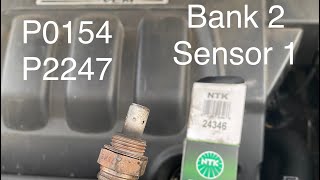
P2247 means the Powertrain Control Module (PCM) detects a broken electrical connection (open circuit) in the reference voltage line for the Bank 2, Sensor 1 oxygen sensor. Without this 5-volt reference signal 🎬 Watch: How to diagnose a 5V reference circuit failure., the PCM cannot read the sensor, forcing the engine into a default rich fuel mixture that ruins fuel economy and increases emissions.
Technical definition: The SAE/ISO definition is "O2 Sensor Reference Voltage Circuit/Open (Bank 2 Sensor 1)". This indicates a complete loss of signal continuity in the reference voltage circuit for the pre-catalytic converter oxygen sensor on the engine bank opposite cylinder #1. An open circuit renders the closed-loop fuel feedback system inoperative.
Can I Drive With P2247?
Yes, But With Caution. Yes, but do not exceed 200 miles. The engine defaults to a rich fuel mixture to protect itself, which destroys the catalytic converter over time—turning a $200 sensor repair into a $2,000 exhaust replacement.
Common Causes

- Faulty Bank 2, Sensor 1 Oxygen (O2) Sensor (Very Common) — The sensor's internal electronics or heater element burn out over time, creating an internal open circuit.
- Damaged Wiring Harness or Connector (Common) — Wires melt against the hot exhaust manifold, chafe from engine vibration, or the connector pins corrode from road salt and moisture.
- Blown O2 Sensor Circuit Fuse (Less Common) — A short in the O2 sensor heater circuit blows the dedicated fuse, instantly cutting power and creating an open circuit condition.
- Faulty Powertrain Control Module (PCM) or Software (Rare) — The internal PCM driver supplying the 5V reference voltage fails, or a software glitch misinterprets the sensor data (requiring a reflash).
Symptoms
- Check Engine Light is On — The PCM illuminates the MIL immediately upon detecting the open circuit.
- Decreased Fuel Economy (15-25% Drop) — The PCM defaults to a rich fuel mixture, causing a severe and noticeable drop in MPG.
- Rough Idle and Engine Hesitation — The incorrect air-fuel ratio causes the engine to run unevenly at idle and stumble during acceleration.
- Failed Emissions Test — The vehicle automatically fails OBD-II emissions testing due to the active code and rich running condition.
- High Positive Fuel Trims (scan-tool only — no driver-felt sign) — Short Term Fuel Trim for Bank 2 (STFT2) maxes out at +20% or higher as the PCM blindly adds fuel to compensate for the missing signal.
Diagnostic Flowchart

Tap your situation to follow the diagnostic path that matches what you're seeing on this code.
Common Fixes & Costs
- Replace Bank 2, Sensor 1 Oxygen Sensor
— Parts: $50-$250, Labor: $100-$200, ~1.2 hr book time
Honda Odyssey (2005-2010): OEM Honda: 36531-RDJ-A01 (Alt: NTK: 24346, Denso: 234-5053)
Ford Mustang V6 (2011-2014): OEM Motorcraft: DY-1252 (Alt: Bosch: 17321, NTK: 23162) - Repair Damaged Wiring or Connector
— Parts: $20-$50, Labor: $150-$300, ~2.5 hr book time
Universal: OEM N/A (Alt: O2 Sensor Pigtail Connector (e.g., Dorman 645-540)) - Replace Blown Fuse — Parts: $1-$5, Labor: $0-$50, ~0.2 hr book time
DIY vs Professional
- Replace Oxygen Sensor — Beginner:
Tools: O2 sensor socket, ratchet, penetrating oil, torque wrench. - Repair Damaged Wiring — Beginner:
Tools: Digital multimeter, soldering iron, heat shrink tubing, wire strippers. - Replace Blown Fuse — Beginner:
Tools: Fuse puller.
Used vs. New Parts: Buying Guide
When a used part is worth it: It never makes sense to buy a used oxygen sensor. O2 sensors are wear items with a 100,000-mile lifespan. A used sensor will likely fail shortly after installation.
Donor-vehicle mileage cap: roughly under 20000 miles for the part to have meaningful remaining life.
Donor quality checklist:
- Only consider used if pulling from a recently wrecked, ultra-low mileage vehicle.
- Never buy a used sensor from a vehicle scrapped for engine problems.
- Internal heater element wear cannot be visually inspected.
Decision logic:
- If The part is an oxygen (O2) sensor. → Always buy new from a reputable OEM brand like Denso, NTK, or Bosch.
- If A new OEM-quality sensor costs less than $150. → The minimal savings from a used part are not worth the risk of paying labor twice.
- If You are using a used sensor for temporary diagnosis only. → A known-good used sensor is acceptable for testing, but remove it once the diagnosis is confirmed.
Warranty tradeoff: Used sensors have no warranty. New aftermarket sensors offer a 1-year warranty. OEM sensors installed by a dealer carry a 12-month/12,000-mile parts and labor warranty.
Worst-case if a used part fails: $300. If the used sensor fails, you pay for the part again and pay a mechanic to do the exact same labor twice.
What Happens If You Wait — Timeline
- 0-2 weeks: Check Engine Light illuminates. The PCM defaults to a fixed, rich fuel map for Bank 2. The driver notices a slight drop in fuel economy. (MPG impact: 5-10%% · Added cost: $0)
- 2 weeks - 3 months: The rich mixture causes carbon fouling on spark plugs in Bank 2 and overheats the catalytic converter. A faint 'rotten egg' sulfur smell appears after highway driving. (MPG impact: 10-20%% · Added cost: $50-$150 in wasted fuel.)
- 3-6 months: The catalytic converter's internal ceramic honeycomb begins to melt and fracture from sustained extreme exhaust temperatures. Engine hesitation becomes severe. (MPG impact: 20-30%% · Added cost: $800-$2500 for catalytic converter replacement.)
- 6+ months: The catalytic converter melts completely, creating a total exhaust blockage. The engine stalls under load and the vehicle becomes undrivable. (MPG impact: >30%% · Added cost: $1500-$3000+ for a new catalytic converter and potential exhaust manifold repairs.)
Cost of Not Fixing It
- Immediate (0-1 month): Failed emissions test and a 15-25% drop in fuel economy due to the engine running in a default rich condition. (Added cost: $50-$100 per month in wasted fuel.)
- Short Term (1-6 months): The rich fuel mixture overheats the catalytic converter. Unburned fuel ignites inside the converter, melting the internal ceramic substrate. (Added cost: $1200-$2800 for catalytic converter replacement.)
- Long Term (6+ months): Complete catalytic converter failure creates an exhaust blockage, causing severe loss of engine power and potential internal engine damage. (Added cost: $1500-$3000+ for exhaust and engine repairs.)
Diagnosis Steps
- Scan Codes and Live Data
Use an OBD-II scanner to confirm P2247. View the live data stream for Bank 2 Short Term Fuel Trim (STFT2). If STFT2 is maxed out at +20% to +25%, the PCM is actively compensating for the missing sensor signal.
Tools: OBD-II Scanner (Beginner) - Visual Inspection of Harness and Connector
Locate Bank 2, Sensor 1. Trace the wiring harness from the sensor to the main engine harness. Look for melted insulation, chafed wires, or a connector packed with oil, water, or corrosion.
Tools: Flashlight, Inspection Mirror (Beginner) - Check O2 Sensor Fuses
Consult the owner's manual to locate the fuse for the O2 sensor heater circuits. Pull the fuse and inspect it. If blown, replace it, but be prepared to hunt for the short circuit that caused it to blow.
Tools: Fuse Puller or Pliers (Beginner) - Test Reference Voltage at Connector
Disconnect the O2 sensor. Turn the ignition to 'On' (engine off). Use a multimeter to measure the voltage on the reference wire at the harness-side connector. You must see approximately 5V. If you see 0V, the wiring to the PCM is broken.
Tools: Digital Multimeter (Intermediate) - Test Sensor Heater Resistance
If you have 5V at the connector, the sensor is likely bad. With the sensor disconnected, measure the resistance (Ohms) between the two heater wires on the sensor itself. A reading of 'OL' (infinity) confirms the internal circuit is broken and the sensor must be replaced.
Tools: Digital Multimeter (Intermediate) - Check Continuity to PCM
If you measured 0V in Step 4, disconnect the battery and the PCM. Measure continuity on the reference wire between the sensor connector and the PCM pin. A reading of 'OL' confirms a broken wire in the harness that must be repaired.
Tools: Digital Multimeter (Advanced) - Substitute a Known-Good Sensor
If all wiring tests pass but the code persists, swap the Bank 2, Sensor 1 with the Bank 1, Sensor 1 (if they share a part number). If the code changes to P2243 (Bank 1), the sensor is definitively faulty.
Tools: Oxygen Sensor Socket, Ratchet, Wrench (Intermediate)
When This Code Triggers (Freeze-Frame Conditions)
- Engine Coolant Temp: 180-200°F (The engine must be fully warmed up to normal operating temperature.)
- RPM: 1500-2500 (The fault registers during steady-state cruise or light acceleration.)
- Engine Load: 30-60% (Occurs under moderate engine load, not during heavy acceleration or deceleration.)
- Vehicle Speed: 40-60 mph (Triggers during highway or steady suburban driving when O2 sensor monitors run.)
Related Codes
- P0154 — Indicates 'O2 Sensor Circuit No Activity Detected'. An open reference circuit (P2247) is the primary reason the sensor shows no activity. Fixing P2247 resolves P0154.
- P2243 — The identical 'Reference Voltage Circuit Open' fault, but for Bank 1. Seeing both codes together strongly suggests a blown shared fuse or a faulty PCM.
- P2249 — Means 'Reference Voltage Circuit Low'. P2247 is a complete break (open), while P2249 means voltage is present but below specification (high resistance).
- P2197 — Means 'O2 Sensor Signal Stuck Lean'. Without a reference voltage (P2247), the PCM interprets the dead signal as a permanent lean condition.
Climate & Environmental Factors
- High Humidity & Road Salt: Moisture and road salt drastically accelerate corrosion of the O2 sensor's electrical connector pins, creating high resistance or a complete open circuit.
- Extreme Cold Weather: Sub-zero temperatures make wiring insulation brittle, causing it to crack and break from engine vibration, severing the 5V reference wire.
- High Heat: If plastic harness clips break, the wiring sags onto the exhaust manifold, instantly melting the insulation and causing an open circuit.
How to Talk to a Mechanic About This Code
Say this: "I have a P2247 code for the Bank 2, Sensor 1 O2 sensor. I need a diagnostic appointment to confirm if the open circuit is in the sensor itself or in the wiring harness before any parts are replaced."
This signals that you understand P2247 is an electrical fault. It directs the technician to test the circuit with a multimeter rather than blindly replacing the sensor.
Avoid saying:
- 'My check engine light is on, can you just fix it?'
- 'I think I need a new oxygen sensor.'
- 'Just do whatever you think is best.'
Questions to ask before authorizing the repair:
- Did you test for a 5-volt reference signal at the harness connector?
- What was the resistance reading on the old sensor's heater circuit?
- If the wiring is the problem, are you soldering a new pigtail or replacing the whole harness?
- What is the parts and labor warranty for this repair?
Where to Take It: Dealer vs Independent vs Chain
- Dealer:
Necessary if the problem is a manufacturer-specific software issue or covered under warranty, but otherwise too expensive.
Best for: Vehicles under PZEV emissions warranty, Nissan vehicles requiring the TSB software reset, Complex electrical issues where a faulty PCM is suspected
Downsides: Highest labor rates ($150-$250/hr), Will replace an entire $800 wiring harness instead of repairing a single wire (Typical cost: +50% vs. baseline) - Independent Shop:
Best overall fit. P2247 is a standard electrical diagnostic job that any competent independent technician can handle affordably.
Best for: Out-of-warranty vehicles, Standard electrical diagnostics and wiring repairs, Getting the best value for a common repair
Downsides: Quality varies; look for ASE-certified technicians specializing in electrical diagnostics. (Typical cost: +0% vs. baseline) - Chain Shop:
Avoid for initial diagnosis. Acceptable only if you've already proven the sensor is dead using a multimeter.
Best for: Simple part replacements when you are 100% certain the sensor is the problem.
Downsides: Technicians often lack the advanced diagnostic skills to trace a wiring fault., High pressure to upsell fuel system cleanings. (Typical cost: -10% vs. baseline)
When to Walk Away From the Repair
If the estimated repair cost exceeds 50% of the car's private-party value, it is time to seriously consider selling or trading it in.
- Car worth $4000, fix is $2200: Walk away. The repair cost is over 50% of the car's value. That money is better spent as a down payment on a reliable vehicle.
- Car worth $12000, fix is $450: Fix it. This is a routine repair cost and a small fraction of the car's value.
- Car worth $2500, fix is $1800: Walk away. The car is near the end of its life, and this expensive repair will likely be followed by others.
What Scan Tool You Need for This Code

Minimum: A tool that reads codes, clears codes, and displays live data streams for O2 sensor voltage and Short Term Fuel Trims.
A $20 code reader only gives you the P2247 code. It will not show you the live fuel trim data required to confirm the engine is running rich, leading to unnecessary parts replacement.
Budget: BlueDriver Bluetooth Pro or Topdon TopScan Lite (~$100) — Pairs with your smartphone to read codes and graph live O2 sensor voltage and fuel trims, providing everything a DIYer needs to diagnose P2247.
Mid-range: Foxwell NT510 Elite or Autel MaxiCOM MK808S (~$180) — Provides live data on a dedicated tablet and includes manufacturer-specific service resets (like the Nissan TSB reset), making it a powerful all-in-one tool.
Professional: Autel MaxiCOM MK906BT (~$800) — Offers full bidirectional control and oscilloscope-like data graphing. This is professional-grade equipment and overkill for a DIYer.
Rent vs buy: If this is a one-time repair, borrow a scanner for free from AutoZone or O'Reilly Auto Parts. Buy a scanner only if you plan to do your own diagnostics regularly.
How to Clear the Code After You Fix It
- Use an OBD-II scan tool to clear the P2247 code.
- Ensure the fuel tank is between 35% and 85% full.
- Perform a complete OBD-II drive cycle to reset the readiness monitors.
Drive cycle (~20 minutes): Start the engine cold and idle for 3 minutes. Drive at a steady 55-60 mph for 10 minutes. Perform 5 minutes of stop-and-go city driving. Coast down to a stop without touching the brakes. This forces the O2 sensor and catalyst monitors to run.
Readiness monitors affected: Oxygen (O2) Sensor Monitor, O2 Sensor Heater Monitor, Catalyst (CAT) Monitor
Before emissions retest: drive at least 50 miles to fully set monitors.
Watch out for:
- Clearing the code resets all readiness monitors to 'incomplete', resulting in an automatic emissions test failure until a drive cycle is finished.
- Disconnecting the battery does not clear permanent codes on 2010+ vehicles.
- If the wiring fault was not fixed, the code will return the moment you turn the key.
Will This Fail Emissions / State Inspection?
Yes — this code typically fails an OBD-II emissions inspection.
- California: An active P2247 code is an automatic failure. After repair, a full drive cycle must be completed to set the O2 sensor readiness monitors before a re-test.
- New York: An illuminated Check Engine Light causes an automatic failure. NY allows for one monitor to be 'not ready' for 2001+ vehicles after clearing the code.
- Texas: In the 17 emissions-testing counties, P2247 causes an automatic OBD-II failure. Only one readiness monitor is permitted to be 'not ready' to pass.
Most Commonly Affected Vehicles

- Honda Odyssey (2005-2010) — Bank 2 Sensor 1 is located on the front (radiator side) of the engine. Use NTK part number 24346.
- Acura MDX (2004-2006) — Common on higher mileage J-series engines. Using a quality OEM-brand sensor (Denso or NTK) is mandatory to prevent premature failure.
- Ford Mustang (2011-2014) — On the 3.7L V6 and 5.0L V8, access to the sensor connector is extremely tight. Wiring damage from exhaust heat is a known issue.
- Toyota Sienna (2007-2010) — The wiring harness routing near the exhaust must be carefully inspected for heat-related damage before replacing the sensor.
- Hyundai Santa Fe (2010-2012) — Check for chafing on the harness where it contacts the engine block. Both sensor failure and wiring issues are common.
- BMW 3-Series (E90/E92) (2006-2011) — Affects N52 and N54 engines. The upstream sensors are difficult to access, requiring a special slotted O2 sensor socket.
- Nissan Titan / Armada (2004-2015) — Nissan TSB #NTB04-126 requires technicians to perform an 'Air-Fuel Ratio Self-Learning' reset with a scan tool after replacing the sensor.
- Chevrolet Silverado / Suburban (2007-2013) — On V8 models, the wiring harness melts if it contacts the exhaust manifold. Always check the wiring before replacing the sensor.
Manufacturer-Specific Notes
- Ford: On V8s and V6s in trucks and Mustangs, the upstream O2 sensor wiring routes dangerously close to the hot exhaust manifold. Inspect for melted wiring before condemning the sensor.
- Honda/Acura: These vehicles reject cheap aftermarket sensors. You must use the OEM brand (DENSO or NTK/NGK) to avoid compatibility issues and returning check engine lights.
- Nissan: For the VK56DE engine (Titan/Armada), TSB #NTB04-126 requires an 'Air-Fuel Ratio Self-Learning' reset with a scan tool after replacing the sensor, or the code returns immediately.
Real Owner Stories
2010 Honda Odyssey with P2247
Check Engine Light illuminated with no severe drivability symptoms. Scanned the code and found P2247.
What they tried:
- Visually inspected the wiring harness leading to the Bank 2 (front, radiator side) O2 sensor and found no damage.
- Replaced the Bank 2, Sensor 1 oxygen sensor with an OEM NTK unit.
Outcome: Replacing the sensor fixed the issue. The code cleared and did not return after a 50-mile drive cycle.
Lesson: On vehicles approaching 100,000 miles, the O2 sensor itself is the most likely failure point. Always use the exact OEM brand (Denso or NTK for Honda) to prevent compatibility issues.
2011 Ford Mustang V6
P2247 code appeared. The owner located the sensor on the driver's side but found it extremely difficult to access.
What they tried:
- Attempted to reach the sensor's electrical connector on top of the transmission but failed.
- Spliced the new sensor's wires directly into the old harness.
Outcome: The spliced wires changed the circuit resistance, causing the code to return. The owner eventually had to pay a shop to access the factory connector and install an un-spliced sensor.
Lesson: Never splice O2 sensor wires. It alters the precise electrical resistance required for the 5V reference signal. If you cannot reach the connector, take the vehicle to a professional.
2004 Acura MDX at 254K miles
P2247 code accompanied by multiple misfire codes (P0300, P0302).
What they tried:
- Diagnosed and replaced faulty ignition coils to fix the misfires.
- Tested the O2 sensor harness and found a solid 5V reference signal, confirming the sensor was dead.
Outcome: Replaced the Bank 2, Sensor 1 A/F sensor. The misfires had dumped raw fuel into the exhaust, prematurely killing the aging O2 sensor.
Lesson: Always fix misfire codes before addressing O2 sensor codes. Unburned fuel from a misfire destroys O2 sensors and catalytic converters rapidly.
How to Prevent This Code From Triggering
- Replace O2 Sensors Proactively (Every 100,000 miles) — O2 sensors degrade over time. Replacing them at 100k miles restores fuel economy and prevents sudden open-circuit failures that leave you stranded or damage the catalytic converter.
- Address Engine Misfires and Oil Leaks Immediately (As they occur) — Unburned fuel from misfires and silica from coolant leaks coat the O2 sensor element, causing it to overheat and burn out internally.
- Secure Wiring Harnesses During Repairs (After any engine work) — Ensuring the O2 sensor wiring is clipped into its factory brackets prevents the harness from sagging onto the 600°F exhaust manifold and melting.
Frequently Asked Questions
What does Bank 2, Sensor 1 mean?
Bank 2 is the engine side opposite cylinder #1. Sensor 1 is the 'upstream' sensor located before the catalytic converter. It monitors exhaust oxygen levels to adjust the real-time fuel mixture.
I replaced the O2 sensor but the P2247 code came back. What now?
This confirms the open circuit is in the wiring harness or connector, not the sensor. You must use a multimeter to test for a 5-volt reference signal and continuity between the sensor connector and the PCM. If the wiring is intact, suspect a blown fuse or a faulty PCM.
What is the most common misdiagnosis for P2247?
The most frequent mistake is blindly replacing the oxygen sensor without testing the electrical circuit. Because P2247 designates a broken wire or connection, a damaged harness triggers the exact same code as a dead sensor. Always verify the 5-volt reference signal before buying parts.
Can a bad catalytic converter cause P2247?
No. A failed catalytic converter triggers efficiency codes (like P0420), not electrical circuit codes. However, ignoring a P2247 code forces the engine to run rich, which will overheat and destroy a healthy catalytic converter.
Will a fuel additive fix this problem?
No. Fuel additives clean internal engine deposits but cannot repair a broken electrical wire or a burnt-out sensor heater element.
How can I prevent P2247 from happening again?
Always use an OEM-quality replacement sensor (like Denso or NTK) and secure the wiring harness away from the exhaust manifold. In states that use road salt, apply dielectric grease to the electrical connector to prevent pin corrosion.
Is it safe to drive long distances with a P2247 code?
No. Driving more than 200 miles with this code forces the engine to dump excess fuel into the exhaust. This raw fuel ignites inside the catalytic converter, melting its internal ceramic honeycomb and causing $1,500+ in damages.
Is this repair covered under warranty?
The federal emissions warranty covers O2 sensors for 2 years/24,000 miles, but PZEV-rated vehicles extend this up to 15 years/150,000 miles. Check your warranty booklet or call a dealer to verify coverage before paying out of pocket.
What is the difference between an O2 sensor and an Air/Fuel Ratio sensor?
They perform the same job, but an Air/Fuel (A/F) sensor provides a precise, linear measurement of the exhaust mixture. Older narrowband O2 sensors simply switch back and forth between rich and lean.
Key Takeaways
- P2247 indicates a broken electrical connection (open circuit), meaning diagnosis must start with a multimeter, not parts replacement.
- While a failed O2 sensor causes 80% of P2247 codes, testing the harness for a 5-volt reference signal prevents wasting $150 on an unnecessary sensor.
- Driving more than 200 miles with an active P2247 code forces the engine to run rich, risking a $1,500+ catalytic converter meltdown.
- Nissan vehicles (like the Titan) require a specific 'Self-Learning Control' software reset after sensor replacement, or the P2247 code will immediately return.
- Expect to pay a shop between $200 and $500 for a professional O2 sensor replacement, depending heavily on sensor accessibility.
Helpful Videos

The information in this article is provided for general reference and educational purposes only. Vehicle specifications, procedures, and part compatibility can vary by production date, trim level, and region. Always consult your vehicle's factory service manual and verify part numbers before purchasing or performing repairs. Safety-critical components such as airbags, seat belts, and braking systems should be installed by a qualified professional.
- 🎬 Helpful Videos
- What Does P2247 Mean?
- Can I Drive With P2247?
- Common Causes
- Symptoms
- Diagnostic Flowchart
- Common Fixes & Costs
- DIY vs Professional
- Used vs. New Parts: Buying Guide
- What Happens If You Wait — Timeline
- Cost of Not Fixing It
- Diagnosis Steps
- When This Code Triggers (Freeze-Frame Conditions)
- Related Codes
- Climate & Environmental Factors
- How to Talk to a Mechanic About This Code
- Where to Take It: Dealer vs Independent vs Chain
- When to Walk Away From the Repair
- What Scan Tool You Need for This Code
- How to Clear the Code After You Fix It
- Will This Fail Emissions / State Inspection?
- Most Commonly Affected Vehicles
- Manufacturer-Specific Notes
- Real Owner Stories
- 2010 Honda Odyssey with P2247
- 2011 Ford Mustang V6
- 2004 Acura MDX at 254K miles
- How to Prevent This Code From Triggering
- Frequently Asked Questions
- What does Bank 2, Sensor 1 mean?
- I replaced the O2 sensor but the P2247 code came back. What now?
- What is the most common misdiagnosis for P2247?
- Can a bad catalytic converter cause P2247?
- Will a fuel additive fix this problem?
- How can I prevent P2247 from happening again?
- Is it safe to drive long distances with a P2247 code?
- Is this repair covered under warranty?
- What is the difference between an O2 sensor and an Air/Fuel Ratio sensor?
- Key Takeaways
- 🎟️ Get 5% Off