

OBD-II Code P2242: O2 Sensor Positive Current Control Circuit High (Bank 2, Sensor 1)
The Ultimate Guide to Meaning, Diagnosis, and Repair for P2242
- P2242 is a hard electrical fault indicating a short-to-power in the Bank 2, Sensor 1 oxygen sensor circuit, not a fuel mixture problem.
- Inspect the O2 sensor wiring harness for melted insulation near the exhaust manifold before spending $150+ on a replacement sensor.
- Driving with an active P2242 code drops fuel economy by 5-10% and guarantees an automatic emissions test failure.
- Fix this code within 200 miles to prevent a rich fuel mixture from melting the catalytic converter, which costs $1,500 to $4,000 to replace.
What Does P2242 Mean?
P2242 means the Powertrain Control Module (PCM) detects a high voltage (often stuck near battery voltage) in the positive current control circuit for the upstream oxygen sensor on Bank 2. This sensor measures exhaust oxygen levels so the computer can adjust the fuel mixture. A high voltage reading indicates a hard electrical short or an internal sensor failure.
Technical definition: O2 Sensor Positive Current Control Circuit High Bank 2 Sensor 1. 🎬 Watch: A quick overview of the P2242 code and its meaning. The PCM detects the positive current control circuit for the Bank 2, Sensor 1 heated oxygen sensor (HO2S) or air-fuel ratio (A/F) sensor is above its specified range. The PCM expects a fluctuating voltage but reads a sustained high voltage, indicating a short to power. This circuit controls the sensor's internal heater, which brings the sensor to its 750°F+ operating temperature.
Can I Drive With P2242?
Yes, But With Caution. You can drive, but do not exceed 200 miles. Your vehicle suffers a 5-10% drop in fuel economy and releases excess emissions. Ignoring the code causes irreversible damage to the catalytic converter, a repair costing $1,500 to $4,000.
Common Causes
- Faulty Bank 2, Sensor 1 Oxygen Sensor (Very Common) — The internal heater element fails or shorts out, causing an excessive current draw and triggering a high voltage reading in the control circuit.
- Damaged Wiring or Short to Power (Common) — The wiring harness routing near hot exhaust components melts the insulation. The exposed wire touches a power source, sending a direct short back to the PCM.
- Incompatible Aftermarket Sensor (Common) — Cheap, universal aftermarket sensors fail to meet the precise resistance specifications required by the PCM, triggering a circuit high fault immediately upon installation.
- Blown Fuse or Faulty Relay (Less Common) — A blown heater circuit fuse or a failed relay disrupts the circuit, causing abnormal voltage readings.
- PCM Software or Hardware Failure (Rare) — The PCM's internal driver circuit malfunctions, or overly sensitive software incorrectly flags a P2242 code. This requires a dealer software update or module replacement.
Symptoms
- Check Engine Light On — The Malfunction Indicator Lamp (MIL) illuminates immediately upon the PCM detecting the circuit high condition.
- Poor Fuel Economy — The vehicle burns more fuel because the PCM defaults to a rich air-fuel mixture, resulting in a 5-10% decrease in MPG.
- Rough Idle or Engine Hesitation — The engine runs rough, hesitates during acceleration, or misfires due to the incorrect air-fuel ratio commanded by the PCM.
- Failed Emissions Test — The vehicle's emissions control system fails to function effectively, leading to increased pollutants and an automatic smog test failure.
- Rich Exhaust Symptoms (Smell/Smoke) (also visible on scanner) — An overly rich fuel mixture causes a strong smell of sulfur (rotten eggs), unburned gasoline, or visible black smoke exiting the tailpipe.
Diagnostic Flowchart
Tap your situation to follow the diagnostic path that matches what you're seeing on this code.
Common Fixes & Costs
- Replace Bank 2, Sensor 1 Oxygen Sensor — Parts: $50-$250, Labor: $100-$200, ~1.0 hr book time (DIY)
- Repair Damaged Wiring or Connector — Parts: $10-$30, Labor: $100-$300, ~1.5 hr book time (Intermediate)
- Replace Blown Fuse — Parts: $1-$5, Labor: $0-$50, ~0.2 hr book time (DIY)
- Update or Replace Powertrain Control Module (PCM) — Parts: $500-$1200, Labor: $80-$300, ~1.5 hr book time (Professional)
Used vs. New Parts: Buying Guide
When a used part is worth it: Never buy a used oxygen sensor. They are wear-and-tear items with a finite lifespan. A used sensor guarantees premature failure and repeat labor costs.
Donor-vehicle mileage cap: roughly under 10000 miles for the part to have meaningful remaining life.
Donor quality checklist:
- Only consider 'new old stock' (NOS) parts in original sealed packaging.
- Avoid any sensor showing signs of installation, carbon fouling, or corrosion.
- Never buy used electrical sensors; internal damage cannot be verified.
Decision logic:
- If The part is an oxygen sensor → Always buy new. The cost savings of a used sensor are negligible compared to the risk of repeat labor.
- If You need to replace a damaged catalytic converter → A used OEM converter from a low-mileage, rear-ended vehicle is cost-effective. Avoid converters from rust-belt states.
- If Choosing between OEM and Aftermarket sensors → Buy OEM or a reputable OEM-supplier (Denso, Bosch, NTK). Cheap aftermarket sensors frequently fail to clear the P2242 code.
Warranty tradeoff: Used sensors have no warranty. New aftermarket sensors offer a 1-year warranty. New OEM sensors carry a 1-2 year warranty.
Worst-case if a used part fails: $200-$400 if a used or cheap aftermarket sensor fails, requiring a second repair job.
What Happens If You Wait — Timeline
- 0-2 weeks: Check Engine Light is on with code P2242. The PCM defaults to a pre-programmed fuel map. No noticeable symptoms other than the light. (MPG impact: 0-5%% · Added cost: $0)
- 2 weeks - 3 months: A noticeable drop in fuel economy occurs. The vehicle hesitates slightly on cold starts or exhibits a rough idle. (MPG impact: 5-10%% · Added cost: $20-$80 in wasted fuel.)
- 3-8 months: The engine consistently runs rich, overheating the catalytic converter. Spark plugs foul with carbon. Exhaust smells of fuel or sulfur. (MPG impact: 10-15%% · Added cost: $150-$400 (spark plug replacement, early catalyst wear).)
- 8+ months: The catalytic converter substrate melts from prolonged extreme heat, creating a major exhaust blockage and severe loss of power. (MPG impact: 15-25%+% · Added cost: $1,500-$4,000 (catalytic converter replacement).)
Cost of Not Fixing It
- 0-1 month: A drop in fuel economy of 5-10% and an automatic emissions test failure. (Added cost: $20-$60 in extra fuel costs per month.)
- 1-6 months: Operating with a rich fuel mixture overheats the catalytic converter and fouls spark plugs, causing misfires. (Added cost: $150-$400 for spark plug replacement and wasted fuel.)
- 6+ months: Catastrophic failure of the catalytic converter. The internal substrate melts, causing a major exhaust restriction and severe loss of power. (Added cost: $1,500-$4,000 to replace the damaged catalytic converter.)
Diagnosis Steps
- Scan for All Codes & Review Freeze Frame Data
Use an OBD-II scanner to read all stored codes. Address the P2242 circuit code first, even if lean/rich codes (P0174/P0175) are present. Note the freeze frame data to see engine conditions when the fault occurred.
Tools: OBD-II Scanner (Beginner) - Visual Inspection of Wiring and Sensor
Safely raise the vehicle and locate the Bank 2, Sensor 1 O2 sensor. Meticulously inspect the wiring harness for melting, fraying, or contact with hot exhaust pipes. Check the connector for bent or corroded pins.
Tools: Jack stands, flashlight (Beginner) - Analyze Live Sensor Data (Pro Tip)
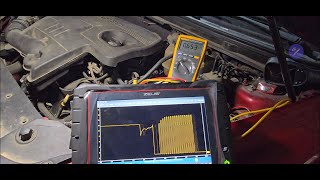
With the engine running, use a scan tool to observe the voltage for 'O2S B2S1'. A healthy zirconia sensor fluctuates between 0.1V and 0.9V. If the voltage is stuck high (above 0.9V or at battery voltage), it confirms a short to power or a failed sensor.
Tools: Advanced OBD-II Scanner (Intermediate) - Test the Circuit for a Short to Power
Disconnect the O2 sensor. With the key on, engine off (KOEO), use a multimeter to measure the voltage on the signal wire in the harness-side connector. If you find battery voltage where it shouldn't be, you have a short to power in the harness.
Tools: Digital multimeter, vehicle-specific wiring diagram (Advanced) - Test the Sensor's Heater Resistance
With the sensor unplugged, use a multimeter set to Ohms (Ω) to measure the resistance between the two heater circuit pins on the sensor. Infinite resistance (OL) or near zero ohms means the internal heater failed and the sensor requires replacement.
Tools: Digital multimeter (Intermediate) - Check Fuses and Relays
Locate the fuse and relay for the O2 sensor heater circuits in the owner's manual. Visually inspect the fuse and swap the relay with a known good one to test for failure.
Tools: Owner's manual, fuse puller (Beginner) - Check for Technical Service Bulletins (TSBs)
Search for TSBs related to P2242 for your specific vehicle. Manufacturers occasionally release software updates to fix overly sensitive diagnostic logic that triggers this code erroneously.
Tools: Internet access (Beginner)
When This Code Triggers (Freeze-Frame Conditions)
- Engine Coolant Temp: 180-210°F (82-99°C) (The engine must be fully warmed up and operating in closed-loop fuel control.)
- RPM: 1500-2500 RPM (The fault is detected during steady-state cruising, not during idle or heavy acceleration.)
- Engine Load: 20-60% (A moderate, stable engine load allows the PCM to run the diagnostic monitor for the sensor circuit.)
- Vehicle Speed: 40-65 mph (64-105 kph) (Sustained driving at highway speeds for several minutes triggers the O2 sensor heater and circuit monitors.)
Related Codes
- P2241 — The direct opposite code: 'O2 Sensor Positive Current Control Circuit Low'. P2242 indicates a short to power, while P2241 indicates an open circuit or short to ground.
- P0174 — 'System Too Lean (Bank 2)'. It appears with P2242 because the faulty O2 sensor provides incorrect data. Diagnose the circuit code (P2242) first.
- P2240 — Indicates an open circuit for the same sensor. P2242 means voltage is too high, while P2240 means there is no connection at all.
- P0153 — 'O2 Sensor Circuit Slow Response'. Indicates the sensor is aging and switching slowly. A slowly failing sensor eventually shorts out, causing P2242.
Climate & Environmental Factors
- Cold Climates / Road Salt: Vehicles in the 'Rust Belt' are highly susceptible to P2242. Salt and moisture accelerate wiring connector corrosion and damage the sensor housing.
- High Humidity / Water Intrusion: Driving through deep water introduces moisture into the sensor's electrical connector, causing a short circuit that triggers the high voltage reading.
- High Altitude: High altitude does not directly cause electrical fault codes like P2242, but it triggers related performance codes (like P0420) if the system is borderline.
How to Talk to a Mechanic About This Code
Say this: "I have a P2242 code for the Bank 2 Sensor 1 O2 sensor. Please check the live data for a stuck high voltage and test the harness for a short to power before recommending a part replacement."
This directs the technician to perform specific electrical tests, preventing them from blindly swapping the sensor and saving you from paying for a misdiagnosis.
Avoid saying:
- 'Just fix whatever's wrong'
- 'My check engine light is on, can you look at it?'
- 'I think I need a new oxygen sensor'
Questions to ask before authorizing the repair:
- Did you see a steady, high voltage on the live data stream for the B2S1 sensor?
- When you unplugged the sensor, did the voltage in the harness connector stay high?
- Can you confirm the wiring harness has been inspected for melting near the exhaust?
- What is the warranty on the parts and labor for this repair?
Where to Take It: Dealer vs Independent vs Chain
- Dealer:
Best for: Vehicles under the 8-year/80,000-mile federal emissions warranty., Complex electrical issues or suspected PCM failure on newer cars., Vehicles with known TSBs for this code (e.g., BMW models).
Downsides: Highest labor rates, typically $150-$250 per hour., Recommends expensive OEM parts by default. (Typical cost: +50% vs. baseline) - Independent Shop:
Best fit for most cases. An experienced independent technician effectively diagnoses the circuit fault without the high cost of a dealership.
Best for: Out-of-warranty vehicles where cost is a factor., Diagnosing common electrical faults like wiring shorts or sensor failures.
Downsides: Diagnostic skill varies; look for ASE-certified technicians., Lacks access to the latest manufacturer software updates. (Typical cost: +0% vs. baseline) - Chain Shop:
Use with caution. Acceptable if you are certain the sensor is the only problem. AVOID for initial diagnosis.
Best for: Simple part replacement if you have already diagnosed the sensor is faulty yourself.
Downsides: Technician skill varies dramatically; lacks experience for proper electrical diagnosis., High pressure to upsell services; replaces parts without confirming the root cause. (Typical cost: -10% vs. baseline)
When to Walk Away From the Repair
If the estimated repair cost exceeds 50% of your car's private-party value, seriously consider selling or trading it in instead of repairing it.
- Car worth $4000, fix is $2000: Borderline. The repair cost is 50% of the car's value. Get a second opinion before authorizing.
- Car worth $12000, fix is $600: Fix it. The repair is only 5% of the vehicle's value.
- Car worth $2500, fix is $1500: Walk away. The repair is 60% of the car's value. Put this money toward a down payment on a reliable vehicle.
What Scan Tool You Need for This Code
Minimum: A scanner that reads and graphs live O2 sensor voltage data.
A basic $20 code reader only shows the P2242 code. It cannot show live voltage data, which is essential to confirm if the sensor's reading is actually stuck high.
Budget: BlueDriver Pro (~$100) — Connects to your smartphone via Bluetooth and graphs live O2 sensor voltage. This confirms if the voltage is stuck high, the key diagnostic step for P2242.
Mid-range: Foxwell NT510 Elite (~$180) — A handheld scanner providing live data graphing for the O2 sensor and bidirectional controls for testing other components.
Professional: Autel MaxiCOM MK808 (~$500) — A professional tablet scanner offering fast, detailed live data graphing, freeze frame data, and access to all vehicle modules for in-depth analysis.
Rent vs buy: Auto parts stores scan codes for free, but their tools rarely show live data. Buying a budget pick like the BlueDriver is a necessary investment for diagnosing P2242.
How to Clear the Code After You Fix It
- Fix the underlying electrical fault (replace sensor or repair wiring).
- Use an OBD-II scan tool to clear the P2242 code from the PCM's memory.
- Perform a complete OBD-II drive cycle to allow the readiness monitors to run.
Drive cycle (~20 minutes): Start with a cold engine (off for 8+ hours). 1) Idle for 3 minutes with A/C and rear defrost on. 2) Accelerate to 55 mph and hold a steady speed for 5 minutes. 3) Coast down to 20 mph without braking. 4) Accelerate to 60 mph and hold for 5 minutes.
Readiness monitors affected: Heated O2 Sensor Monitor, O2 Sensor Monitor, Catalyst Monitor
Before emissions retest: drive at least 50 miles to fully set monitors.
Watch out for:
- Disconnecting the battery clears the code but resets all readiness monitors to 'Not Ready,' resulting in an automatic emissions test failure.
- The code returns immediately if the underlying electrical short remains unaddressed.
- Short city trips prevent the O2 sensor and catalyst monitors from reaching 'Ready' status.
Will This Fail Emissions / State Inspection?
Yes — this code typically fails an OBD-II emissions inspection.
- California: An active P2242 code is an automatic failure. A full OBD-II drive cycle must be completed to set all readiness monitors to 'Ready' before re-testing.
- New York: The NYS DMV inspection includes an OBD-II scan. A Check Engine Light with code P2242 results in immediate failure.
- Texas: In the 17 counties requiring emissions testing, an illuminated Check Engine Light for P2242 is an automatic fail. Clearing the code right before the test results in a 'Not Ready' failure.
Most Commonly Affected Vehicles
- Toyota Tacoma (2005-2015) — Common on V6 models. Toyota refers to this as an Air-Fuel Ratio (A/F) sensor. The wiring harness is highly susceptible to heat damage.
- Honda Accord (2008-2012) — V6 models are frequently affected. The Bank 2 sensor is located near the firewall, making access difficult.
- Ford F-150 (2004-2010) — Common on V8 engines where high exhaust heat damages the wiring harness for the Bank 2 upstream sensor.
- Toyota 4Runner (2003-2009) — The V6 (1GR-FE) engine requires specific troubleshooting. Service manuals detail an 'A/F CONTROL' active test using a scan tool before replacement.
- BMW 3-Series, 6-Series (2013-2019) — Multiple TSBs exist for erroneous oxygen sensor faults due to sensitive DME software. The fix is a vehicle-wide software update, not sensor replacement.
- Lexus GS 460 (2008-2011) — Lexus calls this an A/F sensor. Factory service manuals provide specific diagnostic flowcharts for P2242, indicating a known fault.
- Subaru Legacy, Outback (2015-2019) — Accessing the sensor on the boxer engine is challenging. Subarus are highly sensitive to aftermarket parts; use OEM-spec sensors only.
- Hyundai/Kia Various (2010-2023) — Appears regularly on owner forums. Failures are typically standard sensor wear or wiring issues requiring Bank 2 Sensor 1 replacement.
Manufacturer-Specific Notes
- Toyota/Lexus: Toyota and Lexus refer to the upstream oxygen sensor as an 'Air-Fuel Ratio (A/F) Sensor'. Diagnostic procedures require using a high-end scan tool to perform active tests.
- BMW: BMW issued TSBs for models where sensitive DME software erroneously triggers oxygen sensor faults. The fix is a software update, not part replacement.
- Honda: On Honda V6 models, the Bank 2 sensor is located in a tight spot near the firewall. A flexible-head O2 sensor socket is mandatory for DIY replacement.
- Ford: On EcoBoost engines, TSBs recommend a specific drive cycle to 'de-sulfate' the catalytic converters before replacing any O2 sensors.
- General: Oxygen sensors are covered under the Federal Emissions Warranty (8 years/80,000 miles). If your vehicle is within this window, a dealer must repair it for free.
Real Owner Stories
2007 Toyota Camry 2.4L at 195K miles
Check Engine Light came on. No noticeable drivability issues. Shop quoted $852 to replace both upstream and downstream O2 sensors.
What they tried:
- Owner was considering buying a new car and questioned the necessity of the repair.
Outcome: Forum advice suggested prioritizing the specific sensor mentioned in the code (Bank 2, Sensor 1). Replacing only the faulty upstream sensor resolved the issue for a fraction of the quoted cost.
Lesson: A circuit code for one sensor does not mean all sensors need replacement. Prioritize diagnosing the specific sensor and circuit mentioned in the code.
2011 Ford F-150 with high mileage
P2242 code appeared, along with poor fuel economy. Owner was a DIYer.
What they tried:
- Visually inspected the wiring harness for Bank 2, Sensor 1 and found no visible damage.
- Used a scanner to watch live data; voltage was stuck high, not cycling.
- Unplugged the sensor and tested the heater circuit resistance with a multimeter, confirming an internal short.
Outcome: Replaced the Bank 2, Sensor 1 oxygen sensor. The code cleared, did not return, and fuel economy was restored.
Lesson: Following a logical diagnostic process (visual inspection, live data, resistance test) definitively confirms a failed sensor, preventing unnecessary replacement of good parts.
2014 Honda CR-V with P0420 and P2242
Check Engine Light on. The owner replaced the downstream O2 sensor based on a guess, but the code returned.
What they tried:
- Replaced the downstream (Bank 1, Sensor 2) O2 sensor, which did not fix the issue.
- Replaced the upstream (Bank 1, Sensor 1) A/F sensor, but the code persisted.
- Took the vehicle to a professional shop for advanced diagnostics.
Outcome: An independent shop determined the catalytic converter had failed. The converter was replaced with an aftermarket part for $600, resolving the codes.
Lesson: Do not replace parts based on codes alone, especially when multiple codes are present. Misdiagnosing and replacing the wrong sensors wastes money.
How to Prevent This Code From Triggering
- Use Top Tier certified gasoline (Every fill-up) — High detergent levels prevent carbon deposits, reducing contaminants that foul the oxygen sensor and shorten its life.
- Perform regular engine maintenance (Per manufacturer's schedule) — Replacing spark plugs and air filters ensures efficient combustion. A poorly maintained engine burns oil, poisoning the O2 sensor.
- Avoid using silicone-based sealants near the air intake (During any engine repairs) — Silicone vapors burned in combustion create silica deposits that permanently poison the oxygen sensor.
- Address oil and coolant leaks promptly (As soon as detected) — Fluids leaking onto the O2 sensor's wiring degrade the connection and cause electrical shorts.
- Inspect wiring during under-hood maintenance (During oil changes) — Ensuring O2 sensor wiring is secure and not resting on hot exhaust pipes prevents melted insulation and shorts.
Frequently Asked Questions
Where is the Bank 2, Sensor 1 O2 sensor located?
Bank 2 is the engine side without cylinder #1. Sensor 1 is the upstream sensor located in the exhaust manifold before the catalytic converter. Check your owner's manual for exact cylinder layouts.
I replaced the O2 sensor, but the P2242 code came back. What now?
The problem is in the wiring or the PCM. Inspect the wiring harness for a short to power where it touches hot exhaust components. If the wiring is perfect, suspect a PCM fault.
What's the difference between an O2 Sensor and an Air-Fuel (A/F) Ratio Sensor?
Both measure exhaust oxygen, but operate differently. A traditional O2 sensor switches voltage between 0.1V and 0.9V, while a modern A/F sensor uses variable current for precise air-fuel ratio detection. P2242 applies to the positive current control circuit of either type.
Can a bad O2 sensor damage my engine?
It will not cause immediate catastrophic engine failure, but running rich fouls spark plugs. More importantly, excess unburned fuel overheats and destroys the catalytic converter. This turns a $200 repair into a $2,000 repair.
How much does it cost to fix P2242?
Professional repair ranges from $150 to $450 for a standard sensor replacement. DIY sensor replacement costs $50 to $250 for parts.
Will the P2242 code clear itself?
No. This code indicates a hard electrical fault that requires physical repair. Once fixed, you must manually clear the code with an OBD-II scanner.
Is it hard to replace an O2 sensor myself?
Difficulty ranges from easy to very hard depending on access. Sensors frequently seize in the exhaust pipe due to rust and extreme heat. Removal requires a specialized O2 sensor socket, a breaker bar, and penetrating oil.
Can a vacuum leak cause a P2242 code?
No. A vacuum leak introduces unmetered air, causing a lean condition (codes P0171 or P0174). P2242 is strictly an electrical circuit code indicating high voltage, caused by a short or sensor failure.
What is the difference between Bank 1 and Bank 2?
Bank 1 is the side of the engine containing cylinder #1. Bank 2 is the opposite side. Inline engines only have Bank 1.
What does 'Positive Current Control Circuit' mean?
The PCM supplies voltage to the sensor circuit and monitors the returning voltage or current. A 'high' reading means the PCM detects more voltage than expected. This almost always indicates a short circuit to power.
Key Takeaways
- P2242 is a hard electrical fault indicating a short-to-power in the Bank 2, Sensor 1 oxygen sensor circuit, not a fuel mixture problem.
- Inspect the O2 sensor wiring harness for melted insulation near the exhaust manifold before spending $150+ on a replacement sensor.
- Driving with an active P2242 code drops fuel economy by 5-10% and guarantees an automatic emissions test failure.
- Fix this code within 200 miles to prevent a rich fuel mixture from melting the catalytic converter, which costs $1,500 to $4,000 to replace.
Helpful Videos

The information in this article is provided for general reference and educational purposes only. Vehicle specifications, procedures, and part compatibility can vary by production date, trim level, and region. Always consult your vehicle's factory service manual and verify part numbers before purchasing or performing repairs. Safety-critical components such as airbags, seat belts, and braking systems should be installed by a qualified professional.
- 🎬 Helpful Videos
- What Does P2242 Mean?
- Can I Drive With P2242?
- Common Causes
- Symptoms
- Diagnostic Flowchart
- Common Fixes & Costs
- Used vs. New Parts: Buying Guide
- What Happens If You Wait — Timeline
- Cost of Not Fixing It
- Diagnosis Steps
- When This Code Triggers (Freeze-Frame Conditions)
- Related Codes
- Climate & Environmental Factors
- How to Talk to a Mechanic About This Code
- Where to Take It: Dealer vs Independent vs Chain
- When to Walk Away From the Repair
- What Scan Tool You Need for This Code
- How to Clear the Code After You Fix It
- Will This Fail Emissions / State Inspection?
- Most Commonly Affected Vehicles
- Manufacturer-Specific Notes
- Real Owner Stories
- 2007 Toyota Camry 2.4L at 195K miles
- 2011 Ford F-150 with high mileage
- 2014 Honda CR-V with P0420 and P2242
- How to Prevent This Code From Triggering
- Frequently Asked Questions
- Where is the Bank 2, Sensor 1 O2 sensor located?
- I replaced the O2 sensor, but the P2242 code came back. What now?
- What's the difference between an O2 Sensor and an Air-Fuel (A/F) Ratio Sensor?
- Can a bad O2 sensor damage my engine?
- How much does it cost to fix P2242?
- Will the P2242 code clear itself?
- Is it hard to replace an O2 sensor myself?
- Can a vacuum leak cause a P2242 code?
- What is the difference between Bank 1 and Bank 2?
- What does 'Positive Current Control Circuit' mean?
- Key Takeaways
- 🎟️ Get 5% Off