

P2227 on 2015-2016 Dodge Challenger: Barometric Pressure Circuit Performance Causes and Fixes
On a 2015-2016 Challenger, especially Hellcat models, P2227 often points to a known software issue, not a failed sensor. A specific Technical Service Bulletin (TSB) warns against replacing the expensive Powertrain Control Module (PCM) without consulting a dealer for potential software updates or specialized diagnostics. This is a critical first step before any parts are replaced.
- For a 2015-2016 Dodge Challenger Hellcat, P2227 is a special case. Your first step should be a visit to a dealer to check for essential PCM software updates per TSB #05036750A$.
- Do not replace the expensive Powertrain Control Module (PCM) unless a software update has been performed and all other possibilities have been professionally diagnosed.
- The Barometric Pressure (BARO) sensor is likely integrated into one of the Manifold Absolute Pressure (MAP) sensors located on the intake manifold.
- Symptoms typically include a Check Engine Light, poor acceleration, and rough idle.
- If not a software issue, the most common hardware causes are a faulty MAP/BARO sensor or a problem in its wiring circuit.
What's Unique About the 2015-2016 Dodge CHALLENGER
For the high-performance 6.2L Supercharged Hellcat engine, this code is particularly noteworthy. Chrysler issued a specific and unusual Technical Service Bulletin (TSB #05036750A$) for the 2015-2016 Challenger and Charger Hellcat models regarding code P2227. The bulletin explicitly advises technicians *not* to replace the PCM for this fault without first calling a specific factory contact by name and cell phone number. This strongly implies a known, complex software or diagnostic issue that is not a simple part failure, making a trip to the dealership for a potential software flash a critical first step. Multiple other TSBs (like 18-047-16 and 18-062-17) also bundle a PCM software update as the fix for P2227 along with other codes.
Diagnostic Flowchart
Tap your situation to follow the diagnostic path that matches what you're seeing on this vehicle.
Symptoms You May Notice
- Check Engine Light is on
- Reduced engine performance or vehicle entering 'limp mode'.
- Rough or erratic idle, may worsen as the engine warms up.
- Sluggish acceleration, especially when climbing to a higher altitude.
- Decreased fuel economy.
- Engine hesitation or stalling, particularly at low speeds or after climbing a hill.
- Strong smell of exhaust or black smoke from exhaust, indicating a rich fuel mixture.
- Prematurely replacing the Powertrain Control Module (PCM) without checking for software updates, especially on Hellcat models, as warned against in TSB #05036750A$.
- Replacing a BARO/MAP sensor when the actual fault is in the wiring or is a software glitch that requires a PCM flash.
- Replacing the wrong MAP sensor, as the Hellcat engine has multiple sensors that could provide the BARO reading.
Most Likely Causes
- PCM Software/Calibration Issue (Hellcat Models) 🔴 High Probability As documented in TSB #05036750A$ and others (18-047-16, 18-062-17), the PCM on these high-output engines may misinterpret sensor data, triggering a false code. This is a known issue requiring manufacturer-level attention and is the most likely cause on these specific models.
How to confirm: A Dodge dealership must use a wiTECH scan tool to check for and apply any available PCM software updates related to this code. The TSBs explicitly state this is the remedy for a list of codes including P2227.
Typical fix: Updating the PCM with the latest manufacturer calibration. The flash process often updates the Transmission Control Module (TCM) simultaneously.
Est. part cost: $0 (if under warranty) - $250 - Faulty Barometric Pressure (BARO) Sensor 🟡 Medium Probability On many modern vehicles, including this one, the BARO reading is taken from one of the Manifold Absolute Pressure (MAP) sensors at startup before the engine creates vacuum. The supercharged Hellcat engine uses multiple MAP sensors (pre-throttle body, post-throttle body/pre-supercharger, and in the intake runners), increasing the potential points of failure.
How to confirm: Using a scan tool, monitor the BARO/MAP sensor voltage with the key on and engine off. The reading should correspond to your local atmospheric pressure (e.g., ~101 kPa at sea level). If the value is stuck, irrational, or does not match the other MAP sensors, the sensor is likely faulty. A multimeter can also be used to check for the 5V reference, good ground, and signal voltage at the sensor connector.
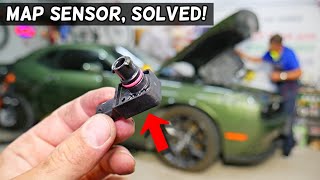
Typical fix: Replace the faulty MAP/BARO sensor. Diagnosis is key to identifying the correct one. On the Hellcat, there are sensors on the supercharger lid and near the throttle body. 🎬 See this walkthrough on how to locate and replace the MAP sensor.
Est. part cost: $40-$120 - Wiring or Connector Issue ⚪ Low Probability Engine vibrations and high heat in the supercharged engine bay can cause wiring to fray or connectors to become loose or corroded over time.
How to confirm: Visually inspect the wiring harness and connector for the BARO/MAP sensor(s) for any signs of damage, corrosion, or loose pins. Use a multimeter to check for proper voltage (5V reference), ground, and signal continuity back to the PCM.
Typical fix: Repair the damaged section of the wiring harness or clean/replace the connector.
Est. part cost: $5-$50 - Faulty Powertrain Control Module (PCM) Very Low Probability This is a rare cause. TSB #05036750A$ specifically warns against assuming the PCM is the problem on Hellcat models, as it's more likely a software issue. A user on SRTHellcat.org with a persistent P2227 ultimately sent his PCMs out for testing after other fixes failed.
How to confirm: This is a diagnosis of last resort. All other possibilities (software, sensor, wiring) must be definitively ruled out by a qualified technician using advanced diagnostic tools.
Typical fix: Replace and program the Powertrain Control Module. This requires a specialized service as 2015+ PCMs are 'locked'.
Est. part cost: $800-$1500
Rare But Worth Checking
- Clogged Air Intake or Dirty Air Filter:
Diagnosis Steps
- Connect an OBD-II scanner to verify code P2227 and document any other codes present.
- For Hellcat Models: Immediately reference TSB #05036750A$, 18-062-17, and 18-047-16. The first and most important step is to have a dealership check for and apply any available PCM software updates. This is the most common fix.
- With the key on and engine off, use a scan tool to view live data for all MAP/BARO sensors. Compare the pressure readings (often in kPa or inHg) to the actual atmospheric pressure for your location and altitude. The readings should be very close to each other and to local weather data.
- Visually inspect the MAP sensors and their electrical connectors for corrosion, damage, or loose connections. On the Hellcat, there is a sensor on the supercharger lid and another near the throttle body.
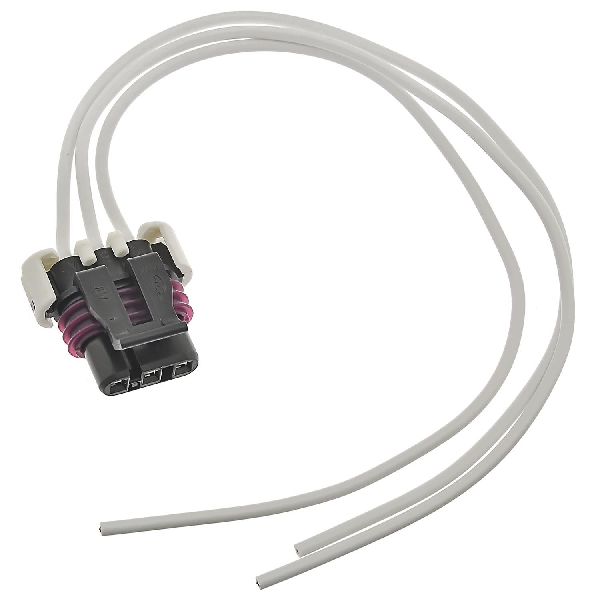
- If a sensor reading is suspect, test the wiring. Disconnect the sensor and use a multimeter to check for the correct reference voltage (typically 5V) and a good ground at the connector.
- If wiring is confirmed good, and a software update does not resolve the issue (or is not available), the sensor itself is the most likely culprit. Replace the sensor that provided the irrational reading.
- Only consider PCM failure after all other diagnostic steps have been exhausted. A forum user with a persistent P2227 after a transmission swap ultimately suspected the PCM after cleaning and checking all four MAP sensors failed to resolve the issue.
Parts You'll Likely Need
- Manifold Absolute Pressure (MAP) Sensor
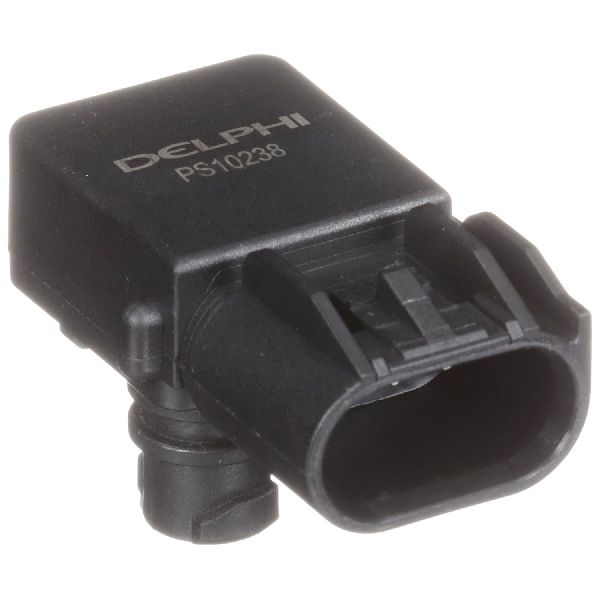
(OEM #68271094AB (or 68271094AA))— On these vehicles, the barometric pressure reading is typically derived from a MAP sensor at startup. If the sensor's internal diaphragm fails or its circuitry drifts, it will send incorrect data, triggering the code. The Hellcat uses multiple sensors, so proper diagnosis is required. This part number is listed for 6.4L engines but is commonly cross-referenced. Always confirm with a dealer using your VIN.
Trusted brands: Mopar, Bosch, NTK
OEM price range: $60-$120
Aftermarket price range: $40-$80
Related Codes That Often Appear With This One
- P2299 — Brake Pedal Position / Accelerator Pedal Position Incompatible. Often appears with P2227 in TSBs 18-062-17 and 18-032-16, suggesting a broader PCM software issue that can be fixed with a flash.
- P0222 / P0223 — Throttle Position Sensor circuit codes. Their presence alongside P2227 points towards a potential PCM or electrical system fault rather than just one bad sensor, and they are also listed in TSB 18-062-17.
- P0441 — EVAP Purge System Performance. Included in the same TSBs (18-062-17, 18-032-16), indicating a possible software calibration issue affecting multiple systems that is resolved with a single PCM update.
- P3032 — Barometric Pressure Sensor Performance Plausibility. This is a closely related code that reinforces a problem with the BARO sensor's readings and is listed in TSB 18-062-17 as being resolved by a software flash.
Technical Service Bulletins (TSBs) & Recalls
- 05036750A$: The most critical TSB, specifically for 2015-2016 Hellcat models, advising against PCM replacement for P2227 without first consulting a specific factory contact.
- 18-062-17: Lists P2227 among other codes that may be resolved by a PCM software update for 2016 models.
- 18-061-17: Also lists P2227 in a group of codes related to potential PCM updates for 2015 models.
- 18-032-16: Mentions P2227 in a list of diagnostic trouble codes for 2016 models.
- 18-047-16: Includes P2227 with other powertrain codes that are addressed by a PCM/TCM software flash for 2015 models.
Platform-Specific Known Issues
- TSB #05036750A$ documents a known issue for 2015-2016 6.2L Supercharged Hellcat models where code P2227 may be set without an actual hardware fault. The bulletin advises against replacing the PCM before consulting with Chrysler technical support, pointing to a complex software or diagnostic issue.
Mechanic-Grade Diagnostic Values
- MAP/BARO Sensor Signal Voltage (Key On, Engine Off) — expected: ~4.5 Volts DC at sea level (0 inches of vacuum). Failure: Voltage is significantly lower or higher, or does not correspond to altitude.
- MAP/BARO Sensor Signal Voltage (Engine Idling) — expected: ~1.0 - 1.7 Volts DC (at normal idle vacuum of ~21 inHg). Failure: Voltage is stuck high (near 4.5V) or does not decrease from the KOEO reading, indicating the sensor is not reading engine vacuum.
- Sensor 5V Reference Voltage (at connector, key on) — expected: Close to 5.0 Volts DC. Failure: Voltage is 0V or significantly below 5V, indicating a wiring issue or a problem with the PCM's 5V reference circuit.
- Sensor Ground Circuit (at connector, key on) — expected: Near 0 Volts (or battery voltage when testing from the positive battery terminal). Failure: Any significant voltage reading indicates a poor ground connection (bad ground strap, corrosion).
Scan Tool Commands That Help
- wiTECH (Dodge Dealer Tool): PCM Flash/Reprogramming — This is the primary fix cited in multiple TSBs for P2227 on this vehicle. It should be performed by a dealer before any parts are replaced to correct known software calibration issues.
- Advanced OBD-II Scanner: Live Data Graphing (MAP Sensor) — To observe the sensor's response to changes in engine load and vacuum. When revving the engine, the graph should show a sharp drop and then stabilize. A flat or erratic line indicates a faulty sensor or circuit.
Wiring & Ground Locations
- MAP Sensor (BARO at startup) — The Hellcat engine has four MAP sensors. The primary ones often referenced are located on the supercharger lid and near the throttle body.. The PCM uses one of these sensors for the initial barometric pressure reading at key-on. A fault in the sensor itself or its dedicated wiring/connector can trigger P2227.
- Engine Ground Strap — A heavy cable connecting the engine block to the vehicle's chassis/frame.. A poor engine ground can introduce electrical noise and voltage drops, causing erratic readings from various sensors, including the MAP/BARO sensor, leading to performance codes like P2227.
OEM Part Supersession History
68207074AA→68207074AB— Standard part revision or supplier change.
Heads up: This is the correct 2-Bar MAP sensor for 2015-2017 Hellcat models.68271094AA→68271094AB— Standard part revision.
Heads up: This part is listed for 6.4L and other engines but is often confused with the Hellcat sensor. It is not the correct primary sensor for the 6.2L supercharged engine.
Model Year Variations Within This Range
- 2015-2017: These models came from the factory with 2-Bar MAP sensors (Part No. 68207074AB).
- 2018+: Starting in 2018, Hellcat models (including Demon and Redeye) were equipped with upgraded 3-Bar MAP sensors from the factory. Owners of 2015-2017 models who increase boost often upgrade to these newer sensors, which requires a corresponding tune update.
Helpful Videos
We Have This Part in Stock


The information in this article is provided for general reference and educational purposes only. Vehicle specifications, procedures, and part compatibility can vary by production date, trim level, and region. Always consult your vehicle's factory service manual and verify part numbers before purchasing or performing repairs. Safety-critical components such as airbags, seat belts, and braking systems should be installed by a qualified professional.
- Dodge CHALLENGER:
- 🎬 Helpful Videos
- 🛍️ Shop This Part
- What's Unique About the 2015-2016 Dodge CHALLENGER
- Diagnostic Flowchart
- Symptoms You May Notice
- Most Likely Causes
- Rare But Worth Checking
- Diagnosis Steps
- Parts You'll Likely Need
- Related Codes That Often Appear With This One
- Technical Service Bulletins (TSBs) & Recalls
- Platform-Specific Known Issues
- Mechanic-Grade Diagnostic Values
- Scan Tool Commands That Help
- Wiring & Ground Locations
- OEM Part Supersession History
- Model Year Variations Within This Range
- 🎟️ Get 5% Off