

P2209 on 2017-2021 Ford F-250 6.7L: NOx Sensor Heater Circuit Causes and Fixes
On a 2017-2021 F-250 with the 6.7L Power Stroke, code P2209 is most often caused by water intrusion into the NOx sensor connector or a faulty NOx sensor itself. This is a widely documented issue confirmed by multiple Ford TSBs. Check for corrosion at the NOx #11 module connector on the passenger-side frame rail first; if it's clean and dry, the sensor itself has likely failed or the PCM needs a software update.
- P2209 on a 6.7L Power Stroke almost always points to the upstream NOx sensor (Bank 1, Sensor 1).
- Before buying parts, ALWAYS inspect the sensor's electrical connector for signs of water damage or corrosion, as this is a known weak point on these trucks.
- Multiple Ford TSBs exist for this exact issue. A dealer can check if your truck is covered under warranty or if a required PCM software update is available.
- If the connector is clean and the software is up to date, the NOx sensor itself has likely failed and needs to be replaced.
What's Unique About the 2017-2021 Ford F-250 SD

The 2017-2021 Super Duty platform with the 6.7L Power Stroke engine is particularly susceptible to this code due to a well-documented design vulnerability. Across multiple model years, Ford has issued several Technical Service Bulletins (TSBs) pointing directly to water intrusion into the NOx sensor's electrical connector as a primary cause. The NOx sensor module is mounted to the passenger-side frame rail, where its connector is exposed to road spray and moisture, leading to corrosion. This makes checking the connector for moisture and green or white crusty corrosion the most important first step, distinguishing it from vehicles where the sensor itself is the automatic primary suspect.
Diagnostic Flowchart
Tap your situation to follow the diagnostic path that matches what you're seeing on this vehicle.
Symptoms You May Notice
- Check Engine Light (Malfunction Indicator Lamp) is on
- Message on the dash regarding exhaust system fault, sometimes with a countdown to limp mode
- Possible reduction in engine power ('limp mode')
- Failed emissions test
- Increased fuel consumption
- Replacing the NOx sensor without first inspecting the electrical connector for water damage. On this truck, the connector is a very common point of failure and could be the only part that needs service.
- Replacing the wrong NOx sensor. P2209 refers to Bank 1, Sensor 1 (NOx 11), which is the upstream sensor, before the DPF/SCR system.
Most Likely Causes

- Water Intrusion at NOx Sensor Connector 🔴 High Probability A recurring issue documented by Ford in multiple TSBs (17-0022, 18-2100, 18-2365, 20-2067) for this specific vehicle range. The NOx module connector, located on the passenger-side frame rail, is susceptible to moisture, causing pin corrosion.
How to confirm: Visually inspect the NOx sensor module's electrical connector for any signs of moisture, green or white crusty corrosion, or bent pins. The TSBs include reference images of this corrosion.
Typical fix: If corrosion is present, Ford's official procedure per the TSBs is to replace both the NOx sensor assembly (which includes the module) and the wiring harness pigtail. After replacement, filling the new connector with dielectric grease is crucial to prevent recurrence.
Est. part cost: $30-$60 for a connector pigtail, plus the cost of the sensor if damaged. - Faulty NOx Sensor (Internal Heater Failure) 🔴 High Probability The heater element inside the sensor can burn out or fail over time, which is a common failure mode for this type of sensor. This can happen independently of water intrusion.
How to confirm: If the connector and wiring are in good condition, and a PCM software update doesn't resolve the issue, the sensor itself is the likely culprit. The heater circuit can be tested with a multimeter for proper resistance; a typical value is between 1.5-8 ohms. An open circuit (infinite resistance) indicates failure.
Typical fix: Replace the Bank 1, Sensor 1 NOx sensor assembly (Ford part HC3Z-5L248-A or a superseding number). This is the 🎬 Watch this professional walkthrough of a NOx sensor replacement. upstream sensor, located before the SCR catalyst. After replacement, a scan tool may be needed to clear adaptations.
Est. part cost: $150-$500 - Outdated PCM Software 🟡 Medium Probability Ford has released TSBs (like 24-2136) that address this and other NOx sensor codes with a PCM software update, indicating the original calibration may be too sensitive or have flawed logic.
How to confirm: A Ford dealership or a shop with a Ford-specific scan tool (like FDRS) can check the current PCM calibration level against the latest available software by VIN.
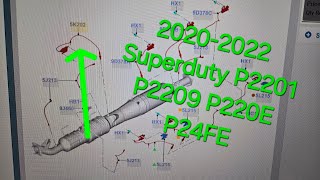
Typical fix: Reprogram the Powertrain Control Module (PCM) to the latest calibration. TSB 24-2136, for 2020-2022 models, 🎬 Watch: A mechanic explains the TSB fix for 2020-2022 models. explicitly calls for replacing the NOx sensor 11 *and* reprogramming the PCM and TCM to correct the issue.
Est. part cost: $0 if under warranty, otherwise shop labor for reprogramming applies (typically 1-2 hours). - Damaged Wiring Harness ⚪ Low Probability The harness runs along the frame and near hot exhaust components. It can be damaged by heat, chafing against chassis components, or road debris. The TSBs for water intrusion often require replacing a section of the harness (p/n 14406) as part of the fix.
How to confirm: Visually inspect the entire length of the NOx sensor wiring harness from the sensor to the main engine harness for any signs of melting, chafing, or breaks. Check for continuity on each wire with a multimeter.
Typical fix: Repair the damaged section of wire or replace the harness section if damage is severe. The pigtail connector (Motorcraft WPT-971) is a common repair part.
Est. part cost: $10-$100 for wiring repair supplies or a new pigtail.
Diagnosis Steps
- Scan the PCM for all stored trouble codes. Note any other codes that appear with P2209, especially U029D or P2201. 🎬 See how to diagnose P2209 alongside communication fault codes.
- Check for applicable TSBs for your vehicle's VIN. TSBs 17-0022, 18-2365, 20-2067, and 24-2136 are highly relevant.
- Locate the Bank 1 Sensor 1 (NOx 11) sensor module. It is bolted to the outside of the passenger-side frame rail.
- Disconnect its main electrical connector. Thoroughly inspect both the harness side and the module side for any signs of moisture or green/white corrosion.
- If corrosion is found, the official Ford repair is to replace both the NOx sensor assembly and the harness pigtail (p/n 14406 or connector WPT-971).
- If the connector is perfectly clean, inspect the wiring harness for any visible damage, chafing, or melting between the sensor and the main harness.
- If wiring is intact, contact a dealership or use a Ford-specific scan tool to check if a PCM software update (per TSB 24-2136 for 2020-22 models) is available and has not been performed.
- If no other cause is found, the NOx sensor itself has likely failed internally and the complete sensor assembly should be replaced.
- After repairs, clear codes and perform a drive cycle, which may include a forced DPF regeneration, to ensure the fault does not return.
Parts You'll Likely Need

- NOx Sensor (Bank 1, Sensor 1)
(OEM #HC3Z-5L248-A)— This is the upstream NOx sensor assembly (also called NOx 11). Its internal heater is the subject of the P2209 code. It is the most common part to fail or be damaged by water intrusion. Note: Part numbers can be superseded; always verify with VIN. For 2020+ models, TSB 24-2136 may call for part number LC3Z-5L248-A.
Trusted brands: Motorcraft, Bosch, Dorman, Standard Motor Products (SMP)
OEM price range: $250-$500
Aftermarket price range: $150-$350 - NOx Sensor Connector
(OEM #WPT-971)— Due to the common water intrusion issue, the connector itself often corrodes and requires replacement along with the sensor. This is the pigtail that gets spliced into the main harness.
Trusted brands: Motorcraft, Standard Motor Products
OEM price range: $30-$60
Aftermarket price range: $20-$40
Related Codes That Often Appear With This One
- U029D — This code indicates a loss of communication with the NOx sensor. It is frequently cited alongside P2209 in Ford TSBs related to water intrusion, as a corroded connector can cause both a performance fault and a total loss of communication.
- P2201 — This code relates to the NOx sensor circuit range/performance. It often appears with P2209 as part of a broader NOx system fault, as seen in TSB 24-2136.
- P22A7 — This code is for NOx Sensor Heater Control Circuit High. It can be triggered by the same water intrusion issues that cause P2209, as noted in TSB 20-2067.
- P220E — This code is for the NOx Sensor Heater Control Circuit Intermittent. It is also mentioned in TSB 24-2136 as being related to PCM software and sensor issues.
- P24FE — A reductant-related code that is also included in TSB 24-2136, suggesting a related software or sensor issue that the PCM update is designed to fix.
Technical Service Bulletins (TSBs) & Recalls

- TSB 24-2136: Addresses P2209 on 2020-2022 models due to PCM software and a faulty NOx sensor 11.
- TSB 20-2067: Cites water intrusion into NOx connectors as the cause for P2209 on models built on or before June 10, 2020.
- TSB 18-2365: Notes water intrusion as the cause for P2209 on 2017-2019 models.
- TSB 18-2100: Supersedes a previous TSB, pointing to water intrusion for P2209 on 2017 models.
- TSB 17-0022: The earliest TSB for 2017 models, identifying water intrusion as the cause for P2209.
- SSM 46268: An early Special Service Message for 2017 models also identifying water intrusion into the NOx sensor 11 connector.
Platform-Specific Known Issues
- Water Intrusion TSBs (2017-2020): TSBs 17-0022, 18-2100, 18-2365, and 20-2067 all point to water intrusion into the NOx sensor connector as a primary cause of P2209 on 2017-2020 models. The fix involves replacing the sensor and harness connector.
- PCM Software & Sensor TSB (2020-2022): TSB 24-2136 indicates that on 2020-2022 models built on or before Oct 31, 2022, a combination of a faulty NOx sensor 11 and outdated PCM software can trigger code P2209. The fix requires both a sensor replacement and a PCM/TCM reprogram.
Mechanic-Grade Diagnostic Values

- NOx Sensor Module Power Supply Voltage (at module connector) — expected: ~12V with Key On, Engine Off (KOEO). Failure: A reading significantly below battery voltage (e.g., 7.5V) points to a wiring or fuse issue upstream of the module.
- NOx Sensor Module Ground Circuit Resistance (at module connector to chassis ground) — expected: < 1 ohm. Failure: High resistance (e.g., 37 ohms) indicates a poor ground connection, possibly at ground point G400.
- NOx Sensor Heater Element Resistance — expected: 1.5 to 8 ohms (general value, varies by manufacturer). Failure: An open circuit (infinite resistance) or a direct short (near zero ohms) indicates a failed heater element requiring sensor replacement.
- CAN Bus Circuit Resistance (at module connector, ignition off) — expected: ~60 ohms between CAN High and CAN Low pins. Failure: A reading significantly different from 60 ohms (e.g., 120 ohms or an open circuit) indicates a problem with the CAN wiring or a terminating resistor.
Scan Tool Commands That Help
- Ford IDS (Integrated Diagnostic System): Reset/Clear Specified Function > Nitrogen Oxide — This function must be used after replacing a NOx sensor to reset the adaptive learn tables in the PCM. Failing to do this can cause the PCM to continue using old data and may result in new, false NOx-related codes being set.
- Ford IDS/FDRS: Module Reprogramming (PCM, TCM, NOx) — Used to apply software updates as specified in TSBs like 24-2136. This is often required in conjunction with sensor replacement to address overly sensitive or flawed diagnostic logic in the original software.
- Ford IDS/FDRS: Operator Commanded Regeneration / DPF Service Regeneration — While not directly for the NOx sensor, performing a forced DPF regeneration after repairs is often recommended. This runs the exhaust system through a full heat cycle, allowing the PCM to verify the new sensor is reading correctly under various conditions and helping the system to relearn.
Wiring & Ground Locations
- NOx 11 Module Connector — Bolted to the outside of the passenger-side frame rail, near the transfer case area.. This is the primary location for the water intrusion failure mode documented in multiple TSBs. All power, ground, and communication for the sensor runs through this connector.
- G400 — On the frame, typically on the LH (driver's) side rear of the cargo area or on a rear crossmember.. A forum post identified this as the ground point for the NOx sensor module. A high-resistance reading on the module's ground pins should lead to an inspection of this location for corrosion or looseness.
- 14406 Harness — The wiring harness assembly that connects to the NOx sensor module.. This is the specific harness assembly Ford calls to be replaced in TSBs related to water intrusion. Damage can occur from corrosion at the connector or chafing/melting along its route over the frame rail.
Real Owner Repair Stories
- Ford Truck Enthusiasts Forum thread (2017 F-250 6.7L with 125k miles) — Check Engine Light with code P2209.
❌ Tried (didn't work) The owner replaced the NOx sensor assembly (module and sensor). This allowed the CEL to be cleared, but a pending code remained and the CEL returned after 10 miles.
✅ What actually fixed it The story is a classic example of misdiagnosis. The owner replaced the part associated with the code but the problem returned, indicating the issue was likely intermittent, a wiring fault not resolved by the new part, or he may have replaced the wrong sensor (Bank 1 vs Bank 2). The thread ends with the user asking for a diagram to confirm he replaced the correct sensor, highlighting the importance of correct sensor identification. - Ford Truck Enthusiasts Forum thread (2020 F-250 6.7L with 50k miles) — CEL with P2209, which would sometimes go out on its own but always returned. Also noted a much higher rate of DEF consumption.
❌ Tried (didn't work) Checked pigtail for rub-through, checked connector for corrosion, added dielectric grease, and had batteries tested. None of these actions resolved the recurring code.
✅ What actually fixed it The owner determined the sensor itself was faulty. The discussion that followed focused on identifying the correct OEM part number, confirming that for a 2020 model, the original part is LC3A-5L248-AC and the replacement service part is LC3Z-5L248-A. This confirms the part number change for the 2020+ model year refresh.
OEM Part Supersession History
HC3Z-5L248-A→LC3Z-5L248-A (for later models)— Model year refresh for 2020+ F-250s. The base part number remains 5L248, but the prefix changes.
Heads up: While the sensors are functionally similar, the prefix (e.g., 'HC3Z' for 2017 vs 'LC3Z' for 2020) indicates a different revision. It is critical to use the part number specified for the vehicle's model year and VIN to ensure correct software compatibility, especially when a PCM reprogram is involved.
Model Year Variations Within This Range
- 2017-2019: The primary cause documented in TSBs for these years is water intrusion into the NOx module connector. The specified replacement part is typically HC3Z-5L248-A and the associated 14406 harness.
- 2020-2021: For these model years, TSB 24-2136 points to a combination of a faulty sensor and sensitive PCM/TCM software. The fix requires replacing the sensor (typically with part number LC3Z-5L248-A) AND reprogramming the modules. The water intrusion issue is less emphasized in the TSB for these later years.
Helpful Videos
We Have This Part in Stock


The information in this article is provided for general reference and educational purposes only. Vehicle specifications, procedures, and part compatibility can vary by production date, trim level, and region. Always consult your vehicle's factory service manual and verify part numbers before purchasing or performing repairs. Safety-critical components such as airbags, seat belts, and braking systems should be installed by a qualified professional.
- Ford F-250 SD:
- 🎬 Helpful Videos
- 🛍️ Shop This Part
- What's Unique About the 2017-2021 Ford F-250 SD
- Diagnostic Flowchart
- Symptoms You May Notice
- Most Likely Causes
- Diagnosis Steps
- Parts You'll Likely Need
- Related Codes That Often Appear With This One
- Technical Service Bulletins (TSBs) & Recalls
- Platform-Specific Known Issues
- Mechanic-Grade Diagnostic Values
- Scan Tool Commands That Help
- Wiring & Ground Locations
- Real Owner Repair Stories
- OEM Part Supersession History
- Model Year Variations Within This Range
- 🎟️ Get 5% Off