

P2187 on 2010-2017 Jaguar XJ: 'System Too Lean at Idle' Causes and Fixes
On a 2010-2017 Jaguar XJ, code P2187 is most often caused by a ruptured PCV diaphragm located in the Bank 1 (right-hand/passenger side) camshaft cover. This creates a significant vacuum leak, leading to a rough idle and a hissing sound. A specific repair kit (C2D60163) is available, making it a relatively inexpensive DIY fix if you can access the valve without breaking the plastic retaining tabs.
- P2187 on a 2010-2017 Jaguar XJ almost always points to a vacuum leak, not a faulty sensor.
- The most likely culprit is a ruptured PCV diaphragm on the Bank 1 (right side) camshaft cover. A specific repair kit (C2D60163) is available for this.
- A smoke test is the best diagnostic tool to quickly and accurately locate the source of the leak.
- Do not replace expensive parts like oxygen sensors or fuel pumps before confirming the absence of vacuum leaks.
- If you also have code P2189 (Bank 2 lean), the cause is a leak large enough to affect the entire engine, making the PCV valve an even more likely suspect.
What's Unique About the 2010-2017 Jaguar XJ

For the Jaguar XJ (X351 generation) with the 3.0L V6 and 5.0L V8 engines, this code is very frequently linked to a specific, known failure point: the diaphragm in the Positive Crankcase Ventilation (PCV) valve. This diaphragm, made of a rubber-like material, is integrated into the camshaft cover and is known to split or rupture over time due to heat and oil vapor exposure. This creates a significant vacuum leak. Jaguar issued a Technical Service Bulletin (SSM74375) acknowledging this and later released a specific repair kit, so owners no longer have to replace the entire expensive camshaft cover.
🎬 Watch: Diagnostic walkthrough for XJ lean codes P2187 and P2189Diagnostic Flowchart
Tap your situation to follow the diagnostic path that matches what you're seeing on this vehicle.
Symptoms You May Notice

- Check Engine Light is on
- Rough, unstable, or vibrating idle.
- Audible hissing or whistling sound from the engine bay at idle, specifically from the top rear of the passenger-side engine bank.
- Engine hesitation when accelerating from a stop.
- Engine may stall when coming to a stop.
- Misfires, which may trigger additional codes (e.g., P0300-P0308).
- Strong vacuum suction when trying to remove the oil filler cap while the engine is running.
- Replacing oxygen (O2) sensors. While an O2 sensor reports the lean condition, it is rarely the cause of it. The sensor is usually doing its job correctly by detecting the unmetered air from a vacuum leak.
- Replacing the fuel pump. A fuel delivery issue would typically affect both engine banks and cause problems under acceleration, not just at idle.
Most Likely Causes

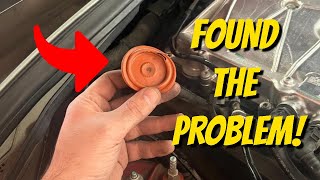
- Ruptured PCV Valve Diaphragm 🔴 High Probability The rubber diaphragm inside the PCV assembly, which is part of the Bank 1 (right-hand) camshaft cover, is a known failure point on these engines. It becomes brittle and splits, causing a large vacuum leak. This is the most common cause by a wide margin.
How to confirm: A smoke test is the definitive method; smoke will pour from the round PCV valve cap. You may also hear a distinct hissing sound from the top of the engine near the right-hand camshaft cover. A simple, though less definitive, test is to place your hand over the PCV valve cap while the engine is running; you may feel suction. Be aware that the plastic tabs on the PCV cap are brittle and may break upon removal, so it's wise to have the replacement kit on hand before inspecting.
Typical fix: Replace the PCV diaphragm, spring, and cap using the available repair kit (Part No. C2D60163). This avoids replacing the entire camshaft cover. The repair can be done in under 30 minutes with basic tools.
Est. part cost: $40-$80 - Vacuum Leak from Other Hoses/Gaskets 🟡 Medium Probability With age, plastic and rubber components in the engine bay, such as intake air ducts, vacuum lines, and intake manifold gaskets, can crack and become brittle.
How to confirm: Perform a smoke test on the intake system. The smoke will escape from the location of the leak, making it visible. Pay attention to the ribbed intake air ducts and all connections to the intake manifold.
Typical fix: Replace the specific cracked hose, duct, or gasket that is found to be leaking.
Est. part cost: $20-$300 - Cracked Symposer Pipe ⚪ Low Probability On supercharged models, a ribbed plastic pipe connected to the intake for the 'symposer' (which pipes engine noise into the cabin) can develop cracks, creating a vacuum leak. This is often located at the back of the engine and can be hard to see.
How to confirm: A hissing sound may be heard from behind the supercharger. A smoke test should reveal the leak. One owner on JaguarForums found a small crack in this pipe where it connects behind the supercharger, causing both P2187 and P2189.
Typical fix: Replace the cracked pipe. Some owners have attempted a temporary repair with gasket maker.
Est. part cost: $50-$150 - Dirty or Faulty Mass Airflow (MAF) Sensor ⚪ Low Probability While not specific to this platform, a contaminated MAF sensor can under-report the amount of air entering the engine, causing the PCM to inject too little fuel. This is less likely than a vacuum leak, as a MAF issue would typically affect both engine banks and might not be isolated to idle.
How to confirm: Inspect the MAF sensor element for dirt or oil. Cleaning it with a dedicated MAF sensor cleaner may resolve the issue. If the problem persists, monitor MAF readings with a scan tool.
Typical fix: Clean the MAF sensor with a specialized cleaner. If cleaning doesn't work, replace the sensor.
Est. part cost: $10-$15 (cleaner), $150-$250 (sensor)
Rare But Worth Checking
- Leaking Fuel Injector: While a lean code suggests a lack of fuel, a leaking injector can sometimes cause erratic fuel delivery that the PCM misinterprets at idle. This is more likely if you also have misfire codes for a single cylinder.
- Exhaust Leak Before Oxygen Sensor: A crack in the exhaust manifold or a leaking gasket before the upstream O2 sensor can allow outside air to be pulled into the exhaust stream. This tricks the O2 sensor into thinking the engine is running lean, causing the PCM to add fuel unnecessarily.
Diagnosis Steps

- Verify the code with a reliable OBD-II scanner. Note any other codes present, especially P2189 (Bank 2 lean).
- With the engine running at idle, listen for an audible hissing sound. Focus on the passenger-side (Bank 1) camshaft cover, near the firewall.
- As a simple check, carefully try to remove the oil filler cap with the engine idling. If there is very strong suction holding it down, this points towards a failed PCV system.
- With the engine running, monitor short-term and long-term fuel trims for Bank 1 (and Bank 2). High positive numbers (e.g., >20%) confirm the PCM is adding fuel to compensate for a lean condition.
- Perform a smoke test. This is the most effective way to find the source of the unmetered air. Introduce smoke into the intake system and look for leaks, paying close attention to the PCV valve on the right-hand (Bank 1) camshaft cover, all vacuum hoses, the symposer pipe (if applicable), and the intake manifold gaskets.
- If no vacuum leaks are found, inspect and clean the Mass Airflow (MAF) sensor(s) using a dedicated cleaner.
- Inspect the flexible intake air ducting between the air filter boxes and the throttle body for cracks, especially in the ribbed sections.
Parts You'll Likely Need

- PCV Valve Diaphragm Repair Kit
(OEM #C2D60163)— This is the most common cause of P2187 on these Jaguar engines, as identified by TSB SSM74375. The original diaphragm ruptures, and this kit provides a replacement cap, spring, and diaphragm.
Trusted brands: Jaguar (OEM), Euro-Amp, Britpart
OEM price range: $50-$100
Aftermarket price range: $30-$60 - Intake Manifold Gasket — If a smoke test reveals a leak from the base of the intake manifold, the gaskets have failed and must be replaced. This is a less common cause than the PCV valve.
Trusted brands: Jaguar (OEM), Mahle, Elring
OEM price range: $100-$150
Aftermarket price range: $50-$80 - Vacuum Hose — A cracked or disconnected vacuum hose can cause a lean condition. The specific hose will be identified during a smoke test.
Trusted brands: Jaguar (OEM)
OEM price range: $30-$150
Aftermarket price range: $10-$50
Related Codes That Often Appear With This One
- P2189 — This is the same 'System Too Lean at Idle' code but for Bank 2. A major vacuum leak, like the PCV valve, often affects both banks, triggering both codes simultaneously.
- P0171 — This is a more general 'System Too Lean (Bank 1)' code. P2187 is more specific, indicating the problem is happening at idle.
- P0507 — Idle Air Control System RPM Higher Than Expected. A vacuum leak allows extra air into the engine, causing the idle speed to be higher than the PCM commands. This code is also mentioned in TSB SSM74375 for the PCV issue.
Technical Service Bulletins (TSBs) & Recalls

- SSM74375: V6 3.0L + V8 5.0L Petrol Right Hand Camshaft Cover Lower Level Repair - Directly links P2187 to a ruptured PCV diaphragm and provides a part number for the repair kit.
Platform-Specific Known Issues

- TSB SSM74375 explicitly calls out P2187 as a potential DTC resulting from a split diaphragm in the pressure control valve (PCV valve) located on the right-hand camshaft cover. It states the cause is a 'Rupture of the camshaft cover pressure control valve rubber diaphragm' and authorizes the use of a lower-level repair kit (part number C2D60163) instead of replacing the entire cover assembly.
Mechanic-Grade Diagnostic Values
- Long Term Fuel Trim (LTFT) at Idle — expected: Close to 0% (ideally +/- 5%). Failure: High positive values, such as +25% or higher, indicate the PCM is adding significant fuel to compensate for a vacuum leak.
- High Pressure Fuel Rail Pressure — expected: 500-2000 PSI, fluctuating with engine demand.. Failure: A sensor reading habitually low could trick the ECU into thinking less fuel is being delivered, causing it to falsely increase fuel trims even if the car is running rich.
- Mass Air Flow (MAF) Sensor Reading at Idle — expected: Approximately 2.78 g/s for a 3.0L engine after warm-up.. Failure: Readings that are significantly lower than expected or do not change with engine RPM can indicate a faulty sensor or wiring issue.
Scan Tool Commands That Help
- Jaguar SDD (Symptom Driven Diagnostics): Vehicle Reset / Reset Adaptations — After replacing a component that affects the air/fuel mixture, such as a MAF sensor or fixing a vacuum leak, this function should be used to clear the learned long-term fuel trim values. This forces the ECU to relearn the fuel strategy with the new/repaired parts.
- Generic OBD-II Scanner / Manual Procedure: Hard Reset (Battery Disconnect) — If dealer-level software is unavailable, a 'hard reset' can be performed by disconnecting the negative battery terminal for at least 10 minutes. Some forum users suggest touching the disconnected negative cable to the positive terminal to fully discharge the capacitors. This will typically reset the fuel adaptations, but if the underlying fault remains, the high fuel trims will return quickly.
Wiring & Ground Locations
- Main Engine Ground Strap — Located directly under the starter on the right (passenger) side of the car, connecting the engine/transmission assembly to the lower frame.. A corroded or loose main engine ground can cause erratic behavior from various sensors, including MAF and O2 sensors, which rely on a stable ground reference. This can lead to incorrect readings and trigger fuel mixture codes.
- MAF Sensor Connector — On the air intake ducts between the air filter boxes and the throttle body. The 5.0L and 3.0L engines use two MAF sensors.. The MAF sensor connector has 5 pins. A poor connection or damaged wire at this connector will cause the ECU to receive incorrect airflow data, leading to improper fueling and potentially a P2187 code. On some models, Pin 1 should have 12V (battery voltage).
Real Owner Repair Stories
- YouTube channel 'fsteddie98' (2013 Jaguar XJ) — Check Engine Light with codes P2187 and P2189, and a noticeable hissing sound from the right side of the engine.
❌ Tried (didn't work) The technician immediately suspected a vacuum leak due to the hissing sound.
✅ What actually fixed it The technician identified the hissing was coming from the PCV valve on the Bank 1 valve cover. He temporarily disconnected and plugged the hose from the PCV, which made the hissing stop and improved fuel trim numbers on the scan tool. He replaced the ruptured PCV diaphragm using a repair kit (which came in a Land Rover bag), which resolved the codes and the rough idle. - JaguarForums user 'zidjan' (2014 Jaguar XJR) — Rough idling and codes P2187 and P2189.
✅ What actually fixed it The user took the vehicle to a mechanic who confirmed the PCV diaphragm was the cause. The part was replaced and the issue was fixed. Another user confirmed this is becoming a common and relatively inexpensive repair.
OEM Part Supersession History
C2D60163→Unknown. One parts site lists a supersession to '102123488' but notes it as 'Unavailable'.— Standard part lifecycle updates.
Heads up: The PCV repair kit C2D60163 is widely used across many Jaguar and Land Rover models with the 3.0L V6 and 5.0L V8 engines, including the XF, F-Type, and Range Rover. No known incompatibilities exist within the specified vehicle range.
Model Year Variations Within This Range
- 2013-2017: Starting in the 2013 model year, the 3.0L supercharged V6 was introduced as the new base engine, and an 8-speed ZF automatic transmission became standard across all models, replacing the previous 6-speed. All-wheel drive also became an option for the V6 models. These changes do not significantly alter the diagnosis for P2187, as both the V6 and V8 engines share the same vulnerable PCV valve design.
- 2016-2017: The 2016 model year brought a facelift with revised bumpers, LED head and tail lights, and a significantly upgraded 'InControl Touch Pro' infotainment system. The core engine and powertrain components related to this code remained the same.
Helpful Videos
Used OEM Parts in Stock


New Aftermarket Parts Available



The information in this article is provided for general reference and educational purposes only. Vehicle specifications, procedures, and part compatibility can vary by production date, trim level, and region. Always consult your vehicle's factory service manual and verify part numbers before purchasing or performing repairs. Safety-critical components such as airbags, seat belts, and braking systems should be installed by a qualified professional.
- Jaguar XJ:
- 🎬 Helpful Videos
- 🛍️ Shop This Part
- What's Unique About the 2010-2017 Jaguar XJ
- Diagnostic Flowchart
- Symptoms You May Notice
- Most Likely Causes
- Rare But Worth Checking
- Diagnosis Steps
- Parts You'll Likely Need
- Related Codes That Often Appear With This One
- Technical Service Bulletins (TSBs) & Recalls
- Platform-Specific Known Issues
- Mechanic-Grade Diagnostic Values
- Scan Tool Commands That Help
- Wiring & Ground Locations
- Real Owner Repair Stories
- OEM Part Supersession History
- Model Year Variations Within This Range
- 🎟️ Get 5% Off