

P2178 on 2012-2018 Land Rover Range Rover Evoque: 'Too Rich' Causes and Fixes
On a 2012-2018 Evoque, code P2178 is often triggered by a fuel system fault rather than a simple sensor issue. The provided TSBs point towards a problem with the high-pressure fuel system, often seen with code P0191. Diagnosis should focus on fuel pressure and potential high-pressure fuel pump (HPFP) failure before replacing parts like O2 sensors. Real-world owner experiences confirm the HPFP is a common, though expensive, fix.
- P2178 on a 2012-2018 Evoque means the engine is running too rich (too much fuel, not enough air).
- Before replacing any parts, check for other codes. If P0191 is present, the problem is almost certainly in the high-pressure fuel system, as confirmed by Land Rover TSBs.
- Diagnosis should focus on live fuel pressure data. A faulty high-pressure fuel pump or fuel rail pressure sensor is a highly probable cause.
- Do not immediately replace the O2 sensors; they are often reporting a problem, not the cause of it.
- Due to the high pressures involved, diagnosis and repair of the fuel system are best left to a professional.
What's Unique About the 2012-2018 Land Rover RANGE ROVER EVOQUE

The 2012-2018 Range Rover Evoque primarily uses a 2.0L turbocharged direct-injection engine (badged Si4, based on the Ford EcoBoost). This engine's high-pressure fuel system is a key area of concern. Manufacturer Technical Service Bulletins (TSBs) for this vehicle explicitly link P2178 with fuel pressure sensor codes (P0191), suggesting that fuel delivery problems are a more common cause than on other vehicles where this code might point to a vacuum leak or MAF sensor. A similar TSB for the Jaguar XF with the same engine also links P2178 to software errors or intake air leaks, reinforcing the platform's sensitivity. Owner forums corroborate that the high-pressure fuel pump is a frequent culprit for these codes.
Diagnostic Flowchart

Tap your situation to follow the diagnostic path that matches what you're seeing on this vehicle.
Symptoms You May Notice
- Check Engine Light is on
- Reduced engine performance or "limp mode"
- Rough or unstable idle
- Engine misfires
- Decreased fuel economy
- A smell of gasoline from the exhaust
- Hard starting, especially when the engine is warm
- Engine oil smells strongly of gasoline
- Immediately replacing the oxygen sensor without checking fuel pressure, fuel trims, and for fuel contamination in the oil.
- Replacing the MAF sensor without first checking for vacuum or boost leaks with a smoke test.
- Replacing the fuel rail pressure sensor when the high-pressure fuel pump is the actual source of the problem by leaking fuel into the crankcase.
Most Likely Causes

- High-Pressure Fuel Pump (HPFP) Failure 🔴 High Probability As indicated by Land Rover TSBs SSM73959.2 and SSM74093, this code frequently appears alongside P0191 (fuel rail pressure sensor code), pointing to a systemic issue. Direct injection HPFPs are a known failure point, and a common failure mode is the internal seals leaking fuel directly into the crankcase. This contaminates the oil, which is then vented through the PCV system back into the intake, causing a rich condition. A forum member's experience confirmed this was the ultimate fix after other parts were tried.
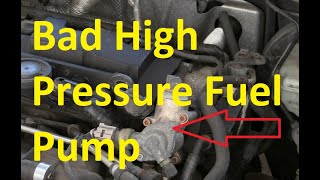
How to confirm: Check the engine oil dipstick for a strong smell of gasoline. Use an advanced scan tool to monitor live fuel rail pressure data; however, the pump can sometimes provide correct pressure while still leaking internally. A fuel pressure leak-down test after shutting the engine off can also be indicative. The most definitive diagnosis is often replacing the pump when other symptoms align. 🎬 Watch: Learn the common symptoms of a failing high-pressure pump.
Typical fix: Replace the high-pressure fuel pump and the cam follower if applicable. An engine oil and filter change is mandatory to remove the fuel-contaminated oil.
Est. part cost: $300-$800 - Faulty Fuel Rail Pressure Sensor 🟡 Medium Probability The sensor provides the primary data for fuel pressure control. TSBs directly link P2178 with P0191, which is a code for this sensor's performance. A faulty sensor can incorrectly report low pressure, causing the PCM to command the HPFP to work harder, resulting in an actual high-pressure/rich condition.
How to confirm: Use a scan tool to monitor live fuel rail pressure data. Compare the desired pressure with the actual pressure reading. A reading that is erratic, stuck, or significantly different from the desired value points to a sensor or wiring issue.
Typical fix: Replace the fuel rail pressure sensor. Part numbers like 8W839F972AA, C2Z21970, and LR079937 are associated with this vehicle. 🎬 See this walkthrough for locating and replacing the pressure sensor.
Est. part cost: $70-$250 - Leaking Fuel Injector(s) 🟡 Medium Probability
How to confirm: A fuel pressure leak-down test can indicate a leaking injector. Another method is to remove the spark plugs after the engine has sat and check for signs of raw fuel or a 'wet' plug in one of the cylinders.
Typical fix: Replace the faulty fuel injector(s) and their seals. It is often recommended to replace them as a set.
Est. part cost: $50-$200 per injector - Faulty Oxygen (O2) Sensor ⚪ Low Probability
How to confirm: A faulty upstream O2 sensor (Bank 1, Sensor 1) can get 'stuck' reading a lean condition, causing the PCM to add more fuel than necessary. Use a scan tool to graph the O2 sensor voltage; it should switch rapidly between high and low values. If it's slow, stuck, or biased, it's likely faulty.
Typical fix: Replace the Bank 1 upstream oxygen sensor.
Est. part cost: $80-$250
Rare But Worth Checking
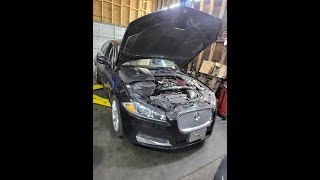
- Leaking Turbocharger Hose or Intercooler: A video from a mechanic fixing P2178/P2187 on a Jaguar with the same 2.0L engine found a split in a hose running from the turbo to the intercooler. This creates a boost leak (unmetered air) which can confuse the PCM's fuel calculations. Another owner fixing a 'limp mode' issue on an Evoque found a similar split intercooler hose. 🎬 Watch: Mechanic fixes P2178 on a Jaguar with this engine.
- PCM Software Issue: A recall (N622) was issued for some 2018 models for a PCM software error related to fuel adaptation monitoring. Additionally, a TSB for the Jaguar XF with the same engine suggests an EMS software error can cause P2178, recommending a software update after fixing any hardware faults. Ensure the vehicle's PCM software is up to date.
- Stuck Open Purge Valve: A stuck open canister purge valve can allow fuel vapors from the EVAP system to enter the intake manifold at the wrong time, creating a rich condition that the PCM cannot compensate for.
Diagnosis Steps
- Check for and record any other stored DTCs. Pay special attention to codes like P0191, as they provide critical clues.
- Analyze freeze frame data to see the engine conditions (RPM, load, temperature) when the code was set.
- Using a scan tool, monitor live data for long-term and short-term fuel trims on Bank 1. A highly negative number (e.g., -25% or more) confirms the rich condition.
- Inspect the engine oil dipstick and oil cap. A strong smell of raw gasoline is a major red flag for a leaking high-pressure fuel pump.
- Monitor the live data for the Fuel Rail Pressure Sensor. Compare the actual pressure to the desired pressure commanded by the PCM. They should be very close at idle and respond together with RPM changes.
- Perform a smoke test on the entire intake system. Carefully check all hoses from the air filter to the throttle body, and especially the turbocharger and intercooler hoses, for any cracks, loose connections, or leaks.
- Graph the upstream O2 sensor (Bank 1, Sensor 1) to ensure it is switching correctly and not stuck rich or lean.
- If fuel pressure is incorrect or unstable, or if fuel is present in the oil, further diagnosis of the high-pressure fuel pump, driver module, and sensor is required.
- If all else checks out, perform a fuel injector leak-down test to check for a mechanically stuck-open injector.
Parts You'll Likely Need

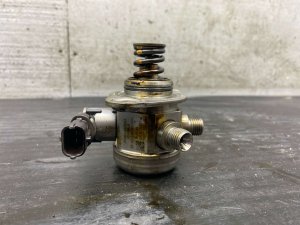
- High-Pressure Fuel Pump
(OEM #LR025599)— This is a common failure point on direct-injection engines and is strongly suggested by the TSBs linking P2178 to fuel pressure code P0191. A leaking internal seal is a frequent cause of unexplained rich conditions.
Trusted brands: Bosch (Part #66800), Genuine Land Rover
OEM price range: $500-$800
Aftermarket price range: $300-$600 - Fuel Rail Pressure Sensor
(OEM #C2Z21970 / 8W839F972AA)— This sensor provides the critical data for fuel pressure. If it fails, it can send incorrect information, leading to a rich condition. It's often replaced during diagnosis due to its link with code P0191.
Trusted brands: Bosch (Part #0261545063), Genuine Land Rover
OEM price range: $120-$250
Aftermarket price range: $70-$150
Related Codes That Often Appear With This One
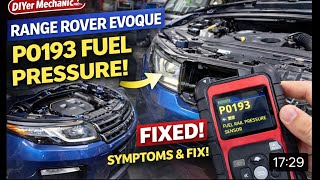
- P0191 — This code means 'Fuel Rail Pressure Sensor Circuit Range/Performance'. The manufacturer TSBs SSM73959.2 and SSM74093 directly link P2178 with P0191, indicating the root cause is very likely in the high-pressure fuel system. Owner forums for JLR vehicles confirm this pairing often leads to HPFP or sensor replacement.
- P168F — Also mentioned in the TSBs alongside P2178. This is a manufacturer-specific code that can be related to fuel system control or a discrepancy between the fuel model and actual pressure.
- P144C — Another code mentioned in TSBs for JLR vehicles, often related to the EVAP system or fuel tank ventilation, which can sometimes influence fuel trims if a valve is stuck.
- P2188 — 'System Too Rich at Idle Bank 1'. This code is the idle-speed equivalent of P2178. Seeing both together strongly points to a persistent issue like a leaking injector, faulty HPFP, or bad purge valve that affects the mixture across all engine speeds.
Technical Service Bulletins (TSBs) & Recalls

- SSM73959.2
- SSM74093
- JTB00463NAS1
Platform-Specific Known Issues
- TSB #SSM73959.2 and #SSM74093: These bulletins explicitly state that for customer reports of reduced performance, code P0191-85 may be present, and P2178-00 may also be stored. This is a strong indicator of a known issue with the high-pressure fuel system.
- Recall N622: For certain 2018 models with the 2.0L Ingenium petrol engine, a PCM software error could prevent the Malfunction Indicator Lamp (MIL) from illuminating when certain fuel adaptation DTCs are stored. This highlights the importance of ensuring the vehicle's software is up-to-date.
- TSB #JTB00463NAS1 (Jaguar): While for a Jaguar XF, this TSB applies to the same 2.0L GTDi engine and addresses P2178 caused by an EMS software error or intake air leak, suggesting a potential software reflash could be part of the solution for the Evoque as well.
Mechanic-Grade Diagnostic Values
- High-pressure fuel rail pressure at idle — expected: 3.0-8.0 MPa (435-1160 PSI). Failure: Pressure is approximately 700-900 KPa (101-130 PSI) and does not increase with engine speed.
- Low-pressure fuel system pressure — expected: Check workshop manual for specific values, but must be stable and within spec before diagnosing the high-pressure side.. Failure: Low or erratic low-side pressure can starve the HPFP and cause misdiagnosis.
Scan Tool Commands That Help
- JLR SDD (Symptom Driven Diagnostics) or equivalent advanced scanner: Reset PCM Adaptions — As an interim measure if no physical faults are found, as suggested by TSB SSM73959. This forces the PCM to relearn fuel trim values. It should also be performed after a hardware repair.
- JLR SDD (Symptom Driven Diagnostics): Air Path Calibration — Recommended after replacing major engine components, including the engine itself, to allow the PCM to learn the airflow characteristics of the new parts.
Wiring & Ground Locations
- G1D130a — Left front of the engine compartment.. This is a primary ground point in the engine bay. A poor ground here can affect the Engine Control Module (ECM) and its sensors, leading to erratic readings and incorrect fuel calculations.
- G1D122b — Lower left front of the engine compartment.. Another critical engine bay ground. Verifying the integrity of these grounds is a key step in diagnosing electrical causes for fuel system codes.
- ECM Connector — Center rear of the engine compartment.. The ECM receives signals from the fuel pressure sensor, O2 sensors, and MAF sensor. Checking for corrosion or damage at the main connector is crucial if sensor readings are suspect.
Real Owner Repair Stories
- YouTube channel 'D&E Auto Repair' (2015 Jaguar XF 2.0L Turbo (same Ford-based engine as early Evoque)) — Rough idle, stalling, codes P2187 (rich at idle) and P2178 (rich off-idle).
❌ Tried (didn't work) Initial checks of sensors and wires.
✅ What actually fixed it A smoke test revealed a large split in the charge air hose running from the turbocharger to the intercooler. Replacing the hose resolved the codes. - Range Rover Evoque Forum user 'Mudi1' (Range Rover Evoque (year not specified)) — Code P0087 (Fuel Rail Pressure - Too Low), which is functionally related to the P2178/P0191 fault family, causing the engine to shut down completely on the highway.
❌ Tried (didn't work) Roadside assistance diagnosed a faulty Fuel Rail Pressure Sensor, but this was not the root cause.
✅ What actually fixed it A mechanic inspected the fuel filter and found it was severely clogged with a 'slimey brown coating' and contained water. Replacing the contaminated fuel filter resolved all fault codes.
"I Checked Everything" — The Actual Cause
- In one documented case related to fuel pressure codes (P0087), the root cause was not a vacuum or boost leak that a smoke test would find, but rather a severely clogged and water-contaminated fuel filter on the low-pressure side. This starved the high-pressure pump, causing the fault, and highlights the need to check the entire fuel delivery system, not just for air leaks.
OEM Part Supersession History
LR030860→LR025599— Updated part for the High-Pressure Fuel Pump (HPFP).LR024969→C2Z21970 / 8W839F972AA / AG9E9F972AA— These part numbers are often listed as cross-references or replacements for the Fuel Rail Pressure Sensor. C2Z21970 is a common Jaguar part number that fits this JLR engine.
Heads up: Always verify fitment with VIN, but these are generally interchangeable for the specified engine.
Model Year Variations Within This Range
- 2012-2015: These early models use the 2.0L Si4 engine, which is a derivative of the Ford 2.0L EcoBoost. They were initially paired with a 6-speed automatic transmission before a 9-speed was introduced around 2014. These Ford-based engines are noted to have specific reliability concerns.
- 2015-2018: Land Rover began phasing in its own 'Ingenium' 2.0L petrol engine family starting in 2015. While these engines also had some initial quality problems, their design, components (including fuel system), and software are different from the earlier Ford-based units. Diagnosis and parts will differ significantly between an Si4 and an Ingenium engine.
Helpful Videos
Used OEM Parts in Stock


New Aftermarket Parts Available



The information in this article is provided for general reference and educational purposes only. Vehicle specifications, procedures, and part compatibility can vary by production date, trim level, and region. Always consult your vehicle's factory service manual and verify part numbers before purchasing or performing repairs. Safety-critical components such as airbags, seat belts, and braking systems should be installed by a qualified professional.
- Land Rover RANGE ROVER EVOQUE:
- 🎬 Helpful Videos
- 🛍️ Shop This Part
- What's Unique About the 2012-2018 Land Rover RANGE ROVER EVOQUE
- Diagnostic Flowchart
- Symptoms You May Notice
- Most Likely Causes
- Rare But Worth Checking
- Diagnosis Steps
- Parts You'll Likely Need
- Related Codes That Often Appear With This One
- Technical Service Bulletins (TSBs) & Recalls
- Platform-Specific Known Issues
- Mechanic-Grade Diagnostic Values
- Scan Tool Commands That Help
- Wiring & Ground Locations
- Real Owner Repair Stories
- "I Checked Everything" — The Actual Cause
- OEM Part Supersession History
- Model Year Variations Within This Range
- 🎟️ Get 5% Off