

Ultimate P2137 Guide: Throttle/Pedal Sensor Signal Mismatch
The Most Comprehensive Guide to Diagnosing and Fixing OBD-II Code P2137
- P2137 is a critical safety code that triggers a 'limp mode,' severely limiting speed and power. The vehicle is not safe for normal driving.
- The most common causes are electrical: a faulty connector, a worn-out accelerator pedal sensor, or a failed electronic throttle body. Do not assume the most expensive part is the cause.
- Thoroughly inspect and test wiring and connectors at both the gas pedal and the throttle body before buying any parts. Check for corrosion, damage, and proper pin tension.
- On many modern cars (especially Ford, GM, and Nissan), the throttle position sensor (TPS) is integrated into the throttle body. If the TPS is faulty, the entire assembly must be replaced, often costing $400 to $900.
- After replacing a throttle body, a 'relearn' procedure is almost always necessary to prevent idle and performance problems.
What Does P2137 Mean?

P2137 means your car's main computer, the Powertrain Control Module (PCM), is receiving conflicting signals from the two sensors that monitor either the accelerator pedal's position or the throttle body's position. For safety and redundancy, these systems use two or more sensors. When their voltage readings disagree by a specified amount for a set period, the PCM can't trust the driver's input, triggering the code and forcing the engine into a protective limp mode.
Technical definition: The official SAE/OBD-II definition is "Throttle/Pedal Position Sensor/Switch ‘B’ / ‘C’ Voltage Correlation". This indicates the PCM has detected that the voltage signals from sensor 'B' and sensor 'C' within the accelerator pedal or throttle body do not agree with each other within a pre-programmed range, typically differing by more than 0.2-0.5 volts for a few seconds.
Can I Drive With P2137?

yes_but_not_recommended. Driving is technically possible, but extremely unsafe and not recommended. Your vehicle will enter a reduced-power 'limp mode,' limiting RPMs (to ~2,000-3,000) and speed (to 30-50 mph), making it hazardous in traffic, especially on highways. Continuing to drive could mask a problem that leads to more severe engine damage. A persistent rich or lean fuel condition caused by incorrect throttle readings could, over time, damage the catalytic converter, a repair costing $800-$2500.
Common Causes

- Faulty Wiring or Connector (very_common) — This is the most frequent culprit. Connectors at the APP sensor or throttle body can suffer from corrosion (especially green oxidation), pushed-out pins, or poor terminal tension ('fretting'). The harness itself can be damaged by chafing, heat, or rodents.
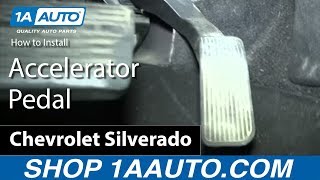
- Faulty Accelerator Pedal Position (APP) Sensor (common) — The sensor assembly attached to your gas pedal contains carbon tracks that wear out over time, creating dead spots or erratic voltage signals. It is almost always replaced as a complete pedal assembly. 🎬 See how to replace the accelerator pedal and position sensor.
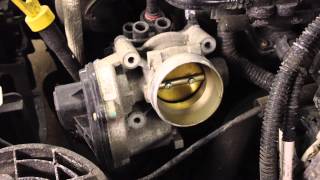
- Faulty Electronic Throttle Body Assembly (common) — The Throttle Position Sensor (TPS) is typically integrated into the electronic throttle body. Internal electronic failure, often from contamination or wear on the sensor contacts, requires replacement of the entire throttle body. 🎬 Watch: Step-by-step guide to replacing a faulty electronic throttle body.
- Poor Engine/Chassis Ground Connection (less_common) — A corroded, loose, or broken main ground strap for the engine or body can create an unstable reference voltage for multiple sensors, including the APP and TPS, leading to correlation faults. This is an often-overlooked cause.
- Water Intrusion into Wiring Harness (less_common) — On certain vehicles (notably some GM models), water can leak into major harness connectors, like the instrument panel-to-body connector, causing widespread corrosion and seemingly unrelated sensor codes like P2137.
- Aftermarket Accessories (rare) — Improperly installed or oiled aftermarket air filters can contaminate the throttle body electronics. Poorly designed cold air intakes may also cause air turbulence, leading to erratic throttle plate behavior that can trigger correlation codes.
- Faulty Powertrain Control Module (PCM) (very_rare) — While possible, a PCM failure is the least likely cause. The PCM should only be suspected after all other possibilities—especially wiring, connectors, and sensors—have been exhaustively tested and ruled out.
- Low or Unstable Battery Voltage (less_common) — A failing battery or alternator can cause low system voltage, which may lead to unpredictable behavior from sensitive electronic modules and sensors, potentially triggering correlation codes during startup or driving.
Symptoms
- Check Engine Light is On — The Malfunction Indicator Lamp (MIL) will be illuminated. Often, an Electronic Throttle Control (ETC) light (a lightning bolt symbol) will also be lit.
- Reduced Engine Power / Limp Mode — The most common symptom. The vehicle will feel extremely sluggish and may not exceed 30-50 mph. You may see a message like 'Engine Power is Reduced' or 'Service Throttle'.
- Hesitant or No Acceleration — The car may hesitate severely, surge, or have a delayed response when you press the gas pedal. In some cases, there may be no throttle response at all, even in Park or Neutral.
- Unstable or High Idle — The engine may idle higher than normal, or the idle speed may fluctuate erratically as the PCM struggles to determine the correct throttle position.
- Engine Stalls Unexpectedly — The engine may stall when you come to a stop or release the pedal quickly, as the PCM loses track of the throttle plate's closed position.
Diagnosis Steps

- Read Codes and Review Freeze Frame Data
Using an OBD-II scanner, confirm P2137 is present. Crucially, look for other codes. P2138 points to the APP sensor, while P2135 points to the TPS. Review the freeze frame data to see the exact conditions (speed, RPM, temperature) when the fault occurred.
Tools: OBD-II Scanner (beginner) - Perform a Meticulous Visual Inspection
Inspect the wiring and connectors at the Accelerator Pedal Assembly and the Electronic Throttle Body. Look for obvious signs of damage, such as rodent chewing, chafing against brackets, or melting from exhaust heat. Unplug connectors and check for green corrosion or bent pins.
Tools: Flashlight, Inspection Mirror (beginner) - Check for Technical Service Bulletins (TSBs)
Search online for TSBs related to P2137 for your vehicle's specific make, model, and year. Manufacturers often release bulletins for known wiring problems or faulty parts, which can save hours of diagnosis.
Tools: Internet Access (beginner) - PRO TIP: Perform a Terminal Drag Test
Poor pin tension is a common, invisible cause. Use a special terminal test pick (or a spare male pin of the correct size) to check the female terminals in the sensor connectors. The terminal should have a noticeable 'drag' or grip on the pin. If it feels loose, the terminal must be replaced or re-tensioned to ensure a solid connection.
Tools: Terminal Test Kit (advanced) - Test Sensor Power and Ground with a Multimeter
Turn the key ON (engine OFF). At the sensor connector (APP or TPS), use a multimeter to verify a stable 5-volt reference signal and a solid ground. A stable reference voltage should be between 4.75V and 5.25V. A good ground connection should read less than 100 millivolts (0.1V). An unstable or missing voltage points to a wiring issue upstream or a PCM fault.
Tools: Multimeter (intermediate) - Test Sensor Signal Voltage Sweep
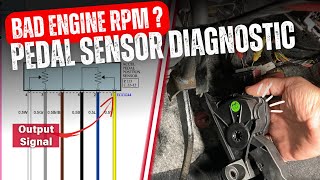
Reconnect the sensor. Back-probe the two signal wires. With a scan tool displaying live data or using a multimeter, slowly press the gas pedal. Watch the two voltage readings. They should sweep smoothly from low (e.g., ~0.5V) to high (e.g., ~4.5V) without any glitches, jumps, or dropouts. 🎬 Watch: How to diagnose and solve accelerator pedal sensor problems. One sensor's voltage may be half of the other, or they may be inverse; this is normal. The key is a smooth, corresponding sweep.
Tools: Multimeter with back-probe pins, OBD-II Scanner with Live Data (intermediate) - Execute a 'Wiggle Test'
While monitoring the live sensor voltages on your scan tool, systematically wiggle the wiring harness and connectors at the pedal, throttle body, and any junction points in between. If the voltage reading jumps or drops out when you move a specific area, you have pinpointed the location of an intermittent short or open circuit.
Tools: OBD-II Scanner with Live Data (intermediate) - PRO TIP: Analyze with an Oscilloscope for Definitive Proof
An oscilloscope is the ultimate tool. Graph both signal voltages simultaneously. A good sensor shows two clean, smooth lines that track each other perfectly as the pedal is pressed and released. A bad sensor will show as a 'glitch'—a sharp drop, spike, or hash/noise—in one of the waveforms that is not mirrored in the other. This is definitive proof of a failing sensor track or wiring fault.
Tools: Automotive Oscilloscope (advanced) - Advanced: Test PCM Ground via Voltage Drop
Using a multimeter, test the voltage drop at the PCM's ground pins. Connect the black lead to the battery negative terminal and the red lead to a back-probe on a PCM ground wire. With the key on, engine running, the voltage drop should be minimal. A reading below 100mV (0.1V) is excellent. Readings of 70-80mV are acceptable. A high reading indicates a poor ground connection, which can cause erratic sensor behavior.
Tools: Multimeter, Wiring Diagram (for PCM pinout) (advanced) - Advanced: Sensor Resistance (Ohm) Sweep Test
Disconnect the sensor connector. Use a multimeter set to Ohms to measure the resistance between the signal and ground pins for each internal sensor. While slowly operating the pedal or throttle plate, watch the resistance values. They should change smoothly with no sudden jumps or dropouts (open circuit). Specific Ohm ranges are manufacturer-dependent and require a service manual, but the smoothness of the sweep is a key indicator of sensor health.
Tools: Multimeter, Service Manual (advanced)
Common Fixes & Costs

- Professional Diagnosis — Parts: $0, Labor: $150-$200 (professional)
- Accelerator Pedal Assembly Replacement — Parts: $70-$300, Labor: $60-$180 (diy)
- Electronic Throttle Body Replacement — Parts: $200-$700, Labor: $100-$250 (intermediate)
- Wiring Harness or Connector Repair — Parts: $20-$100, Labor: $150-$500+ (professional)
- Connector Cleaning and De-pinning — Parts: $10-$30 (Contact Cleaner, Terminal Tools), Labor: $75-$150 (diy)
Most Commonly Affected Vehicles
- Ford Focus, Fusion, Escape (2010-2018) — The 2012-2018 Focus is notorious for this issue due to internal contamination of the throttle body electronics. Ford's Customer Satisfaction Program 13N03 extended the warranty on some models like the Fusion and Escape, but this program has expired for most owners.
- Chevrolet / GMC / Cadillac Trucks & SUVs (Silverado, Tahoe, Sierra, etc.) (2008-2014) — These vehicles are prone to throttle position sensor failures. TSB 11-06-04-007B addresses related code P2135, indicating a known weakness in the throttle body electronics for this era.
- Chevrolet Impala (2009-2011) — Subject to GM Special Coverage Adjustment #14636 for a known issue with a broken solder connection inside the accelerator pedal position (APP) sensor, causing this code and reduced power.
- Hyundai / Kia Sonata, Elantra, Santa Fe, Optima, Sorento (2011-2015) — Frequent reports of P2137 are common for these models. The cause can be either the accelerator pedal sensor or the throttle body assembly, making accurate diagnosis essential to avoid replacing the wrong part.
- Nissan Altima, Sentra, Rogue, Versa (2007-2013) — Often caused by a failing electronic throttle body. Nissan TSB NTB12-051d addresses similar throttle response issues on some models, often recommending throttle body replacement.
- Various GM Models Various Cars and SUVs (2007-2014) — TSB 12-06-04-002B addresses a related code (P2138) caused by water leaking into the instrument panel-to-body harness connector (X224). This known wiring vulnerability can also cause P2137.
- Subaru Outback, Legacy, Impreza (2005-2009) — On these models, issues with spread connector terminals or a failing electronic throttle control relay can mimic a sensor failure. The relay should be checked before condemning the throttle body.
- Buick LaCrosse / Allure (2009) — Also covered under GM's Special Coverage Adjustment #14636 for a faulty accelerator pedal position (APP) sensor due to an internal broken solder connection.
Manufacturer-Specific Notes
- General Motors: A 'Throttle Relearn' or 'Idle Learn' procedure is almost always required after replacing a throttle body or disconnecting the battery. This can often be done without tools by following a specific sequence of key cycles, idling, and driving, but some models require a scan tool.
- Peugeot / Citroen: On many models, P2137 is caused by a poor connection at the accelerator pedal connector. Simply unplugging the connector, spraying it with quality electronic contact cleaner, and plugging it back in firmly can permanently fix the problem.
- Subaru: On some mid-2000s models, throttle control problems are not caused by the sensor but by a failing electronic throttle control relay, often located behind the glove box or in the passenger kick panel. Check this relay before replacing expensive parts.
- Ford: Ford issued Customer Satisfaction Program 13N03, extending the warranty on the electronic throttle body to 10 years/150,000 miles for certain 2009-2013 Fusion, Milan, Escape, and Mariner vehicles due to high failure rates. This program is now expired for most vehicles.
Related Codes
- P2138 — This is the direct partner code for the Accelerator Pedal Position (APP) sensor, indicating a correlation fault between its internal sensors ('D'/'E'). If you have P2137 and P2138 together, the fault is almost certainly in the APP sensor or its dedicated wiring/connector.
- P2135 — This is the direct partner code for the Throttle Position Sensor (TPS), indicating a correlation fault between its internal sensors ('A'/'B'). If you have both P2135 and P2137, the fault is highly likely within the electronic throttle body assembly itself.
- P0120-P0124 — These codes point to specific circuit malfunctions (e.g., low input, high input, intermittent) for TPS 'A'. Unlike a correlation code, they suggest a specific wire is shorted/open or the sensor has a complete internal failure, helping to narrow down the diagnosis.
- P2120-P2128 — These codes indicate a specific circuit malfunction for one of the APP sensor circuits ('D' or 'E'). Seeing one of these (e.g., P2122 for low input) alongside P2137 strongly points to the accelerator pedal assembly as the root cause, not the throttle body.
DIY vs Professional
Climate & Environmental Factors
- High Humidity / Moisture: This is the most significant environmental factor. High humidity accelerates corrosion on wiring harness connectors, sensor pins, and ground points. Water intrusion from clogged drains (sunroof, A/C evaporator) or failed weather seals can directly contaminate connectors, leading to shorts and signal degradation that trigger P2137.
- Road Salt (Winter Climates): In regions that use road salt during winter, the corrosive effects on underbody wiring, ground straps, and engine bay components are magnified. Salt spray can compromise connectors and accelerate the degradation of wiring insulation, leading to intermittent electrical faults.
Frequently Asked Questions
What is the most common mistake when fixing P2137?
The biggest mistake is replacing parts without proper diagnosis. Many people replace the expensive throttle body ($400+) when the actual fault was a less expensive accelerator pedal sensor ($150) or, even cheaper, a corroded wire or loose connector pin. Always test before replacing.
Can I just clean my throttle body to fix P2137?
No. While cleaning carbon buildup from a throttle body is good maintenance for idle issues, P2137 is an electrical correlation fault. The problem is with the electronic sensors, not carbon deposits. Cleaning will not fix the underlying electrical issue.
What's the difference between the APP sensor and the TPS?
The Accelerator Pedal Position (APP) sensor is connected to your gas pedal; it tells the PCM your intent (how much power you're requesting). The Throttle Position Sensor (TPS) is on the throttle body in the engine bay; it reports the actual opening angle of the throttle plate. P2137 can be triggered by a mismatch in either of these locations.
Do I need to perform a 'relearn' procedure after replacing a part?
Yes, almost always after replacing the electronic throttle body, especially on GM, Nissan, and Ford vehicles. The PCM needs to learn the new sensor's closed, open, and idle positions. Failing to do this can result in a high idle, stalling, or incorrect throttle response.
Is it safe to clear the code and keep driving?
You can clear the code, but it will return almost immediately once the PCM detects the sensor mismatch again. Continuing to drive is a significant safety risk, as the vehicle can enter limp mode at any moment, such as when you are trying to merge into traffic.
Why does my car use two sensors? Why not just one?
This is a fail-safe design for the 'drive-by-wire' system. Because there is no physical cable connecting your pedal to the throttle, the computer relies on these sensors. By using two, it can constantly cross-check their readings. If one sensor fails, the disagreement between them alerts the PCM to a critical problem, triggering limp mode to ensure driver safety.
What does a good oscilloscope pattern for a pedal sensor look like?
A good pattern shows two clean, mirror-image or parallel lines moving smoothly as you press the pedal. There should be no 'fuzz' (noise), sharp vertical drops (dropouts), or jagged sections. One signal might sweep from 0.5V to 4.5V while the other sweeps from 4.5V to 0.5V, or they might both sweep up together, with one at half the voltage of the other. The key is that they are clean and track each other perfectly.
Helpful Videos

The information in this article is provided for general reference and educational purposes only. Vehicle specifications, procedures, and part compatibility can vary by production date, trim level, and region. Always consult your vehicle's factory service manual and verify part numbers before purchasing or performing repairs. Safety-critical components such as airbags, seat belts, and braking systems should be installed by a qualified professional.
- 🎬 Helpful Videos
- What Does P2137 Mean?
- Can I Drive With P2137?
- Common Causes
- Symptoms
- Diagnosis Steps
- Common Fixes & Costs
- Most Commonly Affected Vehicles
- Manufacturer-Specific Notes
- Related Codes
- DIY vs Professional
- Climate & Environmental Factors
- Frequently Asked Questions
- What is the most common mistake when fixing P2137?
- Can I just clean my throttle body to fix P2137?
- What's the difference between the APP sensor and the TPS?
- Do I need to perform a 'relearn' procedure after replacing a part?
- Is it safe to clear the code and keep driving?
- Why does my car use two sensors? Why not just one?
- What does a good oscilloscope pattern for a pedal sensor look like?
- 🎟️ Get 5% Off