

P2135 on 2005-2012 GMC Canyon: Throttle Position Sensor Fault Causes & Fixes
On a 2005-2012 GMC Canyon, code P2135 almost always points to a faulty throttle body assembly. The internal throttle position sensors fail, causing a 'Reduced Engine Power' warning. Cleaning may help temporarily, but replacement of the entire throttle body is the common, permanent fix. This issue is also rampant on its platform-mates, the Chevrolet Colorado and Hummer H3.
- P2135 on a 2005-2012 GMC Canyon is a very common code that almost always means the throttle body assembly has failed.
- The primary symptom is the truck entering 'Reduced Engine Power' mode, making it slow and unsafe for normal driving.
- While cleaning the throttle body is a good maintenance step, it will not fix the electronic failure that causes P2135. Replacement is the correct repair.
- Do not mistakenly replace the accelerator gas pedal; the problem is located at the engine's throttle body.
- After replacing the throttle body, you must perform an 'idle relearn' procedure to ensure the engine idles correctly.
What's Unique About the 2005-2012 Gmc CANYON
This generation of GMC Canyon, along with its siblings the Chevrolet Colorado and Hummer H3, is well-known for this specific issue. The problem is so common that General Motors issued a Technical Service Bulletin (TSB #11-06-04-007C) outlining a repair. The TSB initially suggested replacing just the throttle position sensor cover and terminals. However, owner and technician experience overwhelmingly shows that replacing the entire throttle body assembly is often the most reliable long-term solution due to wear and failure of the internal electronic components and motor.
Diagnostic Flowchart
Tap your situation to follow the diagnostic path that matches what you're seeing on this vehicle.
Symptoms You May Notice
- "Reduced Engine Power" message on the instrument cluster.
- Check Engine Light is on.
- Vehicle has very limited acceleration (limp mode), sometimes unable to exceed 5-10 MPH.
- Unstable, surging, or high idle.
- Engine may stall when coming to a stop.
- Hesitation or surging during acceleration.
- On some models, "Service StabiliTrak" or "Traction Failed" messages may appear alongside the reduced power warning.
- Replacing the Accelerator Pedal Position (APP) sensor. While the pedal also has position sensors, code P2135 on this GM platform almost always points to the throttle body on the engine, not the pedal assembly. A failing APP sensor would typically set different codes.
Most Likely Causes
- Faulty Throttle Body Assembly 🔴 High Probability The internal throttle position sensors (TPS) are a widely documented failure point on this platform, as acknowledged by GM's TSB. The sensors are integrated into the throttle body and are not typically sold separately, making full assembly replacement the standard repair.
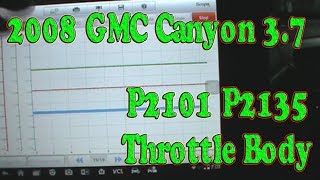
How to confirm: Use a scan tool to graph the live data for TPS1 and TPS2 voltages or percentages. With the key on and engine off, slowly press the accelerator pedal to the floor and release it. The two sensor values should mirror each other smoothly (one sweeping up, one sweeping down). 🎬 See how to test sensor voltage correlation with a scanner. A sudden drop, spike, or erratic reading from one or both sensors confirms the failure.
Typical fix: Replace the entire throttle body assembly. After replacement, an idle relearn procedure is required to ensure the engine idles correctly. This is the most commonly reported successful fix in owner forums.
Est. part cost: $100-$250 - Damaged Wiring or Connector 🟡 Medium Probability The wiring harness connector at the throttle body is subject to engine vibration and heat. This can lead to terminal fretting (micro-vibrations causing oxidation), corrosion, or pushed-out pins over time, disrupting the sensitive voltage signals.
How to confirm: Visually inspect the throttle body connector for green corrosion, backed-out pins, or damaged wires. With the engine running and a scan tool monitoring TPS data, carefully wiggle the connector and harness. If this action causes the sensor readings to glitch or the code to set, the fault is in the wiring.
Typical fix: Repair the damaged section of the wiring harness or replace the connector pigtail. Applying a small amount of dielectric grease designed for low-voltage computer systems during reassembly can help prevent future corrosion.
Est. part cost: $15-$50 - Dirty Throttle Body ⚪ Low Probability Carbon and oil vapor from the PCV system can build up around the throttle plate, causing it to stick or move slowly. This can cause a mismatch between the commanded and actual throttle positions.
How to confirm: Remove the air intake tube and visually inspect the throttle bore and plate for heavy black carbon deposits. A sticky plate can cause the sensors to report a position that doesn't match the computer's command.
Typical fix: Clean the throttle body bore and plate thoroughly with a dedicated throttle body cleaner and a soft brush. Note: This is often a temporary fix for P2135, as the root cause is usually an electronic sensor failure, not a mechanical binding issue. If cleaning doesn't resolve the code, the throttle body is likely faulty.
Est. part cost: $5-$15
Rare But Worth Checking
- Faulty Powertrain Control Module (PCM): This is extremely rare. Before condemning the PCM, all other possibilities, especially the throttle body and its wiring, must be exhaustively ruled out. Misdiagnosis is common, as one shop incorrectly advised a customer they needed a new ECM when the throttle body was the actual culprit.
Diagnosis Steps
- Read all fault codes with an OBD-II scanner. Note any other codes that are present, such as P1516, P0121, or P0221.
- Using the scanner's live data function, monitor the voltage or percentage of 'TP Sensor 1' and 'TP Sensor 2'.
- With the key on and engine off, slowly press and release the accelerator pedal. The two sensor values should change smoothly and mirror each other. One should sweep up (e.g., ~0.5V to ~4.5V) while the other sweeps down (e.g., ~4.5V to ~0.5V). Look for any jumps, drops, or flat spots in the data, which indicate a failing sensor.
- If the data glitches, perform a 'wiggle test'. While observing the live data, carefully move the wiring harness and connector at the throttle body to see if it induces a fault.
- Inspect the throttle body connector pins for corrosion or damage. Clean if necessary and consider applying a suitable dielectric grease.
- If the wiring is intact and the sensor data is erratic, the throttle body assembly is the primary suspect. Cleaning the throttle body is unlikely to fix an electronic correlation error but can be attempted.
- Replace the throttle body assembly. This is the most common and effective repair.
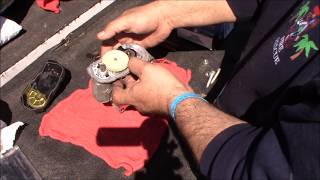
- After installing the new throttle body, perform the Idle Relearn Procedure. A common method is to start the engine and let it idle in Park for 3 minutes, turn the engine off for 60 seconds, then restart and let it idle for another 3 minutes. Driving the vehicle may also be required for the computer to fully adapt. 🎬 Watch: How to perform the idle relearn procedure after replacement.
Parts You'll Likely Need
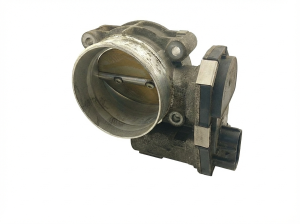
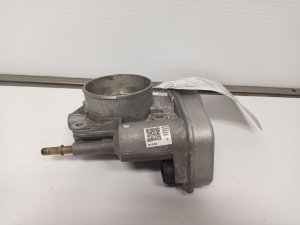
- Throttle Body Assembly
(OEM #Varies by engine. Common numbers include: 12565553 (2.8L), 12568580 (3.5L/3.7L), 12631018 (2.9L), 12580760 (5.3L).)🎬 Watch this 2008 Canyon throttle body replacement and diagnostic walkthrough. — This is the most common cause of P2135. The internal throttle position sensors are integrated into the assembly and fail electronically. It's critical to verify the part number with the vehicle's VIN.
Trusted brands: ACDelco (OEM), Dorman, Bosch, Standard Motor Products
OEM price range: $200-$400
Aftermarket price range: $95-$220
Related Codes That Often Appear With This One
- P0121 — This code indicates a performance problem with TPS 'A' circuit, which is one of the two sensors involved in the P2135 correlation check.
- P0221 — This code indicates a performance problem with TPS 'B' circuit, the other sensor involved in the P2135 correlation check.
- P1516 — This GM-specific code relates to the Throttle Actuator Control (TAC) module performance. It is often set as a consequence of the PCM not trusting the throttle position signals due to the P2135 fault.
- P2101 — This code for 'Throttle Actuator Control Motor Circuit Range/Performance' can be triggered by the P2135 fault, as the computer detects that the throttle actuator's performance is compromised by the unreliable sensor data.
Technical Service Bulletins (TSBs) & Recalls
- 11-06-04-007C: Diagnosis and Repair - Malfunction Indicator Lamp (MIL) Illuminated, Reduced Engine Power Message Displayed, DTC P2135 Set. This bulletin details a procedure for replacing the throttle position sensor cover, but also requires checking sensor data and potentially reprogramming the ECM.
Platform-Specific Known Issues
- TSB #11-06-04-007C and Community Experience: GM issued TSB #11-06-04-007C for the P2135 code, which initially involved replacing only the TPS cover and terminals. However, many owners and technicians on forums report that this fix is often temporary. The consensus in the DIY community is that replacing the entire throttle body assembly is a more robust and permanent solution to prevent the code from returning.
- Real-World Repair Story: A Hummer H3 owner on the Hummer4x4Offroad forums documented their struggle with an intermittent P2135 code. Their repair journey involved multiple dealership visits where the code was cleared, the battery was replaced, the accelerator pedal was replaced, and the ECM was updated, all without success. The final, successful repair was the replacement of the entire throttle body assembly, highlighting it as the definitive solution after other common misdiagnoses failed.
Mechanic-Grade Diagnostic Values
- 5-Volt Reference Circuit Voltage — expected: 4.8 - 5.2 Volts (between terminal E and ground). Failure: Voltage below 4.8V or above 5.2V indicates a problem with the reference circuit or ECM.
- Low Reference Circuit Resistance — expected: Less than 5.0 Ohms (between terminal C and ground). Failure: Resistance greater than 5.0 Ohms indicates an open or high resistance in the ground circuit.
- TP Sensor 1 Voltage Range — expected: 0.27 - 4.67 Volts (changes with pedal input). Failure: A reading less than 0.32V or more than 4.75V for over 0.4 seconds will set a fault.
- TP Sensor 2 Voltage Range — expected: 0.31 - 4.7 Volts (changes with pedal input). Failure: A reading less than 0.25V or more than 4.59V for over 0.5 seconds will set a fault.
Wiring & Ground Locations
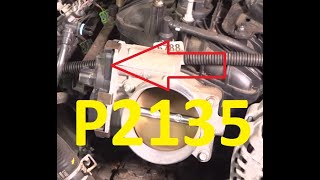
- Throttle Body Connector Pinout — The main electrical connector on the throttle body assembly.. Knowing the specific pin functions allows for targeted voltage and resistance testing without guesswork. Key pins are: Terminal C (Low Reference/Ground), Terminal D (TP Sensor 1 Signal), Terminal E (5V Reference), Terminal F (TP Sensor 2 Signal).
- G105 / SP105 — On the driver's side of the engine compartment, near the battery and cooling fan relays.. This is a major ground splice pack for multiple critical components, including the fuel pump, fuel-level sender, and various relays. Corrosion or looseness at this point can create an unstable ground reference, leading to erratic voltage signals that can be misinterpreted by the ECM and trigger a P2135 code, even if the throttle body itself is good.
Real Owner Repair Stories
- YouTube channel 'Pine Hollow Auto Diagnostics' (2008 GMC Canyon) — Check engine light, limp mode (Reduced Engine Power).
❌ Tried (didn't work) The owner was told by another shop that the vehicle needed a new Engine Control Module (ECM) based on their diagnostic procedure.
✅ What actually fixed it The technician graphed the live data for TP Sensor 1 and TP Sensor 2 and observed that one sensor's signal was dropping out and erratic. This confirmed the fault was internal to the throttle body assembly, not the ECM. Replacing the throttle body assembly resolved the issue, saving the owner from a costly and incorrect ECM replacement. - User comment on YouTube (Not specified, but GM vehicle with P2135) — Persistent P2135 code over several years.
❌ Tried (didn't work) Thousands of dollars in attempted repairs (specifics not listed).
✅ What actually fixed it The owner reseated every wiring harness from the throttle body to the gas pedal, including both plugs on the ECM. They also blew out and wiped the connectors. This 10 minutes of work finally fixed the issue that had plagued them for years, indicating an intermittent connection was the root cause.
OEM Part Supersession History
N/A (procedure-based)→Full Throttle Body Assembly— GM's initial fix, detailed in TSB #11-06-04-007C and Special Coverage 11273A, was to replace only the throttle position sensor cover and terminals using kit P/N 19259452. However, real-world experience and technician feedback showed this repair was often not a permanent solution. The wear and failure of the internal motor and sensor components led to the widespread practice of replacing the entire throttle body assembly as the more reliable long-term repair.
Model Year Variations Within This Range
- 2004-2012: The base I4 and I5 engines were updated for the 2007 model year (2.8L to 2.9L and 3.5L to 3.7L). A 5.3L V8 option was also added in 2009. While the P2135 fault is common to all, the specific throttle body part number is different for each engine. It is critical to verify the correct part number for your specific engine and year.
- 2008-2011: TSB #11-06-04-007C was revised over time to include newer model years, indicating the problem persisted through the generation. The final version ('C') includes vehicles up to the 2011 model year.
Helpful Videos
Used OEM Parts in Stock


New Aftermarket Parts Available





The information in this article is provided for general reference and educational purposes only. Vehicle specifications, procedures, and part compatibility can vary by production date, trim level, and region. Always consult your vehicle's factory service manual and verify part numbers before purchasing or performing repairs. Safety-critical components such as airbags, seat belts, and braking systems should be installed by a qualified professional.
- Gmc CANYON:
- 🎬 Helpful Videos
- 🛍️ Shop This Part
- What's Unique About the 2005-2012 Gmc CANYON
- Diagnostic Flowchart
- Symptoms You May Notice
- Most Likely Causes
- Rare But Worth Checking
- Diagnosis Steps
- Parts You'll Likely Need
- Related Codes That Often Appear With This One
- Technical Service Bulletins (TSBs) & Recalls
- Platform-Specific Known Issues
- Mechanic-Grade Diagnostic Values
- Wiring & Ground Locations
- Real Owner Repair Stories
- OEM Part Supersession History
- Model Year Variations Within This Range
- 🎟️ Get 5% Off