

P2135 on 2007-2012 Chevrolet Avalanche: Throttle Position Sensor Fault Causes and Fixes
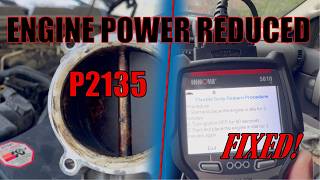
On a 2007-2012 Avalanche, P2135 almost always means the Throttle Position Sensor (TPS) on the throttle body has failed. This triggers 'Reduced Engine Power' mode and may display a 'Service Stabilitrak' message. The fix is to replace the TPS, which is available separately from the throttle body, for about $70-$150 in parts. A throttle relearn procedure is recommended after replacement.
- P2135 on a 2007-2012 Avalanche is almost certainly a failed Throttle Position Sensor (TPS), a very common and well-documented issue for this platform.
- The correct repair is to replace only the TPS sensor kit (ACDelco #19259452 or equivalent), not the entire throttle body assembly.
- Symptoms include 'Reduced Engine Power', 'Service Stabilitrak', and severely limited acceleration.
- After replacing the sensor, a manual idle relearn procedure is necessary to prevent a high or rough idle and can be done without special tools.
What's Unique About the 2007-2012 Chevrolet AVALANCHE
This is a notoriously common problem on this generation of GM trucks (GMT900 platform), including the Avalanche. The failure rate of the original throttle position sensor was so high that GM issued a Technical Service Bulletin (TSB 11-06-04-007C) and a Special Coverage Adjustment (11273A / 14582A), extending the warranty for this specific part to 10 years or 120,000 miles. While this warranty has likely expired for most vehicles, its existence confirms that the original sensor is a significant weak point. The fix involves replacing just the sensor cover on the side of the throttle body, not the entire unit.
Diagnostic Flowchart
Tap your situation to follow the diagnostic path that matches what you're seeing on this vehicle.
Symptoms You May Notice
- "Reduced Engine Power" message on the dashboard.
- Check Engine Light is on.
- "Service Stabilitrak" and "Service Traction Control" messages may appear.
- Severely limited acceleration and vehicle speed (limp mode).
- Hesitation or surging during acceleration.
- Rough or unstable idle.
- Vehicle may stall.
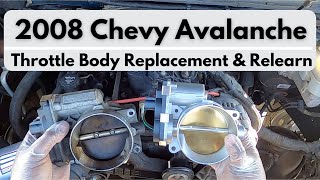
- Replacing the entire throttle body assembly. 🎬 See how to replace the full throttle body and perform a relearn. GM's TSB specifically advises against this, as the fault is with the replaceable sensor cover. Replacing the whole unit is more expensive and unnecessary unless the throttle body itself is damaged.
- Replacing the Accelerator Pedal Position (APP) sensor. While the APP sensor is part of the drive-by-wire system, P2135 specifically points to a correlation issue between the two sensors on the throttle body itself, not the pedal. A user on a forum replaced the APP sensor first, which did not solve the issue.
Most Likely Causes
- Failed Throttle Position Sensor (TPS) 🔴 High Probability The original sensor is a well-documented, high-failure part, as acknowledged by GM's TSBs and special coverage adjustments. The internal electronic contacts wear out or develop fretting corrosion over time, causing the voltage signals to become erratic.
How to confirm: With a scan tool, monitor the live data for TP Sensor 1 and TP Sensor 2. As you slowly press the accelerator pedal, the voltage readings should change smoothly and correlate (one rising, one falling). A failing sensor will show erratic jumps, drops, or a disagreement between the two sensor readings. Wiggling the connector and harness at the throttle body while watching the data can also expose an intermittent fault.
Typical fix: Replace the throttle position sensor and its cover 🎬 Watch: Step-by-step TPS sensor replacement and relearn walkthrough. on the side of the throttle body. It is not necessary to replace the entire throttle body assembly. While the throttle body is removed, it's a good idea to clean the throttle plate and bore of carbon buildup with a dedicated cleaner and soft brush. After reinstallation, a throttle relearn procedure is required to ensure a stable idle. 🎬 Watch: How to perform a throttle relearn using a scan tool. For 2008-2011 models, an ECM reprogram by a dealer is also required per TSB 11-06-04-007C.
Est. part cost: $70-$150 - Wiring or Connector Issues ⚪ Low Probability Wires in the engine bay are subject to heat and vibration. Breaks in the wires can occur inside the insulation, typically within a few inches of the throttle body connector, and terminal crimps can become loose.
How to confirm: Visually inspect the wiring harness and connector going to the throttle body. Look for any signs of damage, corrosion, or loose/pushed-out pins in the connector. Wiggle the harness near the connector while observing the live sensor data on a scan tool to see if the voltage readings fluctuate, which would indicate an intermittent break in a wire.
Typical fix: Repair the damaged section of wire or clean/replace the connector pigtail. A replacement pigtail connector is available as an aftermarket part.
Est. part cost: $15-$50
Rare But Worth Checking
- Faulty Powertrain Control Module (PCM): This is very rare. Before suspecting the PCM, all other possibilities, especially the TPS and wiring, must be exhaustively ruled out.
- Dirty or Sticking Throttle Body: While cleaning the throttle body is recommended during a TPS replacement, it is unlikely to be the sole cause of a P2135 correlation code. However, severe carbon buildup could theoretically cause the throttle plate to stick, creating a momentary mismatch in sensor readings.
Diagnosis Steps
- Connect an OBD-II scanner and confirm that P2135 is the primary code stored.
- Access live data on the scanner and monitor 'TP Sensor 1' and 'TP Sensor 2' voltages or percentages.
- With the key on and engine off, slowly press and release the accelerator pedal. Watch the sensor values. They should rise and fall smoothly together. If one or both jump erratically or do not respond, the TPS is faulty.
- If the sensor data seems okay, turn the ignition off. Unplug the connector at the throttle body and inspect the wiring harness and connector pins for damage, corrosion, or looseness.
- Wiggle the harness near the connector while watching live data to check for intermittent wire breaks.
- If the wiring is good and the sensor data is erratic, the Throttle Position Sensor is the confirmed cause.
- If the sensor and wiring appear perfect, the issue could be an extremely rare PCM fault, which would require professional diagnosis.
Parts You'll Likely Need
- Throttle Position Sensor (TPS) Kit
(OEM #ACDelco 19259452)— This is the direct cause of the P2135 code in the vast majority of cases on this vehicle, as documented by GM's own service bulletins.
Trusted brands: ACDelco (GM Genuine), Dorman (p/n 977-000), Standard Motor Products (p/n TH445), Hitachi
OEM price range: $100-$150
Aftermarket price range: $70-$120 - Throttle Body Gasket — The gasket should always be replaced when the throttle body is removed to prevent vacuum leaks. Most mechanics report the original rubber O-ring style gasket is often reusable if not damaged.
Trusted brands: ACDelco, Fel-Pro
OEM price range: $10-$20
Aftermarket price range: $5-$15
Related Codes That Often Appear With This One
- P0121 — This code also relates to 'Throttle/Pedal Position Sensor/Switch 'A' Circuit Range/Performance' and can be triggered by the same failing sensor.
- P0221 — This code points to a range/performance issue with the 'B' circuit of the throttle position sensor and can be set along with P2135.
- P2119 — This code indicates an issue with the 'Throttle Actuator Control Throttle Body Range/Performance', which can occur alongside the P2135 sensor fault.
Technical Service Bulletins (TSBs) & Recalls
- 11-06-04-007C: Details the procedure for replacing the throttle position sensor cover to fix DTC P2135 and the reduced power message. It explicitly states that if P2135 is present, this repair should be performed without extensive diagnosis.
- 11273A / 14582A: A Special Coverage Adjustment (extended warranty) for the throttle position sensor due to high failure rates, covering vehicles for 10 years or 120,000 miles.
Platform-Specific Known Issues
- A known issue prompted GM to issue TSB 11-06-04-007C, which provides a specific procedure for replacing only the throttle position sensor cover, rather than the entire throttle body.
- GM also created Special Coverage Adjustment 11273A / 14582A, extending the warranty on this part to 10 years/120,000 miles due to the high failure rate. This confirmed the part was a widespread problem across the GMT900 truck and SUV platform.
Mechanic-Grade Diagnostic Values
- TP Sensor 1 vs. TP Sensor 2 Voltage Correlation — expected: The two sensors are inversely proportional. One should read approx. 0.5V at closed throttle and 4.5V at wide-open throttle, while the other reads approx. 4.5V at closed and 0.5V at wide-open.. Failure: Voltage readings that jump, drop out, or do not move smoothly and inversely as the throttle is opened and closed.
- TP Sensor 1 Signal Voltage (Key On, Engine Off, Throttle Closed) — expected: Less than 1.0V.. Failure: Voltage is significantly higher or shows 0V.
- TP Sensor 2 Signal Voltage (Key On, Engine Off, Throttle Closed) — expected: Between 4.8V and 5.2V.. Failure: Voltage is significantly lower or shows 0V.
- Battery System Voltage (Pre-Diagnosis Check) — expected: 12.4 volts or higher with the key on, engine off.. Failure: Low system voltage can cause erratic electronic behavior and false codes.
Scan Tool Commands That Help
- Tech 2 / GDS2: ECM Reprogramming — Required for 2008-2011 models after replacing the throttle position sensor, per TSB 11-06-04-007C. This updates the software to work correctly with the new sensor.
- Tech 2 / GDS2: Reset Idle Learn / Idle Learn Reset — After replacing the TPS or cleaning the throttle body, to erase old learned throttle angle values and force the ECM to learn the new baseline idle. This is found in the 'Module Set Up' or 'Special Functions/TAC System' menu.
- Manual Procedure (No Scan Tool): Idle Relearn Procedure — After replacing the TPS or disconnecting the battery. A common procedure is: 1. Start and idle the engine in PARK for 3 minutes. 2. Turn the engine OFF for 60 seconds. 3. Start and idle the engine in PARK for another 3 minutes. The idle should now be stable.
Wiring & Ground Locations
- Throttle Body Connector — The 6-pin electrical connector on the throttle body assembly.. GM Preliminary Information bulletin PIP3089B identifies loose wire crimps and wires broken inside the insulation near this connector as a known cause for P2135. Wiggling the harness here during testing is critical. The TP sensor 1 signal is a dark green wire, and the TP sensor 2 signal is a purple wire.
- G101 / G106 — Located on the lower front or side of the engine block, sometimes jumpered to the frame cross rail under the crank pulley.. This is a primary ground point for the Engine Control Module (ECM) and Transmission Control Module (TCM). A poor connection here can cause unstable voltage references for all engine sensors, including the TPS, leading to correlation codes.
- G103 — Located on the cowl in the left rear of the engine compartment, often above the brake booster.. This grounds several important modules including the Body Control Module (BCM) and the Data Link Connector (DLC). While not a direct engine ground, poor grounding here can cause communication issues that may complicate diagnosis.
- Firewall Ground Straps — Braided metal straps connecting the rear of the engine/cylinder heads to the vehicle's firewall.. These straps ensure the engine and body share a common ground potential. If broken or corroded, sensor signals that use the chassis as a ground reference can become noisy and unreliable, triggering faults.
Real Owner Repair Stories
- YouTube channel 'sixtyfiveford' (2008 Chevrolet with 5.3L engine) — P0122 and P2135 codes, reduced engine power.
❌ Tried (didn't work) Cleaning the throttle body.
✅ What actually fixed it The technician performed voltage tests and found the TP Sensor 2 signal circuit was stuck high (5V) and not responding. Tracing the circuit, he determined it was not shorted and the sensor was not the cause. The ECM itself was faulty and not correctly processing the sensor signal. Replacing and reprogramming the ECM resolved the codes. - CorvetteForum user (2003-2006 GM V8 (similar ETC system)) — Reduced engine power, DTC P2135.
❌ Tried (didn't work) Initial diagnostics did not pinpoint the cause.
✅ What actually fixed it A responding technician cited GM bulletin PIP3089B, which advised the fix was to carefully inspect the wiring crimps at the throttle body connector. The bulletin states a broken wire can occur inside the insulation with no visible damage, requiring a wiggle test of individual wires to identify the fault.
"I Checked Everything" — The Actual Cause
- In the context of P2135, the equivalent of a 'smoke test clean' scenario is when both the throttle position sensor and the wiring harness pass basic continuity and visual checks. In these cases, the root cause is often more subtle. One documented instance involved a technician confirming the sensor signals were incorrect but tracing the fault to the ECM itself, which was providing a bad reference voltage; replacing the ECM fixed the issue. Another hidden cause is fretting corrosion, a nearly invisible oxidation on the connector pins caused by vibration, which creates intermittent signal loss that may not be caught by a simple wiggle test.
When the Usual Fixes Don't Work
- While the vast majority of P2135 codes on this platform are fixed by replacing the throttle position sensor (p/n 19259452), there are documented cases where this does not solve the problem. The next most likely cause, identified in GM service information, is a broken wire inside the insulation within a few inches of the throttle body connector, which requires careful inspection and testing of the harness itself. In very rare instances, after both the sensor and wiring have been definitively ruled out, the fault can lie within the Engine Control Module (ECM) itself, requiring replacement and programming.
OEM Part Supersession History
Entire Throttle Body Assembly→ACDelco 19259452 (Sensor Kit)— GM recognized the high failure rate was isolated to the sensor, not the entire throttle body. They released the sensor kit as a more cost-effective repair, which is now the procedure recommended in TSB 11-06-04-007C.
Model Year Variations Within This Range
- 2008-2011: Per TSB 11-06-04-007C, vehicles in this year range MUST have the ECM reprogrammed by a dealer after the TPS sensor kit is installed. This is a mandatory step for the repair to be successful.
- 2011 only: As part of the mandatory ECM reprogram for the P2135 fix, 2011 models also receive an updated 'enhanced oil life monitor' algorithm, which changes the maximum oil change interval.
Helpful Videos
Used OEM Parts in Stock

New Aftermarket Parts Available





The information in this article is provided for general reference and educational purposes only. Vehicle specifications, procedures, and part compatibility can vary by production date, trim level, and region. Always consult your vehicle's factory service manual and verify part numbers before purchasing or performing repairs. Safety-critical components such as airbags, seat belts, and braking systems should be installed by a qualified professional.
- Chevrolet AVALANCHE:
- 🎬 Helpful Videos
- 🛍️ Shop This Part
- What's Unique About the 2007-2012 Chevrolet AVALANCHE
- Diagnostic Flowchart
- Symptoms You May Notice
- Most Likely Causes
- Rare But Worth Checking
- Diagnosis Steps
- Parts You'll Likely Need
- Related Codes That Often Appear With This One
- Technical Service Bulletins (TSBs) & Recalls
- Platform-Specific Known Issues
- Mechanic-Grade Diagnostic Values
- Scan Tool Commands That Help
- Wiring & Ground Locations
- Real Owner Repair Stories
- "I Checked Everything" — The Actual Cause
- When the Usual Fixes Don't Work
- OEM Part Supersession History
- Model Year Variations Within This Range
- 🎟️ Get 5% Off