

OBD-II Code P2128: Accelerator Pedal Position Sensor 'E' Circuit High
The Ultimate Guide to What P2128 Means, Why It Triggers, and How to Fix It for Good
- Code P2128 immediately triggers 'Limp Mode', capping vehicle speed at 35-45 mph and making highway driving dangerous.
- Perform a live-data 'wiggle test' on the gas pedal wiring harness before buying parts, as broken connector wires cause over 50% of these faults.
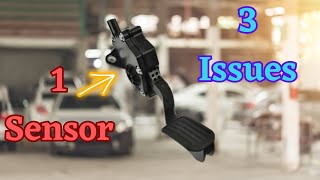
- The Accelerator Pedal Position (APP) sensor is permanently integrated into the pedal assembly, requiring a complete $150-$400 unit replacement if the sensor fails.
- Check Technical Service Bulletins (TSBs) like GM's #PIP3783D for 2007-2014 trucks, which point directly to known wiring flaws rather than bad sensors.
What Does P2128 Mean?
The Powertrain Control Module (PCM) detected the voltage signal from the secondary gas pedal sensor (Circuit 'E') is stuck above its maximum expected threshold (typically >4.5V). Modern gas pedals use two redundant 'drive-by-wire' sensors (APP1 and APP2) to translate physical pedal movement into an electrical signal. When the PCM sees an impossibly high voltage from the secondary sensor, it distrusts the pedal input entirely and triggers a failsafe 'limp mode' to prevent unintended acceleration.
Technical definition: The SAE/OBD-II definition is "Throttle/Pedal Position Sensor/Switch 'E' Circuit High". This indicates the PCM registered a voltage from the APP sensor's 'E' circuit at or near the 5-volt reference limit (typically above 4.5V or 4.8V) for a predetermined duration.
Can I Drive With P2128?
Yes, But With Caution. Driving is possible but dangerous. Your vehicle immediately activates 'Reduced Engine Power' or 'Limp Mode,' capping speed at 35-45 mph and severely limiting acceleration. This makes highway driving or pulling into traffic unsafe. Extended driving in limp mode causes the transmission to overheat and accelerates internal wear. Use this mode only to limp to a safe location or repair shop.
Common Causes
- Damaged Wiring or Connector at the Accelerator Pedal (Very Common) — Thin wires in the pedal harness endure constant foot traffic, kicked wires, and moisture from wet shoes. This causes broken wires, loose pins, or corrosion inside the connector, creating a short to voltage. This is the leading cause of P2128.
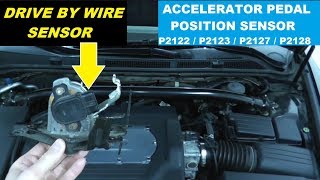
- Failed Accelerator Pedal Position (APP) Sensor (Common) — The internal potentiometers or Hall-effect sensors inside the pedal assembly wear out over time. This internal failure causes the sensor to send 🎬 Watch: How to test and replace a drive-by-wire sensor a continuous, erroneously high voltage signal to the PCM.
- Corrosion in a Body Harness Connector (Common) — On specific vehicles (like 2007-2014 GM trucks), water intrusion in large wiring harness connectors (e.g., the X209 connector in the driver's kick panel) corrodes the pins. This shorts the APP sensor signal to a power wire before it reaches the PCM.
- Bad or Open Ground Circuit (Uncommon) — The sensor requires a solid ground to pull the voltage down to normal resting levels. A broken or corroded ground wire causes the signal voltage to float high, mimicking a failed sensor.
- Faulty Powertrain Control Module (PCM) (Less Common) — An internal PCM fault, such as a burned-out driver circuit or analog-to-digital converter, causes the computer to misinterpret a normal 1.0V signal as a 5.0V signal.
- Software Glitch / Needs PCM Update (Rare) — Original PCM software is sometimes overly sensitive to minor voltage fluctuations. Manufacturers release software updates (reflashes) to widen the acceptable voltage range and prevent false codes.
- Floor Mat Obstruction (Rare) — Thick aftermarket floor mats physically wedge under the pedal, preventing it from returning to its true 0% idle position. This keeps the resting voltage artificially high.
- Charging System Overvoltage (Very Rare) — A failing alternator that overcharges the battery raises the entire vehicle's system voltage. This pushes the sensor's 5-volt reference circuit too high, causing the output signal to exceed the threshold.
Symptoms
- Reduced Engine Power / Limp Mode — The dashboard displays "Reduced Engine Power" or "Service StabiliTrak," and the vehicle severely limits acceleration and top speed.
- Check Engine Light is On — The Malfunction Indicator Lamp (MIL) illuminates immediately when the PCM stores the P2128 code.
- Dead Gas Pedal — The gas pedal feels completely unresponsive, or the vehicle accelerates sluggishly even with the pedal pressed to the floor.
- Illuminated EPC Light — On European vehicles (Volkswagen, Audi), the Electronic Power Control (EPC) warning light illuminates alongside the Check Engine Light.
Diagnostic Flowchart
Tap your situation to follow the diagnostic path that matches what you're seeing on this code.
Common Fixes & Costs
- Replace Accelerator Pedal Connector Pigtail — Parts: $25-$60, Labor: $100-$200, ~1.5 hr book time (Intermediate)
- Replace Accelerator Pedal Assembly — Parts: $70-$250, Labor: $75-$150, ~1.0 hr book time (DIY)
- Repair Damaged Wiring in Harness — Parts: $10-$30, Labor: $200-$500, ~2.5 hr book time (Professional)
- Clean or Repair Ground Connection — Parts: $5-$15, Labor: $50-$150, ~0.8 hr book time (DIY)
- Replace Powertrain Control Module (PCM) — Parts: $800-$1500, Labor: $150-$300, ~1.5 hr book time (Professional)
Used vs. New Parts: Buying Guide
When a used part is worth it: Buying a used pedal assembly makes sense only for older vehicles (over 125k miles) where a new OEM part exceeds 10% of the car's value. It saves 50-75% but carries a high risk of premature failure.
Donor-vehicle mileage cap: roughly under 80000 miles for the part to have meaningful remaining life.
Donor quality checklist:
- Source from a reputable salvage yard offering a 30-90 day warranty.
- Verify the part number matches your original pedal exactly.
- Avoid parts from flood-damaged vehicles or regions with heavy road salt.
Decision logic:
- If The cause is confirmed to be the pedal itself and not wiring. → Proceed with evaluating part options.
- If Vehicle is less than 8 years old or under 100k miles. → Buy a new OEM or high-quality aftermarket part. The reliability is worth the cost.
- If Budget is the primary concern on an older vehicle. → Buy a used part, but expect a significantly shorter lifespan.
Warranty tradeoff: Used parts offer a 30-90 day warranty. New aftermarket parts offer 1-year to lifetime warranties. New OEM parts carry a 1-2 year warranty.
Worst-case if a used part fails: $200-$400 if a used pedal fails shortly after installation, requiring repeat labor and a new part.
What Happens If You Wait — Timeline
- 0-1 month: Intermittent P2128 triggers 'Reduced Engine Power'. Restarting the car clears the issue temporarily. (MPG impact: 0-5%% · Added cost: $0)
- 1-4 months: Fault occurs weekly. The car hesitates before the light comes on. The underlying wiring short or sensor failure worsens. (MPG impact: 5-10%% · Added cost: $100-$300 for potential towing if stranded.)
- 4-8 months: Code permanently sets. Driving in Limp Mode strains the transmission, causing overheating and clutch wear. (MPG impact: 10-20%% · Added cost: $500-$2000 for transmission diagnostics and minor repairs.)
- 8+ months: A persistent short-to-voltage back-feeds and destroys the PCM driver circuits. The vehicle becomes undrivable. (MPG impact: N/A% · Added cost: $1500-$4000 for mandatory PCM replacement and programming.)
Cost of Not Fixing It
- Immediately: Vehicle enters 'Limp Mode', capping speed and acceleration. This makes the car unsafe for highway driving or merging into traffic. (Added cost: $100-$300 for towing if stranded.)
- 1-3 months: Driving in limp mode forces the transmission to operate outside normal parameters, causing it to overheat and accelerating clutch wear. (Added cost: $500-$2000 for transmission diagnostics or minor repairs.)
- 6+ months: A persistent short-to-voltage in the wiring harness back-feeds into the Powertrain Control Module (PCM), permanently damaging its internal driver circuits. (Added cost: $1500-$4000 for PCM replacement and programming.)
Diagnosis Steps
- Read Codes and Analyze Live Data
Connect an OBD-II scanner and confirm P2128. Navigate to live data and monitor APP Sensor 1 and APP Sensor 2 voltages. With the key on and engine off, normal idle voltage for APP Sensor 2 is 0.2V to 0.9V. If the 'E' circuit (APP Sensor 2) is stuck above 4.5V regardless of pedal position, you have a hard fault.
Tools: OBD-II Scanner with Live Data (Beginner) - Execute a 'Wiggle Test'
With the scanner displaying live APP sensor voltages, gently wiggle the wiring harness at the pedal connector and up into the dashboard. If the APP Sensor 2 voltage spikes or drops to normal, you confirmed a broken wire or loose pin. Do this before replacing any parts.
Tools: OBD-II Scanner with Live Data (Beginner) - Perform a Visual Inspection
Inspect the accelerator pedal assembly, electrical connector, and nearby harness. Look for frayed wires, green corrosion on the pins, or moisture. Ensure no aftermarket floor mats obstruct the pedal's travel.
Tools: Flashlight (Beginner) - Check for Technical Service Bulletins (TSBs)
Search for TSBs related to P2128 for your specific vehicle. Manufacturers frequently issue bulletins (e.g., GM #PIP3783D for connector issues) that pinpoint exact wiring flaws, saving hours of diagnostic time.
Tools: Internet Access (Intermediate) - [PRO TIP] Test Power, Ground, and Signal at the Connector
Disconnect the pedal connector. Turn the key on. Use a multimeter to test the harness-side terminals. Verify a stable 5-volt reference (4.5V-5.5V) and a solid ground (<0.1V). Check the signal wire for APP Sensor 2; it should read near 0V. If the signal wire reads 5V while disconnected, it is shorted to power in the harness.
Tools: Digital Multimeter, Vehicle-Specific Wiring Diagram (Advanced) - [PRO TIP] Perform a Voltage Drop Test on the Ground Circuit
Back-probe the ground pin on the APP sensor connector with the sensor connected. Connect the other multimeter lead to the battery negative. With the key on, the reading must be under 100mV (0.1V). Higher readings indicate excessive resistance in the ground circuit.
Tools: Digital Multimeter, Back-Probe Pins (Advanced) - [ADVANCED] Test Sensor Resistance
With the pedal disconnected, measure the internal resistance (Ohms) of APP Sensor 2. Slowly press the pedal; resistance must change smoothly without dropouts or spikes (e.g., 2.3 kΩ to 1.8 kΩ). An erratic reading or open circuit (OL) confirms a failed sensor.
Tools: Digital Multimeter, Vehicle-Specific Wiring Diagram (Advanced) - [PROFESSIONAL] Analyze the Signal with an Oscilloscope
For intermittent issues, back-probe the APP Sensor 2 signal wire with an oscilloscope. Press and release the pedal. Look for sudden spikes, dropouts, or electrical noise (fuzzy lines) that a multimeter is too slow to catch.
Tools: Automotive Oscilloscope (Professional)
When This Code Triggers (Freeze-Frame Conditions)
- Engine Coolant Temp: 175-210°F (Occurs at any temperature, but frequently logs when the engine is fully warmed up and cabin heat expands wiring.)
- RPM: 700-2500 RPM (Triggers at idle if the resting voltage is too high, or during light acceleration.)
- Engine Load: 15-50% (Logs under light to moderate engine load conditions.)
- Vehicle Speed: 0-65 mph (Sets at any speed, as this is a hard electrical circuit fault, not a mechanical performance issue.)
Related Codes
- P2138 — Throttle/Pedal Position Sensor/Switch D/E Voltage Correlation. The PCM compares Sensor 1 and Sensor 2. When P2128 occurs, the high voltage from Sensor 2 breaks correlation with Sensor 1, triggering P2138 simultaneously.
- P2127 — Circuit Low for APP Sensor 2. Seeing P2128 and P2127 intermittently is a classic sign of a broken wire making and breaking contact, swinging voltage from a short-to-power (High) to an open circuit (Low).
- P2123 — Circuit High for APP Sensor 1. Seeing P2123 and P2128 together indicates a shared circuit problem, such as a shorted 5-volt reference wire, a bad shared ground, or a faulty PCM.
- P0643 — Sensor Reference Voltage 'A' Circuit High. If the 5-volt reference circuit shorts to battery voltage, it forces the APP sensor to send an abnormally high signal, triggering P2128.
Climate & Environmental Factors
- High Humidity / Water Intrusion: Water leaks into the driver's footwell directly contaminate the APP sensor connector or body harness connectors (like the GM X209), causing shorts that trigger P2128.
- Cold Climates / Road Salt: Salt slush brought into the vehicle on shoes saturates the carpet and wicks into the APP sensor connector, creating a highly corrosive environment that degrades terminals.
- Temperature Fluctuations: Rapid temperature changes cause condensation inside unsealed electrical connectors. Repeated moisture exposure leads to intermittent electrical contact and sporadic codes.
How to Talk to a Mechanic About This Code
Say this: "I have a P2128 code and the car is in 'Reduced Power Mode'. I'd like to schedule a diagnostic. Based on my research, this is often a wiring issue at the pedal. Could you perform a live-data 'wiggle test' on the harness and check the connector pins before quoting a full pedal replacement?"
This signals you are an informed customer. It directs the technician to check the cheapest-to-fix cause first, potentially saving you from paying for a $250 pedal assembly when a $150 pigtail repair is needed.
Avoid saying:
- 'My car is acting weird and the check engine light is on.' (Invites an expensive, open-ended diagnostic).
- 'Just replace the gas pedal sensor.' (You assume liability if the new part doesn't fix the wiring issue).
- 'Just fix it, I don't care what it takes.' (Invites upselling).
Questions to ask before authorizing the repair:
- Did you perform a wiggle test on the wiring harness, and what was the result on the live data scanner?
- If recommending a new pedal, what specific test confirmed the old one failed internally?
- Did you check for Technical Service Bulletins (TSBs) for my vehicle?
- Does this repair require a pedal position relearn procedure, and is it included in the labor cost?
- What is the warranty on the parts and labor?
Where to Take It: Dealer vs Independent vs Chain
- Dealer:
Recommended only if under warranty or as a last resort for difficult diagnoses.
Best for: Vehicles under powertrain warranty or GM Special Coverage campaigns., Complex electrical issues independent shops failed to fix., European brands requiring specialized diagnostic tools.
Downsides: Highest labor rates., Defaults to replacing the entire pedal assembly rather than repairing wiring. (Typical cost: +50% vs. baseline) - Independent Shop:
Best overall fit. Experienced independent techs correctly diagnose wiring vs. pedal failures at a fair price.
Best for: Out-of-warranty vehicles., Cost-conscious owners wanting proper diagnosis., Vehicles with known wiring issues (GM trucks), as experienced techs know these quirks.
Downsides: Technician skill varies. Vet the shop for ASE certifications. (Typical cost: +0% vs. baseline) - Chain Shop:
AVOID for diagnosis. Acceptable for a straightforward pedal replacement only.
Best for: If you diagnosed the issue yourself and only need a straightforward pedal replacement.
Downsides: Lacks electrical diagnostic experience., High pressure to upsell., Will not perform nuanced wiring repairs. (Typical cost: -10% vs. baseline)
When to Walk Away From the Repair
If the total estimated repair cost exceeds 40-50% of your car's current private-party value, pause and evaluate your options.
- Car worth $4000, fix is $450: Fix it. This is a routine repair cost well below the threshold.
- Car worth $3000, fix is $1800: Walk away. The shop likely condemned the PCM. Get a second opinion, but be prepared to sell as-is.
- Car worth $15000, fix is $600: Fix it. This is a minor repair relative to the vehicle's value.
What Scan Tool You Need for This Code
Minimum: An OBD-II reader that displays LIVE DATA. You must see voltage readings from both APP sensors in real-time.
A $20 code reader only shows 'P2128'. It cannot show live sensor voltage, which is mandatory for performing a 'wiggle test' to find bad wiring.
Budget: BlueDriver Pro or OBDLink (~$100) — Connects to your smartphone and graphs live data streams for APP sensors. This is all the diagnostic power a DIYer needs to confirm a wiring issue vs. a failed pedal.
Mid-range: Foxwell NT510 Elite or Autel MaxiCOM MK808 (~$180-350) — Offers dedicated screens, faster processing, and manufacturer-specific functions like the 'pedal relearn' procedure required after replacing the pedal assembly.
Professional: Autel MaxiSys or Launch X431 (~$500-1500) — Provides professional bidirectional controls and oscilloscope functionality to analyze electrical waveforms. Overkill for DIYers.
How to Clear the Code After You Fix It
- Fix the underlying mechanical or electrical fault.
- Use an OBD-II scan tool to erase the diagnostic trouble codes from the PCM's memory.
- Perform a complete drive cycle to allow the vehicle's readiness monitors to run.
Drive cycle (~20 minutes): Start the cold engine and idle for 3 minutes. Drive in stop-and-go traffic for 5 minutes. Drive at a steady 55-60 mph for 10 minutes. Safely decelerate to a stop and idle for 2 minutes.
Readiness monitors affected: Comprehensive Component Monitor (CCM), Catalyst (CAT) Monitor, Evaporative System (EVAP) Monitor
Before emissions retest: drive at least 50 miles to fully set monitors.
Watch out for:
- Clearing the code without fixing the circuit fault causes the code to return immediately.
- Disconnecting the battery clears the code but erases all readiness monitors, guaranteeing an emissions test failure.
- Some vehicles require a scan-tool 'pedal relearn' procedure after replacing the pedal assembly.
Will This Fail Emissions / State Inspection?
Yes — this code typically fails an OBD-II emissions inspection.
- California: An active P2128 code is an automatic Smog Check failure. A full drive cycle must be completed after repair to set readiness monitors before re-testing.
- New York: The NYS Vehicle Inspection Program fails any vehicle with an illuminated MIL (Check Engine Light) for a code like P2128.
- Texas: In emissions-testing counties, a vehicle with P2128 stored as an active code fails the OBD portion of the inspection immediately.
Most Commonly Affected Vehicles
- GMC / Chevrolet Yukon, Sierra, Silverado, Tahoe, Suburban (2007-2014) — Extremely common. The primary cause is broken wires at the pedal connector (TSB #PIP3783D) or corrosion in the X209 body harness connector (TSB #07-06-04-019F). Always perform a wiggle test before replacing the pedal.
- Hyundai Sonata, Elantra, Santa Fe, Tucson (2010-2016) — Frequently affected by internal failure of the APP sensor. The entire pedal assembly requires replacement.
- Honda Accord, Civic, CR-V (2008-2023) — Sets P2128 due to internal APP sensor failure. Honda diagnostics refer to this circuit as 'APP Sensor B' or 'TP Sensor E', triggering when voltage exceeds 4.0V.
- Nissan Altima, Pathfinder, Titan (2004-2015) — Commonly caused by internal pedal assembly failure. A throttle relearn procedure is required after replacement.
- Volkswagen / Audi Jetta, Golf, A4, Q5 (2006-2014) — P2128 always illuminates the EPC light. Wiring harness issues near the firewall are just as common as pedal failures.
- Mazda Mazda3, Mazda6, CX-7 (2009-2013) — Triggers due to internal APP sensor failure. Mazda does not sell the sensor separately; the entire assembly must be replaced.
- Ford Focus, Fusion, Escape (2005-2012) — Experiences P2128 due to pedal position sensor failure. Chafed wiring in the steering column erroneously triggers this code on older models.
- Subaru Forester, Impreza, Outback (2005-2014) — A degraded rubber stopper on the pedal arm allows the pedal to travel too far when released, sending an excessively high voltage signal.
Manufacturer-Specific Notes
- General Motors (Chevrolet/GMC): The most common cause is a broken wire at the pedal's 6-pin connector (TSB #PIP3783D) or a corroded X209 body harness connector (TSB #07-06-04-019F). GM issued Special Coverage Adjustments (#14636, #N182188250) extending warranties to 10 years/150k miles for pedal replacements on specific models.
- Honda: Honda diagnostic systems label the P2128 circuit as 'APP Sensor B' or 'TP Sensor E'. The diagnostic threshold triggers when voltage exceeds 4.0V.
- Subaru: A small rubber bump stop on the floor bracket degrades, allowing the pedal to travel beyond its normal 'at rest' range. This causes the sensor voltage to spike and set P2128.
- Volkswagen / Audi: This code always illuminates the EPC (Electronic Power Control) light. Diagnosis must focus equally on wiring harness integrity near the firewall and the pedal assembly itself.
Real Owner Stories
2009 Mazda 3 with intermittent P2128
Check engine light and limp mode triggered intermittently for 8 months. Restarting the car temporarily cleared the issue.
What they tried:
- Dealer checked wiring, found no fault, and denied warranty coverage.
- Owner drove with the intermittent issue until the code permanently set.
Outcome: An independent shop replaced the entire accelerator pedal assembly for $200 plus one hour of labor, permanently resolving the issue.
Lesson: Intermittent electrical issues worsen over time. If wiring checks out, the sensor itself is failing internally. Replacing the pedal assembly is the correct fix.
2006 Saturn Ion with recurring P2128
The check engine light illuminated every few days. The owner cleared it repeatedly.
What they tried:
- Owner planned to replace the pedal sensor immediately based on the code definition.
Outcome: Forum research revealed a common misdiagnosis: the Throttle Position Sensor (TPS) on the throttle body was actually causing the fault on this specific model year.
Lesson: Search for your specific vehicle make, model, and year alongside the code. Forum discussions reveal model-specific quirks that prevent you from replacing the wrong part.
Mazda RX-8 with sudden limp mode on the highway
The car lost all power and entered limp mode at highway speeds, creating a dangerous traffic situation.
What they tried:
- Owner cleared the code and pumped the gas pedal three times, temporarily resolving the issue.
- Owner noted previous electrical issues in cold weather.
Outcome: The recurring fault pointed to an unresolved root cause in the PCM or main wiring harness, requiring professional electrical diagnosis.
Lesson: Reset procedures do not fix underlying electrical faults. Sudden limp mode is a major safety risk requiring immediate, thorough diagnosis.
How to Prevent This Code From Triggering
- Clean the accelerator pedal connector (Every 30,000 miles or 2 years) — Disconnecting the plug and spraying electronic contact cleaner removes dust and moisture, preventing poor connections and corrosion.
- Apply dielectric grease to the connector seal (When cleaning or replacing parts) — A thin layer of dielectric grease on the rubber seal keeps moisture out, protecting pins in humid or salt-belt climates.
- Use properly fitting floor mats (Always) — Prevents mats from bunching up and physically obstructing the pedal's return travel, which causes high resting voltage.
- Secure wiring harnesses (During under-dash repairs) — Routing the APP harness away from foot traffic prevents physical stress that breaks wires or loosens pins.
Frequently Asked Questions
Can I just replace the sensor instead of the whole gas pedal?
No. On modern vehicles, the two APP sensors are permanently integrated into the pedal assembly. You must replace the entire pedal unit.
What is the difference between an APP sensor and a TPS?
The APP sensor is on the gas pedal and reads driver input. The TPS is on the engine's throttle body and measures the throttle plate opening. P2128 specifically targets the APP sensor.
I replaced the pedal and the code came back. What now?
The problem is in the wiring harness, a bad ground, or the PCM. Perform detailed voltage drop tests on the ground wire and continuity tests on the signal wires.
Does the new pedal need to be programmed?
Usually, no. Most are plug-and-play, but some manufacturers require a quick 'idle relearn' procedure using a scan tool to calibrate the new sensor.
Is P2128 a serious code?
Yes. It forces the engine into 'limp mode', severely limiting speed and acceleration. This creates a major safety hazard in traffic.
What's a common misdiagnosis for P2128?
Replacing the pedal assembly without checking the wiring connector first. On many vehicles, a simple $50 connector pigtail repair fixes the issue.
Can a bad battery or alternator cause P2128?
Yes, though rare. An overcharging alternator increases the 5-volt reference supply, causing the sensor's output signal to exceed the maximum threshold and trigger the code.
Key Takeaways
- Code P2128 immediately triggers 'Limp Mode', capping vehicle speed at 35-45 mph and making highway driving dangerous.
- Perform a live-data 'wiggle test' on the gas pedal wiring harness before buying parts, as broken connector wires cause over 50% of these faults.
- The Accelerator Pedal Position (APP) sensor is permanently integrated into the pedal assembly, requiring a complete $150-$400 unit replacement if the sensor fails.
- Check Technical Service Bulletins (TSBs) like GM's #PIP3783D for 2007-2014 trucks, which point directly to known wiring flaws rather than bad sensors.
Helpful Videos

The information in this article is provided for general reference and educational purposes only. Vehicle specifications, procedures, and part compatibility can vary by production date, trim level, and region. Always consult your vehicle's factory service manual and verify part numbers before purchasing or performing repairs. Safety-critical components such as airbags, seat belts, and braking systems should be installed by a qualified professional.
- 🎬 Helpful Videos
- What Does P2128 Mean?
- Can I Drive With P2128?
- Common Causes
- Symptoms
- Diagnostic Flowchart
- Common Fixes & Costs
- Used vs. New Parts: Buying Guide
- What Happens If You Wait — Timeline
- Cost of Not Fixing It
- Diagnosis Steps
- When This Code Triggers (Freeze-Frame Conditions)
- Related Codes
- Climate & Environmental Factors
- How to Talk to a Mechanic About This Code
- Where to Take It: Dealer vs Independent vs Chain
- When to Walk Away From the Repair
- What Scan Tool You Need for This Code
- How to Clear the Code After You Fix It
- Will This Fail Emissions / State Inspection?
- Most Commonly Affected Vehicles
- Manufacturer-Specific Notes
- Real Owner Stories
- 2009 Mazda 3 with intermittent P2128
- 2006 Saturn Ion with recurring P2128
- Mazda RX-8 with sudden limp mode on the highway
- How to Prevent This Code From Triggering
- Frequently Asked Questions
- Can I just replace the sensor instead of the whole gas pedal?
- What is the difference between an APP sensor and a TPS?
- I replaced the pedal and the code came back. What now?
- Does the new pedal need to be programmed?
- Is P2128 a serious code?
- What's a common misdiagnosis for P2128?
- Can a bad battery or alternator cause P2128?
- Key Takeaways
- 🎟️ Get 5% Off