

P2122 on 2007-2011 GMC Yukon Denali: Causes and Fixes for Reduced Engine Power
On a 2007-2011 GMC Yukon Denali, code P2122 almost always triggers 'Reduced Engine Power' mode and is caused by a faulty accelerator pedal assembly or a bad electrical connection at the pedal. First, inspect the connector for loose pins as per GM TSB #PIP3783D. If the wiring is good, replacing the pedal assembly (OEM part #25832864 for models with adjustable pedals) costs about $80-$150 for the part and is a simple DIY fix.
- P2122 on a 2007-2011 Yukon Denali will almost certainly put the vehicle into 'Reduced Engine Power' mode, making it unsafe for normal driving.
- Before buying parts, follow GM's own advice (TSB PIP3783D) and thoroughly inspect the electrical connector at the accelerator pedal for loose pins or damage.
- The most common fix is replacing the entire accelerator pedal assembly (OEM part #25832864), which is a beginner-friendly DIY job that takes less than an hour.
- Do not confuse the Accelerator Pedal Position (APP) sensor with the Throttle Position Sensor (TPS); this code points specifically to the pedal inside the cabin.
What's Unique About the 2007-2011 Gmc YUKON DENALI
For this generation of GMC Yukon and its siblings on the GMT900 platform (like the Tahoe, Suburban, and Escalade), the root cause of P2122 is frequently not the pedal sensor itself, but a poor electrical connection to it. General Motors issued a Technical Service Bulletin (PIP3783D) that specifically highlights poor terminal tension in the APP sensor's wiring harness connector as a common cause for this code. Owners should always inspect the wiring and connector integrity before spending money on a new pedal assembly. Some repair guides also suggest checking intermediate connectors like C109/X109 (underhood) and C205/X205 (in-dash) for corrosion.
Diagnostic Flowchart
Tap your situation to follow the diagnostic path that matches what you're seeing on this vehicle.
Symptoms You May Notice
- "Reduced Engine Power" message on the dash 🎬 Watch: How to diagnose and fix the Reduced Engine Power message.board
- Check Engine Light (Malfunction Indicator Lamp) is on
- Severely limited acceleration or no throttle response
- Vehicle may hesitate or feel like it has a "dead spot" in the pedal
- Vehicle may be stuck in a low gear
- Traction control or Stabilitrak warning light may also illuminate
- Replacing the Throttle Body. The throttle body has its own position sensor (TPS), but code P2122 specifically relates to the accelerator pedal assembly inside the cabin. A throttle body issue typically sets different codes, such as P2135. Many owners replace the throttle body only to have the P2122 code persist.
Most Likely Causes
- Poor Terminal Tension at APP Sensor Connector 🔴 High Probability This is a well-documented issue on GM's GMT900 platform, as cited in TSB #PIP3783D. The female terminals in the plastic connector can lose their grip on the male pins of the sensor over time, causing an intermittent low voltage signal.
How to confirm: With the ignition on, wiggle the wiring harness connector at the accelerator pedal. If this action causes the 'Reduced Engine Power' message to appear or makes the engine stumble, it confirms a connection issue. A visual inspection may also reveal corrosion or backed-out pins.
Typical fix: Repairing or replacing the connector pigtail (e.g., ACDelco PT2628, Dorman 645-800). In some cases, simply ensuring the connector is fully seated and secure can resolve the issue. Some technicians add dielectric grease to prevent future moisture intrusion.
Est. part cost: $15-$40 - Faulty Accelerator Pedal Position (APP) Sensor 🔴 High Probability The sensor is an electronic component that wears out over time, especially in vehicles with over 100,000 miles. It is integrated into the pedal assembly and is not sold separately. Several owner accounts confirm that replacing the pedal assembly was the ultimate fix.
How to confirm: Using a scan tool, monitor the live data for APP Sensor 1 and APP Sensor 2 voltage. As you press the pedal, both voltages should sweep smoothly without any dropouts or glitches. If the voltage for Sensor 1 (often associated with circuit 'D') is stuck low or responds erratically, and the wiring is confirmed to be good, the sensor is faulty.
Typical fix: Replacement of the entire accelerator pedal assembly.
Est. part cost: $80-$150 - Damaged Wiring Harness 🟡 Medium Probability Wires in the circuit between the APP sensor and the ECM can become chafed, broken, or shorted to ground, especially near the pedal or where the harness passes through the firewall. A broken ground wire on the back of the intake manifold has also been identified as a cause for similar power reduction issues on this platform.
How to confirm: Perform a continuity test on the wires for the APP sensor circuit (specifically the Dark Blue wire for P2122) between the pedal connector and the ECM connector. Check for shorts to ground and shorts between wires.
Typical fix: Repair or replace the damaged section of the wiring harness.
Est. part cost: $5-$50
Rare But Worth Checking
- Faulty Engine Control Module (ECM): This is extremely rare. The ECM should only be considered after all other possibilities, including wiring and the sensor itself, have been exhaustively tested and ruled out.
Diagnosis Steps
- Read all diagnostic trouble codes with an OBD-II scanner. Note any other codes present, especially P2127 and P2138.
- Visually inspect the accelerator pedal's electrical connector and nearby wiring for any obvious signs of damage, looseness, or corrosion.
- Perform a 'wiggle test': With the ignition on, gently move the connector and wiring at the pedal while an assistant watches the dashboard for the 'Reduced Engine Power' message.
- Refer to TSB #PIP3783D, which strongly suggests checking for poor terminal tension in the APP sensor connector. Disconnect it and check if the female pins feel loose.
- Use a scan tool to view live data for APP Sensor 1 and APP Sensor 2. Press the pedal slowly from fully released to fully depressed. The voltage readings should be smooth and directly proportional to pedal movement. P2122 indicates a problem with the 'D' circuit (APP Sensor 1), which should read around 0.32-4.75V and not be stuck low.
- If the live data is erratic or stuck low, use a multimeter to check for 5-volt reference (Pin F, White/Black wire) and a good ground at the connector with the sensor unplugged.
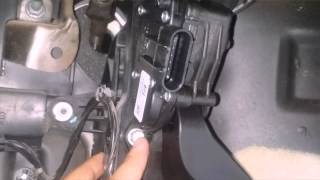
- If reference voltage and ground are present, and the wiggle test fails or live data is bad, the accelerator pedal assembly is the most likely culprit and should be replaced. 🎬 Watch: Step-by-step walkthrough for replacing the accelerator pedal assembly.
- If reference voltage or ground is missing, you must trace the wiring back to the ECM to find the open or short in the circuit, paying attention to intermediate connectors like C109/X109 and major grounds like G103/G104.
Parts You'll Likely Need
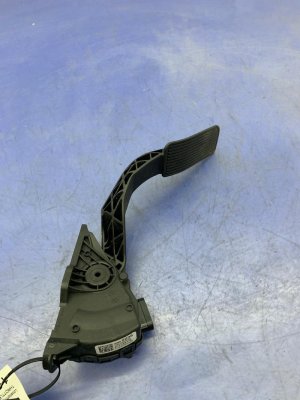
- Accelerator Pedal Assembly (with adjustable pedals)
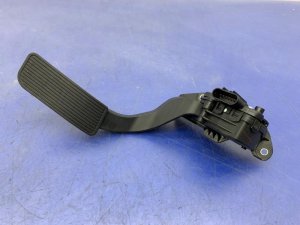
(OEM #25832864)— This is the most common fix for P2122 when wiring is not the cause. The sensor is integrated into this assembly and cannot be replaced separately. This part number is for models equipped with adjustable pedals (RPO Code JF4).
Trusted brands: ACDelco (GM Genuine), Dorman, Standard Motor Products
OEM price range: $120-$160
Aftermarket price range: $60-$110 - Accelerator Pedal Assembly (without adjustable pedals)
(OEM #25900932)— For models without the adjustable pedal feature, a different part is required. It serves the same function and is also a common replacement item for this code. The previously listed part number (19418303) is incorrect and fits other vehicles.
Trusted brands: ACDelco (GM Genuine), Dorman
OEM price range: $100-$140
Aftermarket price range: $50-$90 - APP Sensor Connector Pigtail
(OEM #ACDelco PT2628 / Dorman 645-800)— If the diagnosis points to poor terminal tension or a damaged connector body as per TSB PIP3783D, replacing the pigtail is the most robust repair.
Trusted brands: ACDelco, Dorman
OEM price range: $25-$45
Aftermarket price range: $15-$30
Related Codes That Often Appear With This One
- P2127 — This code is for 'APP Sensor 'E' Circuit Low'. Since the pedal has two sensors for redundancy, it's common for both low-voltage fault codes to appear together when the assembly fails or wiring is damaged.
- P2138 — This code indicates a 'Throttle/Pedal Position Sensor/Switch 'D'/'E' Voltage Correlation' error. It often appears with P2122 because the ECM sees that the signals from the two redundant sensors do not agree with each other, which is a common result of a failing sensor or bad connection.
- P2120 — This is another code related to the APP sensor circuit. The provided TSB #PIP3783D lists it as a commonly related code.
- P2123 — This code indicates 'APP Sensor 'D' Circuit High Input', the opposite of P2122. It can sometimes appear intermittently along with P2122 if there is a severe wiring issue causing shorts to both ground and power.
Technical Service Bulletins (TSBs) & Recalls
- PIP3783D: Addresses a Service Engine Soon lamp or Reduced Engine Power message with various APP sensor codes (including P2122, P2127, P2138). The bulletin directs technicians to inspect the APP circuits for poor terminal tension before replacing components.
Platform-Specific Known Issues
- GM Technical Service Bulletin #PIP3783D specifically calls out intermittent 'Reduced Engine Power' messages with codes like P2122 on these vehicles. The primary recommendation is to inspect the Accelerator Pedal Position (APP) sensor circuits for poor terminal tension before replacing any parts.
- A user on Tahoe Yukon Forum reported getting codes P2122 and P2127 even after replacing the throttle position sensor and the pedal position sensor, indicating that wiring issues or other system faults can mimic a simple part failure.
Mechanic-Grade Diagnostic Values
- APP Sensor 1 ('D' Circuit) Signal Voltage — expected: Approx. 0.32V - 0.45V at idle (pedal released), sweeping smoothly up to 4.6V - 4.75V at wide-open throttle.. Failure: Voltage is stuck below 0.25V, does not change with pedal movement, or has dropouts/glitches.
- APP Sensor 5-Volt Reference Voltage — expected: 4.8V to 5.2V with key on, engine off.. Failure: Voltage is below 4.5V or is absent, indicating an open/short in the supply circuit or an ECM fault.
- APP Sensor Low Reference (Ground) Circuit — expected: Less than 0.1V (100mV).. Failure: Voltage is significantly higher than 0.1V, indicating a poor ground connection.
Scan Tool Commands That Help
- Tech2 / GDS2 or equivalent professional scanner: ETC Relearn / Accelerator Pedal Relearn — After replacing the accelerator pedal assembly, this function should be used to have the ECM learn the new sensor's voltage range for idle and wide-open throttle. Failure to do so may cause the code to persist or result in an incorrect idle speed.
Wiring & Ground Locations
- X209 — The 6-pin electrical connector located directly at the top of the accelerator pedal assembly inside the driver's footwell.. This is the primary point of failure due to poor terminal tension as cited in TSB PIP3783D. All circuit tests for the APP sensor begin here.
- G104 — On the left rear of the engine block or cylinder head, often near the brake booster.. This is a major engine and ECM ground. A corroded or loose connection here can introduce electrical noise and voltage offsets, potentially causing the ECM to misread sensor data and trigger faults like P2122.
- G103 — On the lower left (driver's side) front of the engine block, above the oil pan.. This is another critical ECM ground point. Like G104, a poor connection here can lead to a variety of intermittent and difficult-to-diagnose sensor codes, including P2122.
Real Owner Repair Stories
- Tahoe Yukon Forum user (2004 GMC Yukon XL Denali (GMT800, but a directly analogous repair)) — Persistent 'Reduced Engine Power' message.
❌ Tried (didn't work) Replacing the Mass Air Flow sensor, Replacing the throttle body, Replacing the throttle position sensor, Replacing the accelerator position sensor, Replacing fuel lines and fuel pump, Replacing the crankshaft position sensor
✅ What actually fixed it After spending a significant amount of money on parts, the owner cleaned the main ground wire connections. Specifically, the two ground wires on the vehicle frame directly under the driver's side door and the ground wire on the firewall behind the engine. This completely fixed the problem. - Go-Parts repair summary (2007-2014 GMC Yukon) — P2122 and other related codes, Reduced Engine Power.
❌ Tried (didn't work) Initial diagnosis was inconclusive between the pedal and throttle body.
✅ What actually fixed it Replacing the original accelerator pedal assembly with a Standard Motor Products aftermarket part resolved all codes. The owner noted the replacement part was a physically updated and more robust design compared to the original GM part.
"I Checked Everything" — The Actual Cause
- While not a smoke test issue, a common pattern for this code is for all component and direct wiring tests to pass, yet the problem persists. In one documented case, after replacing nearly every related sensor without success, the actual cause was found to be corroded main chassis and firewall grounds. Cleaning these ground points, which are often overlooked, provided the final fix.
When the Usual Fixes Don't Work
- While the most common fixes are replacing the APP sensor connector or the pedal assembly itself, there are multiple owner accounts where these repairs did not solve the problem. In one detailed case involving a similar GM truck, the owner replaced the pedal sensor, throttle body, and numerous other parts to no avail. The final solution was cleaning corroded main ground points on the frame and firewall. This serves as strong evidence that before concluding the ECM is faulty (a very rare event), technicians should expand their diagnosis to include the integrity of the vehicle's main grounding system, as it can mimic a component-specific failure.
OEM Part Supersession History
15101848, 15847349→25832864— Standard part revision and consolidation by the manufacturer.
Heads up: These part numbers are for models WITH adjustable pedals (RPO JF4). The newest part, 25832864, is the correct service replacement for the older numbers.
Helpful Videos
We Have This Part in Stock

The information in this article is provided for general reference and educational purposes only. Vehicle specifications, procedures, and part compatibility can vary by production date, trim level, and region. Always consult your vehicle's factory service manual and verify part numbers before purchasing or performing repairs. Safety-critical components such as airbags, seat belts, and braking systems should be installed by a qualified professional.
- Gmc YUKON DENALI:
- 🎬 Helpful Videos
- 🛍️ Shop This Part
- What's Unique About the 2007-2011 Gmc YUKON DENALI
- Diagnostic Flowchart
- Symptoms You May Notice
- Most Likely Causes
- Rare But Worth Checking
- Diagnosis Steps
- Parts You'll Likely Need
- Related Codes That Often Appear With This One
- Technical Service Bulletins (TSBs) & Recalls
- Platform-Specific Known Issues
- Mechanic-Grade Diagnostic Values
- Scan Tool Commands That Help
- Wiring & Ground Locations
- Real Owner Repair Stories
- "I Checked Everything" — The Actual Cause
- When the Usual Fixes Don't Work
- OEM Part Supersession History
- 🎟️ Get 5% Off