

P2120 on 2007-2014 Cadillac Escalade ESV: Causes and Fixes for the Pedal Sensor Circuit
On a 2007-2014 Escalade, code P2120 usually points to a wiring problem at the accelerator pedal or a faulty pedal sensor assembly. A GM Technical Service Bulletin highlights poor connector pin tension as a common cause. Inspecting the connector is the first step before replacing the pedal assembly, which costs about $80-$160.
- P2120 on your Escalade means there's a fault in the accelerator pedal's sensor circuit, which will likely trigger the 'Reduced Engine Power' warning.
- Before buying any parts, follow GM's advice from TSB #PIP3783D and thoroughly inspect the electrical connector at the gas pedal for loose or corroded pins.
- A 'wiggle test' on the connector while watching sensor data on a scan tool is the fastest way to confirm a bad connection.
- If the connection is solid, the fix is to replace the entire accelerator pedal assembly, which is a straightforward DIY job with basic tools.
What's Unique About the 2007-2014 Cadillac ESCALADE ESV
For this generation of Cadillac Escalade and its GM truck/SUV platform mates, the P2120 code is frequently not caused by a failed sensor, but by a poor electrical connection. General Motors released a Technical Service Bulletin (TSB #PIP3783D) specifically pointing to poor terminal tension in the APP sensor's electrical connector as a primary cause for this code and the resulting 'Reduced Engine Power' mode. This makes a thorough inspection of the connector and wiring a critical first diagnostic step, potentially saving you the cost of a new pedal assembly. Another TSB (#07-06-04-019F) also points to water intrusion into the instrument panel-to-body harness connector as a potential cause for this and related codes.
Diagnostic Flowchart
Tap your situation to follow the diagnostic path that matches what you're seeing on this vehicle.
Symptoms You May Notice
- "Service Engine Soon" or Check Engine Light is on
- "Reduced Engine Power" message displayed on the dashboard
- Poor, delayed, or no throttle response
- Vehicle hesitates or surges during acceleration
- Engine RPM is limited and will not go high
- Unstable or high idle, sometimes surging to 3000 RPM or more after a restart
- Harsh or lurching downshifts, especially when coming to a stop
- Replacing the throttle body. The symptoms of a bad pedal sensor can mimic a throttle body issue, but codes like P2120 specifically point to the pedal sensor circuit, not the throttle body itself. While throttle body codes (like P1516 or P2135) can appear alongside pedal codes, P2120 on its own strongly suggests the problem is at the pedal end.
Most Likely Causes
- Poor Terminal Tension at APP Sensor Connector 🔴 High Probability This is a known issue documented by GM in TSB #PIP3783D for this specific vehicle platform. The female pins in the connector can lose their grip on the male pins of the sensor over time, causing an intermittent signal. This is the most common culprit.
How to confirm: With the ignition on, use a scan tool to monitor APP sensor 1 and 2 voltage while gently wiggling the connector and harness at the accelerator pedal. If the voltage reading jumps, drops out, or becomes erratic, the connection is faulty. Visually inspect the female terminals in the connector to see if they look spread open or damaged.
Typical fix: Clean the connector pins and use a terminal pick tool to carefully tighten the female terminals. If terminals are corroded or damaged, the connector pigtail must be replaced. Solder and heat-shrink connections are recommended over crimp connectors for a durable repair.
Est. part cost: $20-$50 - Faulty Accelerator Pedal Position (APP) Sensor 🟡 Medium Probability
How to confirm: If the connector and wiring are confirmed to be good, the sensor itself is the next likely culprit. A scan tool can show erratic or non-linear voltage readings from the sensor as the pedal is depressed, confirming internal failure. You can also test with a multimeter; APP1 voltage should sweep smoothly from below 1.1V at rest to above 2.1V at full press, while APP2 voltage should sweep from above 3.9V at rest to below 2.9V at full press.
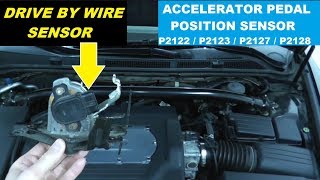
Typical fix: Replace the entire accelerator pedal assembly, as the sensor is integrated into it. 🎬 See this walkthrough for testing and replacing the pedal assembly.
Est. part cost: $80-$160 - Damaged Wiring Harness ⚪ Low Probability The harness can be damaged by aftermarket accessory installation passing through the firewall or by rodents. Water intrusion into the main instrument panel-to-body harness connector (often located in the driver's kick panel) is also a known issue documented in TSB #07-06-04-019F.
How to confirm: Visually inspect the wiring harness between the APP sensor and the ECM for any signs of chafing, pinching, or breaks, paying close attention to the firewall grommet area and where the harness may rub against the engine block. Perform a continuity test on each wire with a multimeter to find any open or short circuits.
Typical fix: Repair the specific damaged wire or section of the harness. In cases of water intrusion, the affected harness connector must be disconnected, cleaned, dried, and protected with dielectric grease.
Est. part cost: $5-$50
Rare But Worth Checking
- Faulty Engine Control Module (ECM): This is extremely rare and should only be considered after all other possibilities (sensor, connector, and wiring) have been definitively ruled out through proper testing.
- Poor Ground Connection: A corroded or loose ground wire for the engine or ECM can cause a variety of electrical issues, including APP sensor codes. One owner of a related platform fixed similar codes by finding and repairing a broken ground wire on the passenger side of the intake manifold. A common ground point to inspect on this platform is G103, located on the front of the passenger side cylinder head.
Diagnosis Steps
- Connect an OBD-II scanner and check for P2120 and any other related codes. Record the freeze frame data.
- Use the scanner's live data function to monitor the voltage readings from APP Sensor 1 and APP Sensor 2.
- Slowly press and release the accelerator pedal, watching for smooth, continuous voltage changes. Any jumps, dropouts, or flat spots indicate a problem.
- As per TSB #PIP3783D, perform a 'wiggle test' by manipulating the wiring and connector at the accelerator pedal while watching the live data. If the voltage readings become erratic, the issue is in the connector or harness.
- Disconnect the battery. Unplug the APP sensor connector and visually inspect the female terminals for corrosion, damage, or being spread too far apart (poor tension).
- If the connector looks good, check for 5V reference and good ground at the connector using a multimeter. With the key on, you should have 4.8-5.2 volts between the 5-volt reference and low reference (ground) terminals.
- Inspect other harness connectors between the pedal and ECM, specifically the instrument panel-to-body connector (often in the driver's kick panel area), for signs of water intrusion or corrosion, as noted in TSB #07-06-04-019F.
- If the connector and wiring test good, the APP sensor within the pedal assembly is likely faulty and requires replacement.
- As a final step if all else fails, check for continuity on the signal wires from the APP connector to the ECM connector to rule out a hidden wire break.
Parts You'll Likely Need
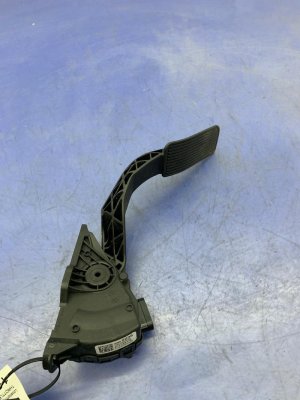
- Accelerator Pedal Assembly
(OEM #25832864)— This assembly contains the integrated Accelerator Pedal Position (APP) sensor, which is the most common part to fail if wiring issues are ruled out. This part number fits many models but always verify with your VIN. It supersedes older part numbers 15847349 and 15101848.
Trusted brands: ACDelco (OEM), Standard Motor Products, Dorman, NGK/NTK
OEM price range: $95-$170
Aftermarket price range: $70-$120 - Accelerator Pedal Position Sensor Connector
(OEM #ACDelco PT2628 (GM 13580112))— As identified in TSB #PIP3783D, the connector itself can be the source of the problem due to poor pin tension or corrosion. Replacing the pigtail is a common repair. This is an 8-pin connector, but the APP sensor only uses 6 pins.
Trusted brands: ACDelco, Dorman (645-595), Standard Motor Products (S-1479)
OEM price range: $30-$50
Aftermarket price range: $20-$40
Related Codes That Often Appear With This One
- P2122 — Indicates low voltage in the APP Sensor 1 ('D') circuit.
- P2123 — Indicates high voltage in the APP Sensor 1 ('D') circuit.
- P2125 — Indicates a fault in the 'E' circuit of the APP sensor (APP Sensor 2).
- P2127 — Indicates low voltage in the APP Sensor 2 ('E') circuit.
- P2128 — Indicates high voltage in the APP Sensor 2 ('E') circuit.
- P2138 — Indicates a correlation problem between the two internal APP sensors (APP1 vs APP2). This code is very common alongside P2120 and is also mentioned in TSB #PIP3783D and TSB #07-06-04-019F.
Technical Service Bulletins (TSBs) & Recalls
- PIP3783D: Addresses SES Light, Reduced Engine Power, and DTCs P2120, P2122, P2123, P2125, P2127, P2128, and/or P2138. Recommends inspecting APP sensor circuits for poor terminal tension at the sensor and other harness connectors.
- 07-06-04-019F: Addresses intermittent MIL and Reduced Engine Power with DTC P2138 (and related codes like P2120). Points to water intrusion into the instrument panel (IP) to body harness connector as a potential cause.
Platform-Specific Known Issues
- GM Technical Service Bulletin #PIP3783D directly addresses this code on 2007-2014 Escalades. It warns that intermittent 'Reduced Engine Power' messages with codes like P2120 are often caused by poor terminal tension in the APP sensor's electrical connector, not necessarily a failed sensor.
- A second TSB, #07-06-04-019F, highlights that water intrusion into the instrument panel (IP) to body harness connector can also cause these codes. This suggests checking other connectors beyond just the one at the pedal.
Mechanic-Grade Diagnostic Values
- APP Sensor 1 (VPA) Signal Voltage — expected: Below 1.1V at pedal rest, increasing smoothly to above 2.1V at full depression.. Failure: Voltage is outside the range of 0.24V to 4.49V, or signal does not change smoothly with pedal movement.
- APP Sensor 2 (VPA2) Signal Voltage — expected: Above 3.9V at pedal rest, decreasing smoothly to below 2.9V at full depression.. Failure: Voltage is erratic, does not change smoothly, or does not correlate inversely with APP Sensor 1.
- 5-Volt Reference at APP Connector — expected: 4.8 - 5.2 volts with ignition ON, engine OFF.. Failure: Voltage is below 4.8V or above 5.2V, indicating a short, open, or issue with the ECM/shared sensor circuit.
- Low Reference (Ground) at APP Connector — expected: Less than 3 ohms of resistance to a known good chassis ground.. Failure: Resistance is higher than 3 ohms, indicating an open or high resistance in the ground circuit.
Scan Tool Commands That Help
- Tech2 / GDS2: Live Data Monitoring (APP Sensor 1, APP Sensor 2) — This is the primary function used to diagnose P2120. It allows real-time observation of the sensor voltage signals as the pedal is operated, making it easy to spot jumps, dropouts, or non-linear response that indicates a fault.
- Scan Tool (Generic or Professional): Clear DTCs — After a repair is performed, the codes must be cleared. A history DTC will clear on its own after 40 consecutive warm-up cycles without a failure, but clearing it manually is required for immediate verification of the fix.
Wiring & Ground Locations
- APP Sensor Connector (X212) — Directly on the accelerator pedal assembly, under the driver's side dashboard.. This is the primary connection point for the pedal's sensors and the location where poor terminal tension is most common, as cited by TSB PIP3783D. The 6 pins used are: Pin A (Low Reference), Pin B (APP 2 Signal), Pin C (5V Reference 2), Pin D (Low Reference), Pin E (APP 1 Signal), Pin F (5V Reference 1).
- IP-to-Body Harness Connector — Located in the driver's side kick panel area.. This large connector carries the APP sensor signals from the cabin to the engine bay. TSB 07-06-04-019F identifies it as a common point for water intrusion from windshield or A-pillar leaks, causing corrosion and setting P2120/P2138.
- G103 - Engine Ground — On the front of the passenger side (right side) cylinder head.. A poor engine-to-chassis ground can cause floating voltages and erratic sensor readings. While multiple grounds exist, G103 is a key grounding point for engine electronics and should be inspected for tightness and corrosion.
- ECM/TCM Ground (G101) — Located at the lower front of the engine block.. This is a direct ground for the Engine Control Module and Transmission Control Module. A fault here can cause a wide range of DTCs, including those for the 5V reference circuits that supply the APP sensor.
Real Owner Repair Stories
- Grand Prix Forums user 'Mtbuicknut' (2008 Pontiac Grand Prix (related GM platform)) — Codes P1125, P2120, P2125, P2138 and 'Reduced Engine Power' message.
❌ Tried (didn't work) Replaced Throttle Body, Replaced Accelerator Pedal Assembly
✅ What actually fixed it Found a bad ground wire that had backed out of the connector at the throttle body. - Clore Automotive Blog - User 'Rick' (2008 Chevrolet Silverado (same GMT900 platform)) — Intermittent P0641 (5-volt Reference 'A' Circuit) and limp mode. This code is on the same circuit as the APP sensor.
❌ Tried (didn't work) Wiggling harnesses at multiple sensors on the circuit., Disconnecting each sensor one-by-one to isolate the short.
✅ What actually fixed it Found that the insulation on the 5-volt reference (gray wire) for the fuel tank pressure sensor had rubbed through against the vehicle body, causing an intermittent short to ground. The fuel tank pressure sensor shares the same 5V reference circuit as the APP sensor.
Helpful Videos
We Have This Part in Stock

The information in this article is provided for general reference and educational purposes only. Vehicle specifications, procedures, and part compatibility can vary by production date, trim level, and region. Always consult your vehicle's factory service manual and verify part numbers before purchasing or performing repairs. Safety-critical components such as airbags, seat belts, and braking systems should be installed by a qualified professional.
- Cadillac ESCALADE ESV:
- 🎬 Helpful Videos
- 🛍️ Shop This Part
- What's Unique About the 2007-2014 Cadillac ESCALADE ESV
- Diagnostic Flowchart
- Symptoms You May Notice
- Most Likely Causes
- Rare But Worth Checking
- Diagnosis Steps
- Parts You'll Likely Need
- Related Codes That Often Appear With This One
- Technical Service Bulletins (TSBs) & Recalls
- Platform-Specific Known Issues
- Mechanic-Grade Diagnostic Values
- Scan Tool Commands That Help
- Wiring & Ground Locations
- Real Owner Repair Stories
- 🎟️ Get 5% Off