

P2119 on 2006-2010 GMC Savana: Throttle Body Control Fixes
P2119 on a 2006-2010 GMC Savana usually means the throttle body is dirty or failing, causing the engine to enter 'Reduced Power' mode. The most common fix is to thoroughly clean the throttle body and perform an idle relearn procedure. If that fails, the entire throttle body assembly likely needs to be replaced.
- P2119 on your Savana almost always points to an issue with the electronic throttle body.
- The most common symptom is the 'Reduced Engine Power' message, which severely limits vehicle speed.
- Before buying any parts, the first step should always be to remove and thoroughly clean the throttle body and its bore.
- If cleaning doesn't fix the problem, the entire throttle body assembly will likely need to be replaced.
- After cleaning or replacing the part, a throttle idle relearn procedure is recommended to ensure smooth operation.
What's Unique About the 2006-2010 Gmc SAVANA
On this generation of GMC Savana and its platform mates (like the Chevrolet Express and Silverado), the electronic throttle control system is notoriously sensitive to carbon buildup. As these high-mileage work vehicles accumulate miles, oil vapor from the PCV system and other contaminants bake onto the throttle bore and plate, restricting its movement. The ECM tries to compensate for this buildup over time, but eventually, the throttle's movement becomes so restricted that it can't match the computer's commands, triggering P2119 and the 'Reduced Engine Power' mode. GM has issued several technical service bulletins (TSBs) acknowledging this exact issue across a wide range of its trucks and SUVs.
Diagnostic Flowchart
Tap your situation to follow the diagnostic path that matches what you're seeing on this vehicle.
Symptoms You May Notice
- "Reduced Engine Power" message on the dashboard.
- Check Engine Light is on.
- Vehicle has very limited acceleration and power (limp mode).
- Unstable, rough, or high idle.
- Vehicle may stall, be difficult to start, or may not start at all.
- Delayed or hesitant throttle response.
- In some cases, an "Engine Disabled" message may appear after failed start attempts.
- Replacing the accelerator pedal position (APP) sensor. While the APP sensor is part of the throttle control system, P2119 specifically points to a problem at the throttle body itself (range/performance), not the pedal input. Other codes like P2138 would typically point to the pedal sensor.
- Replacing only the Throttle Position Sensor (TPS). On these GM throttle bodies, the TPS is integrated into the assembly and not typically sold as a separate, reliable part. Attempts to replace just the sensor are often unsuccessful.
Most Likely Causes
- Dirty Throttle Body 🔴 High Probability Carbon and oil vapor from the PCV system can accumulate in the throttle body over many miles, physically restricting the throttle plate's movement. This is a very common issue on GM V8 engines of this era, as documented in TSB PIP4578B.
How to confirm: Remove the air intake duct from the throttle body and visually inspect the throttle plate and bore for a thick, black, sticky layer of carbon buildup. The plate should be relatively clean and move without sticking.
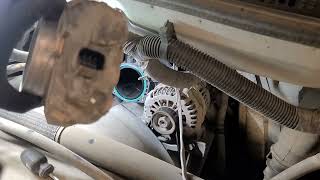
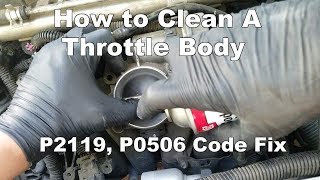
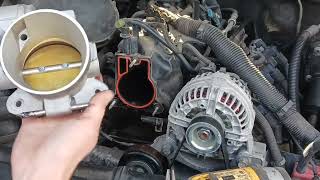
Typical fix: Remove the throttle body from the intake manifold and clean it thoroughly with a dedicated throttle body cleaner and a soft cloth or brush. 🎬 Watch this guide on how to properly clean your throttle body. Do not spray cleaner directly into the engine. A throttle relearn procedure is mandatory afterward using a scan tool or a specific manual sequence.
Est. part cost: $5-$15 - Failing Throttle Body Assembly 🟡 Medium Probability The internal electric motor or the integrated throttle position sensors (TPS) within the sealed throttle body unit can fail electronically or mechanically over time, causing erratic behavior.
How to confirm: If a thorough cleaning and idle relearn procedure does not resolve the code, the failure is almost certainly internal to the throttle body assembly. A scan tool can monitor commanded vs. actual throttle position to spot discrepancies that confirm the malfunction.
Typical fix: Replace the entire throttle body assembly. This is sold as a complete unit including the motor and sensors. An idle relearn procedure is required after installation.
Est. part cost: $100-$250 - Wiring or Connector Issue ⚪ Low Probability Engine heat and vibration can cause wiring harnesses to become brittle or connections at the throttle body to become loose or corroded. On trucks, a common failure point is a poor ground connection for the engine control module.
How to confirm: Visually inspect the wiring harness and connector at the throttle body for any signs of damage, corrosion, or loose pins. Wiggle the connector with the engine running to see if it affects the idle. Check main engine and PCM ground straps 🎬 Watch this video to help troubleshoot and fix Reduced Power mode. for corrosion and tightness.
Typical fix: Repair the damaged section of the wiring harness, replace the connector pigtail, or clean and tighten faulty ground connections.
Est. part cost: $15-$50
Rare But Worth Checking
- Faulty Powertrain Control Module (PCM): This is very rare. Before condemning the PCM, all other possibilities, especially the throttle body, its wiring, and ground connections, must be exhaustively ruled out. Usually, other unrelated codes would be present if the PCM were failing.
- Low Battery Voltage: A weak or failing battery can cause a variety of seemingly unrelated electronic issues in modern vehicles, including setting throttle body codes. Ensure the battery and charging system are healthy before proceeding with more complex diagnostics.
Diagnosis Steps
- Confirm that P2119 is present using an OBD-II scanner. Note any other codes, especially P1516, P2101, or P2135, as they reinforce a throttle body issue.
- Turn the ignition off. Remove the air intake hose connected to the throttle body.
- Visually inspect the throttle bore and plate for heavy, black carbon buildup. This is the most likely cause.
- Carefully try to move the throttle plate with your fingers (with ignition off). It should have spring tension and return to its resting position without sticking, binding, or scraping.
- If significant carbon is present, disconnect the battery. Remove the four 10mm bolts holding the throttle body, disconnect the electrical connector, and clean it thoroughly off the vehicle using dedicated throttle body cleaner and a soft cloth.
- While the throttle body is off, inspect the electrical connector and wiring for any signs of damage, corrosion, or loose pins.
- Reinstall the clean throttle body with a new gasket if the old one is flattened or damaged. Torque the bolts to 89 in-lbs (about 7.4 ft-lbs). Reconnect the electrical connector and air intake.
- Perform a throttle idle learn reset procedure. A scan tool is the most reliable method. A manual procedure may also work: idle the engine for 3 minutes, turn it off for 60 seconds, then idle again for 3 minutes.
- If the code returns after a thorough cleaning and successful relearn, the throttle body assembly is faulty and requires replacement.
Parts You'll Likely Need
- Throttle Body Assembly
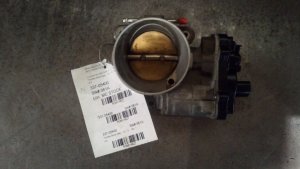
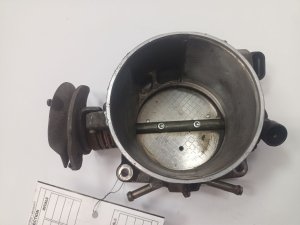
(OEM #217-3151 (ACDelco GM Original Equipment), 12629992 (GM))— If cleaning does not resolve the issue, the internal electronics or motor have failed, requiring replacement of the entire unit. This is the definitive fix when cleaning fails.
Trusted brands: ACDelco, Dorman, Hitachi
OEM price range: $200-$360
Aftermarket price range: $100-$200 - Throttle Body Cleaner — This is the first and most crucial step in attempting to fix the code, as carbon buildup is the most common cause. Use a cleaner specifically designed for throttle bodies to avoid damaging sensors.
Trusted brands: CRC, WD-40 Specialist, Berryman
Aftermarket price range: $5-$15 - Throttle Body Gasket — It is best practice to replace the gasket when removing the throttle body to prevent a vacuum leak.
Trusted brands: Fel-Pro, Mahle, ACDelco
OEM price range: $5-$15
Aftermarket price range: $3-$10
Related Codes That Often Appear With This One
- P1516 — This is a GM-specific code for Throttle Actuator Control (TAC) Module Performance, often set together with P2119 when the throttle command from the PCM doesn't match the actual throttle plate position.
- P2101 — This code relates to the control motor circuit range/performance, indicating a problem with the electric motor that moves the throttle plate. It frequently accompanies P2119.
- P2135 — This code indicates a correlation issue between the two throttle position sensors (TPS 1 and TPS 2) within the throttle body, a common companion code that points directly to a failing throttle body assembly.
- P2176 — This code, 'Minimum Throttle Position Not Learned', often appears after a cleaning or replacement if an idle relearn procedure hasn't been completed successfully, or if carbon buildup is preventing the plate from closing to its minimum position.
Technical Service Bulletins (TSBs) & Recalls
- PIP4578B: Mentions DTC P2119 in relation to idle surge and reduced engine power on high mileage vehicles due to carbon buildup. It emphasizes the need for cleaning and performing an 'idle learn reset' with a scan tool.
- PIP5513: Advises that P2119 alone does not warrant throttle body replacement and should be diagnosed in conjunction with other codes or symptoms like reduced power mode.
- 06-06-04-032: Informs technicians that an adaptive value reset (idle learn procedure) is required after cleaning the throttle body to prevent DTC P2119 from setting and to avoid RPM fluctuations.
Platform-Specific Known Issues
- A GM Technical Service Bulletin (PIP4578B) directly addresses P2119 along with other codes causing idle surge and reduced power on high-mileage vehicles, confirming that heavy carbon buildup is the expected cause and cleaning/relearning is the prescribed fix.
- Another GM document, PIP5513, explicitly sta
Mechanic-Grade Diagnostic Values
- Throttle Position Sensor (TPS) 1 Signal Voltage — expected: Approx. 0.5-0.7V at idle (closed throttle), increasing smoothly to approx. 4.5V at wide-open throttle (WOT).. Failure: Voltage that is erratic, jumps, or does not correspond smoothly with throttle plate movement.
- Throttle Position Sensor (TPS) 2 Signal Voltage — expected: Typically inverse of TPS 1, starting high (approx. 4.5V) at idle and decreasing smoothly to approx. 0.5-0.7V at WOT.. Failure: Voltage that doesn't mirror TPS 1 or shows erratic behavior, triggering correlation codes like P2135.
- 5-Volt Reference at Throttle Body Connector — expected: Constant ~5.0 volts with key on, engine off.. Failure: Voltage that is significantly lower than 5.0V or is absent, indicating a wiring or PCM issue.
- Low Reference (Ground) at Throttle Body Connector — expected: Near 0.0 volts or showing continuity to a known good ground.. Failure: Any significant voltage reading, indicating a poor ground connection.
- Scan Tool Parameter: Throttle Body Idle Airflow Compensation — expected: Less than 90%.. Failure: A value of 90% or greater suggests the ECM is compensating for excessive carbon buildup or a mechanical restriction, pointing towards the need for throttle body cleaning.
Scan Tool Commands That Help
- Tech2 / GDS2: Throttle Sweep Test — This bidirectional control commands the throttle actuator motor to sweep the throttle plate from fully closed to fully open. It's used to verify the mechanical and electrical integrity of the throttle body assembly without the engine running.
- Tech2 / GDS2: Idle Learn Reset / Throttle Learn — This function must be performed after cleaning or replacing the throttle body. It resets the learned idle airflow values in the ECM, preventing high idle or the code from returning.
- Tech2 / GDS2: Monitor TAC Motor Command vs. Actual Throttle Position — While observing live data, compare the commanded throttle percentage from the ECM to the actual percentage reported by the TPS. A significant discrepancy indicates a fault in the throttle body motor or sensors.
Wiring & Ground Locations
- G103 — On the front of the passenger side (right) cylinder head.. This is a primary engine ground. A poor connection here can cause a host of sensor and actuator problems, including erratic throttle body behavior and setting TAC-related codes like P2119 and P1516.
- G104 — On the right frame rail in the engine compartment.. This is another critical ground point in the engine bay. Corrosion or looseness at this location can lead to intermittent electrical issues for various engine components, including the throttle control system.
- Throttle Body Connector (6-pin) — Directly on the throttle body assembly.. This is the single point of connection for power, ground, and signals to the throttle body. The pins for the two 5V reference lines, two low reference (ground) lines, and two TAC motor control lines must be clean and making solid contact. Wiggling this connector with the engine running can help identify intermittent connection problems.
Real Owner Repair Stories
- Tahoe Yukon Forum user (GM Truck/SUV (similar platform)) — Persistent 'Reduced Engine Power' message with code P1516, which often accompanies P2119.
❌ Tried (didn't work) Replacing the throttle body (multiple times), Replacing the Throttle Actuator Control (TAC) module, Replacing the gas pedal sensor (APP)
✅ What actually fixed it The root cause was a poor ground connection. The final fix involved adding multiple redundant ground wires: one from the TAC module to the firewall, and another from the engine block to a solid chassis ground. The user noted that checking the pigtail connector to the throttle body for broken internal wires was also a critical step. - Chevrolet Forum user (2005 Silverado 5.3L (similar platform)) — Immediate 'Reduced Engine Power' and code P1516 upon starting.
❌ Tried (didn't work) Replacing APP sensor with relearn, Testing all pigtails, Clearing ECM
✅ What actually fixed it The user suspected the issue was an aftermarket throttle body they had installed. They noted that these trucks are known to be sensitive to non-OEM sensors and that a response delay of more than 0.5 seconds can trigger the code. The implication is that returning to a genuine GM/ACDelco part is often the solution when aftermarket parts fail to resolve the issue.
OEM Part Supersession History
12601387→12629992— Standard part evolution and potential internal improvements.
Heads up: The OEM part 12629992 (also sold as ACDelco 217-3151) is the correct replacement for later models in this range. While earlier throttle bodies may physically fit, there can be internal electronic differences. Using the wrong year part can cause compatibility issues.
Model Year Variations Within This Range
- 2007 vs. 2009+: There are known physical differences in the throttle body design between early (e.g., 2007) and later (e.g., 2009) NNBS platform vehicles, which includes the Savana. The shape of the throttle bore opening was slightly changed. While they may be interchangeable in some cases (sometimes requiring an adapter harness), it is critical to order the part number specific to the vehicle's year and VIN to avoid compatibility codes.
Helpful Videos
Used OEM Parts in Stock



New Aftermarket Parts Available


The information in this article is provided for general reference and educational purposes only. Vehicle specifications, procedures, and part compatibility can vary by production date, trim level, and region. Always consult your vehicle's factory service manual and verify part numbers before purchasing or performing repairs. Safety-critical components such as airbags, seat belts, and braking systems should be installed by a qualified professional.
- Gmc SAVANA:
- 🎬 Helpful Videos
- 🛍️ Shop This Part
- What's Unique About the 2006-2010 Gmc SAVANA
- Diagnostic Flowchart
- Symptoms You May Notice
- Most Likely Causes
- Rare But Worth Checking
- Diagnosis Steps
- Parts You'll Likely Need
- Related Codes That Often Appear With This One
- Technical Service Bulletins (TSBs) & Recalls
- Platform-Specific Known Issues
- Mechanic-Grade Diagnostic Values
- Scan Tool Commands That Help
- Wiring & Ground Locations
- Real Owner Repair Stories
- OEM Part Supersession History
- Model Year Variations Within This Range
- 🎟️ Get 5% Off