

OBD-II Code P2116: Throttle/Pedal Position Sensor 'E' Minimum Stop Performance
The Ultimate Guide to P2116: What it means, why it triggers, and exactly how to fix it
- P2116 triggers a mandatory 'limp mode' that caps vehicle speed under 40 mph to prevent uncontrolled acceleration.
- Cleaning the throttle body with a $15 dedicated spray fixes this code in over 50% of cases by removing carbon that blocks the plate.
- Never replace the $300+ throttle body or pedal assembly without first verifying a steady 5-volt reference signal at the sensor connector.
- After any repair, you must perform an Electronic Throttle Control (ETC) relearn procedure using a bidirectional scan tool to restore normal idle.
What Does P2116 Mean?

Your Powertrain Control Module (PCM) detected a critical failure in the electronic throttle control (ETC) system. Specifically, sensor 'E' is not reporting its expected minimum voltage when the throttle commands closed. This conflict forces the PCM to distrust the throttle system, triggering a failsafe mode and severely restricting acceleration.
Technical definition: The SAE/OBD-II definition is "Throttle/Pedal Position Sensor 'E' Minimum Stop Performance". The PCM ran a diagnostic check and found sensor circuit 'E' failed to reach its pre-calibrated minimum voltage when the throttle closed. Unable to verify the throttle's true resting position, the PCM enters 'limp mode' to prevent dangerous, unintended acceleration.
Can I Drive With P2116?
Yes, But With Caution. You can drive, but it is strongly not recommended. The vehicle enters a 'limp home mode,' severely limiting engine power and speed to prevent uncontrolled acceleration. Continuing to drive in traffic is a safety hazard and risks destroying the catalytic converter from a poor air-fuel mixture, adding $800-$2,500 to the repair cost.
Common Causes

- Dirty or obstructed throttle body (Very Common) — Carbon buildup from crankcase vapors creates a thick layer of gunk around the throttle plate, physically preventing it from closing completely. This is the most frequent and cheapest-to-fix cause. 🎬 Watch: Step-by-step guide to cleaning your throttle body correctly.
- Faulty throttle body assembly (Common) — The internal electric motor or the integrated Throttle Position Sensor (TPS) fails. On most modern vehicles, these components are sealed, requiring complete assembly replacement.
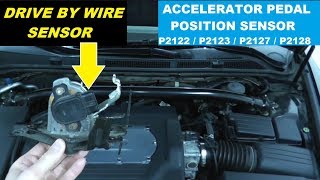
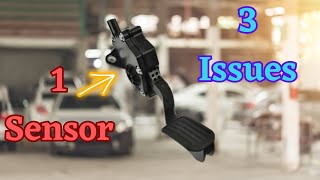
- Faulty Accelerator Pedal Position (APP) sensor (Common) — The APP sensor inside the gas pedal assembly fails and sends incorrect voltage signals to the PCM, creating a mismatch with the throttle position sensor. 🎬 See how to test and replace the accelerator pedal sensor.
- Wiring or connector issues (Common) — Damaged, corroded, or frayed wiring between the throttle body, APP sensor, and PCM causes voltage drops or short circuits.
- Faulty 5-Volt Reference Circuit (Less Common) — The PCM supplies a shared 5-volt reference signal to multiple sensors. A short in this circuit cuts power to the throttle sensors, triggering P2116.
- Software or calibration mismatch (Less Common) — After a battery disconnect or component replacement, the PCM loses its learned values for the throttle's minimum and maximum positions.
- Powertrain Control Module (PCM) failure (Rare) — The PCM itself fails to process the sensor signals correctly. This is a last-resort diagnosis accompanied by U-series communication codes.
Symptoms

- Reduced engine power or 'limp mode' — The vehicle feels extremely sluggish and caps speed under 40 mph. A "Reduced Engine Power" message appears on the dashboard.
- Check Engine Light and ETC Light illuminated — The Malfunction Indicator Lamp turns on alongside the Electronic Throttle Control (ETC) light, which looks like a lightning bolt inside parentheses.
- Poor, delayed, or no acceleration — The car hesitates, stumbles, or fails to speed up when pressing the gas pedal. The response feels disconnected from your foot.
- Engine stalling — The engine stalls when coming to a stop because the PCM cannot properly control the idle airflow.
- Cruise control disabled — The PCM disables cruise control as a mandatory safety measure whenever an electronic throttle fault is active.
Diagnostic Flowchart

Tap your situation to follow the diagnostic path that matches what you're seeing on this code.
Common Fixes & Costs
- Cleaning the throttle body — Parts: $10-$20, Labor: $100-$150, ~0.8 hr book time (DIY)
- Replacing the throttle body assembly — Parts: $150-$400, Labor: $100-$200, ~1.5 hr book time (Intermediate)
- Replacing the Accelerator Pedal Position (APP) sensor assembly — Parts: $70-$250, Labor: $100-$150, ~1.0 hr book time (DIY)
- Repairing damaged wiring or connectors — Parts: $10-$50, Labor: $150-$300, ~2.0 hr book time (Intermediate)
- PCM Reprogramming or Replacement — Parts: $500-$1000, Labor: $150-$300, ~1.8 hr book time (Expert)
Used vs. New Parts: Buying Guide
When a used part is worth it: Never buy used electronic throttle bodies or pedal sensors. The risk of hidden electronic wear and repeat labor costs negates any initial savings.
Donor quality checklist:
- Match the part number exactly; electronic modules have multiple software versions.
- Check for shaft play and a clean bore on mechanical parts.
Decision logic:
- If The part is a complete electronic throttle body or accelerator pedal assembly. → Buy new (OEM or high-quality aftermarket). Used parts carry too much risk of internal sensor drift.
- If A shop is performing the labor. → Buy new. Paying $200 in labor twice to replace a faulty used part ruins the investment.
Warranty tradeoff: Salvage yards offer 30-day part-only warranties. New aftermarket parts carry 1-year to lifetime warranties.
Worst-case if a used part fails: 400-800
What Happens If You Wait — Timeline
- 0-2 weeks: Vehicle enters 'limp mode' immediately. Acceleration is severely limited, making driving difficult and unsafe in traffic. (MPG impact: 5-10%% · Added cost: $0)
- 2 weeks - 2 months: Continued driving in limp mode causes the PCM to operate with incorrect air/fuel calculations, leading to fouled spark plugs. (MPG impact: 10-25%% · Added cost: $50-150)
- 2-6 months: A persistent incorrect air/fuel mixture overheats the catalytic converter. The internal substrate starts to get coated or damaged. (MPG impact: 20-30%% · Added cost: $200-500)
- 6+ months: Catastrophic failure of the catalytic converter occurs. The substrate melts or clogs completely, creating a major exhaust blockage. (MPG impact: >30%% · Added cost: $1000-3000)
Cost of Not Fixing It
- Immediate: Vehicle is unreliable and unsafe due to sudden entry into 'limp mode' in traffic. (Added cost: 0)
- 1-3 months: Driving with a poor air/fuel mixture fouls spark plugs, creates carbon buildup on valves, and drops fuel economy by 20%. (Added cost: 100-300)
- 3-6+ months: A persistent rich or lean condition overheats and destroys the catalytic converter, requiring a massive exhaust repair. (Added cost: 800-2500)
Diagnosis Steps
- Read Trouble Codes & Freeze Frame Data
Use an OBD-II scanner to confirm P2116. Codes for other sensors (P2115, P2127), the actuator motor (P2101), or reference voltage (P0652) dictate your next move. Analyze freeze frame data to see engine conditions when the fault occurred.
Tools: OBD-II Scanner (Beginner) - Inspect and Clean the Throttle Body
Remove the air intake tube. Inspect the throttle bore and plate for carbon buildup. Clean it thoroughly with throttle body cleaner and a soft cloth. Manually and gently move the plate to clean all surfaces. Do not use harsh tools.
Tools: Socket set, Throttle body cleaner, Soft cloths (Intermediate) - Verify 5-Volt Reference and Ground
Disconnect the APP or TPS sensor connector. With the key 'ON' (engine off), use a multimeter to test the terminals. You must find one pin with a steady 5-volt reference signal and another with a solid ground (under 100mV). If missing, you have a wiring or PCM problem.
Tools: Multimeter, T-pins (Advanced) - Inspect Wiring and Connectors
Meticulously inspect the wiring harnesses at the throttle body and accelerator pedal. Look for chafed insulation, bent pins, and loose connections. Wiggle the harness with the engine running to see if it triggers a change in idle.
Tools: Flashlight, Multimeter (Intermediate) - Test Sensor Voltage with Live Data
Using a scan tool, monitor voltage readings for the APP and TPS sensors. As you slowly press and release the gas pedal, voltages must move smoothly. Sudden jumps, drops, or flat spots indicate a failing sensor.
Tools: Advanced OBD-II Scanner (Advanced) - Live Data PID Analysis
Monitor TPS1, TPS2, APP1, and APP2. At idle, TPS voltages sit low (~0.5V-0.8V) and APP voltages sit at minimum (~0.6V-1.2V). At Wide Open Throttle, both read near maximum (~4.5V). Deviation from expected correlation proves sensor failure.
Tools: Advanced OBD-II Scanner (Advanced) - Sensor Resistance Test (Bench Test)
With the sensor disconnected, measure resistance between the reference and ground terminals (typically 3.5kΩ to 6.5kΩ). Manually sweep the sensor; resistance on the signal circuit must change smoothly without open loops.
Tools: Multimeter, Sensor Pinout Diagram (Advanced) - Graph Sensor Data with a Scope
Backprobe the signal wires of the APP and TPS sensors. A good sensor shows a smooth waveform. A bad sensor shows sharp dropouts or 'hairy' noise that a multimeter is too slow to catch.
Tools: Oscilloscope, Backprobe pins (Expert) - Isolate with Component Disconnection
If a 5-volt reference code (P0652) is present, unplug sensors on that circuit one by one with the key on. When the 5V signal returns on your multimeter, the last sensor unplugged is the one shorting the circuit.
Tools: Multimeter (Expert) - Perform an ETC Relearn Procedure
After cleaning or replacing any throttle component, a relearn procedure is mandatory to reset the PCM's learned values. Use a professional scan tool to initiate the calibration.
Tools: Professional scan tool (Advanced)
When This Code Triggers (Freeze-Frame Conditions)
- Engine Coolant Temp: 175-210°F (Engine is at normal operating temperature.)
- RPM: 700-1200 (Fault sets at or near idle when the PCM checks the minimum stop position.)
- Engine Load: 15-30% (Low load during deceleration or idle when the throttle expects to be fully closed.)
- Vehicle Speed: 0-10 mph (Occurs at low speeds or when coming to a stop.)
Related Codes
- P2101 — Indicates the electric motor inside the throttle body is stuck or drawing too much current. Appears alongside P2116 during total throttle body failure.
- P2115 — Identical fault to P2116 but for redundant sensor circuit 'D'. Seeing both strongly suggests a failure in the sensor assembly itself, not an intermittent glitch.
- P2127 — Indicates the voltage signal from sensor 'E' is below the expected range. If present, diagnose P2127 first as the electrical fault causes the P2116 performance code.
- P0652 — Indicates a short in the 5-volt power supply provided by the PCM. If this voltage drops, sensors cannot send correct signals. Diagnose P0652 immediately.
Climate & Environmental Factors
- High Humidity / Water Intrusion: Moisture entering sensor connectors causes pin corrosion, leading to intermittent short-circuits and erratic voltage readings.
- Extreme Cold: Moisture in the throttle body turns to ice, physically restricting the throttle plate from closing. This causes a temporary P2116 code upon startup.
- High Altitude: Lower air density requires the throttle plate to open further for a given airflow, making the PCM more sensitive to minor carbon restrictions.
How to Talk to a Mechanic About This Code
Say this: "I have a P2116 code and the car is in limp mode. I'd like to schedule a diagnostic. Please start by inspecting and cleaning the throttle body before recommending any part replacements. I'd also like to know the diagnostic fee upfront."
This signals you've done research, directs the mechanic to the cheapest fix first, and prevents them from immediately quoting an expensive throttle body replacement.
Avoid saying:
- 'My check engine light is on, can you look at it?' (Invites a wide-ranging, expensive diagnostic).
- 'The car is acting weird and won't go fast.' (Too vague, focus on the code).
- 'Just fix whatever's wrong.' (A blank check for unnecessary repairs).
Questions to ask before authorizing the repair:
- Did you clean the throttle body first, and did that solve the problem?
- If not, did you test the 5-volt reference and ground at the throttle body and accelerator pedal connectors?
- Can you show me the live data graphs for the TPS and APP sensors?
- Does the repair estimate include performing the ETC relearn procedure?
- What is the warranty on the parts and labor for this specific repair?
Where to Take It: Dealer vs Independent vs Chain
- Dealer:
Best for: Vehicles still under a powertrain or emissions warranty., Complex electrical issues with multiple control module codes., Recalls or known manufacturer-specific issues (TSBs).
Downsides: Significantly higher labor rates, often 1.5-2x more than an independent shop., More likely to replace an entire assembly rather than attempting a simpler fix like cleaning. (Typical cost: +50% vs. baseline) - Independent Shop:
Best fit for most situations. P2116 is a common code that any competent independent mechanic diagnoses effectively, starting with cost-effective solutions.
Best for: Most out-of-warranty vehicles where cost is a factor., Straightforward diagnosis and repair of common codes like P2116.
Downsides: Quality and diagnostic capabilities vary widely; check for ASE certifications., May lack manufacturer-specific diagnostic tools for very new models. (Typical cost: +0% vs. baseline) - Chain Shop:
Use with caution. They may replace a throttle body without performing a thorough diagnosis first, leading you to pay for parts you don't need.
Best for: Simple, routine maintenance like oil changes and tires.
Downsides: High pressure to upsell services and parts., Technicians are less experienced with in-depth electrical diagnostics. (Typical cost: -10% vs. baseline)
When to Walk Away From the Repair
If the estimated repair cost exceeds 50% of your car's private-party value, seriously consider not fixing it.
- Car worth $4000, fix is $750: Fix it. This repair is well below the 50% threshold and is a common issue.
- Car worth $3000, fix is $1600: Walk away. The repair cost is over half the car's value, and it's likely not the last expensive repair needed.
- Car worth $15000, fix is $800: Fix it. The cost is a small fraction of the vehicle's value.
What Scan Tool You Need for This Code
Minimum: A scanner that reads and graphs live data for throttle position (TPS) and accelerator pedal position (APP) sensors.
A $20 basic code reader only shows the P2116 code. It cannot show live sensor data, which is essential to determine if the fault is with the pedal, throttle body, or wiring.
Budget: BlueDriver Pro Scan Tool (~$100) — Connects to your smartphone and provides excellent live data graphing for the APP and TPS sensors to confirm hardware failure before buying parts.
Mid-range: Innova 5610 (~$350) — Provides live data and adds bidirectional controls, including the crucial 'Electronic Throttle Relearn' function to complete the repair without a shop.
Professional: Autel MaxiCOM MK808S / XTOOL D7 (~$450-600) — Full-featured bidirectional tablets that perform throttle relearns on virtually all makes and provide active tests to command the throttle motor directly.
Rent vs buy: Auto parts stores let you use a scanner for free to read the code, but they don't allow extensive live data testing. Buying a tool like the BlueDriver is a worthwhile investment.
How to Clear the Code After You Fix It
- Perform the mandatory ETC Relearn Procedure.
- Use an OBD-II scan tool to clear the P2116 code.
- Perform a complete drive cycle to set the readiness monitors.
Drive cycle (~20 minutes): From a cold start, idle for 3 minutes. Drive in mixed city/highway conditions, including steady-speed cruises and stop-and-go traffic, to experience a wide range of engine loads.
Readiness monitors affected: Comprehensive Component Monitor, Catalyst Monitor, Evaporative System Monitor, Oxygen Sensor Monitor
Before emissions retest: drive at least 50 miles to fully set monitors.
Watch out for:
- Disconnecting the battery clears the code but erases all readiness monitors, guaranteeing an emissions test failure.
- The code returns immediately if you skip the mandatory ETC relearn procedure after replacing parts.
Will This Fail Emissions / State Inspection?
Yes — this code typically fails an OBD-II emissions inspection.
- California: An active Check Engine Light is an automatic failure. All readiness monitors must be 'Ready' before re-testing.
- New York: An illuminated MIL due to P2116 results in an immediate emissions test failure.
- Texas: A P2116 code causes the vehicle to fail the OBD portion of the state inspection.
Most Commonly Affected Vehicles
- Chevrolet Silverado, Tahoe, Suburban (2007-2013) — Highly prone to carbon buildup and outright electronic failure of the throttle body assembly, presenting with a 'Reduced Engine Power' message.
- Ford F-150, Explorer, Fusion (2004-2013) — Internal electronic throttle body failures trigger a 'wrench' light and sudden limp mode. Ford issued an extended warranty program (13N03) that has since expired.
- Dodge/Ram Ram 1500, Charger (2005-2016) — Often sets P2116 with a cluster of pedal codes due to a faulty APP sensor or chafed wiring harness. A failing TIPM is a rare underlying cause.
- Chrysler 300, Town & Country (2005-2010) — The ETC 'lightning bolt' light is the primary symptom. Requires a specific ETC relearn procedure with a scan tool after any repair.
- Jeep Patriot, Compass, Wrangler (2007-2017) — Throttle body failure causes limp mode and flashing ETC lights. Aftermarket throttle bodies are a popular fix.
- Hyundai Sonata, Elantra (2011-2018) — The fault typically lies with the accelerator pedal position (APP) sensor, replaced as a complete pedal assembly.
- Kia Optima, Sorento, Soul (2011-2020) — Experiences frequent failures in the accelerator pedal assembly, leading to limp mode and inconsistent acceleration.
- Subaru Forester, Outback, Impreza (2005-2014) — Caused by significant carbon buildup restricting the throttle plate or an internal failure of the throttle position sensor.
Manufacturer-Specific Notes
- Chrysler/Dodge/Jeep: The ETC warning light (lightning bolt) is the key indicator. An 'ETC Relearn' function via a scan tool is mandatory after any repair.
- Ford: Throttle body failure causes a 'wrench' light. Replacement of the entire throttle body is the standard fix, followed by a 'keep alive memory' reset.
- General Motors (Chevrolet/GMC): Highly sensitive to carbon buildup. A generic relearn involves idling for 2 minutes with A/C off, 2 minutes with A/C on, then in gear with the brake on for 2 minutes.
- Nissan: Requires a precise, manual 'Throttle Valve Closed Position Learning' sequence of key turns and timed pedal presses after cleaning to avoid idle issues.
Real Owner Stories
2012 Jeep Wrangler with ~100k miles
Vehicle suddenly went into limp mode with flashing ETC light. Codes P2116, P2122, P2127 were present.
What they tried:
- Initially suspected a bad accelerator pedal sensor based on the codes.
Outcome: A mechanic diagnosed a faulty throttle body. After replacing the throttle body and performing a relearn procedure, all codes cleared.
Lesson: A cluster of pedal and throttle codes doesn't always point to the pedal sensor. The throttle body itself is a common failure point that generates multiple related codes.
2003 Dodge Ram 1500 5.7L Hemi
Truck would start but not accelerate, with the ETC 'lightning bolt' light on. Codes P2115, P2116, P2166, P2167 were present.
What they tried:
- Replaced the accelerator pedal assembly and the throttle body, but the problem persisted.
- Attempted an ETC relearn with a scan tool, which failed to correct the hard faults.
Outcome: The owner suspected an electrical issue related to a faulty TIPM (Totally Integrated Power Module), a known issue on these trucks.
Lesson: When multiple new parts don't fix the issue, suspect a foundational electrical problem (wiring, grounding, or a control module) before replacing more sensors.
2011 Infiniti G37 after DIY maintenance
After performing a DIY throttle body cleaning, the car had significantly less power and a 15% drop in MPG.
What they tried:
- Suspected they used too much cleaner or damaged the throttle body by manually forcing the plate open.
Outcome: The discussion pointed to the high sensitivity of Nissan/Infiniti throttle bodies. Manually forcing the plate breaks the integrated sensor.
Lesson: Be extremely careful when cleaning electronic throttle bodies. Never force the plate open manually. Using too much cleaner fouls downstream components like spark plugs.
How to Prevent This Code From Triggering
- Clean the throttle body periodically (Every 30,000-50,000 miles) — Removes the carbon buildup that physically restricts the throttle plate, preventing the most common cause of P2116.
- Use high-quality fuel with detergents (Every fill-up) — Top Tier certified gasoline contains detergents that reduce carbon deposits from forming within the intake system.
- Inspect and clean air filter regularly (Every oil change or 5,000 miles) — A clogged air filter creates a pressure differential that pulls oil vapors from the PCV system into the intake, accelerating carbon buildup.
- Check wiring harnesses for chafing (During any under-hood maintenance) — Ensures the wiring loom going to the throttle body is secured and not rubbing against sharp edges, preventing short circuits.
Frequently Asked Questions
Can I just clean the throttle body to fix P2116?
Yes, and it is your mandatory first step. Carbon buildup physically blocks the plate and is the most common cause of P2116. A $15 can of cleaner often prevents a $500 repair.
What is the 'lightning bolt' light on my dashboard?
This is the Electronic Throttle Control (ETC) warning light. It illuminates or flashes when the PCM detects a critical drive-by-wire fault, indicating the vehicle is in limp mode.
What is 'limp mode'?
Limp mode is a PCM safety protocol that restricts engine power, RPMs, and speed to under 40 mph. It triggers when the computer cannot trust the throttle signals, preventing unintended acceleration.
How much does it cost to fix P2116?
Costs range from $15 for a DIY throttle cleaning to $600 for a shop to replace the throttle body. Accelerator pedal replacements average $250. Always clean the throttle body before authorizing expensive part replacements.
What is a common misdiagnosis for P2116?
Mechanics frequently replace the expensive throttle body or pedal assembly without checking for a shorted 5-volt reference wire. Failing to perform the mandatory ETC relearn procedure after a repair also causes immediate code return.
What's the difference between the Accelerator Pedal Sensor and the Throttle Position Sensor?
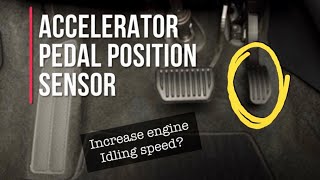
The Accelerator Pedal Position (APP) sensor tells the computer how far you press the gas pedal. The Throttle Position Sensor (TPS) reports the actual physical opening of the engine's throttle plate. P2116 triggers when these two signals disagree.
Can a weak or bad battery cause P2116?
Yes. A weak battery causes low system voltage, leading to unpredictable behavior and erroneous codes from electronic modules. Always test your battery and alternator if multiple sensor codes appear simultaneously.
How do you perform a throttle relearn procedure?
Many vehicles require a bidirectional scan tool to initiate the ETC relearn function. Some allow a manual reset by turning the key to 'ON', slowly pressing the gas pedal to the floor, releasing it, and turning the key 'OFF'.
Key Takeaways
- P2116 triggers a mandatory 'limp mode' that caps vehicle speed under 40 mph to prevent uncontrolled acceleration.
- Cleaning the throttle body with a $15 dedicated spray fixes this code in over 50% of cases by removing carbon that blocks the plate.
- Never replace the $300+ throttle body or pedal assembly without first verifying a steady 5-volt reference signal at the sensor connector.
- After any repair, you must perform an Electronic Throttle Control (ETC) relearn procedure using a bidirectional scan tool to restore normal idle.
Helpful Videos
![NISSAN Electronic Throttle Body [ETB] | EASY RE-LEARN Procedure](https://img.youtube.com/vi/hUlGxqylpCs/mqdefault.jpg)

The information in this article is provided for general reference and educational purposes only. Vehicle specifications, procedures, and part compatibility can vary by production date, trim level, and region. Always consult your vehicle's factory service manual and verify part numbers before purchasing or performing repairs. Safety-critical components such as airbags, seat belts, and braking systems should be installed by a qualified professional.
- 🎬 Helpful Videos
- What Does P2116 Mean?
- Can I Drive With P2116?
- Common Causes
- Symptoms
- Diagnostic Flowchart
- Common Fixes & Costs
- Used vs. New Parts: Buying Guide
- What Happens If You Wait — Timeline
- Cost of Not Fixing It
- Diagnosis Steps
- When This Code Triggers (Freeze-Frame Conditions)
- Related Codes
- Climate & Environmental Factors
- How to Talk to a Mechanic About This Code
- Where to Take It: Dealer vs Independent vs Chain
- When to Walk Away From the Repair
- What Scan Tool You Need for This Code
- How to Clear the Code After You Fix It
- Will This Fail Emissions / State Inspection?
- Most Commonly Affected Vehicles
- Manufacturer-Specific Notes
- Real Owner Stories
- 2012 Jeep Wrangler with ~100k miles
- 2003 Dodge Ram 1500 5.7L Hemi
- 2011 Infiniti G37 after DIY maintenance
- How to Prevent This Code From Triggering
- Frequently Asked Questions
- Can I just clean the throttle body to fix P2116?
- What is the 'lightning bolt' light on my dashboard?
- What is 'limp mode'?
- How much does it cost to fix P2116?
- What is a common misdiagnosis for P2116?
- What's the difference between the Accelerator Pedal Sensor and the Throttle Position Sensor?
- Can a weak or bad battery cause P2116?
- How do you perform a throttle relearn procedure?
- Key Takeaways
- 🎟️ Get 5% Off