

P2101 on 2007-2010 GMC Sierra 2500: Throttle Control Fault Causes and Fixes
On a 2007-2010 GMC Sierra 2500, code P2101 almost always points to a problem with the electronic throttle body, causing a 'Reduced Engine Power' warning and limp mode. The most common fix is replacing the entire throttle body assembly after a thorough cleaning fails to resolve the issue. Wiring issues and, rarely, ECM software glitches are other potential causes.
- P2101 on your Sierra will almost always trigger the 'Reduced Engine Power' warning, making the truck unsafe to drive in normal traffic.
- The most probable cause is a dirty or failing electronic throttle body assembly.
- Always start with the cheapest and easiest fix: thoroughly cleaning the carbon buildup from the throttle body.
- If you clean or replace the throttle body, you must perform an idle relearn procedure to avoid further issues.
- If cleaning doesn't work, replacing the entire throttle body assembly is the next step. A software update at a dealership is a final, less common possibility.
What's Unique About the 2007-2010 Gmc SIERRA 2500
The GMT900 platform, which includes the 2007-2010 Sierra, is well-known for throttle body issues at higher mileage. GM's own service bulletin PIP4578B acknowledges that as carbon builds up, the ECM learns to open the throttle plate wider at idle to compensate. Eventually, the required adjustment exceeds its programmed limits, or the carbon physically restricts plate movement, triggering P2101 and related codes. Unlike older vehicles with throttle cables, the throttle actuator control is integrated directly into the ECM's logic, making the throttle body assembly and its wiring the primary points of failure.
Diagnostic Flowchart
Tap your situation to follow the diagnostic path that matches what you're seeing on this vehicle.
Symptoms You May Notice
- "Reduced Engine Power" message on the instrument cluster
- Drastic loss of engine power and acceleration
- Check Engine Light is on
- Unstable or rough idle, or an idle that is higher than normal
- Engine may stall at stops
- Delayed or unresponsive throttle pedal
- Jerky or uneven acceleration.
- Messages like "Service Stabilitrak" or "Service Traction Control" may also appear
- Replacing the accelerator pedal position (APP) sensor. While the APP sensor is part of the throttle control system, it typically sets its own specific codes (like P2135 or P2138) when it fails and is not a common cause for P2101 on this truck.
- Replacing the Mass Airflow (MAF) sensor. While a dirty MAF can cause performance issues, it does not directly cause a P2101 code, which is specific to the throttle actuator's performance.
Most Likely Causes
- Failing/Dirty Throttle Body Assembly 🔴 High Probability As noted in TSB PIP4578B, these trucks are prone to heavy carbon buildup in the throttle body at higher mileage, which restricts the throttle plate's movement and overworks the actuator motor. The internal electronics or motor can also fail from heat, age, and wear, causing the internal resistor strips that track plate position to wear out.
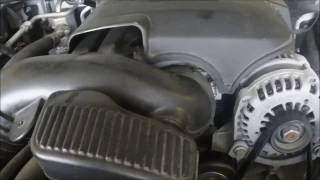
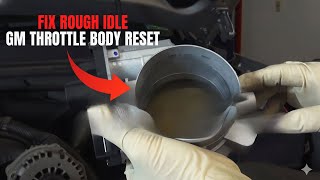
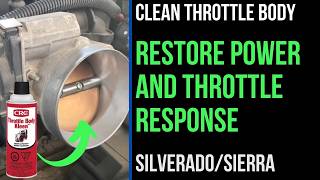
How to confirm: Remove the air intake hose and visually inspect the throttle plate and bore for a thick, black layer of carbon; the back side is often the worst. 🎬 Watch: A simple walkthrough for cleaning your throttle body. If cleaning doesn't resolve the issue, the entire assembly is likely faulty. A mechanic can also use a scan tool to watch the commanded vs. actual throttle position percentages; a significant discrepancy points to a bad throttle body.
Typical fix: Start by thoroughly cleaning the throttle body with a dedicated cleaner and a soft brush or microfiber cloth. Do not force the plate open by hand. If the code returns, the entire throttle body assembly must be replaced. A throttle relearn procedure is required after cleaning or replacement to prevent high idle and other codes.
Est. part cost: $150-$450 - Wiring or Connector Issue 🟡 Medium Probability The wiring harness to the throttle body is exposed to significant engine heat and vibration, which can cause wires to break internally (often right at the connector), or pins in the connector to corrode or lose contact over time.
How to confirm: Visually inspect the harness for damage. Unplug the connector and check for corroded or loose-fitting pins. With the key on, wiggle the connector and harness to see if it affects engine idle or triggers the fault. A multimeter can be used to check for proper voltage and ground at the throttle body connector based on a wiring diagram.
Typical fix: Repair the broken wire or replace the damaged connector pigtail. In some cases, adding a supplemental ground wire can resolve intermittent issues caused by poor grounding.
Est. part cost: $20-$50 - ECM Software Anomaly ⚪ Low Probability TSB #18-NA-037, which applies to later model years but describes a similar logic flaw, notes that a software glitch can falsely set a P2101 code. This can happen during a feature called 'Driver Door Open Prime' (DDOP) where the system runs diagnostics prematurely, especially if the battery is low. While this specific TSB doesn't cover 2007-2010, it highlights the possibility of software-related false codes.
How to confirm: This can only be confirmed by a GM dealer or a shop with access to GM's programming software (SPS). If the throttle body and wiring are confirmed to be good, this is the next logical step.
Typical fix: Reprogram the Engine Control Module (ECM) with the latest software calibration. This requires specialized tools.
Est. part cost: $0 (if done under warranty) - $200
Rare But Worth Checking
- Faulty Engine Control Module (ECM): While rare, the internal drivers in the ECM that control the throttle body can fail. This should only be considered after all other possibilities, including wiring and the throttle body itself, have been exhaustively ruled out.
Diagnosis Steps
- Scan for all DTCs. Note P2101 and any other related codes like P1516, P2119, or P0121.
- Turn the ignition off and remove the plastic engine cover and air intake duct from the throttle body.
- Visually inspect the throttle bore and plate for heavy carbon buildup. The back of the throttle plate is often the dirtiest.
- If significant carbon is present, clean it thoroughly using throttle body cleaner and a soft rag or brush. Do not spray cleaner directly into the electronics. It's important not to force the throttle plate open with your fingers; have an assistant press the gas pedal with the key on, or gently push it open with a non-marring tool.
- Inspect the throttle body electrical connector and wiring harness for any signs of damage, corrosion, or loose pins. Pay close attention to the area where wires enter the connector.
- After cleaning, reassemble the intake, clear the codes, and perform a throttle body relearn procedure. A common non-scan tool method is to let the engine idle in Park for 3 minutes, turn it off for 60 seconds, then start and idle again for 3 minutes. 🎬 See how to manually perform the throttle relearn procedure.
- Test drive the vehicle. If the 'Reduced Engine Power' message and P2101 return, the throttle body assembly is the most likely culprit and should be replaced.
- If a new throttle body does not fix the issue, consult a professional to check for ECM software updates or to perform advanced circuit integrity tests on the harness between the ECM and throttle body.
Parts You'll Likely Need
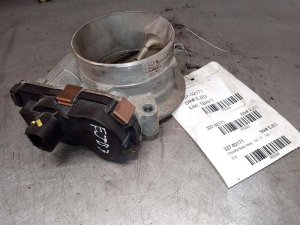
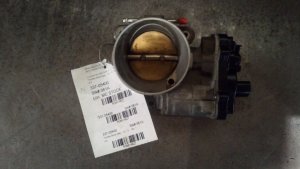
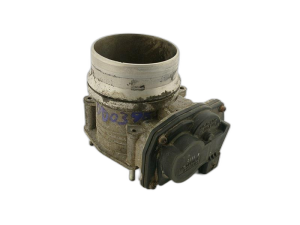
- Fuel Injection Throttle Body Assembly
(OEM #12670839 (Supersedes 217-3153, 12627217, 12669073))— This is the most common failure point for code P2101. The assembly includes the throttle plate, actuator motor, and position sensor, which fail as a unit. Cleaning is a temporary fix; replacement is often the permanent solution.
Trusted brands: ACDelco (GM Genuine), Bosch, Hitachi, TRQ
OEM price range: $250-$450
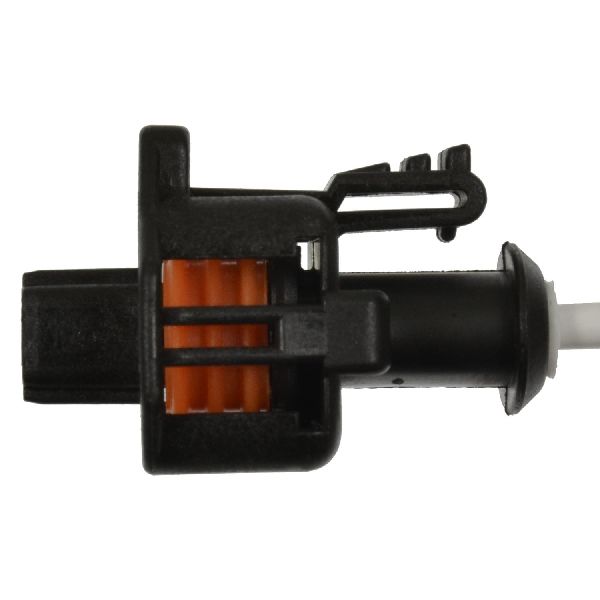
Aftermarket price range: $150-$250 - Throttle Body Connector Pigtail — Needed if the original connector is corroded, melted, or if wires are broken at the connector body, which is a common point of failure.
Trusted brands: ACDelco PT2628, Dorman
OEM price range: $30-$50
Aftermarket price range: $15-$30
Related Codes That Often Appear With This One
- P1516 — This is a GM-specific code for 'Throttle Actuator Control (TAC) Module Throttle Actuator Position Performance'. It is often set alongside P2101 as they both relate to the throttle body's failure to match the commanded position.
- P2119 — This code means 'Throttle Closed Position Performance'. It can be triggered if the throttle plate is sticking due to carbon buildup and cannot return to the proper closed position, a condition explicitly mentioned in TSB PIP4578B.
- P2176 — This code, 'Throttle Actuator Control System - Idle Position Not Learned', often appears after cleaning or replacing the throttle body if the mandatory idle relearn procedure is not performed correctly.
- P0121 — This code indicates a performance problem with the Throttle Position Sensor (TPS) circuit. Since the TPS is integrated into the throttle body assembly, a failing throttle body will often trigger this code as well, as noted in TSB PIP4578B.
Technical Service Bulletins (TSBs) & Recalls
- PIP4578B: Notes that P2101 and reduced power mode can be caused by throttle bo
Platform-Specific Known Issues
- High-mileage vehicles are particularly susceptible to this code due to carbon buildup, as the ECM's learned compensation for the buildup eventually reaches its limit, as mentioned in TSB #PIP4578B.
- A software glitch can falsely trigger P2101, which can be corrected by an ECM reprogram as outlined in TSB #18NA037 for later models, indicating a potential fix for earlier models with similar symptoms.
- Intermittent failures are common, where restarting the truck temporarily resolves the 'Reduced Engine Power' mode, leading owners to delay repairs. This is often a sign of failing electronics within the throttle body or a poor wiring connection.
Mechanic-Grade Diagnostic Values
- Throttle Position Sensor (TPS) Voltage — expected: Should rise smoothly from ~0.5V (throttle closed) to ~4.5V (throttle wide open).. Failure: Erratic spikes, dropouts, or values that do not change with throttle plate movement indicate a failing sensor.
- Throttle Actuator Control (TAC) Motor Resistance — expected: Typically between 5 and 15 ohms when measured across the motor terminals.. Failure: Infinite resistance (open circuit) or zero resistance (short circuit) indicates a failed motor.
- Voltage Drop Test at TAC Motor Connector — expected: Less than 0.5V difference between the voltage at the battery and the voltage at the motor's power pin.. Failure: A voltage drop greater than 0.5V points to high resistance in the wiring or a corroded connector.
Scan Tool Commands That Help
- Tech2 / GDS2 (or equivalent professional scanner): Throttle Actuator Test / Throttle Valve Activation — This bidirectional control allows a technician to command the throttle plate to specific angles (e.g., 10%, 25%, 50%) to verify if the motor is physically responding correctly and if the TPS sensors are reporting the position accurately. It is used to isolate a stuck plate or a failing motor from a sensor or wiring issue.
- Tech2 / GDS2 (or equivalent professional scanner): Idle Learn Reset — This function must be used after cleaning or replacing the throttle body. It resets the ECM's learned idle position values. Failing to perform this reset can cause a high or unstable idle and may trigger other codes like P2176.
Wiring & Ground Locations
- G104 — On the rear of the driver's side (left) cylinder head, where a large ground strap connects to the firewall.. This is a critical engine-to-chassis ground. Corrosion or looseness here is a well-documented cause of intermittent 'Reduced Engine Power' messages and P2101 codes on GMT900 trucks, as it can cause unstable voltage references for the entire engine management system.
- G103 — On the front of one of the cylinder heads (sources differ between driver's and passenger's side).. This is another primary engine ground. A poor connection here can cause electrical noise and voltage drops, affecting sensor inputs to the ECM, including those from the throttle body.
- ECM Ground — On the top rear of the engine block itself.. This is the main ground for the Engine Control Module harness. If this connection is compromised, the ECM can receive faulty data from all sensors, leading directly to limp mode and codes like P2101.
Real Owner Repair Stories
- YouTube channel 'IAMMAKNIFICENT' (2007 Chevrolet Suburban (GMT900 platform-mate)) — Reduced Engine Power, Service StabiliTrak, Service Traction Control messages, code P2101, and a completely unresponsive accelerator pedal.
❌ Tried (didn't work) Initially suspected a faulty throttle body after cleaning it.
✅ What actually fixed it The owner had accidentally left a cleaning rag inside the air intake tube after cleaning the throttle body, which physically blocked the throttle plate from moving. Removing the rag and performing an 'Idle Learn Reset' with a scan tool resolved all symptoms and codes. - YouTube channel 'LegacyJR' (GM Truck (Silverado/Sierra)) — Flickering dashboard lights (including Check Engine and ABS), dimming interior lights, and slow power window operation, which are common symptoms of grounding issues that can trigger various electronic fault codes.
❌ Tried (didn't work) Living with intermittent electrical problems.
✅ What actually fixed it The owner fixed the widespread electrical issues by adding a new, supplemental ground strap from the back of the engine block to the chassis (firewall), ensuring a solid ground connection. This resolved the voltage drops and flickering lights.
"I Checked Everything" — The Actual Cause
- While P2101 is an electronic fault, a similar diagnostic dead-end can occur. In one documented case, all electronic components were functional, but the code persisted. The root cause was a shop rag left in the intake tube after a throttle body cleaning, which physically blocked the throttle plate from moving. This would not be found by electrical tests.
OEM Part Supersession History
12580760→12679524 (also listed as ACDelco 217-2422)— Part has been updated by the manufacturer.
Heads up: This throttle body is for the earlier GMT900 models and is not compatible with 2009 and newer trucks.12601387→12629992 (also listed as ACDelco 217-3151)— Part has been updated by the manufacturer.
Heads up: This is the correct throttle body for the later models in this range and uses a different electronic configuration than the earlier part.
Model Year Variations Within This Range
- 2007-2010: The OEM part number for the throttle body assembly changed during this period. 2007-2008 models typically use part number 12580760 (or its successor), while 2009-2010 models use part number 12601387 (or its successor). The parts are not interchangeable. Verifying the correct part for the specific model year is critical before ordering.
Helpful Videos

Used OEM Parts in Stock

New Aftermarket Parts Available


The information in this article is provided for general reference and educational purposes only. Vehicle specifications, procedures, and part compatibility can vary by production date, trim level, and region. Always consult your vehicle's factory service manual and verify part numbers before purchasing or performing repairs. Safety-critical components such as airbags, seat belts, and braking systems should be installed by a qualified professional.
- Gmc SIERRA 2500:
- 🎬 Helpful Videos
- 🛍️ Shop This Part
- What's Unique About the 2007-2010 Gmc SIERRA 2500
- Diagnostic Flowchart
- Symptoms You May Notice
- Most Likely Causes
- Rare But Worth Checking
- Diagnosis Steps
- Parts You'll Likely Need
- Related Codes That Often Appear With This One
- Technical Service Bulletins (TSBs) & Recalls
- Platform-Specific Known Issues
- Mechanic-Grade Diagnostic Values
- Scan Tool Commands That Help
- Wiring & Ground Locations
- Real Owner Repair Stories
- "I Checked Everything" — The Actual Cause
- OEM Part Supersession History
- Model Year Variations Within This Range
- 🎟️ Get 5% Off