

P2101 on 2007-2014 GMC Sierra 1500: Throttle Actuator Control Fault Fixes
On a 2007-2014 GMC Sierra, code P2101 almost always points to a problem with the electronic throttle body, causing the 'Reduced Engine Power' warning. The first step is to thoroughly clean the throttle body; if that doesn't work, replacement is the most common fix. A new throttle body costs between $120 and $250 for an aftermarket part. Always verify wiring and grounds before replacement.
- P2101 on a GMC Sierra almost always means the truck is in 'Reduced Engine Power' mode due to a throttle body issue.
- Always start with the cheapest, easiest fix: thoroughly clean the throttle body and perform an idle relearn procedure.
- If cleaning doesn't work, replacing the entire throttle body assembly is the next logical step and the most common permanent fix.
- Do not replace the gas pedal (APP sensor) for this code; it points specifically to the throttle body circuit.
- After any repair, a throttle relearn procedure is mandatory to ensure proper idle and performance.
What's Unique About the 2007-2014 Gmc SIERRA 1500
On these GMC Sierra trucks and their GMT900 platform mates, P2101 is a very common code, especially on higher-mileage vehicles. The issue is so frequent that GM issued a Technical Service Bulletin (TSB #PIP4578B) acknowledging that carbon buildup in the throttle body can cause this and other related codes, leading to reduced power and idle surges. This isn't a rare or mysterious failure; it's a well-documented wear and tear issue for this entire generation of GM trucks and SUVs.
Diagnostic Flowchart
Tap your situation to follow the diagnostic path that matches what you're seeing on this vehicle.
Generation note: This range covers two generations of the Sierra 1500: the GMT900 (2007-2013) and the early K2XX (2014). The causes and fixes for P2101 are largely the same for both generations, as they both use a similar electronic throttle control system prone to carbon buildup and eventual failure. The issue is endemic to the entire GMT900 family, including the Silverado, Tahoe, and Yukon.
Symptoms You May Notice
- "Reduced Engine Power" message on the dashboard
- Check Engine Light is on
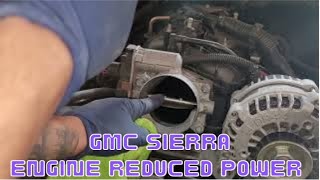
- Vehicle has very limited acceleration (limp mode) 🎬 Watch: What to do when you see the Reduced Engine Power message.
- Unstable or surging idle, especially after cleaning the throttle body without a relearn
- Delayed or jerky throttle response
- Vehicle may stall at low speeds or when coming to a stop
- Replacing the Accelerator Pedal Position (APP) Sensor. P2101 specifically points to a problem at the throttle body motor circuit. A faulty pedal sensor would typically set a different code, such as P2138 or P2135.
- Replacing the Mass Airflow (MAF) Sensor. While a dirty MAF can cause performance issues, it is not a direct cause of P2101. Cleaning the MAF is good maintenance but will not fix a throttle actuator circuit fault.
Most Likely Causes
- Dirty or Carbon-Clogged Throttle Body 🔴 High Probability As vehicles accumulate miles, crankcase oil vapors and carbon can build up around the throttle plate, creating a sticky residue that restricts its movement. This is a well-documented issue mentioned in GM TSB PIP4578B as a cause for P2101 on high-mileage vehicles.
How to confirm: Remove the air intake tube from the throttle body and visually inspect the throttle plate and bore for a thick, black layer of carbon buildup. The plate may feel sticky or slow to move when pushed (with the engine off).
Typical fix: Thoroughly clean the throttle body bore and plate with a dedicated throttle body cleaner and a soft, lint-free cloth or brush. Do not spray cleaner directly into the electronics. A throttle relearn procedure is mandatory afterward to prevent high idle or other codes.
Est. part cost: $10-$20 - Failing Throttle Body Assembly 🔴 High Probability If cleaning does not resolve the issue, the internal electronic motor or the integrated position sensor within the throttle body has likely failed. This is a common failure item after 80,000-100,000 miles due to wear on the internal gears and electronic contacts.
How to confirm: If a thorough cleaning and relearn procedure do not clear the code, and the wiring is confirmed to be good, the throttle body itself is the culprit. A scan tool may show the commanded vs. actual throttle position deviating significantly.
Typical fix: Replace the entire throttle body assembly. This is a straightforward unbolt/re-bolt repair, followed by a mandatory throttle relearn procedure.
Est. part cost: $120-$450 - Wiring or Connector Issue 🟡 Medium Probability The wiring harness connector at the throttle body is subject to engine vibration and heat, which can lead to loose connections, corrosion, or frayed wires over time. Wires can break internally within the insulation right at the connector.
How to confirm: With the key off, disconnect the throttle body connector and inspect for corrosion, bent pins, or loose wires. Check for proper terminal tension. Wiggle the harness with the engine running (use caution) to see if it affects idle or triggers the code.
Typical fix: Clean the connector pins with a contact cleaner or repair the damaged section of the wiring harness. In some cases, a new connector pigtail is required. Ensure a secure connection.
Est. part cost: $5-$50
Rare But Worth Checking
- Poor Ground Connection: The throttle control system is sensitive to voltage. A corroded or loose engine or chassis ground can cause erratic behavior and trigger this code. On GMT900 trucks, specifically check the main ground straps from the engine block to the chassis and firewall, particularly G103 (front of driver's side cylinder head) and G104 (rear of driver's side cylinder head).
- Faulty Powertrain Control Module (PCM): This is very rare. Before suspecting the PCM, all other possibilities, especially the throttle body, its wiring, and grounds, must be exhaustively ruled out. A PCM failure can also be caused by software anomalies that may be fixed with a dealer re-program.
- Failing Starter Motor: In some documented cases, a failing starter motor can cause a significant voltage drop during cranking, which can disrupt the PCM and other modules, falsely triggering a P2101 code upon startup. If the code only appears during a difficult start, the starter should be investigated.
Diagnosis Steps
- Scan for all DTCs. Note if P2101 is accompanied by other codes like P1516, P2119, or P2176.
- Turn the ignition off and remove the air intake duct from the throttle body.
- Visually inspect the throttle bore and plate for heavy carbon buildup. The presence of a thick, black, sticky ring is a strong indicator.
- If dirty, clean it thoroughly with throttle body cleaner and a soft rag. Do not force the plate open by hand. Have a helper turn the key to 'ON' (engine off) and press the gas pedal to open it electronically for cleaning.
- Inspect the wiring harness and connector at the throttle body for any signs of damage, corrosion, or loose pins. Gently tug on each wire at the connector to check for internal breaks.
- Check key ground points, especially G103 and G104 on the engine block, for tightness and corrosion.
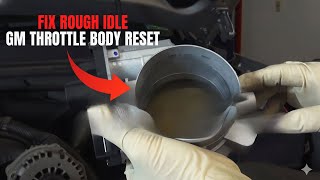
- Reassemble the intake, clear the codes, and perform a throttle body relearn procedure. The simplest non-scan tool method is to let the engine idle in Park for 3 minutes, turn the engine off for 60 seconds, then restart and idle for another 3 minutes. 🎬 Watch: How to manually reset and relearn your GM throttle body. Note: Many owners and technicians report this manual method is unreliable and a scan tool is the only way to perform the 'Idle Learn Reset' properly.
- Test drive the vehicle. If the 'Reduced Engine Power' message and P2101 code return, the throttle body assembly is the most likely cause and should be replaced.
Parts You'll Likely Need
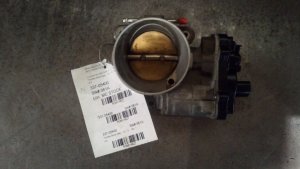
- Throttle Body Assembly
(OEM #12679524 (Verify by VIN))— This is the most common fix for P2101 when cleaning fails. The internal motor or sensor wears out over time. The part number can vary by specific engine (4.8L, 5.3L, 6.2L) and year, so always verify with the vehicle's VIN. The part number from Pass 1 (12670839) is incorrect for this application.
Trusted brands: ACDelco (GM Original Equipment), Bosch, Hitachi, Standard Motor Products
OEM price range: $250-$450
Aftermarket price range: $120-$250
Related Codes That Often Appear With This One
- P1516 — This is a GM-specific code for 'Throttle Actuator Control (TAC) Module Throttle Actuator Position Performance'. It is very commonly set alongside P2101 as they both relate to the PCM detecting a mismatch between the commanded and actual throttle position. They are often treated as the same fault.
- P2119 — This code indicates 'Throttle Closed Position Performance', often triggered by carbon buildup preventing the throttle plate from closing properly, which is a direct cause of P2101. This code is explicitly mentioned in TSB PIP4578B.
- P2176 — This code is 'Throttle Actuator Control System - Idle Position Not Learned'. It often appears after a battery disconnect or after cleaning/replacing the throttle body if the relearn procedure hasn't been performed or completed successfully.
Technical Service Bulletins (TSBs) & Recalls
- PIP4578B: Explicitly states that on high mileage vehicles, carbon buildup can cause idle surge, reduced power, and DTCs including P2101, P1516, and P2119. It recommends cleaning the throttle body and performing an idle learn reset with a scan tool.
- 18-NA-037: Notes a software issue on some 2017-2018 models that can falsely set
Platform-Specific Known Issues
- A known software anomaly on some 2017-2018 models could falsely set DTC P2101 due to a feature called 'Driver Door Open Prime'. The fix is an ECM reprogram at the dealer, as described in TSB 18-NA-037. While outside this guide's primary year range, it shows a history of software-related triggers for this code.
- On some 2019+ models (outside this guide's year range but relevant context), TSB PIP5660A notes that an internal gel contamination in the throttle body could cause P2101, requiring replacement.
Mechanic-Grade Diagnostic Values
- Throttle Actuator Control (TAC) Motor Resistance — expected: 2 to 15 Ohms between the two motor control pins.. Failure: A reading of Over Limit (OL) indicates an open circuit, while a reading under 1 Ohm suggests a short circuit.
- Throttle Position Sensor (TPS) 1 Resistance Sweep — expected: Resistance should increase smoothly as the throttle plate is opened and decrease smoothly as it is closed.. Failure: If the resistance value stays stuck, has gaps, or does not change smoothly, the sensor is defective.
- Throttle Position Sensor (TPS) 2 Resistance Sweep — expected: Resistance should decrease smoothly as the throttle plate is opened and increase smoothly as it is closed (inverse of TPS1).. Failure: If the resistance value stays stuck, has gaps, or does not change smoothly, the sensor is defective.
- Live Data - Throttle Position Sensor (TPS) Voltage — expected: Approximately 0.5V at idle and 4.5V at wide-open throttle.. Failure: Voltage that is erratic, drops out, or does not correspond to the throttle angle indicates a fault.
Scan Tool Commands That Help
- GDS2 (Global Diagnostic System 2): Idle Learn Reset — This function is used after cleaning or replacing the throttle body to force the ECM to relearn the new minimum idle position. It is often more reliable than the manual (non-scan tool) relearn procedure and may be required to clear associated codes like P2176.
- GDS2 (Global Diagnostic System 2): Clear DTCs — After a repair, all codes must be cleared. Sometimes, during a manual relearn, temporary idle speed codes may appear that need to be cleared for the ECM to complete the learning process.
Wiring & Ground Locations
- Throttle Body Connector (X87) — The 6-pin electrical connector on the electronic throttle body assembly.. This is the primary connection point for the TAC motor and both throttle position sensors. The TAC motor is controlled by a Yellow wire (Pin B, TAC Motor Control 1) and a Brown wire (Pin A, TAC Motor Control 2). A 5-Volt reference is supplied on a Gray wire (Pin E). Poor connection or damage here is a direct cause of P2101.
- G103 — On the front of the driver's side cylinder head, often near the thermostat housing.. This is a critical engine ground. Pass 2 mentioned this ground, and further research confirms its location on the front of the engine. Poor grounding here can cause a variety of sensor and module communication issues, including erratic throttle control.
- G104 — On the rear of the passenger's side cylinder head, near the firewall.. This ground point serves numerous functions, including the Vehicle Control Module (VCM) and various sensors. A bad connection here can lead to unpredictable electrical problems that could trigger a P2101.
Real Owner Repair Stories
- YouTube user 'Magnificent' (2007 Chevrolet Suburban (GMT900 platform-mate)) — Reduced Engine Power message, Service Stabilitrak/Traction Control warnings, no throttle response, and code P2101.
❌ Tried (didn't work) Initially, the owner suspected he had installed the throttle body incorrectly after cleaning it.
✅ What actually fixed it The owner discovered he had accidentally left a cleaning rag inside the air intake tube, which was blocking airflow and causing the throttle body to fault. Removing the rag and performing an 'Idle Learn Reset' with a scan tool resolved all issues. - Reddit user in r/Cartalk (2008 Chevrolet Impala) — Check Engine Light with codes P1516 and P2101, 'Reduced Engine Power' message.
❌ Tried (didn't work) The user was advised by a parts store employee to focus on the MAF sensor.
✅ What actually fixed it The user cleaned the throttle body, cleaned the MAF sensor, and replaced a very dirty engine air filter. After clearing the codes and driving, the issue was resolved. While the MAF and filter were good maintenance, the primary fix for the codes was likely cleaning the carbon from the throttle body.
OEM Part Supersession History
12572658→12580760— Standard part evolution and revision by the manufacturer.12580760→12679524— Standard part evolution and revision by the manufacturer. This is the most current OEM part number commonly available.
Heads up: This part requires programming and/or special setup procedures (like the idle relearn) to ensure proper operation.
Helpful Videos

We Have This Part in Stock





The information in this article is provided for general reference and educational purposes only. Vehicle specifications, procedures, and part compatibility can vary by production date, trim level, and region. Always consult your vehicle's factory service manual and verify part numbers before purchasing or performing repairs. Safety-critical components such as airbags, seat belts, and braking systems should be installed by a qualified professional.
- Gmc SIERRA 1500:
- 🎬 Helpful Videos
- 🛍️ Shop This Part
- What's Unique About the 2007-2014 Gmc SIERRA 1500
- Diagnostic Flowchart
- Symptoms You May Notice
- Most Likely Causes
- Rare But Worth Checking
- Diagnosis Steps
- Parts You'll Likely Need
- Related Codes That Often Appear With This One
- Technical Service Bulletins (TSBs) & Recalls
- Platform-Specific Known Issues
- Mechanic-Grade Diagnostic Values
- Scan Tool Commands That Help
- Wiring & Ground Locations
- Real Owner Repair Stories
- OEM Part Supersession History
- 🎟️ Get 5% Off