

P2097 on 2023-2025 Subaru WRX: Post-Catalyst Rich Fuel Trim Causes and Fixes
On a 2023-2025 Subaru WRX, code P2097 is most often caused by an exhaust leak before the rear O2 sensor or a failing front Air/Fuel (A/F) ratio sensor. Do not immediately replace the rear O2 sensor; diagnose by checking for leaks and monitoring sensor data first. This is a common issue across Subaru platforms with the FA24F engine.
- P2097 means the rear O2 sensor is detecting a rich fuel mixture.
- Do not automatically replace the rear O2 sensor; it is often just reporting a problem that started elsewhere.
- The most likely causes on a 2023-2025 WRX are an exhaust leak or a failing *front* Air/Fuel sensor.
- Always perform a thorough diagnosis by checking for exhaust leaks and analyzing live sensor data before buying parts.
- If your WRX is modified, the code may be a sign that your ECU tune needs to be updated.
What's Unique About the 2023-2025 Subaru WRX
The 2023-2025 WRX uses the 2.4L FA24F direct-injection turbocharged engine, which is highly sensitive to changes in airflow and exhaust pressure. This code is common on modified WRXs, especially those with aftermarket intakes or downpipes without a proper ECU tune designed for those specific parts. Subaru has also issued a Technical Service Bulletin (TSB #18-228-25R) outlining specific diagnostic procedures for this code, indicating it's a known issue requiring careful diagnosis across many of their models, including the WRX.
Diagnostic Flowchart
Tap your situation to follow the diagnostic path that matches what you're seeing on this vehicle.
Symptoms You May Notice
- Check Engine Light is on
- Decreased fuel economy
- Rough or erratic idle
- Slight loss of engine performance
- In rare, extreme cases, black smoke from the tailpipe or a smell of fuel
- Immediately replacing the rear O2 sensor. The P2097 code is set based on the rear O2 sensor's reading, but the root cause is often an upstream issue like an exhaust leak or a faulty front A/F sensor.
Most Likely Causes
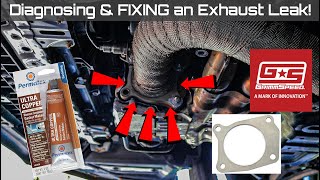
- Exhaust Leak (Upstream of Rear O2 Sensor) 🔴 High Probability Subaru turbocharged platforms are known for developing exhaust leaks, especially at the gasket between the turbo and the downpipe (J-pipe). Aftermarket exhausts can also be a source of leaks if gaskets fail or flanges aren't perfectly sealed. This issue is also commonly reported after another repair (like a clutch replacement) requires removal and reinstallation of the exhaust system.
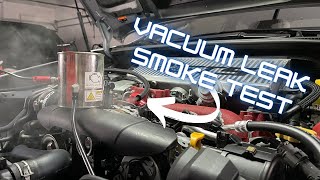
How to confirm: Perform a visual inspection of the exhaust system from the engine to the rear O2 sensor, looking for black soot marks. A smoke test is the most reliable method to find small leaks. A DIY method involves spraying soapy water on cold exhaust joints and looking for bubbles after starting the engine.
Typical fix: Replace the leaking gasket (e.g., the turbo-to-downpipe donut gasket, OEM Part #44616AA320) or tighten loose flange bolts.
Est. part cost: $20-$60 - Failing Front Air/Fuel (A/F) Ratio Sensor 🔴 High Probability This is a very common failure pattern on modern direct-injection Subarus like the WRX, Crosstrek, and Ascent. The front A/F sensor (Bank 1, Sensor 1) is the primary input for fuel control. If it fails and incorrectly reads a lean condition, the ECM will add excess fuel, creating a genuinely rich condition that the rear O2 sensor correctly reports, triggering P2097.
How to confirm: Use a scan tool to monitor live data for the front A/F sensor (Sensor 1). A healthy sensor will show rapidly changing values at idle and in response to throttle input. If the readings are stuck, slow to respond, or biased, the sensor is likely faulty.
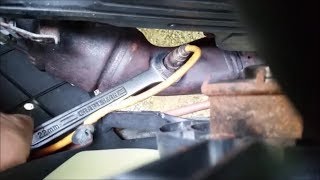
Typical fix: Replace the front Air/Fuel ratio sensor (OEM Part #22641AA790). It is highly recommended to use an OEM or Denso part, as cheaper aftermarket sensors are known to cause issues. 🎬 Watch: Step-by-step guide to replacing both Subaru O2 sensors
Est. part cost: $150-$250 - Failing Rear Oxygen (O2) Sensor 🟡 Medium Probability While less common than the front sensor, the rear O2 sensor that triggers the code can fail and send a false 'rich' signal to the ECM. This is a common wear-and-tear item, and some owners have fixed the code by replacing it, but it should not be the first part replaced without diagnosis.
How to confirm: Monitor the rear O2 sensor (Sensor 2) voltage with a scan tool after the engine is fully warmed up. A healthy rear sensor monitoring a good catalytic converter should show a relatively steady voltage, often between 0.6V and 0.8V. If it's stuck high (e.g., >0.8V) or fluctuating rapidly like the front sensor, it is suspect.
Typical fix: Replace the rear (downstream) oxygen sensor (OEM Part #22690AB090).
Est. part cost: $80-$220
Rare But Worth Checking
- Leaking Fuel Injector: A fuel injector can get stuck partially open, dumping excess fuel into a cylinder and creating a true rich condition. This is less common than sensor or leak issues but worth considering if other causes are ruled out.
- Clogged or Failing Catalytic Converter: While rare, a failing or contaminated catalytic converter can cause incorrect readings. This is usually a result of a long-term unaddressed rich condition, not the initial cause. One owner found metal flakes from a disintegrating cat, which was likely the ultimate cause of his persistent P2097.
- Issue with an Aftermarket Tune: If the vehicle has an aftermarket downpipe, intake, or other performance parts, the P2097 code may indicate that the ECU tune is incorrect for the installed hardware. An 'Off-The-Shelf' (OTS) map not designed for a specific intake is a known cause of this code.
Diagnosis Steps
- Check for any other stored trouble codes that could indicate a related problem.
- Thoroughly inspect the exhaust system for any signs of leaks (soot, cracks, broken gaskets), especially between the turbocharger and the rear O2 sensor. A smoke test is the most effective method. 🎬 See how to perform a smoke test on your WRX Pay close attention to the turbo-to-downpipe gasket.
- Use a scan tool to monitor live data. Compare the readings of the front A/F sensor (Sensor 1) and the rear O2 sensor (Sensor 2) at idle and while driving once the engine is in closed loop.
- Analyze the front A/F sensor's behavior. It should react quickly to changes in throttle. If it's slow, stuck, or seems biased, it's a primary suspect.
- Analyze the rear O2 sensor's behavior. If the front sensor appears healthy and there are no exhaust leaks, but the rear sensor is stuck reading a high voltage (e.g., >0.8V), the rear sensor itself may be faulty.
- If all sensors and the exhaust system check out, investigate less common causes like leaking fuel injectors or a contaminated Mass Airflow (MAF) sensor.
- For modified vehicles, consult with a professional tuner to ensure the ECU map is correct for the installed hardware. An incorrect OTS tune is a known cause.
Parts You'll Likely Need
- Front Air/Fuel Ratio Sensor (Bank 1, Sensor 1)
(OEM #22641AA790)— This is a very common failure point on WRX models that causes the ECM to add too much fuel, leading to the P2097 code.
Trusted brands: Subaru (OEM), Denso
OEM price range: $200-$297
Aftermarket price range: $150-$250 - Exhaust Gasket (Turbo to Downpipe)
(OEM #44616AA320)— This 'donut' gasket is a frequent source of exhaust leaks that can trigger this code, especially after other exhaust work.
Trusted brands: Subaru OE, GrimmSpeed
OEM price range: $25-$40
Aftermarket price range: $20-$35 - Rear Oxygen Sensor (Bank 1, Sensor 2)
(OEM #22690AB090)— Though less common than the front sensor, the rear O2 sensor can fail and send false rich signals.
Trusted brands: Subaru (OEM), Denso, Bosch
OEM price range: $150-$230
Aftermarket price range: $80-$220
Related Codes That Often Appear With This One
- P0420 — Catalyst System Efficiency Below Threshold. If the rich condition from P2097 persists long enough, it can damage the catalytic converter, leading to a P0420 code. One owner reported getting P0420 for a long time before the more persistent P2097 appeared.
- P2096 — Post Catalyst Fuel Trim System Too Lean. Seeing opposite codes like P2096 and P2097 can indicate a serious issue with a sensor or a major exhaust leak causing erratic readings as the ECM struggles to compensate. TSB #18-228-25R covers diagnostic procedures for both codes.
Technical Service Bulletins (TSBs) & Recalls
- 18-228-25R: Announces specific diagnostic procedures for DTCs P2096 (Post Catalyst Fuel Trim System Too Lean Bank 1) and P2097 (Post Catalyst Fuel Trim System Too Rich Bank 1). It applies to a wide range of Subaru models, including the 2015-2025 WRX.
Platform-Specific Known Issues
- Subaru issued Technical Service Bulletin (TSB) #18-228-25R specifically to provide technicians with updated diagnostic procedures for codes P2096 and P2097, as the standard manual's steps may be insufficient.
- This code is very common on WRX models modified with aftermarket air intakes or downpipes that are not paired with a professional ECU tune to recalibrate fuel trims.
Mechanic-Grade Diagnostic Values
- Downstream O2 Sensor (Bank 1, Sensor 2) Voltage — expected: Relatively steady voltage between 0.5V and 0.8V at warm idle.. Failure: Voltage is stuck high (>0.8V), stuck low, or fluctuating rapidly like the upstream sensor. One technician noted a reading of 0.875V on a vehicle with this code.
- Upstream Air/Fuel (A/F) Sensor (Bank 1, Sensor 1) Voltage — expected: For Subaru's wideband sensor, voltage should fluctuate rapidly around a central point, often between 2.8V and 3.3V.. Failure: Sensor voltage is stuck, slow to respond, or biased. A reading of 2.8V was noted on an Outback with a P2097 code, potentially indicating the front sensor was the cause.
- O2 Sensor Heater Circuit Resistance — expected: Approximately 5 to 25 ohms when tested with a multimeter.. Failure: An open circuit (infinite resistance) or a very high reading (over 50 ohms) indicates a failed heater element inside the sensor.
Scan Tool Commands That Help
- Subaru Select Monitor (SSM) or equivalent: Follow Diagnostic Procedure in TSB 18-228-25R — When diagnosing P2097 or P2096. This TSB provides an updated diagnostic flowchart that supersedes the standard service manual and is the manufacturer's recommended path for an accurate diagnosis.
- Subaru Select Monitor (SSM) or equivalent: ECM Reprogramming / Software Update — As a final step if all mechanical, wiring, and sensor tests pass. In some cases, a P2097 code can be falsely triggered by a logic error in the ECM, and manufacturers may release software patches to correct this.
Wiring & Ground Locations
- E25 — This is the wiring diagram identifier for the rear oxygen sensor connector plug.. Knowing the specific connector ID helps in locating the correct component in service manuals and wiring diagrams for testing pins for voltage, ground, and signal.
- Rear O2 Sensor Extension Harness Connector — The harness for the rear O2 sensor often includes an extension that plugs in on top of the transmission.. This connector is a potential point of failure due to heat and vibration. It can become melted or damaged, causing sensor communication issues. It's also a key location to check for continuity during diagnosis.
Real Owner Repair Stories
- Reddit user Yellow_Tatoes14 (2006 WRX (demonstrates a common wiring/repair issue)) — Check Engine Light for a bad oxygen sensor one year after a previous repair.
❌ Tried (didn't work) Initially replaced a stock exhaust and found the O2 sensor connector was melted., Cut the melted connector off and hard-wired a cheap Bosch sensor.
✅ What actually fixed it The user ordered a proper Denso sensor and a new female plug to wire it back to OEM spec. They learned that the extension harness on top of the transmission is wired straight through (pin 1 to pin 1, etc.) and that relying on wire colors can be misleading; a pinout is the best way to ensure correct wiring.
Helpful Videos
Used OEM Parts in Stock

New Aftermarket Parts Available


The information in this article is provided for general reference and educational purposes only. Vehicle specifications, procedures, and part compatibility can vary by production date, trim level, and region. Always consult your vehicle's factory service manual and verify part numbers before purchasing or performing repairs. Safety-critical components such as airbags, seat belts, and braking systems should be installed by a qualified professional.
- Subaru WRX:
- 🎬 Helpful Videos
- 🛍️ Shop This Part
- What's Unique About the 2023-2025 Subaru WRX
- Diagnostic Flowchart
- Symptoms You May Notice
- Most Likely Causes
- Rare But Worth Checking
- Diagnosis Steps
- Parts You'll Likely Need
- Related Codes That Often Appear With This One
- Technical Service Bulletins (TSBs) & Recalls
- Platform-Specific Known Issues
- Mechanic-Grade Diagnostic Values
- Scan Tool Commands That Help
- Wiring & Ground Locations
- Real Owner Repair Stories
- 🎟️ Get 5% Off