

P2097 on 2013-2018 Nissan Altima: Post-Catalyst Rich Fuel Trim Causes and Fixes
On a 2013-2018 Nissan Altima, code P2097 most often points to a failing downstream (post-catalyst) oxygen sensor or an exhaust leak. However, several Nissan TSBs indicate an ECM software update is a critical step, often performed along with replacing the *upstream* A/F sensor, not the downstream one. Replacing the downstream O2 sensor is a common first step but may not solve the issue if the underlying cause is a software glitch or a failing upstream sensor.
- P2097 on a 2013-2018 Altima means the system is too rich on Bank 1, as measured *after* the catalytic converter.
- Before replacing any parts, thoroughly inspect for exhaust leaks between the engine and the rear O2 sensor.
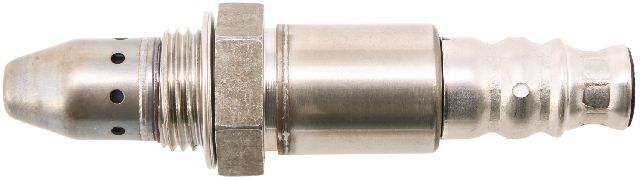
- The most common fix is replacing the downstream (Bank 1, Sensor 2) oxygen sensor.
- Be aware of Nissan TSBs for this code; your vehicle may only need an ECM software update from a dealer.
- Do not replace the expensive catalytic converter unless it has been definitively proven to be faulty, as it is often misdiagnosed.
What's Unique About the 2013-2018 Nissan ALTIMA

For the 2013-2018 Altima, this code is frequently tied to specific Technical Service Bulletins (TSBs) issued by Nissan that point to software and upstream sensor issues, rather than the downstream sensor that triggers the code. For the V6 (VQ35DE) engine, TSB NTB19-030 requires an ECM software update to correct fault logic for P2097. For the 2.5L (QR25DE), TSBs NTB12-085b and NTB15-115a explicitly state that the fix for P2097 is to reprogram the ECM *and* replace the upstream Air/Fuel (A/F) ratio sensor. This is a critical distinction, as many owners and shops replace the downstream sensor first, only for the code to return.
Diagnostic Flowchart

Tap your situation to follow the diagnostic path that matches what you're seeing on this vehicle.
Symptoms You May Notice

- Check Engine Light is on
- Reduced fuel economy
- Rough or erratic idle
- Engine hesitation or stumbling during acceleration
- Strong smell of fuel or a "rotten egg" smell from the exhaust
- Black exhaust smoke in extreme cases
- Replacing the catalytic converter when the actual issue is a faulty oxygen sensor or an exhaust leak.
- Immediately replacing the downstream O2 sensor without first checking for applicable TSBs regarding an ECM reprogram and upstream A/F sensor replacement.
- Replacing spark plugs or other ignition components without proper diagnosis, as one owner experienced before the O2 sensor and catalytic converter were also needlessly replaced.
Most Likely Causes

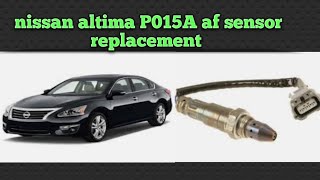
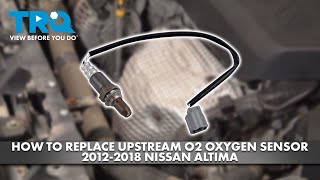
- Outdated ECM Software / Faulty Upstream A/F Sensor 🔴 High Probability Nissan has issued multiple TSBs (NTB12-085b, NTB15-115a, NTB19-030) for this specific issue, indicating the original ECM logic is overly sensitive or incorrect. The TSBs for the 2.5L engine specifically call for replacing the upstream A/F sensor 🎬 Watch: How to replace the upstream sensor on 2.5L models. in conjunction with the software update, suggesting the sensor itself is a common failure point leading to this code. An owner on Reddit confirmed their dealer fixed a 2013 2.5L by replacing the A/F ratio sensor and reprogramming the ECM per a bulletin.
How to confirm: A Nissan dealership or a qualified shop with a CONSULT-III plus scan tool must check the vehicle's current ECM part number against the numbers listed in the applicable TSB. If the part number matches, the bulletin applies.
Typical fix: For applicable vehicles, the fix is to reprogram the Engine Control Module (ECM) to the latest software version. For 2.5L models, this is done *after* replacing the Bank 1, Sensor 1 (upstream) Air/Fuel Ratio sensor. For V6 models, the TSB primarily calls for the reprogram.
Est. part cost: $80-$200 (A/F Sensor) + $100-$250 (Labor for reprogram) - Failing Downstream Oxygen (O2) Sensor 🟡 Medium Probability O2 sensors are wear-and-tear items that degrade over time, sending inaccurate signals. While a common cause for P2097 on many cars, on this specific Altima, it's often replaced mistakenly when the issue is software or the upstream sensor. However, if the TSBs do not apply, the sensor itself is the next logical suspect.
How to confirm: Use an OBD-II scanner to monitor the live data for the Bank 1 Sensor 2 voltage. On a warm, running engine, a healthy downstream sensor should show a relatively stable voltage. If the voltage is stuck high (e.g., above 0.8V) or fluctuating rapidly like the upstream sensor, it is likely faulty.
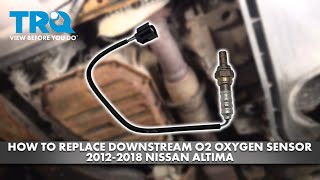
Typical fix: Replace the Bank 1, Sensor 2 🎬 See this walkthrough for replacing the downstream oxygen sensor. (downstream) oxygen sensor.
Est. part cost: $60-$120 - Exhaust System Leak 🟡 Medium Probability Corrosion can cause leaks at exhaust pipe flanges, flex pipes, or gaskets, particularly on higher-mileage vehicles. A leak before or near the downstream O2 sensor can allow outside air into the exhaust, skewing the sensor's readings and causing the code.
How to confirm: Perform a visual inspection of the exhaust system from the engine to the tailpipe, looking for rust, holes, or black soot marks at joints. A common DIY method is to have an assistant temporarily block the tailpipe with a rag while the engine is running to make leaks more audible (a hissing or puffing sound). A shop may use a smoke machine to pinpoint the leak's location.
Typical fix: Repair the leak. This may involve replacing a gasket, patching a small hole with exhaust putty for a temporary fix, or welding/replacing the leaking section of the pipe.
Est. part cost: $10-$300
Rare But Worth Checking
- Failing Catalytic Converter: While a failing converter can cause this code, it's more often misdiagnosed. Usually, other codes like P0420 (Catalyst System Efficiency Below Threshold) would be present. A temperature check using a laser thermometer before and after the converter can help diagnose a clog; if the inlet is significantly hotter than the outlet, it may be clogged.
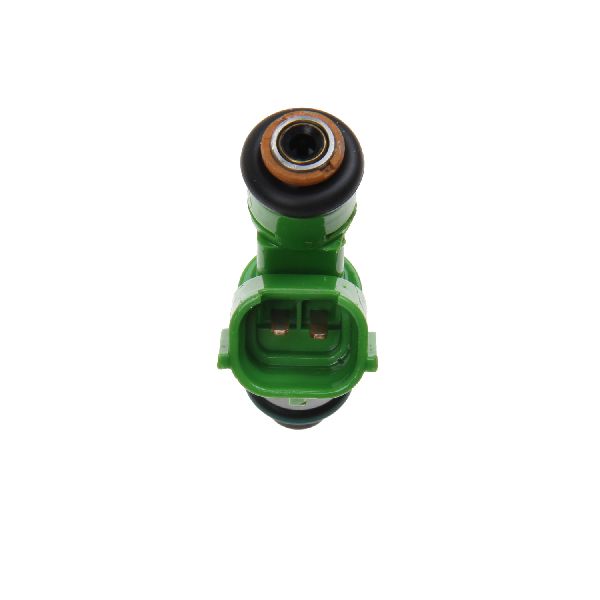
- Leaking Fuel Injector: A fuel injector stuck open can dump excess fuel into a cylinder, causing a true rich condition. This would typically be accompanied by other symptoms like a noticeable engine misfire, a cylinder-specific misfire code (e.g., P0301), and potentially a P0172 code.
- Dirty or Faulty Mass Airflow (MAF) Sensor: A dirty MAF sensor can under-report the amount of air entering the engine, causing the ECM to inject too much fuel. This can sometimes lead to a P2097 code. Cleaning the MAF sensor with a dedicated cleaner is a simple diagnostic step.
Diagnosis Steps
- Scan for Codes: Read the trouble codes and check for any other pending or stored codes. Note any codes grouped with P2097 in the TSBs.
- Check for TSBs: This is the most critical first step for this vehicle. Check if TSBs NTB19-030 (for V6), NTB15-115a (for 2015 2.5L), or NTB12-085b (for 2013 2.5L) apply to your vehicle's VIN and ECM part number. If a TSB applies, following its instructions is the most likely fix.
- Inspect for Exhaust Leaks: Visually and audibly inspect the entire exhaust system for leaks, especially between the engine and the downstream O2 sensor. A smoke test is the most effective method.
- Analyze Live Data: Use a scanner to observe the voltage readings from the upstream (A/F Sensor 1) and downstream (O2 Sensor 2). The upstream sensor should fluctuate rapidly. The downstream should be relatively steady. A downstream voltage stuck high (above 0.8V) suggests a rich condition or a bad sensor.
- Follow TSB Repair Path: If a TSB applies, perform the specified repair, which is typically replacing the upstream A/F sensor and/or reprogramming the ECM.
- Test the Downstream O2 Sensor: If no TSBs apply and no leaks are found, and the live data is suspect, the downstream O2 sensor is a likely culprit. Replace it.
- Investigate Upstream Causes: If the code returns, investigate potential causes of a true rich condition, such as a leaking fuel injector, dirty MAF sensor, or high fuel pressure.
Parts You'll Likely Need
- Upstream Air/Fuel Ratio Sensor (Bank 1, Sensor 1)
(OEM #22693-3TA0A (or subsequent revisions, verify by VIN))— For 2.5L models, TSBs NTB12-085b and NTB15-115a specifically require replacing this sensor along with an ECM reprogram to fix code P2097. This is often the true root cause, not the downstream sensor.
Trusted brands: Denso, Bosch, NGK/NTK
OEM price range: $150-$220
Aftermarket price range: $80-$180 - Downstream Oxygen Sensor (Bank 1, Sensor 2)
(OEM #226A0-3TA0A (or subsequent revisions like 226A0-3NT0A, verify by VIN))— This sensor is the one that reports the fault. If TSBs don't apply and no other cause is found, this sensor may have failed. It is a common misdiagnosis if TSBs are not checked first.
Trusted brands: Denso (e.g., 234-4775), Bosch (e.g., 15510), NGK/NTK (e.g., 24298)
OEM price range: $110-$150
Aftermarket price range: $60-$120
Related Codes That Often Appear With This One
- P0172 — P0172 (System Too Rich Bank 1) indicates a rich condition detected by the *upstream* A/F sensor. TSB NTB15-115a groups P2097 with P0172, pointing to a required ECM reprogram and A/F sensor replacement for 2015 models.
- P2099 — P2099 is the same code but for Bank 2 (Post Catalyst Fuel Trim System Too Rich Bank 2). This would only appear on V6 models and indicates a systemic issue affecting both banks. TSB NTB19-030 for the V6 engine covers both P2097 and P2099.
- P0171 — TSB NTB19-030 for the V6 engine groups P2097 with P0171 (System Too Lean Bank 1). This seems counterintuitive but indicates the ECM software update is designed to address a range of fuel trim calculation errors.
- P0130, P014C, P014D — TSB NTB12-085b for 2013 4-cylinder models groups these A/F sensor circuit codes with P2097, indicating the prescribed fix is an ECM reprogram and A/F sensor replacement.
Technical Service Bulletins (TSBs) & Recalls
- NTB19-030
- NTB15-115a
- NTB12-085b
Platform-Specific Known Issues
- On 2016-2018 Altimas with the VQ35 (V6) engine, TSB NTB19-030 was issued for the MIL being on with DTC P2097, P0171, P0174, and/or P2099. The fix requires checking the ECM part number and, if it matches the bulletin, reprogramming the ECM. [⭐ MANUFACTURER TSB — highest authority, Bulletin #NTB19-030]
- TSB NTB15-115a applies to 2015 2.5L models and addresses several A/F sensor and fuel trim DTCs, including P2097. The official action is to reprogram the ECM and replace the upstream A/F sensor. The bulletin explicitly states the reprogram must be done *before* the sensor is replaced. [⭐ MANUFACTURER TSB — highest authority, Bulletin #NTB15-115a]
- For 2013 2.5L models, TSB NTB12-085b was released for DTC P2097 among others. The prescribed fix is identical to the 2015 TSB: reprogram the ECM and replace the upstream A/F sensor. [⭐ MANUFACTURER TSB — highest authority, Bulletin #NTB12-085b]
Mechanic-Grade Diagnostic Values
- Fuel Pressure at Idle — expected: ~34-35 psi. Failure: Pressure is significantly high (e.g., 40+ psi without vacuum on regulator) or bleeds down to 0 immediately after the pump primes, which could indicate a bad check valve.
Hidden / Shadow Codes Worth Checking
- Mode $06: While not a hidden code, Mode $06 data on a capable scanner can provide detailed results from the onboard diagnostic monitors. Technicians can review the test IDs ($TID) and component IDs ($CID) for the Catalyst Monitor and Oxygen Sensor Monitor to see specific test values and limits that may be failing or borderline, even before a DTC is set. A 2011 Altima report shows these monitors are available. (see via A professional-level OBD-II scan tool with Mode $06 functionality.)
Wiring & Ground Locations
- Upstream O2 Sensor Connector — On the 2.5L engine, the connector for the upstream (A/F) sensor has a brown harness and is located near the top of the engine bay, accessible after removing the engine cover.. Correctly identifying and inspecting this connector is crucial when replacing the upstream A/F sensor as per the TSB.
- Downstream O2 Sensor Connector — On the 2.5L engine, the connector for the downstream sensor has a black harness and is located underneath the vehicle, attached to a bracket.. This is the sensor that triggers the P2097 code. Checking its connector for damage, moisture, or corrosion is a key diagnostic step.
- ECM/Sensor Circuit Connectors — Wiring diagrams for the 2014 Altima show junction connector J/C E08 at the left end of the dash and ECM connector E9 in the lower left rear of the engine compartment as being part of the sensor circuits.. A fault, corrosion, or poor connection at these main junctions could cause erratic sensor readings, leading to a P2097 code.
Real Owner Repair Stories
- Reddit user post in r/Nissan (2013 Nissan Altima 2.5L with 50,000 miles) — Check Engine Light with code P2097.
✅ What actually fixed it The dealership followed a service bulletin, which involved replacing the upstream air/fuel ratio sensor and reprogramming the ECM. This resolved the code. - CarKiller forum user post (Nissan Altima (year not specified)) — P2097 code returned 6 months after a previous repair.
❌ Tried (didn't work) Replacing the downstream O2 sensor, Replacing the catalytic converter
✅ What actually fixed it The user was advised by another forum member that the catalytic converter should not cause that code and that the next step should be to replace the *front air fuel ratio sensor* with an OEM part, as they can be temperamental. This points to the upstream sensor as the likely solution.
When the Usual Fixes Don't Work
- One 2013 Altima owner with P2097 at 65,000 miles was led down an expensive and incorrect diagnostic path by their mechanic. The shop first replaced the spark plugs, which did not fix the issue. When the code returned, they replaced the downstream oxygen sensor. When the code returned again, the shop's next recommendation was to replace the catalytic converter. This story serves as a strong counter-example to the 'parts cannon' approach and highlights the importance of checking for the TSB regarding the upstream A/F sensor and ECM reprogram before replacing more expensive components like the O2 sensor and catalytic converter.
OEM Part Supersession History
22693-3TA0A→22693-3TA0B— Unspecified, but part revisions are common for improving reliability or accommodating minor manufacturing changes.
Heads up: The parts are listed as interchangeable (the new one replaces the old), but it is best practice to use the latest revision (22693-3TA0B) when performing the TSB repair on applicable model years.
Model Year Variations Within This Range
- 2016-2018: The 2016 model year received a significant facelift. While the 2.5L QR25DE engine was fundamentally unchanged in terms of performance, it received new engine mounts and a larger muffler. The upstream A/F sensor part number was also superseded around this time (from June 2015), indicating a potential hardware change that aligns with the model refresh.
Helpful Videos
![How to Fix NISSAN P2097 Engine Code in 4 Minutes [2 DIY Methods / Only $9.53]](https://img.youtube.com/vi/6qGemkMGeXI/mqdefault.jpg)
We Have This Part in Stock


The information in this article is provided for general reference and educational purposes only. Vehicle specifications, procedures, and part compatibility can vary by production date, trim level, and region. Always consult your vehicle's factory service manual and verify part numbers before purchasing or performing repairs. Safety-critical components such as airbags, seat belts, and braking systems should be installed by a qualified professional.
- Nissan ALTIMA:
- 🎬 Helpful Videos
- 🛍️ Shop This Part
- What's Unique About the 2013-2018 Nissan ALTIMA
- Diagnostic Flowchart
- Symptoms You May Notice
- Most Likely Causes
- Rare But Worth Checking
- Diagnosis Steps
- Parts You'll Likely Need
- Related Codes That Often Appear With This One
- Technical Service Bulletins (TSBs) & Recalls
- Platform-Specific Known Issues
- Mechanic-Grade Diagnostic Values
- Hidden / Shadow Codes Worth Checking
- Wiring & Ground Locations
- Real Owner Repair Stories
- When the Usual Fixes Don't Work
- OEM Part Supersession History
- Model Year Variations Within This Range
- 🎟️ Get 5% Off