

P2097 on 2018 GMC Terrain: Causes and Fixes for Rich Fuel Trim
For a 2018 GMC Terrain, code P2097 is most often caused by a faulty downstream oxygen sensor, an exhaust leak, or a leaking fuel injector. GM has issued service bulletins (PIP5534A, PIP4964F) that provide special diagnostics and point toward checking the EVAP system and performing a fuel injector balance test early in the process, as injectors are a known issue.
- P2097 means the downstream O2 sensor on Bank 1 is detecting a rich fuel mixture.
- Do not immediately replace the catalytic converter; it is rarely the root cause.
- The most common fixes are replacing the downstream O2 sensor, fixing an exhaust leak, or addressing a leaking fuel injector.
- For this specific vehicle, GM has issued service bulletins (PIP5534A, PIP4964F) that provide special diagnostic steps and point towards checking fuel injectors.
- Driving with this code for an extended period can lead to catalytic converter damage, a much more expensive repair.
What's Unique About the 2018-2018 Gmc TERRAIN
For the 2018 GMC Terrain and its platform-mate, the Chevy Equinox, this code is specifically addressed by Technical Service Bulletins. TSB #PIP5534A provides advanced diagnostic steps because the cause can be elusive, instructing technicians to first rule out the EVAP purge system before proceeding. It also notes that certain driving styles, like heavy stop-and-go traffic or repeatedly accelerating and coasting (called being a "digital driver"), can induce this code without a true component fault. Furthermore, TSB #PIP4964F, which applies to similar models, strongly recommends performing a fuel injector balance test early, highlighting leaking injectors as a known primary issue across many GM platforms.
Diagnostic Flowchart
Tap your situation to follow the diagnostic path that matches what you're seeing on this vehicle.
Symptoms You May Notice
- Check Engine Light is on
- Decreased fuel economy
- Rough or erratic idle
- Engine hesitation or lack of power
- Smell of gasoline or rotten eggs from the exhaust
- In extreme cases, black smoke from the tailpipe
- Replacing the catalytic converter first. The P2097 code is often a symptom of another issue. Replacing the converter without fixing the root cause (like a leaking injector) will likely lead to the new converter failing as well.
- Replacing the downstream O2 sensor without testing. While the sensor can be the cause, it is often just accurately reporting a problem that originates further upstream. Always test before replacing parts. 🎬 Check this video to find your oxygen sensor fuse location.
Most Likely Causes
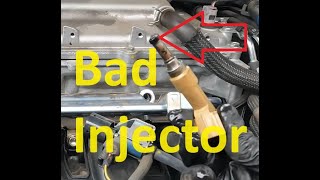
- Leaking Fuel Injector(s) 🔴 High Probability GM TSB #PIP4964F specifically points to leaking fuel injectors as a primary cause for P2097 on this and related platforms. An injector can leak excess fuel into a cylinder, creating a genuinely rich condition that the downstream O2 sensor correctly reports.
How to confirm: Perform a fuel injector balance test using a capable scan tool or an Active Fuel Injector Tester (AFIT), as recommended by GM service literature. Another method is to remove the spark plugs and inspect them; a plug that is significantly darker or sootier than the others indicates a rich condition in that cylinder.
Typical fix: Replace the faulty fuel injector(s). It is often recommended to replace them as a set to ensure balanced fuel delivery.
Est. part cost: $50-$300 - Faulty Downstream Oxygen Sensor (Bank 1, Sensor 2) 🟡 Medium Probability The downstream O2 sensor is the component that directly reports this code. It can fail and send incorrect 'rich' signals (stuck high voltage) even if the fuel mixture is normal. It is a common replacement part, but often misdiagnosed as the root cause.
How to confirm: Use a scan tool to monitor the live voltage of the downstream O2 sensor. A healthy sensor should show a relatively steady voltage. If it's stuck high (e.g., above 0.8V) or not responding, it is likely faulty.
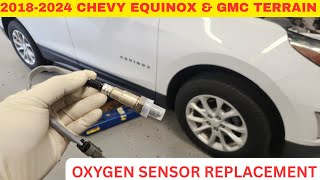
Typical fix: Replace the Bank 1 downstream oxygen sensor. For the 1.5L engine, the OEM part number is 12701634. 🎬 Watch: How to replace the oxygen sensor on your Terrain.
Est. part cost: $40-$120 - Exhaust Leak 🟡 Medium Probability Leaks can occur at gaskets or flex pipes. A leak before the downstream O2 sensor can draw in outside air, confusing the sensor readings and causing the ECM to overcompensate by adding fuel, leading to a rich condition reported by the downstream sensor.
How to confirm: Visually inspect the exhaust system for cracks or black soot marks, especially around gaskets. A shop can perform a smoke test or a low-pressure air test as detailed in TSB PIP4964F to pinpoint hard-to-see leaks.
Typical fix: Replace the leaking gasket or repair the damaged section of the exhaust pipe.
Est. part cost: $20-$150 - EVAP System Fault 🟡 Medium Probability TSB #PIP5534A explicitly instructs technicians to verify the EVAP (Evaporative Emission) system is not the cause before proceeding with other diagnostics. A stuck-open EVAP purge valve can allow unmetered fuel vapors to enter the intake manifold, creating a rich condition.
How to confirm: Use a scan tool (like the GM GDS2) to command the EVAP purge solenoid valve open and closed to test for proper function. Listen for a clicking sound and check if it holds a vacuum when commanded closed.
Typical fix: Replace the faulty EVAP purge valve or solenoid.
Est. part cost: $25-$75 - Faulty Upstream Oxygen Sensor (Bank 1, Sensor 1) ⚪ Low Probability A failing upstream O2 sensor can send incorrect 'lean' signals to the ECM. The computer then compensates by adding too much fuel (negative fuel trims), which the downstream sensor correctly reports as a rich condition (P2097).
How to confirm: Monitor live data from the upstream O2 sensor. If its readings are slow, biased, or stuck, it may be the root cause.
Typical fix: Replace the Bank 1 upstream oxygen sensor.
Est. part cost: $50-$150
Rare But Worth Checking
- Failing Catalytic Converter: A contaminated or failing catalytic converter may no longer process exhaust gases correctly, causing the downstream sensor to report a rich condition. This is usually a result of another problem (like a leaking injector) and not the root cause.
- High Fuel Pressure: A faulty fuel pressure regulator or an issue with the high-pressure fuel pump can cause excessive fuel delivery to the engine, leading to a rich condition. This should be checked with a fuel pressure gauge if other causes are ruled out.
- ECM Software Issue: On some GM vehicles, outdated Engine Control Module (ECM) software can cause this code to be set incorrectly. TSBs for other models suggest a software update (reflash) from a dealer can be a fix, particularly if fuel trims are within a certain range.
Diagnosis Steps
- Scan for all DTCs. Note any other codes that are present, as they can provide important clues (e.g., P0172, P030x).
- Visually inspect the exhaust system from the engine to the tailpipe for any signs of leaks, such as cracks, holes, or black soot at the flanges.
- Use a scan tool to observe live data for the Bank 1 upstream (Sensor 1) and downstream (Sensor 2) oxygen sensors. The downstream sensor's voltage should be relatively stable. If it is stuck high (above 0.8V), it confirms the rich reading.
- Check long-term and short-term fuel trims. High negative numbers indicate the ECM is trying to remove fuel to correct a rich condition.
- Follow TSB #PIP5534A guidance: Test the EVAP purge system to ensure the purge valve is not stuck open.
- If other tests are inconclusive, perform a fuel injector balance test using an AFIT tool as recommended by GM TSB #PIP4964F to check for leaking injectors.
- Test fuel pressure to ensure it is within the manufacturer's specified range.
- Check for any available ECM software updates with a GM dealer or capable shop, especially if no other faults are found.
- If all else fails, test the catalytic converter's efficiency, but only after ruling out all other potential causes.
Parts You'll Likely Need
- Downstream Oxygen Sensor (Bank 1 Sensor 2)
(OEM #12701634 (for 1.5L engine, supersedes 12663317))— This sensor is the primary source of the P2097 code reading and is a common failure point. It may be sending false rich signals.
Trusted brands: ACDelco, Bosch, Denso, NGK
OEM price range: $70-$120
Aftermarket price range: $40-$80 - Fuel Injector — GM TSBs specifically identify leaking fuel injectors as a likely cause for this code on this platform.
Trusted brands: ACDelco, Bosch
OEM price range: $80-$150
Aftermarket price range: $50-$100 - Exhaust Gasket — An exhaust leak is a common cause, and a failed gasket between exhaust components is often the culprit.
Trusted brands: Fel-Pro, Walker Exhaust
OEM price range: $15-$40
Aftermarket price range: $10-$25
Related Codes That Often Appear With This One
- P0420 — This code for 'Catalyst System Efficiency Below Threshold' can appear with P2097 because the rich condition or sensor failure can also be interpreted by the ECM as poor catalyst performance.
- P0172 — 'System Too Rich Bank 1' is detected by the upstream O2 sensor. If both are present, it strongly points to a genuine rich-running condition, such as a leaking injector or EVAP system fault.
- P0300-P0304 — Cylinder misfire codes can occur if a severely leaking injector fouls a spark plug or disrupts combustion, leading to incomplete combustion.
Technical Service Bulletins (TSBs) & Recalls
- PIP5534A: Communicates additional diagnostics to assist technicians with diagnosing and repairing trouble code P2097. Key takeaways include checking the EVAP system first and being aware that certain driving habits can induce the code.
- PIP4964F: Although for a different model year, this highly relevant TSB advises performing a fuel injector balance test early when P2097 is found, identifying leaking injectors as a common root cause across GM platforms.
Platform-Specific Known Issues
- TSB #PIP5534A was issued specifically for the 2018 Terrain (among other GM models) to provide advanced diagnostic steps for P2097, indicating it can be a tricky code to solve. It specifically calls out checking the EVAP system first.
- The TSB also notes that specific driving habits, such as extensive stop-and-go city driving or being a 'digital driver' (rapid acceleration followed by coasting), can sometimes trigger this code without a true component fault.
Mechanic-Grade Diagnostic Values
- Mode $06 Downstream O2 Sensor Test (Bank 1) — expected: Using an advanced scan tool, check OBDMID $02. Test IDs (TID) like $01 (Rich to Lean Threshold) and $07 (Min. Sensor Voltage) should be within manufacturer-specified limits.. Failure: A test result that is marked as 'FAIL' or is outside the min/max value range for a specific TID indicates a sensor or system problem.
- O2 Sensor Fuse Integrity — expected: Fuses F3 (15A) and F15 (10A) in the underhood fuse box should have continuity.. Failure: A blown fuse will cause the O2 sensor heater circuit to fail, leading to incorrect readings.
- Fuel in Oil Check — expected: Engine oil on the dipstick should not have a strong gasoline odor.. Failure: A strong smell of fuel in the crankcase oil can indicate a problem with leaking injectors or a faulty PCV system, as noted in TSB 18-NA-246.
Hidden / Shadow Codes Worth Checking
- Mode $06, OBDMID $01, $02: These are not DTCs but Monitor IDs for the oxygen sensors. They contain specific test results for sensor performance, such as switch times (TID $05, $06) and voltage thresholds (TID $01, $02), which provide deeper insight than the generic P-code. (see via Requires an advanced scan tool capable of displaying Mode $06 test data.)
Scan Tool Commands That Help
- GM GDS2 / AFIT: Injector Balance Test — As recommended by TSB #PIP4964F, this should be used early in the diagnosis for P2097 to identify leaking or poorly performing fuel injectors, which are a known cause on this platform.
- GM GDS2: EVAP Purge/Seal — As recommended by TSB #PIP5534A, this bidirectional command is used to manually operate the EVAP purge valve to confirm it is not stuck open and allowing unmetered fuel vapor into the intake.
Wiring & Ground Locations
- O2 Sensor Fuses — In the main fuse box located under the hood, in front of the battery.. The O2 sensors for a 2018 Terrain are protected by fuses F3 (15A) and F15 (10A). A blown fuse is a simple but critical failure point to check before replacing sensors.
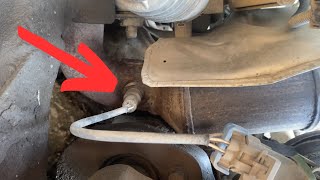
- Downstream O2 Sensor Connector — On the exhaust pipe after the catalytic converter. The connector is a gray, 4-terminal female connector.. The connector and its wiring are exposed to heat and road debris. Physical damage, corrosion, or melting at this connector can cause a loss of signal or incorrect readings, triggering P2097.
Real Owner Repair Stories
- AcadiaForum.net user report (2018 GMC Acadia 3.6L V6 (similar GM platform and engine logic)) — Check Engine Light with code P2097.
❌ Tried (didn't work) Replaced the Bank 1 Sensor 2 (downstream) oxygen sensor, Replaced the Bank 1 Sensor 1 (upstream) oxygen sensor, Replaced the EVAP purge solenoid
✅ What actually fixed it The dealership performed a fuel injector flow test and found two injectors on Bank 1 were leaking. Replacing the two faulty injectors resolved the code.
"I Checked Everything" — The Actual Cause
- In a documented case on a similar GM platform, standard diagnostics including replacing both O2 sensors and the EVAP solenoid did not resolve the P2097 code. The root cause was found to be leaking fuel injectors, which would not be detected by an exhaust or EVAP smoke test. The issue was only identified after a specific fuel injector flow test was performed.
OEM Part Supersession History
12672582→12705503— Standard manufacturer revision for the Fuel Rail Pressure Sensor.12663317→12701634— Standard manufacturer revision for the Downstream Oxygen Sensor.
Heads up: Some sources indicate the new part may require programming or special setup procedures.
Helpful Videos

![How to Fix P2097 Engine Code in 4 Minutes [2 DIY Methods / Only $9.84]](https://img.youtube.com/vi/rCwtzRmhMwY/mqdefault.jpg)
Used OEM Parts in Stock


New Aftermarket Parts Available



The information in this article is provided for general reference and educational purposes only. Vehicle specifications, procedures, and part compatibility can vary by production date, trim level, and region. Always consult your vehicle's factory service manual and verify part numbers before purchasing or performing repairs. Safety-critical components such as airbags, seat belts, and braking systems should be installed by a qualified professional.
- Gmc TERRAIN:
- 🎬 Helpful Videos
- 🛍️ Shop This Part
- What's Unique About the 2018-2018 Gmc TERRAIN
- Diagnostic Flowchart
- Symptoms You May Notice
- Most Likely Causes
- Rare But Worth Checking
- Diagnosis Steps
- Parts You'll Likely Need
- Related Codes That Often Appear With This One
- Technical Service Bulletins (TSBs) & Recalls
- Platform-Specific Known Issues
- Mechanic-Grade Diagnostic Values
- Hidden / Shadow Codes Worth Checking
- Scan Tool Commands That Help
- Wiring & Ground Locations
- Real Owner Repair Stories
- "I Checked Everything" — The Actual Cause
- OEM Part Supersession History
- 🎟️ Get 5% Off