

P2097 on 2020 Chevrolet Impala: Post-Catalyst Fuel Trim Too Rich Causes & Fixes
On a 2020 Impala, code P2097 indicates a rich fuel mixture detected after the catalytic converter. While a bad O2 sensor is possible, a GM Technical Service Bulletin (TSB) points to leaking fuel injectors as a primary cause. Diagnosis should focus on injector testing before replacing sensors.
- For a P2097 code on a 2020 Impala, suspect a leaking fuel injector before a bad oxygen sensor.
- Do not replace the downstream O2 sensor unless you have definitively diagnosed it as faulty; it is usually just reporting the problem, not causing it.
- A thorough diagnosis must include checking for exhaust leaks and performing a fuel injector balance test as per GM service information.
- Ignoring the code can lead to expensive catalytic converter damage in the long run.
- The only initial symptom may be the Check Engine Light, with no other noticeable performance issues.
What's Unique About the 2020-2020 Chevrolet IMPALA
For many vehicles, a P2097 code often leads to the replacement of the downstream oxygen sensor. However, on this specific platform, General Motors has issued Technical Service Bulletins (TSBs) that direct technicians to investigate other causes first. Specifically, TSB #PIP4964F points to leaking fuel injectors as a likely culprit on the 3.6L V6, making an injector balance test a critical diagnostic step. For the 2.5L I4, TSB #PIP5534A outlines a complex diagnostic procedure, acknowledging that causes can range from vacuum leaks to specific 'on-off' driving habits that can induce the code without a hard fault. This guidance confirms that on the 2020 Impala, the O2 sensor is often just accurately reporting a problem that originates elsewhere.
Diagnostic Flowchart
Tap your situation to follow the diagnostic path that matches what you're seeing on this vehicle.
Symptoms You May Notice
- Check Engine Light illuminated. 🎬 Watch this overview of common causes and fixes for P2097.
- Reduced fuel economy.
- Rough or erratic idling.
- Engine hesitation or stumbling during acceleration.
- In rare, severe cases, a smell of fuel or black smoke from the exhaust.
- Often, no noticeable drivability issues other than the Check Engine Light.
- Replacing the downstream (post-catalyst) oxygen sensor without proper diagnosis. The sensor is usually just reporting the rich condition created by another component, such as a leaking fuel injector.
Most Likely Causes
- Leaking Fuel Injector(s) 🔴 High Probability Manufacturer TSB #PIP4964F specifically calls out fuel injector testing as a key diagnostic step for this code on the 3.6L V6, indicating it's a known issue across multiple GM platforms. TSB #PIP5534A also recommends an injector test on the 2.5L I4 if other diagnostics fail.
How to confirm: Perform a fuel injector balance test or an Active Fuel Injector Test (AFIT) using a capable diagnostic scan tool, as recommended by the TSBs. This measures the flow from each injector to see if one is leaking or flowing more fuel than commanded. A real-world repair on a 2018 GMC Acadia with the 3.6L V6 confirmed that after replacing O2 sensors and an EVAP solenoid failed to fix the P2097 code, an injector flow test found two leaking injectors, which resolved the issue when replaced.
Typical fix: Replace the faulty fuel injector(s). TSB #PIP5534A advises that if no single faulty injector can be identified, all injectors on the affected bank should be replaced.
Est. part cost: $50-$150 per injector - Exhaust System Leak 🟡 Medium Probability The 10th generation Impala and its platform mates with the 3.6L V6 are known to have issues with cracks forming on the catalytic converter housing near the mounting flange. A video of a 2019 Traverse with P2097 showed the pipe completely broken off at the weld on the converter housing. 🎬 See how a cracked catalytic converter housing causes this code. An exhaust leak before the downstream O2 sensor can allow outside air to enter, confusing the sensor readings and leading to incorrect fuel trim adjustments.
How to confirm: Visually inspect the exhaust system from the engine to the tailpipe for cracks, rust, or black soot trails indicating a leak. A smoke test is the most effective way to find small leaks. Pay close attention to the welds and flanges on the catalytic converter.
Typical fix: Repair the leak by replacing the faulty gasket, tightening connections, or welding the damaged pipe section. If the catalytic converter housing is cracked, it will need to be replaced.
Est. part cost: $20-$200 for gaskets or welding - Faulty Upstream Oxygen Sensor (Bank 1, Sensor 1) 🟡 Medium Probability
How to confirm: Use a scan tool to monitor the live data from the upstream O2 sensor. It should fluctuate rapidly between approximately 0.1V and 0.9V. If it is stuck or slow to respond, it may be faulty, causing the PCM to incorrectly enrich the fuel mixture, which the downstream sensor then reports.
Typical fix: Replace the Bank 1 upstream oxygen sensor.
Est. part cost: $40-$120 - Faulty Downstream Oxygen Sensor (Bank 1, Sensor 2) ⚪ Low Probability This is a common misdiagnosis. The sensor is often just reporting the rich condition, not causing it. A GM diagnostic aid explicitly states not to replace the O2 sensor for this code unless a separate sensor circuit code is present.
How to confirm: After confirming there are no exhaust leaks, fuel injector issues, or upstream sensor problems, test the sensor's response with a scan tool. A Reddit user with a 2.5L Impala noted their downstream sensor voltage was steady at 0.65V with the P2097 code present. If its voltage is stuck high (e.g., >0.7V) even when the fuel mixture is known to be lean, the sensor itself may be faulty.
Typical fix: Replace the Bank 1 downstream oxygen sensor.
Est. part cost: $40-$120
Rare But Worth Checking
- High Fuel Pressure: A faulty fuel pressure regulator or high-pressure fuel pump can cause excessive pressure throughout the system, leading to a rich condition. This should be checked with a fuel pressure gauge.
- Failing Catalytic Converter: While a failing converter is more likely to set a P0420 (Catalyst Efficiency) code, a clogged or contaminated converter can sometimes affect exhaust flow and cause the post-catalyst sensor to give a rich reading.
- ECM Software Anomaly: On some similar GM models, TSB 19-NA-017 was issued for a software glitch on the 2017 Malibu 1.5L that could falsely trigger P2097. While not directly applicable to the 2020 Impala, it shows precedent. If all mechanical causes are ruled out, checking for available ECM updates is a valid final step.
- Specific Driving Habits (2.5L Engine): TSB PIP5534A notes that for the 2.5L engine, certain driving styles can induce a P2097 code without a mechanical fault. This includes heavy stop-and-go traffic or being a 'digital driver' (accelerating to speed, then coasting down, then accelerating again repeatedly). According to the TSB, there is no vehicle fix for this behavior.
Diagnosis Steps
- Read the code from the OBD-II port using a scanner and check for any other stored codes.
- Analyze the freeze frame data to understand the engine conditions when the code was set.
- Perform a thorough visual inspection of the exhaust system for any signs of leaks, cracks, or damage, especially around the Bank 1 catalytic converter and O2 sensor bungs.
- Use a scan tool to monitor live data for both the upstream (Sensor 1) and downstream (Sensor 2) oxygen sensors on Bank 1. The upstream sensor should fluctuate rapidly, while the downstream sensor should be relatively steady. A consistently high voltage from the downstream sensor (>0.7V) confirms a rich condition is being reported.
- Follow the guidance of TSB #PIP4964F (especially for 3.6L V6): Perform a fuel injector balance test or Active Fuel Injector Test (AFIT) to check for leaking or over-fueling injectors.
- For the 2.5L I4, follow the added steps in TSB #PIP5534A if initial diagnostics are inconclusive: check for vacuum leaks with a smoke machine, verify the EVAP purge system is not the cause, and monitor long-term fuel trims while idling in Park, idling in Drive, and driving at a steady 50+ MPH.
- Check the fuel pressure to ensure it is within the manufacturer's specified range.
- If all other tests are inconclusive, inspect the oxygen sensor wiring for damage. If the wiring is intact, test the sensor itself before deciding to replace it. 🎬 Watch: Two quick DIY methods to fix the P2097 code.
Parts You'll Likely Need
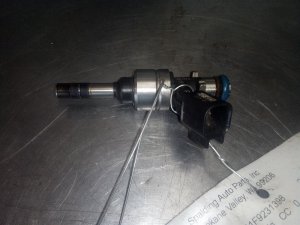
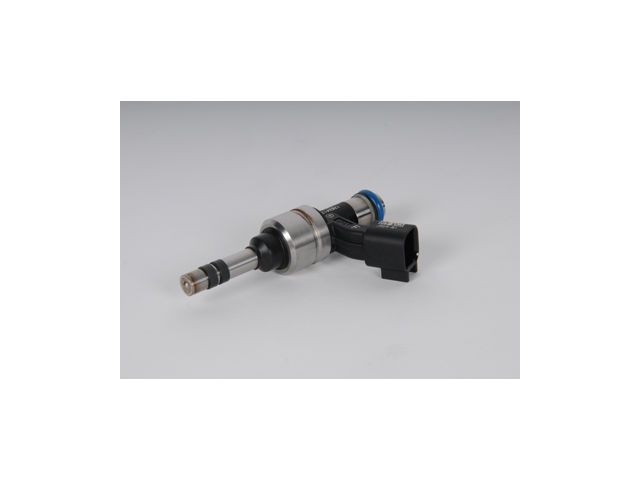
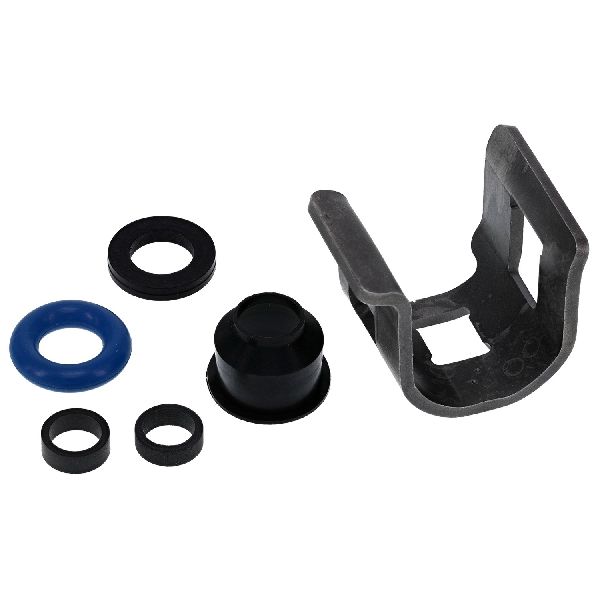
- Fuel Injector
(OEM #12669384)— A leaking fuel injector is a primary cause for P2097 on this vehicle, as identified in GM Technical Service Bulletin #PIP4964F. Note: Verify the exact part number with your vehicle's VIN before ordering, as catalog information can vary.
Trusted brands: ACDelco, Bosch
OEM price range: $80-$120
Aftermarket price range: $50-$90 - Downstream Oxygen Sensor (Bank 1)
(OEM #12676388)— This part is often replaced, but should only be done after ruling out fuel injectors and exhaust leaks, as it's a common misdiagnosis.
Trusted brands: ACDelco, Denso, NGK
OEM price range: $70-$110
Aftermarket price range: $40-$80
Related Codes That Often Appear With This One
- P2099 — This is the same 'Post Catalyst Fuel Trim Too Rich' code, but for Bank 2. On V6 engines, if the cause is systemic (like high fuel pressure or an EVAP fault), both codes may appear together.
- P0300-P0306 — These are cylinder misfire codes. A severely leaking fuel injector can foul the spark plug in its cylinder, leading to a misfire in addition to the rich condition.
- P0172 — This code for 'System Too Rich (Bank 1)' indicates the upstream sensor is also detecting a rich condition, reinforcing that the problem is happening before the catalytic converter.
Technical Service Bulletins (TSBs) & Recalls
- PIP4964F: Recommends performing a fuel injector balance test or Active Fuel Injector Tester prior to further diagnosis for P2097 on the 3.6L V6, as leaking injectors are a primary cause.
- PIP5534A: Provides advanced diagnostics for the 2.5L and 2.0L engines. It details a process of monitoring fuel trims under various load conditions and checking for vacuum leaks, and notes that certain driving habits can induce the code without a mechanical fault.
Platform-Specific Known Issues
- TSB PIP4964F (3.6L V6): Directs technicians to check for leaking fuel injectors using an injector balance test as a primary diagnostic step for P2097, rather than immediately suspecting the oxygen sensor.
- TSB PIP5534A (2.5L I4): Provides extensive diagnostic assistance for P2097, noting it can be a complex issue. It suggests checking for vacuum leaks, skewed MAF sensors, and even specific driving patterns ('digital driver') as potential non-obvious causes. It recommends an AFIT test as a key step.
Mechanic-Grade Diagnostic Values
- Low-Side Fuel Pressure (Key On, Engine Off) — expected: 55-60 psi during the initial prime pulse. Failure: Significantly lower pressure may indicate a weak fuel pump; significantly higher pressure could indicate a regulator issue.
- Fuel Injector Coil Resistance — expected: 11-14 ohms when the engine coolant temperature is between 50-90°F (10-32°C). The difference between the highest and lowest reading among all injectors should be less than 3 ohms.. Failure: A reading outside the 11-14 ohm range, or a variance greater than 3 ohms between injectors, points to a faulty injector coil.
- Downstream O2 Sensor (Bank 1, Sensor 2) Voltage at Idle — expected: A steady reading around 0.45V on a fully warmed-up engine with a healthy catalytic converter.. Failure: A voltage reading that is consistently high (e.g., > 0.7V) confirms the rich condition reported by the P2097 code. If it fluctuates rapidly like the upstream sensor, the catalytic converter may be failing.
Scan Tool Commands That Help
- GDS2 / Tech2 / AFIT Tool (CH-47976): Active Fuel Injector Test (AFIT) / Injector Balance Test — This is a critical diagnostic step recommended by GM TSB #PIP4964F for code P2097. It tests the flow rate and checks for leaks in each fuel injector without requiring their physical removal from the engine. It is the most definitive way to confirm or deny leaking injectors as the cause.
Wiring & Ground Locations
- G111 — On the transmission-to-engine bolt, typically located above the starter motor.. This is a primary engine block ground. A poor connection here can cause erratic signals from various engine sensors, including those that influence fuel calculations, potentially leading to an incorrect rich condition.
- G102 — Near the battery, often on the chassis or inner fender.. This ground point is often used for the ignition coils. While not a direct cause of a rich mixture, a poor ground here could lead to weak spark and incomplete combustion, which can be misinterpreted by O2 sensors.
- G103 — On the cowl in the rear of the engine compartment, often above the brake booster.. This ground is critical as it often serves the Engine Control Module (ECM), Body Control Module (BCM), and the Data Link Connector (DLC). A poor connection at G103 can cause a wide range of bizarre electrical issues, including incorrect ECM calculations for fuel trim.
Real Owner Repair Stories
- GM Technical Service Bulletin #PIP5681C (Chevrolet Traverse (platform-mate with shared 3.6L engine)) — Check Engine Light with DTC P2097 set.
❌ Tried (didn't work) Replacing oxygen sensors., Searching for exhaust leaks only on Bank 1.
✅ What actually fixed it The TSB identifies that a broken exhaust bracket on Bank 2 (the front bank) can cause engine movement to transfer stress to the Bank 1 (rear bank) exhaust pipe, causing it to crack near the catalytic converter. The fix is to inspect the Bank 2 bracket and repair the crack on the Bank 1 pipe.
"I Checked Everything" — The Actual Cause
- A standard exhaust system smoke test may come back clean, with no leaks found between the engine and tailpipe. However, the P2097 rich condition can be caused by a faulty EVAP (Evaporative Emission) system. If the EVAP purge valve sticks open, it can allow un-metered fuel vapors from the charcoal canister to be drawn into the intake manifold. The ECM does not account for this extra fuel, causing a rich condition that is then detected by the oxygen sensors. This requires a separate EVAP system test to diagnose.
OEM Part Supersession History
12611545, 12632255, 12638530→12669384— Standard part evolution for improved performance, reliability, or manufacturing efficiency.
Heads up: The newest part number, 12669384, is the correct service replacement for the older numbers on applicable 3.6L engines. Using old stock or used parts with the older numbers is not recommended.
Helpful Videos
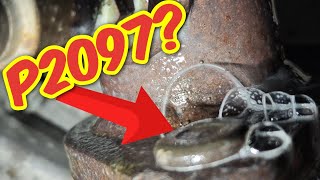
![How to Fix P2097 Engine Code in 4 Minutes [2 DIY Methods / Only $9.84]](https://img.youtube.com/vi/rCwtzRmhMwY/mqdefault.jpg)

Used OEM Parts in Stock
New Aftermarket Parts Available


The information in this article is provided for general reference and educational purposes only. Vehicle specifications, procedures, and part compatibility can vary by production date, trim level, and region. Always consult your vehicle's factory service manual and verify part numbers before purchasing or performing repairs. Safety-critical components such as airbags, seat belts, and braking systems should be installed by a qualified professional.
- Chevrolet IMPALA:
- 🎬 Helpful Videos
- 🛍️ Shop This Part
- What's Unique About the 2020-2020 Chevrolet IMPALA
- Diagnostic Flowchart
- Symptoms You May Notice
- Most Likely Causes
- Rare But Worth Checking
- Diagnosis Steps
- Parts You'll Likely Need
- Related Codes That Often Appear With This One
- Technical Service Bulletins (TSBs) & Recalls
- Platform-Specific Known Issues
- Mechanic-Grade Diagnostic Values
- Scan Tool Commands That Help
- Wiring & Ground Locations
- Real Owner Repair Stories
- "I Checked Everything" — The Actual Cause
- OEM Part Supersession History
- 🎟️ Get 5% Off