

P2096 on 2023-2025 Subaru WRX: Post Catalyst Fuel Trim Too Lean Causes & Fixes
On a 2023-2025 Subaru WRX, code P2096 almost always points to an exhaust leak somewhere between the turbocharger and the rear oxygen sensor. Before buying any parts, carefully inspect all exhaust gaskets and flanges for soot or damage. A very common trigger for this code is the installation of aftermarket exhaust components like a J-pipe/downpipe or cat-back system that introduces a small leak. If no leak is found, the rear O2 sensor is the next most likely cause.
- P2096 on your WRX means the exhaust is too lean after the catalytic converter.
- The most probable cause is an exhaust leak. Thoroughly inspect all exhaust gaskets before replacing parts.
- A faulty rear oxygen sensor is the second most likely cause.
- Do not replace the catalytic converter unless all other possibilities have been exhausted.
- A Subaru TSB exists for this code, so a dealer will have a specific diagnostic flowchart to follow.
What's Unique About the 2023-2025 Subaru WRX
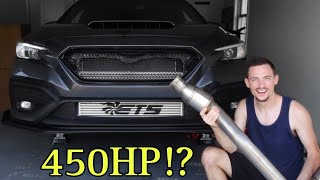
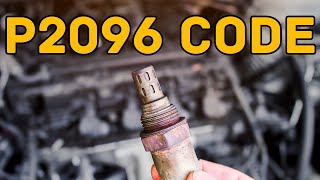
The 2023-2025 WRX uses the FA24F 2.4L turbocharged engine. Like many turbocharged Subarus, the exhaust system is a common source of issues, especially related to leaks at gasket connection points. Because these cars are frequently modified with aftermarket downpipes (J-pipes) and cat-back exhausts, P2096 often appears post-modification. An aftermarket exhaust can introduce new leak points if gaskets aren't seated perfectly or if components warp slightly. The existence of a specific TSB for this code on modern Subarus, including the 2022+ WRX, suggests that dealers have a defined procedure to follow, likely starting with a thorough exhaust leak inspection 🎬 Watch: A breakdown of what P2096 means and how to fix it. before condemning expensive parts.
Diagnostic Flowchart
Tap your situation to follow the diagnostic path that matches what you're seeing on this vehicle.
Symptoms You May Notice
- Check Engine Light is on
- Slightly reduced fuel economy
- Audible exhaust leak (ticking or hissing sound, especially when cold or during initial acceleration)
- Louder than normal exhaust note
- Potential for a faint exhaust or 'rotten egg' smell in the cabin
- Rough idle or poor acceleration in some cases
- Replacing the catalytic converter first. This is a very expensive part and is rarely the cause of an isolated P2096 code. Always rule out exhaust leaks and faulty sensors first.
- Replacing the rear O2 sensor without checking for exhaust leaks. An exhaust leak will make a brand new sensor report the same lean condition, causing the code to return. This is the most common reason for the code coming back after a repair.
- Assuming the front A/F sensor is the cause. While possible, it's much less likely to be the root of an isolated P2096 code compared to post-catalyst exhaust leaks or the rear O2 sensor itself.
Most Likely Causes
- Exhaust Leak 🔴 High Probability Turbocharged vehicles have many high-pressure, high-heat exhaust connections. Gaskets between the turbo, downpipe (J-pipe), and mid-pipe are common failure points. Even a tiny, un-torqued flange or a reused gasket after installing an aftermarket exhaust can allow outside air to be sucked into the pipe, creating a false lean reading at the rear O2 sensor.
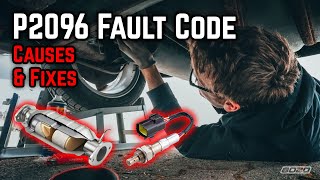
How to confirm: Perform a visual inspection of all exhaust flanges for black soot trails, which indicate a leak. A common DIY method is to spray soapy water on cold exhaust joints and start the engine, looking for bubbles. A professional will use a smoke machine 🎬 See how to diagnose and fix common WRX exhaust leaks. to pressurize the exhaust and easily find the leak source, which is the most reliable method.
Typical fix: Tighten the bolts at the leaking flange to the correct torque specification or replace the exhaust gasket. Never reuse exhaust gaskets, especially the multi-layer steel type. The turbo-to-downpipe and downpipe-to-cat-back gaskets are the most frequent culprits.
Est. part cost: $20-$60 - Faulty Rear Oxygen (O2) Sensor 🟡 Medium Probability The rear O2 sensor (also called post-catalyst sensor) can fail or become 'lazy' over time, sending an incorrect low-voltage signal to the ECM. While the FA24F engine is relatively new, sensor failure is always a possibility, and sometimes a new sensor can be faulty out of the box.
How to confirm: Use an OBD-II scanner to monitor the live data voltage of the rear O2 sensor (Bank 1, Sensor 2). A healthy sensor's voltage should fluctuate. If it's stuck at a low voltage (typically below 0.4v) and doesn't respond to changes in engine RPM, it is likely faulty. This must be done *after* confirming there are no exhaust leaks.
Typical fix: Replace the rear (post-catalyst) oxygen sensor. The OEM part number for the 2022-2025 WRX is often cited as 22690AB090, though this is sometimes listed as the *upstream* sensor, causing confusion. The correct rear sensor is 22641AA790.
Est. part cost: $150-$250 - Faulty Front Air/Fuel (A/F) Ratio Sensor ⚪ Low Probability If the front sensor (Bank 1, Sensor 1) is failing and causing the engine to genuinely run lean, the rear sensor will correctly report this condition. This is less common to appear as an isolated P2096 code and will usually be accompanied by other codes like P0171.
How to confirm: Monitor fuel trims with a scan tool. If long-term fuel trims are highly positive (e.g., >15%) and you also have a P0171 code, the front sensor is a strong suspect.
Typical fix: Replace the front (pre-catalyst) Air/Fuel Ratio sensor. The OEM part number for the front A/F sensor on the 2022-2025 WRX is 22690AB090.
Est. part cost: $150-$230
Rare But Worth Checking
- Clogged or Failing Catalytic Converter: This is an expensive part and should be the last thing to check. It is more likely to be the cause if P2096 is accompanied by a P0420 (Catalyst System Efficiency Below Threshold) code or a rattling sound from the exhaust.
- Engine Vacuum Leak: A significant leak in the intake manifold or vacuum hoses can cause a system-wide lean condition, but this will almost always trigger a P0171 (System Too Lean Bank 1) code first before or alongside P2096.
- Aftermarket Tune/Component Issue: If the vehicle has an aftermarket downpipe, especially a catless one, an O2 sensor spacer or a specific tune ('e-tune' or 'pro-tune') may be required to prevent this code. Sometimes an off-the-shelf (OTS) tune may not fully account for the specific flow characteristics of your exhaust setup.
Diagnosis Steps
- Read the code with an OBD-II scanner and check for any other pending or stored codes. Note them down. If codes like P0171 are present, diagnose them first.
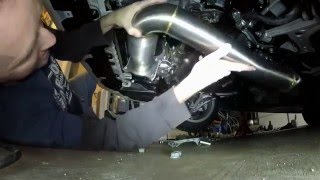
- CRITICAL: Inspect the entire exhaust system, from the turbocharger to the rear muffler, for any signs of leaks. Pay close attention to gasketed flanges, especially if any aftermarket parts are installed. 🎬 Watch: How to properly install a J-pipe on the 2022+ WRX. Look for black soot marks.
- A professional smoke test is the most effective way to find small leaks. Alternatively, with the engine cold, you can have a helper briefly block the tailpipe with a rag while you listen and feel for air escaping at the exhaust joints.
- If any leaks are found, replace the faulty gasket and properly torque the hardware. Clear codes and re-test.
- If NO leaks are found, use a scan tool to view live data for the rear O2 sensor (B1S2). The voltage should fluctuate steadily. If it is flat or stuck low (e.g., <0.2V), the sensor is suspect.
- Inspect the wiring and connector for the rear O2 sensor for any damage, corrosion, or loose pins. The sub-harness on top of the transmission is a known point of failure.
- If exhaust and the rear O2 sensor seem fine, investigate the front A/F sensor's readings and the engine's long-term fuel trims for signs of a pre-catalyst issue.
- Only after ruling out all other possibilities should the catalytic converter be considered as the cause.
Parts You'll Likely Need
- Turbo to Downpipe (J-Pipe) Gasket
(OEM #44616AA220)— This gasket, located between the turbocharger and the J-pipe/downpipe, is a very common failure point for exhaust leaks on the FA24 engine. Aftermarket options are often thicker and more robust than OEM.
Trusted brands: Subaru OE, GrimmSpeed, OVERTAKE
OEM price range: $25-$40
Aftermarket price range: $20-$35 - Rear Oxygen Sensor
(OEM #22641AA790)— If no exhaust leaks are present, a failing sensor is the next logical cause. It directly measures the value that is triggering the code. Note: Many parts sites incorrectly list the front sensor for the rear position.
Trusted brands: Subaru OE (Denso), Denso
OEM price range: $200-$250
Aftermarket price range: $150-$200
Related Codes That Often Appear With This One
- P0171 — If a major vacuum leak is present, it will cause a system-wide lean condition, triggering both the primary fuel trim code (P0171) and the post-catalyst code (P2096).
- P0420 — This code indicates low catalyst efficiency. If the catalytic converter is failing, it can sometimes lead to incorrect readings by the rear O2 sensor, potentially triggering P2096 as well.
- P0137 / P0140 — These codes relate to the rear O2 sensor circuit (low voltage and no activity, respectively). If seen with P2096, it strongly points to a faulty rear O2 sensor or a wiring/connector issue.
Technical Service Bulletins (TSBs) & Recalls
- 18-228-25R: This bulletin announces updated diagnostic procedures for DTCs P2096 (Post Catalyst Fuel Trim System Too Lean Bank 1) and P2097 (Post Catalyst Fuel Trim System Too Rich Bank 1).
Platform-Specific Known Issues
- Subaru issued Technical Service Bulletin (TSB) #18-228-25R, which provides specific diagnostic procedures for dealers to follow when encountering P2096 and P2097 codes. This TSB applies to a wide range of modern Subarus, including the 2022-2025 WRX.
- A significant number of P2096 cases on the VB WRX are self-inflicted, appearing immediately after the owner installs an aftermarket J-pipe or cat-back exhaust system. This is almost always due to a small, undetected gasket leak.
Mechanic-Grade Diagnostic Values
- Mode $06 - Rear O2 Sensor (Bank 1, Sensor 2) Switching Time — expected: The test value should be below the maximum threshold set by the manufacturer.. Failure: A test value exceeding the maximum limit indicates the sensor is responding too slowly, a common sign of aging or contamination, even if it hasn't set a specific sensor performance code yet.
- Mode $06 - Misfire Count per Cylinder — expected: Counts should be at or very near zero for all cylinders.. Failure: While not a direct cause, a consistently high misfire count on one or more cylinders (that hasn't yet triggered a P030x code) can lead to an incorrect fuel mixture downstream, potentially contributing to a P2096 code. This points the diagnosis towards an engine issue rather than an exhaust leak.
Hidden / Shadow Codes Worth Checking
- Mode $06 TID:$81: On some Subaru models, this Test ID within Mode $06 relates to the performance monitoring of the post-catalyst oxygen sensor. A failure on this specific test can be an early warning that the sensor is failing or that an exhaust leak is borderline, even before the P2096 code becomes persistent. (see via Advanced OBD-II scan tool capable of displaying Mode $06 data. The specific ID may vary by model year and ECU software.)
Scan Tool Commands That Help
- Subaru Select Monitor (SSM4): Clear AT Learning Data / Clear Memory — After replacing a major component like an O2 sensor or fixing a significant leak, using the dealer tool to clear all learned values ensures the ECU starts with a clean slate, rather than trying to apply old, incorrect fuel trim adjustments.
- Subaru Select Monitor (SSM4): Work Support -> Read/Write Control module setting information — While more commonly used for other modules, this function can save and restore all ECU settings. This is a valuable step before performing major diagnostics or reprogramming to ensure no settings are lost.
Wiring & Ground Locations
- Rear O2 Sensor Sub-Harness — A short (approx. 2-foot) harness that connects the rear O2 sensor to the main engine harness, typically running along the top of the transmission.. This sub-harness is exposed to significant heat and vibration. Damage, melting, or corrosion at its connectors can cause erratic or low voltage signals from the rear O2 sensor, directly leading to P2096 or related sensor circuit codes. It is a frequent point of failure that can be missed if only the sensor itself is inspected.
- Engine Ground Strap (J-Pipe) — A grounding strap that often connects from the chassis or engine block to a mounting point on the factory J-pipe/downpipe.. Many aftermarket J-pipes do not include a provision for this ground strap. If it is left disconnected or improperly relocated to a poor ground on the engine block, it can introduce electrical noise into the system, affecting sensor readings. A poor ground can cause the ECU to receive incorrect data from the O2 sensors. The ECU itself is grounded to the intake manifold, making the entire engine grounding scheme critical for stable sensor operation.
Real Owner Repair Stories
- Reddit user on r/WRX (2022+ (VB) WRX with aftermarket ETS J-pipe) — P2096 code appeared after installing the J-pipe and getting a dyno tune. Also experienced what felt like a fuel cut at high RPM on a hot day.
❌ Tried (didn't work) The owner was tuned and the tuner was aware of the aftermarket parts.
✅ What actually fixed it The user noted their aftermarket J-pipe did not have a mounting point for the factory ground strap. They had relocated it to the engine block per online advice but suspected this was the issue. The resolution is to ensure the engine and exhaust components are properly grounded, potentially by creating a new, solid grounding point for the strap that was originally on the J-pipe. - iWire Wiring Solutions (Specialist) (General Subaru models, applicable to 2023-2025 WRX) — Erratic sensor behavior, strange electrical issues, and codes like P2096.
❌ Tried (didn't work) Replacing sensors without addressing the underlying electrical stability.
✅ What actually fixed it The factory grounding system on Subarus is notoriously mediocre. The ECU grounds through the intake manifold, not directly to the chassis. If the ground path from the block/manifold to the chassis is weak, sensor readings become unreliable. The fix is to install a supplementary grounding kit that creates solid ground points between the chassis, engine block, alternator housing, and intake manifold, stabilizing the electrical system for all sensors, including O2 sensors.
"I Checked Everything" — The Actual Cause
- In cases where a smoke test reveals no leaks, the cause is often electrical. A common culprit is a missing or improperly relocated ground strap after an aftermarket J-pipe installation, which introduces electrical noise and causes false lean readings from the rear O2 sensor.
- Another possibility is a failing rear O2 sensor sub-harness, which runs over the transmission. Heat and vibration can damage the wiring or connectors, causing a correct signal to leave the sensor but become corrupted before it reaches the ECU. This would not be found with a smoke test.
When the Usual Fixes Don't Work
- While the most common cause of P2096 is an exhaust leak, a significant number of real-world cases on modified vehicles are resolved by addressing electrical grounding issues. After installing an aftermarket J-pipe, owners often neglect or improperly relocate the factory ground strap that attaches to the original pipe. This leads to an unstable ground for the engine sensors, causing the rear O2 sensor to send incorrect data to the ECU. In these instances, fixing the ground connection resolves the P2096 code even when no exhaust leak is present.
OEM Part Supersession History
N/A→N/A— Part Number Clarification
Heads up: There is significant confusion in parts catalogs for the 2022+ WRX. The front A/F sensor is Part No. 22690AB090. The rear O2 sensor is Part No. 22641AA790. Many vendors incorrectly label 22641AA790 as a 'primary' or 'front' sensor, but diagrams and fitment data confirm it is the post-catalyst (rear) sensor. Ordering the wrong part is a very common mistake.
Helpful Videos

We Have This Part in Stock


The information in this article is provided for general reference and educational purposes only. Vehicle specifications, procedures, and part compatibility can vary by production date, trim level, and region. Always consult your vehicle's factory service manual and verify part numbers before purchasing or performing repairs. Safety-critical components such as airbags, seat belts, and braking systems should be installed by a qualified professional.
- Subaru WRX:
- 🎬 Helpful Videos
- 🛍️ Shop This Part
- What's Unique About the 2023-2025 Subaru WRX
- Diagnostic Flowchart
- Symptoms You May Notice
- Most Likely Causes
- Rare But Worth Checking
- Diagnosis Steps
- Parts You'll Likely Need
- Related Codes That Often Appear With This One
- Technical Service Bulletins (TSBs) & Recalls
- Platform-Specific Known Issues
- Mechanic-Grade Diagnostic Values
- Hidden / Shadow Codes Worth Checking
- Scan Tool Commands That Help
- Wiring & Ground Locations
- Real Owner Repair Stories
- "I Checked Everything" — The Actual Cause
- When the Usual Fixes Don't Work
- OEM Part Supersession History
- 🎟️ Get 5% Off