

P2096 on 2011-2016 Chevrolet Cruze: Post-Catalyst Lean Causes & Fixes
On a 2011-2016 Chevy Cruze, P2096 is most often caused by an exhaust leak before the downstream O2 sensor or a faulty downstream O2 sensor itself. For 1.4L turbo engines, a failed PCV system in the valve cover is also a primary cause. For 1.8L engines, a simple software update (TSB PI0422A) may fix the code.
- For the 1.4L Turbo engine, always check for PCV system failure (whistling noise, vacuum at oil cap) if you have P2096, especially if P0171 is also present.
- For the 1.8L engine, your first step for a lone P2096 code should be to inquire about the ECM software update (TSB PI0422A) to avoid unnecessary repairs.
- Always inspect for exhaust leaks between the engine and the second O2 sensor before replacing any parts.
- The downstream (post-catalyst) O2 sensor is the same part number (GM 55572216) for both the 1.4L and 1.8L engines in this year range.
What's Unique About the 2011-2016 Chevrolet Cruze

The Chevrolet Cruze has two very distinct, high-probability causes for P2096 depending on the engine. For the 1.4L turbo engine, this code is frequently a symptom of the platform's well-documented PCV system failure, which involves a check valve in the intake manifold and a diaphragm in the valve cover. For the 1.8L engine, GM issued a Technical Service Bulletin (TSB PI0422A) acknowledging that the code can be triggered falsely by a software glitch, with the fix being a simple ECM reprogram.
Generation note: This guide covers the first-generation Chevrolet Cruze (2011-2015) and the 2016 'Cruze Limited,' which was a carryover of the first generation. The all-new second-generation Cruze sedan also launched in 2016 and is not covered by this guide.
Symptoms You May Notice
- Check Engine Light is on
- Reduced fuel economy
- Rough or fluctuating idle
- Hesitation or poor acceleration
- Engine misfires (in severe cases)
- Whistling or hissing noise from the engine bay (especially on 1.4L models with PCV failure)
- Muffled exhaust sound and loss of power when hot (can indicate a clogged catalytic converter)
- Replacing the downstream O2 sensor without first thoroughly checking for exhaust leaks.
- On 1.4L engines, replacing O2 sensors when the root cause is the PCV system/valve cover vacuum leak.
- On 1.8L engines, replacing expensive hardware like O2 sensors or catalytic converters before checking if the simple ECM reprogram (TSB PI0422A) is needed.
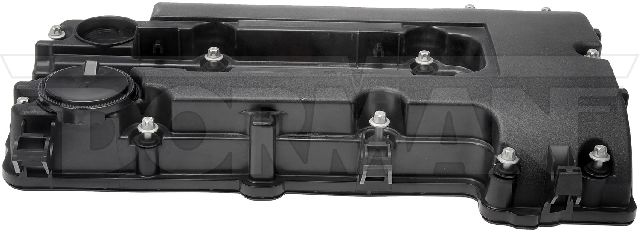
- On 1.4L engines, some owners have had issues with aftermarket Dorman valve covers leaking, with one owner on Reddit stating the gasket channel bowed, causing oil to leak into the spark plug wells. They recommended sticking with the OEM part.
Most Likely Causes


- Exhaust Leak 🔴 High Probability The flex pipe and exhaust manifold are common areas for cracks or gasket failures, allowing unmetered oxygen to enter the exhaust and fool the downstream O2 sensor. This is a primary suspect for both engines.
How to confirm: Visually inspect the exhaust manifold, gaskets, and flex pipe for cracks, rust, or black soot trails. Listen for a ticking or hissing sound that is louder when the engine is cold. A professional smoke test is the most definitive way to find a leak.
Typical fix: Replace the cracked component (e.g., exhaust manifold, flex pipe) or the failed gasket.
Est. part cost: $20-$250 - Failed PCV System / Valve Cover (1.4L Turbo Engine) 🔴 High Probability A check valve in the intake manifold fails, causing excess vacuum that ruptures a diaphragm in the valve cover. This creates a large vacuum leak, often triggering P0171 and P2096.
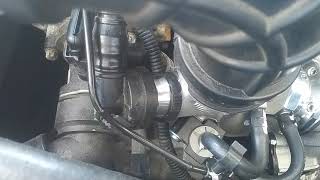
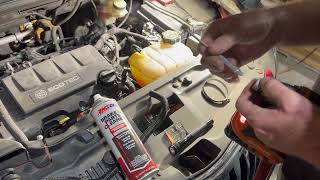
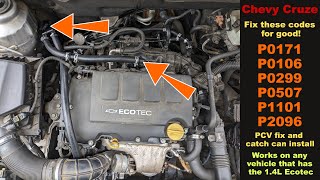
How to confirm: With the engine running, listen for a distinct whistling or hissing sound from the engine bay. Try removing the oil filler cap; if there is strong suction and the engine idle changes drastically, the PCV system has likely failed. This is addressed in GM TSB PIP5197G. 🎬 Watch: How to diagnose and solve common 1.4L PCV issues.
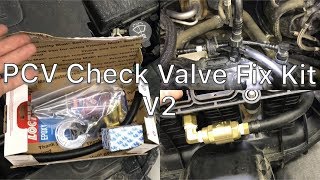
Typical fix: Replace the entire valve cover assembly. Some owners also install an aftermarket external PCV check valve kit to prevent recurrence. The intake manifold should also be inspected for a missing check valve.
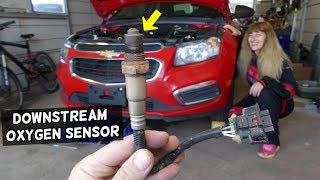
Est. part cost: $60-$150 - Faulty Downstream Oxygen Sensor (Sensor 2) 🔴 High Probability O2 sensors are wear items and can fail over time, sending incorrect (false lean) voltage signals to the ECM. This is a very common fix reported by owners, but should only be done after ruling out leaks. 🎬 See this walkthrough for replacing the downstream oxygen sensor.
How to confirm: Use a scan tool to monitor the live voltage data for Bank 1 Sensor 2. A healthy downstream sensor should show a relatively stable voltage, typically between 0.6V and 0.8V on a warm engine. If it's stuck low (e.g., under 0.2V) or fluctuating rapidly like the upstream sensor, it is likely faulty. This test should only be done after confirming there are no exhaust leaks.
Typical fix: Replace the downstream (post-catalyst) oxygen sensor.
Est. part cost: $40-$90 - Incorrect ECM Calibration (1.8L Engine) 🟡 Medium Probability GM issued TSB PI0422A stating that on the 1.8L engine, the P2096 code can be set falsely without any actual problem present, especially on low-mileage vehicles.
How to confirm: This can only be confirmed by a GM dealership or a qualified shop with access to GM's TIS2WEB programming system. They can check the current calibration version against the updated one mentioned in the TSB. A Reddit user mentioned this TSB as a key first step for 1.8L owners.
Typical fix: Reprogram the Engine Control Module (ECM) with the updated software calibration.
Est. part cost: $0 (if covered) - $200 (shop labor)
Rare But Worth Checking
- Failing Catalytic Converter: While not the most common cause, a converter that is losing its efficiency can no longer properly store oxygen, causing erratic readings from the downstream O2 sensor. This is more likely if code P0420 is also present. A user on Reddit described symptoms of a clogged cat including a muffled sound and power loss when hot.
- Low Fuel Pressure or Faulty Injectors: A weak fuel pump or clogged fuel injector can cause a true lean condition that the downstream sensor detects. This is less common than exhaust/vacuum leaks but should be considered if other codes like P0171 are present and no leaks are found.
- Driving Habits (Digital Throttle Input): Manufacturer service bulletin #PIP5467A notes that P2096 can sometimes be triggered if a driver "drives digitally," frequently tapping the accelerator pedal (on-off-on-off) to maintain speed.
Diagnosis Steps

- Scan for other DTCs. If P0171 is present, prioritize finding a vacuum or fuel delivery issue. If P0420 is present, suspect the catalytic converter.
- (1.8L Engine Only): If P2096 is the only code, contact a dealer or qualified shop to check if your ECM has the latest software per TSB PI0422A before proceeding.
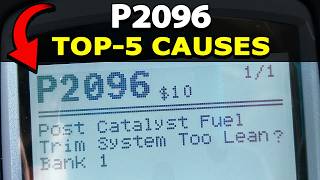
- Thoroughly inspect the exhaust system for leaks from the exhaust manifold to the downstream O2 sensor. Look for cracks, soot, and listen for hissing sounds. A smoke test is the most reliable method. 🎬 Watch: A professional guide to diagnosing the P2096 code.
- (1.4L Engine Only): Inspect the PCV system. With the engine running, listen for whistling noises and check for strong vacuum at the oil filler cap. This is a sign of a failed valve cover diaphragm per TSB PIP5197G.
- If no leaks are found, use a scan tool to observe the live data from the downstream O2 sensor (Bank 1, Sensor 2). A healthy, warm sensor should show a steady voltage around 0.7V-0.8V. If the voltage is stuck low (below ~0.2V) and does not respond, the sensor is the likely culprit.
- If all else fails, test fuel pressure to rule out a weak fuel pump. A professional may be needed to test the catalytic converter's efficiency or check for clogged fuel injectors.
Parts You'll Likely Need

- Downstream Oxygen Sensor (Post-Catalyst, Sensor 2)
(OEM #55572216)— This sensor is a common failure point and directly provides the reading that triggers the P2096 code. It fits both 1.4L and 1.8L engines.
Trusted brands: ACDelco, Bosch, Denso, NGK/NTK
OEM price range: $70-$110
Aftermarket price range: $40-$90 - Engine Valve Cover (1.4L Turbo)
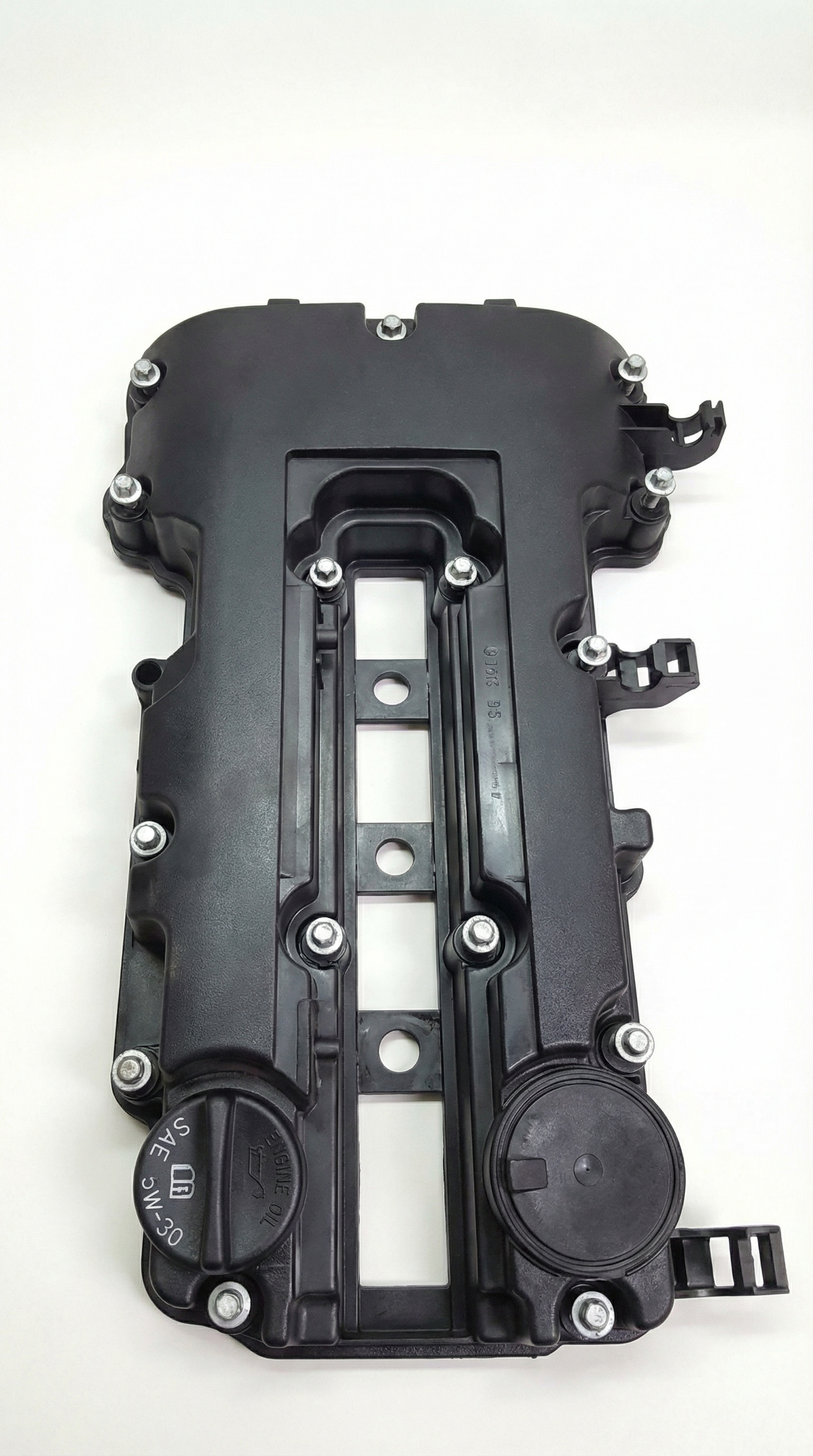
(OEM #25198874 (supersedes 55573746, 25198498))— A failed internal PCV diaphragm requires replacement of the whole cover. This is a very common cause of vacuum leaks and lean codes on the 1.4L engine. The Dorman aftermarket equivalent is part number 264-968, though some users report fitment issues.
Trusted brands: ACDelco (OEM), Dorman
OEM price range: $120-$180
Aftermarket price range: $60-$100 - Exhaust Manifold Gasket — A failed gasket between the cylinder head and exhaust manifold can cause a significant exhaust leak, leading to a false lean reading.
Trusted brands: Fel-Pro, ACDelco
OEM price range: $25-$40
Aftermarket price range: $15-$30
Related Codes That Often Appear With This One
- P0171 — This code for 'System Too Lean (Bank 1)' often appears with P2096, especially on the 1.4L engine. It strongly indicates a true lean condition caused by a vacuum leak (like a failed PCV system) or a fuel delivery issue, rather than just a faulty downstream sensor. Diagnosing the P0171 cause will almost always fix the P2096 in this case.
- P0420 — This code for 'Catalyst System Efficiency Below Threshold' points directly to a failing catalytic converter. If seen with P2096, the converter is a primary suspect, as its inability to store oxygen can cause the lean reading downstream.
- P0621 — According to TSB #PI1409A, this code related to the generator lamp L terminal circuit can sometimes appear alongside P2096.
Technical Service Bulletins (TSBs) & Recalls
- PI0422A: Addresses false P2096 code on 1.8L engines, fixed by an ECM reprogram.
- PIP5197 (and revisions like PIP5197G): Details diagnosis for oil consumption, smoke, and lean codes (P0171, P2096) related to the PCV system failure on 1.4L engines.
- PI0552: Referenced within PIP5197, relates to checking for proper sealing of the oil dipstick and fill cap, which can cause unmetered air entry.
- PIP4925: Referenced within PIP5197, relates to checking for air leaks in the intake system.
- TSB #18NA014: Provides ECM reprogramming information specifically to correct DTC P2096.
- TSB #19NA017: Outlines a procedure to program the ECM to correct a Malfunction Indicator Lamp (MIL) illuminated with DTC P2096 or P2097.
- TSB #19NA058: Notes that P2096 may be set alongside customer concerns of hesitation or low power due to false knock detection.
Platform-Specific Known Issues
- 1.4L Turbo PCV System Failure: The positive crankcase ventilation (PCV) system is integrated into the valve cover. A non-return valve in the intake manifold can fail, allowing boost pressure into the crankcase, which then ruptures the PCV diaphragm in the valve cover. This creates a massive vacuum leak, pulling unmetered air into the engine and causing lean codes P0171 and P2096. The fix is to replace t
Mechanic-Grade Diagnostic Values
- Downstream O2 Sensor (Sensor 2) Voltage at Idle (Warm Engine) — expected: Relatively steady 0.76V.. Failure: Stuck low around 0.12V - 0.18V after deceleration, and slow to rise back to the normal range.
- Downstream O2 Sensor Heater Circuit Resistance — expected: Approximately 4.5Ω – 6.2Ω at room temperature for a compatible sensor.. Failure: A reading significantly outside this range (open circuit or short) indicates a failed heater element, which can cause slow sensor response and trigger codes.
- Fuel Pump Pressure — expected: Generally 40-60 PSI for most similar port-injected vehicles.. Failure: Pressure below the specified range indicates a weak fuel pump, which can cause a true lean condition.
- TSB PI0422A False Code Conditions (1.8L Engine) — expected: N/A. Failure: If freeze frame data shows Ambient Air Temp < 5°C (41°F), Engine Speed < 1200 RPM, Vehicle Speed = 0, and Accelerator Pedal = 0%, the code was likely set falsely and requires an ECM reflash.
Hidden / Shadow Codes Worth Checking
- Mode $06, TID $8B, CID $0A: Post Catalyst Sensor Rich Test. This onboard test checks the sensor's ability to detect a rich condition. (see via A scan tool capable of displaying Mode $06 data. The value is reported in volts.)
- Mode $06, TID $8C, CID $0A: Post Catalyst Sensor Lean Test. This onboard test checks the sensor's ability to detect a lean condition, which is directly relevant to P2096. (see via A scan tool capable of displaying Mode $06 data. The value is reported in volts. A failing value here can predict a P2096 code before it becomes persistent.)
Scan Tool Commands That Help
- GDS2 / Tech2 / Professional Scan Tool: Fuel Trim Reset — After replacing a component that affects the air-fuel ratio (like a valve cover, O2 sensor, or fixing an exhaust leak), resetting the long-term fuel trim values forces the ECM to relearn from scratch with the new, correct inputs.
- GDS2 / TIS2WEB: ECM Reprogramming (SPS) — Specifically for the 1.8L engine, this is used to apply the updated calibration from TSB PI0422A to fix the false P2096 code issue.
Wiring & Ground Locations
- G100 / G105 — Located at the left front corner of the engine compartment. G100 is lower, G105 is higher up behind the cooling fan relays.. These are primary engine bay ground points. A corroded or loose connection here can cause erratic behavior from multiple sensors and modules, including the ECM and its inputs from the O2 sensors.
- G103 — Located on the left shock tower in the engine compartment.. This ground serves the Body Control Module (BCM) and Data Link Connector (DLC), among other things. A fault here can cause communication issues and potentially incorrect diagnostic readings.
- ECM Connector 2 (X2) — On the Engine Control Module (ECM).. On the 1.8L engine, pins 1, 3, and 5 are grounds, while pins 2, 4, and 6 are 12V power feeds. Verifying these is a critical step before condemning the ECM itself.
Real Owner Repair Stories
- MHH AUTO Forum User (2010 Chevrolet Cruze 1.8L Petrol) — Check Engine Light with code P2096.
❌ Tried (didn't work) Replaced both upstream and downstream O2 sensors twice, assuming the new parts were faulty.
✅ What actually fixed it The issue was a false code being set due to an ECM calibration error. The fix was to reprogram the ECM with the updated software file as described in GM TSB PI0422A. The user noted the code would set under specific conditions: low ambient temperature, low RPM, and zero vehicle speed. - P & G Motors Diagnostic Case Study (2009 Holden Cruze (equivalent to Chevrolet Cruze) with F18D 1.8L Engine) — Check Engine Light with P2096. The light would only come back on 2-3 days after clearing. The tech found a specific way to reproduce the fault: warm up the engine, drive to 80 km/h, then decelerate. At idle, the rear O2 sensor would get stuck at a low voltage (0.12-0.18v) for a while before recovering.
❌ Tried (didn't work) Multiple code clearing attempts by a previous mechanic.
✅ What actually fixed it The final repair involved two steps: replacing both the front and rear O2 sensors (which were visually contaminated) AND reprogramming the ECM with the updated calibration from the TSB. The author notes it's unclear if just one or both actions were necessary, but the combination resolved the fault.
OEM Part Supersession History
55573746, 25198498→25198874— Revisions to address the PCV system failure.
Heads up: While physically interchangeable, using an older part number risks experiencing the same PCV failure. It is critical to use the latest revision (25198874) for the 1.4L valve cover replacement.
Model Year Variations Within This Range
- 2016 (Second Generation): The 2016 model year is a split. The 'Cruze Limited' is a carryover of the first generation and is covered by this guide. The all-new 2016 Cruze sedan is the second generation, featuring a completely redesigned and lighter chassis and a new, more powerful 1.4L turbo engine (153 hp vs 138 hp). While some causes may be similar, diagnostic procedures and parts will differ.
- 2011-2013 vs 2014-2016 (1.4L Turbo): Earlier 1.4L turbo models (2011-2012) are considered more problematic, particularly regarding cooling system and oil leaks that can sometimes be related to PCV issues triggering lean codes. While the P2096 causes are the same, the probability of PCV failure is higher on earlier models.
Diagnostic Flowchart
Used vs. New Parts: Buying Guide for This Vehicle
When a used part is the smart pick: For this specific code, buying used parts is generally not recommended for the most common failures. Structural components like an exhaust manifold could be sourced from a junkyard, but only after a thorough inspection for cracks or warping.
Donor-vehicle mileage cap: roughly under 50000 miles for the part to have meaningful remaining life.
What to inspect on the donor part:
- For an exhaust manifold, check for hairline cracks, especially around the flange and collector.
- Ensure all mounting studs are intact and not stripped.
- Look for a vehicle with a documented front-end collision rather than one junked for engine failure.
OEM-only on this vehicle (don't cheap out):
- Engine Valve Cover (1.4L): The failure rate of the integrated PCV system is extremely high. A used part has unknown remaining life, and some aftermarket versions (like Dorman) have forum reports of poor fitment and gasket quality. Sticking with a new OEM (ACDelco) part is the most reliable fix.
- Catalytic Converter: Aftermarket converters for this platform are known to fail prematurely or not meet emissions standards, potentially causing P0420 to appear shortly after fixing P2096.
Aftermarket brands forum-validated for this vehicle:
- O2 Sensors: Bosch, Denso, and NGK/NTK are all highly reputable OEM suppliers and are considered safe and reliable replacements.
Brands owners have reported issues with on this vehicle:
- Valve Cover (1.4L): Use caution with Dorman (p/n 264-968). While a popular and affordable option, multiple owner reports mention issues with the gasket channel bowing or leaking oil into spark plug wells, sometimes requiring a return to the more expensive OEM part.
- Universal O2 Sensors: Avoid universal sensors that require splicing wires. They are a common point of failure and can introduce signal problems. A direct-fit sensor from a reputable brand is worth the small extra cost.
Real Owner Stories
Aggregated from forums and TSBs cited above. Mileages and costs reflect what owners reported in those sources.
2015 Cruze LT — 156000 miles
Symptoms: Check engine light with codes P0171 and P2096, sluggish acceleration, horrible gas mileage (half of normal), and a smell of gas after driving. Also received service traction control and stabiltrack messages.
What fixed it: Owner replaced the upstream O2 sensor, but the codes returned after three months, indicating this was not the final solution.
Source hint: Reddit r/cruze
2011 Chevrolet Cruze 1.8L
Symptoms: Check Engine Light with code P2096, potentially with no other noticeable symptoms or drivability issues.
What fixed it: The issue was identified as a false code addressed by GM TSB PI0422A. The fix was to reprogram the Engine Control Module (ECM) with updated software calibration.
Cost: $0-$200
Source hint: Reddit r/MechanicAdvice
Related OBD-II Codes
Frequently Asked Questions
I hear a whistling noise from my 1.4L Turbo Cruze and have a P2096 code. What's the likely cause?
My 1.8L Cruze has only the P2096 code and seems to run fine. What should I check first?
What is the most common cause of P2096 on the Cruze if it's not the PCV system or an ECM issue?
How can I test the downstream O2 sensor on my Cruze to see if it's faulty?
Does GM TSB PIP5197G apply to my 2014 Cruze 1.4L with P2096 and P0171 codes?
My mechanic wants to replace the downstream O2 sensor, but I'm not sure. What should I do first?
Helpful Videos
Used OEM Parts in Stock
New Aftermarket Parts Available


The information in this article is provided for general reference and educational purposes only. Vehicle specifications, procedures, and part compatibility can vary by production date, trim level, and region. Always consult your vehicle's factory service manual and verify part numbers before purchasing or performing repairs. Safety-critical components such as airbags, seat belts, and braking systems should be installed by a qualified professional.
- Chevrolet Cruze:
- 🎬 Helpful Videos
- 🛍️ Shop This Part
- What's Unique About the 2011-2016 Chevrolet Cruze
- Symptoms You May Notice
- Most Likely Causes
- Rare But Worth Checking
- Diagnosis Steps
- Parts You'll Likely Need
- Related Codes That Often Appear With This One
- Technical Service Bulletins (TSBs) & Recalls
- Platform-Specific Known Issues
- Mechanic-Grade Diagnostic Values
- Hidden / Shadow Codes Worth Checking
- Scan Tool Commands That Help
- Wiring & Ground Locations
- Real Owner Repair Stories
- OEM Part Supersession History
- Model Year Variations Within This Range
- Diagnostic Flowchart
- Used vs. New Parts: Buying Guide for This Vehicle
- Real Owner Stories
- 2015 Cruze LT — 156000 miles
- 2011 Chevrolet Cruze 1.8L
- Related OBD-II Codes
- Frequently Asked Questions
- 🎟️ Get 5% Off