

OBD-II Code P2082: Exhaust Gas Temperature Sensor Performance Problem (Bank 2, Sensor 1)
What P2082 means, why it triggers, and how to fix it like a pro
- P2082 indicates the Bank 2, Sensor 1 Exhaust Gas Temperature (EGT) sensor is sending an illogical voltage reading outside the normal 0.1V to 4.9V range.
- Do not drive more than 10-20 miles with this code; ignoring it disables DPF regeneration and causes irreversible filter damage costing upwards of $2,000.
- Before buying a $150 replacement sensor, use an OBD-II scanner to verify the live EGT data isn't stuck at -40°F, which confirms an open circuit or dead sensor.
- Inspect the wiring harness near the exhaust up-pipe for melted insulation, as heat-damaged wires cause 30% of P2082 codes on heavy-duty diesel trucks.
What Does P2082 Mean?
P2082 means the Powertrain Control Module (PCM) detects an irrational or out-of-range voltage reading from the Exhaust Gas Temperature (EGT) sensor. This code points to the sensor on Bank 2 (the engine side without cylinder #1) at the Sensor 1 position, located upstream of the catalytic converter or Diesel Particulate Filter (DPF).
Technical definition: Exhaust Gas Temperature (EGT) Sensor Circuit Range/Performance Bank 2 Sensor 1.
Can I Drive With P2082?
Yes, But With Caution. You can drive the vehicle, but do not exceed a few miles, especially on diesel models. Ignoring the code prevents the Diesel Particulate Filter (DPF) from regenerating, leading to a permanently clogged DPF and a $1,500-$4,500 repair. Continued driving also damages the catalytic converter, adding $900-$2,500 to the bill. Drive only to a repair shop to avoid a multi-thousand-dollar exhaust system overhaul.
Common Causes
- Faulty Exhaust Gas Temperature (EGT) Sensor (Very Common) — The internal thermistor fails from extreme heat cycles, vibration, or heavy soot contamination, sending erratic or open-circuit readings to the PCM.
- Damaged Wiring or Connectors (Common) — The wiring harness melts from exhaust heat, becomes brittle and breaks, or corrodes from moisture and road salt. Loose connectors disrupt the 5-volt reference signal.
- Exhaust System Leaks (Common) — A crack in the exhaust manifold or up-pipe allows ambient air to enter the exhaust stream. This cools the exhaust gases, causing the sensor to report an illogically low temperature.
- Clogged Diesel Particulate Filter (DPF) (Less Common) — A restricted DPF causes exhaust backpressure and temperature to build unpredictably. The PCM interprets these extreme EGT readings as a sensor performance fault.
- Engine Control Module (ECM) Software Glitch (Less Common) — Outdated PCM software contains overly sensitive fault logic. Manufacturers frequently release Technical Service Bulletins (TSBs) to recalibrate expected EGT voltage ranges.
- Aftermarket Exhaust Modifications (Less Common) — Deleting or altering the catalytic converter or DPF significantly changes exhaust flow and temperature, causing the stock EGT sensor to provide out-of-range readings.
- Faulty Fuel Injector or EGR Valve (Rare) — A malfunctioning injector or stuck EGR valve alters combustion, leading to abnormal exhaust temperatures that the PCM misinterprets as a sensor fault.
- Faulty Powertrain Control Module (PCM) (Very Rare) — The PCM's internal circuit for reading the EGT sensor is damaged, requiring module replacement or repair.
Symptoms
- Check Engine Light is On — The primary and often only immediate symptom noticed by the driver.
- Reduced Engine Power ('Limp Mode') — The PCM limits engine power to protect the turbocharger and DPF from overheating due to unknown exhaust temperatures.
- Failed Emissions Test — An active P2082 code automatically fails an OBD-II state emissions inspection.
- Flashing Glow Plug Light — On Volkswagen and Audi diesels, a flashing glow plug light accompanies the Check Engine Light for EGT faults.
- Inability for DPF to Regenerate & Decreased MPG (also visible on scanner) — The PCM disables DPF regeneration without accurate EGT data, leading to rapid soot accumulation and a 5-10% drop in fuel economy.
Diagnostic Flowchart
Tap your situation to follow the diagnostic path that matches what you're seeing on this code.
Common Fixes & Costs
- Replace the EGT Sensor — Parts: $50-$250, Labor: $100-$300, ~1.5 hr book time (Intermediate)
- Repair Damaged Wiring or Connector — Parts: $10-$50, Labor: $100-$250, ~1.5 hr book time (Intermediate)
- Repair Exhaust Leak — Parts: $20-$200, Labor: $150-$500, ~2.5 hr book time (Professional)
- Reprogram the Powertrain Control Module (PCM) — Parts: $0-$100, Labor: $100-$250, ~1 hr book time (Professional)
- Perform a Professional Check Engine Light Diagnostic — Parts: $0, Labor: $100-$200, ~1 hr book time (Professional)
DIY vs Professional
- Replace the EGT Sensor — Beginner:
Tools: Penetrating oil, flare nut wrench set, torch, EGT sensor-specific socket set. - Repair Damaged Wiring or Connector — Beginner:
Tools: Wire strippers, crimpers, heat shrink tubing, multimeter. - Repair Exhaust Leak — Beginner:
Tools: Full socket set, torque wrench, welding equipment, gasket scrapers.
Used vs. New Parts: Buying Guide
When a used part is worth it: Buying a used EGT sensor is never recommended. It is an inexpensive wear-and-tear component where labor is the primary cost. The risk of a used sensor failing outweighs the savings.
Donor-vehicle mileage cap: roughly under 20000 miles for the part to have meaningful remaining life.
Donor quality checklist:
- Only select from a low-mileage wrecked vehicle.
- Avoid parts from flood-damaged or rust-belt vehicles.
- Match the part number exactly to ensure correct calibration.
Decision logic:
- If The part is an EGT sensor → Buy a new OEM or high-quality aftermarket part. Savings from a used sensor are not worth repeat labor costs.
- If The related expensive part (DPF/Catalytic Converter) failed → A used part from a low-mileage wreck is a budget-conscious option.
Warranty tradeoff: Used sensors offer a 30-day warranty. New aftermarket sensors offer 1-year to lifetime warranties, and OEM parts offer 1-2 year warranties.
Worst-case if a used part fails: $200-$400. If a used sensor fails, you pay diagnostic and labor costs twice.
What Happens If You Wait — Timeline
- 0-1 month: Check Engine Light is on. Vehicle fails emissions test. DPF regeneration becomes less efficient. (MPG impact: 0-5%% · Added cost: $0-$75 in wasted fuel.)
- 1-3 months (Diesel): DPF regeneration is disabled. Soot accumulates rapidly. A DPF warning light appears. Engine power reduces as backpressure builds. (MPG impact: 5-10%% · Added cost: $150-$300 in wasted fuel. The DPF is at risk.)
- 3-6 months (Diesel): The DPF is severely clogged with hardened soot. Forced regeneration fails. The catalytic converter sustains damage from incorrect temperatures. (MPG impact: 10-20%% · Added cost: $2,500-$7,000 for DPF and catalytic converter replacement.)
- 6+ months: Catastrophic failure. Extreme backpressure damages the turbocharger seals or internal engine components. The vehicle enters permanent limp mode. (MPG impact: >20%% · Added cost: $5,000-$10,000+ for major engine and exhaust repair.)
Cost of Not Fixing It
- 0-1 month: Failed emissions test and a 5-10% decrease in fuel economy as the PCM defaults to a richer fuel mixture. (Added cost: $0-$75)
- 1-6 months (Diesel): The DPF becomes irreversibly clogged with soot because the PCM cannot initiate regeneration cycles. (Added cost: $2,000-$5,000)
- 1-6 months (Gasoline/Diesel): The catalytic converter overheats or becomes coated with unburnt fuel due to incorrect PCM fuel management. (Added cost: $1,200-$2,800)
- 6+ months: Extreme exhaust backpressure from a clogged DPF damages the turbocharger seals and internal engine components. (Added cost: $4,000-$8,000)
Diagnosis Steps
- Read the Code and Freeze Frame Data
Use an OBD-II scanner to confirm P2082. Analyze the freeze-frame data to identify the exact engine RPM, load, and coolant temperature when the fault occurred to replicate the conditions.
Tools: OBD-II Scanner (Beginner) - Test the EGT Sensor with Live Data
Monitor the live data stream for 'EGT Bank 2, Sensor 1' using an advanced scanner. The temperature must rise steadily from ambient to 250-500°F (120-260°C) at idle. If the reading is stuck at -40°F, erratic, or significantly lower than Bank 1, the sensor or circuit has failed.
Tools: Advanced OBD-II Scanner (Intermediate) - Visually Inspect the Sensor and Wiring
Locate the EGT sensor on Bank 2, upstream of the DPF/catalyst. Inspect the wiring harness for melted insulation, chafing against the engine block, or corroded connector pins.
Tools: Flashlight, Safety Glasses (Beginner) - Inspect for Exhaust Leaks
With the engine running cold, feel and listen for air puffs from the exhaust manifold, up-pipes, and flange gaskets leading to the sensor. Black soot trails indicate a leak drawing in cold ambient air.
Tools: Gloves, Safety Glasses (Intermediate) - Check for Reference Voltage and Ground
Unplug the sensor and turn the key to 'On' (engine off). Test the vehicle-side connector with a multimeter. One pin must have a stable 5-volt reference signal from the PCM. The other must show less than 0.2 ohms of resistance to chassis ground.
Tools: Digital Multimeter (Intermediate) - Pro Tip: Test the EGT Sensor's Resistance
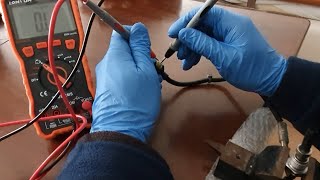
Measure the resistance between the disconnected sensor's two pins. Look for an open circuit ('OL' or infinite resistance) or a short circuit (near zero ohms), both confirming a dead sensor. Normal resistance is typically 200-250 ohms at room temperature.
Tools: Digital Multimeter, Service Manual (Advanced) - Pro Tip: Perform a Sensor Bench Test
With the multimeter attached to the disconnected sensor, heat the tip with a heat gun. The resistance must change smoothly without jumping or dropping out. Erratic resistance confirms internal sensor failure.
Tools: Digital Multimeter, Heat Gun (Advanced) - Advanced: Test Sensor Voltage Output
Back-probe the signal wire with the sensor connected and engine running. Voltage must rise steadily from ~0.5V at cold start to 3.0-4.5V at operating temperature. Stuck voltage indicates a circuit failure.
Tools: Digital Multimeter with back-probes (Advanced) - Advanced: Perform a Voltage Drop Test
Connect the multimeter positive lead to the battery positive and negative lead to the 5V reference pin (engine running). A reading over 0.5V indicates excessive resistance in the power circuit. Repeat for the ground side.
Tools: Digital Multimeter with back-probes (Advanced) - Check for PCM Software Updates
If the sensor and wiring pass all tests, the PCM fault logic is likely too sensitive. Check manufacturer databases for Technical Service Bulletins (TSBs) requiring a software reflash.
Tools: Phone or Online TSB Database (Professional)
When This Code Triggers (Freeze-Frame Conditions)
- Engine Coolant Temp: 185-210°F (85-99°C) (The engine is fully warmed up and running for several minutes.)
- Engine RPM: 1500-2500 RPM (The vehicle is driven at a steady cruising speed.)
- Engine Load: 30-60% (The engine is under a moderate, consistent load.)
- Vehicle Speed: 45-65 mph (72-105 km/h) (The fault logs during steady-state highway driving when the PCM actively monitors EGT for DPF regeneration.)
Related Codes
- P2080 — Identical fault for Bank 1, Sensor 1. Simultaneous P2080 and P2082 codes strongly suggest a systemic issue like a PCM software glitch or widespread wiring damage.
- P0548 — Indicates 'Circuit High' for Bank 2, Sensor 1. Voltage is stuck at maximum, suggesting a direct short to power or an open circuit.
- P0547 — Indicates 'Circuit Low' for Bank 2, Sensor 1. Voltage is stuck at minimum, suggesting a short to ground (e.g., chafed wire touching the engine block).
- P2031 — Indicates a fault for Bank 1, Sensor 2 (post-catalyst/DPF). Simultaneous codes for different sensors point toward a wiring harness problem.
Climate & Environmental Factors
- Cold Climates / Road Salt: Road salt accelerates corrosion on the EGT sensor's wiring harness and connector pins, leading to poor connections or shorts.
- High Humidity: Sustained humidity promotes moisture intrusion into unsealed connectors, degrading signal integrity over time.
How to Clear the Code After You Fix It
- Use an OBD-II scan tool to clear the P2082 code from the PCM's memory.
- Perform a complete OBD-II drive cycle to allow readiness monitors to run.
- Verify the code does not return as pending after the drive cycle.
Drive cycle (~30 minutes): A generic drive cycle includes a cold start (engine off for 8+ hours), a 2-3 minute idle, 10-15 minutes of mixed city driving, and 10-15 minutes of steady highway speed driving at 55 mph.
Readiness monitors affected: Catalyst Monitor, Exhaust Gas Sensor (O2/EGT) Monitor, EGR System Monitor
Before emissions retest: drive at least 50 miles to fully set monitors.
Watch out for:
- Disconnecting the battery clears the code but resets all readiness monitors to 'Not Ready', causing an automatic emissions failure.
- The code returns immediately if the root cause (bad wire, exhaust leak) is not fixed.
- Failing to meet specific drive cycle conditions (fuel level between 15-85%) prevents readiness monitors from setting.
Will This Fail Emissions / State Inspection?
Yes — this code typically fails an OBD-II emissions inspection.
- California: P2082 is an automatic SMOG check failure. All required OBD-II readiness monitors must be 'Ready' before a retest.
- New York: An active Check Engine Light causes automatic NYVIP3 failure. Only one readiness monitor can be 'Not Ready' for 2001+ vehicles.
- Texas: An illuminated Check Engine Light is an automatic failure. You must complete a drive cycle after clearing the code.
Most Commonly Affected Vehicles
- Ford F-250/F-350 Super Duty (Powerstroke) (2008-2016) — The 6.7L (2011-2016) has four EGT sensors. Wiring harnesses routed near high-heat areas frequently melt, causing shorts.
- Dodge / Ram 2500/3500 (Cummins) (2007-2018) — EGT sensor failures are highly common on the 6.7L Cummins, immediately disabling the DPF regeneration process.
- Chevrolet / GMC Silverado/Sierra 2500/3500 (Duramax) (2007-2016) — LMM and LML engines are susceptible to EGT sensor and wiring harness issues, frequently triggering limp mode.
- Volkswagen Jetta / Golf / Touareg (TDI) (2009-2016) — TSB 2055826/2 notes a faulty ambient air temperature sensor falsely triggers EGT codes. Many are covered by the 'Dieselgate' extended warranty.
- Audi A3 / Q7 (TDI) (2009-2015) — Shares the VW ambient air temperature sensor TSB issue and 'Dieselgate' extended emissions warranty coverage.
- BMW 335d / X5 xDrive35d (2009-2013) — Advanced emissions systems utilize multiple EGT sensors; failures cause immediate DPF regeneration lockouts.
- Subaru Forester / Outback (Diesel) (2008-2014) — Boxer engine layout makes accessing the Bank 2 EGT sensor challenging, increasing labor times.
- Mercedes-Benz Sprinter / E-Class / GL-Class (BlueTEC) (2010-2016) — Sensor failure prevents DPF regeneration and triggers a hard-coded countdown to a no-start condition.
Manufacturer-Specific Notes
- Ford / GM / Ram (Diesel Trucks): The EGT sensor wiring harness is the primary failure point due to extreme heat exposure from the exhaust up-pipe. Inspect for melted wires before replacing the sensor.
- Volkswagen / Audi: TSB 2055826 states a faulty Ambient Air Temperature Sensor causes the ECM to falsely trigger P2080/P2082. Diagnose ambient air temp codes first.
- Volkswagen / Audi (TDI): WARRANTY ALERT: The 'Dieselgate' extended emissions warranty covers all EGT sensors for 10 years/120,000 miles or 4 years/48,000 miles from the emissions modification date. Check eligibility before paying.
- Mercedes-Benz: BlueTEC EGT sensor failures trigger a 'Service DEF System' warning and a countdown of remaining engine starts, eventually resulting in a no-start condition.
Real Owner Stories
2012 VW Jetta TDI with 130k miles - Intermittent Fault
Check Engine Light and flashing glow plug light appeared intermittently on cold days.
What they tried:
- Initial shop replaced the wrong EGT sensor. Code returned.
- VW specialist diagnosed it correctly as Bank 2, Sensor 1.
- Specialist found slight corrosion on the wiring harness connector.
Outcome: The specialist cleaned the connector pins and applied dielectric grease. Total cost was $150 for diagnostic labor. The code did not return.
Lesson: An intermittent P2082 often points to a wiring issue rather than a hard sensor failure. Always inspect the circuit before replacing parts.
2015 Ram 2500 Cummins at 95k miles - The Misdiagnosis
P2082 code appeared. General mechanic recommended replacing the EGT sensor.
What they tried:
- Mechanic replaced the sensor. Code returned within 50 miles.
- Mechanic suggested the DPF was clogged and quoted $3,500.
- Owner sought a second opinion at a diesel shop.
Outcome: The specialist found a hairline crack in the exhaust manifold upstream of the sensor letting in air. Repairing the manifold cost $650. The original sensor was fine.
Lesson: Do not condemn an expensive DPF immediately. Thoroughly check for subtle exhaust leaks first to avoid costly incorrect repairs.
2011 Chevy Silverado 2500 Duramax (LML) at 152k miles - Easy Fix
P2082 code triggered, putting the truck into 'limp mode'.
What they tried:
- Owner used a scan tool to monitor live data.
- Live data showed the EGT sensor stuck at -40°F.
Outcome: The stuck reading pointed to a failed sensor or open circuit. Visual inspection showed no wiring damage. The owner replaced the EGT sensor in an hour, restoring full power.
Lesson: Live data is the fastest way to confirm a failed sensor. An illogical reading stuck at a minimum value strongly indicates internal sensor failure.
2013 Audi A3 TDI - The TSB Pitfall
P2082 code appeared with an Ambient Air Temperature Sensor code.
What they tried:
- Dealership quoted $800 to replace the EGT sensor and harness.
Outcome: The owner asked the advisor to check TSBs. TSB 2055826/2 states a faulty Ambient Air Temperature Sensor falsely triggers EGT codes. Replacing the ambient air sensor resolved both codes under warranty.
Lesson: Always check for TSBs on VW/Audi models. Diagnose seemingly unrelated sensor codes first, as they can cause false EGT codes.
How to Prevent This Code From Triggering
- Use high-quality diesel fuel and fuel system cleaners. (Every fill-up / Every 5,000 miles) — Better fuel burns cleaner, producing less soot. This reduces stress on the DPF and prevents soot from coating the EGT sensor.
- Ensure DPF regeneration cycles complete. (Weekly) — Short trips prevent the DPF from getting hot enough to regenerate. Drive at highway speeds for 30-45 minutes weekly to ensure a full regen and prevent soot buildup.
- Use the correct low-SAPS engine oil. (Every oil change) — Low-SAPS oil is designed for modern diesels. Incorrect oil creates metallic ash that permanently clogs the DPF, leading to excessive heat and EGT sensor failure.
- Periodically inspect wiring harnesses. (Every 15,000 miles) — EGT sensor wiring lives in a hot environment. Ensuring harnesses are secure prevents wires from sagging and melting against hot exhaust pipes.
- Address engine performance issues immediately. (As they occur) — Leaking injectors or a faulty EGR valve increase exhaust temperatures and soot production, quickly destroying the EGT sensor or DPF.
Frequently Asked Questions
What does 'Bank 2, Sensor 1' actually mean?
Bank 2 is the engine side without the #1 cylinder. Sensor 1 is the first EGT sensor in the exhaust stream, located before the catalytic converter or DPF.
Can I just clean the EGT sensor to fix it?
No. While heavy soot insulates the sensor, cleaning rarely provides a permanent fix. The failure is almost always internal to the sensor's resistor or an electrical fault, requiring full replacement.
What are the long-term consequences of ignoring code P2082?
Ignoring P2082 causes automatic emissions test failure and prevents DPF regeneration on diesel engines. This irreversibly clogs the DPF, leading to a replacement cost exceeding $2,000. It also risks severe damage to the catalytic converter and turbocharger.
How difficult is replacing an EGT sensor as a DIY job?
It is manageable for experienced DIYers but carries high risk. The sensor frequently seizes in the exhaust pipe from rust and heat cycles, requiring penetrating oil, a flare nut wrench, and a torch. Breaking the sensor off requires drilling and re-tapping, turning a $100 fix into a major repair.
My mechanic replaced the sensor, but the code came back. What now?
If a new sensor fails to clear the code, the root cause remains unfixed. The most common hidden culprits are intermittent wiring shorts, hairline exhaust manifold cracks, or outdated PCM software requiring a manufacturer update.
What are the most common misdiagnosis mistakes for P2082?
The biggest mistake is replacing the sensor without testing the circuit or checking live data. The actual cause is often a broken wire, a small exhaust leak, or a faulty ambient air temperature sensor (especially on VW/Audi models).
What's the difference between an EGT sensor and an O2 sensor?
An EGT sensor measures exhaust temperature to protect components and manage DPF regeneration. An O2 sensor measures unburned oxygen in the exhaust to help the PCM fine-tune the air-fuel mixture.
Will a bad EGT sensor cause my truck not to start?
A bad EGT sensor rarely causes an immediate no-start condition. However, on modern diesels like Mercedes-Benz BlueTEC, ignoring the fault triggers a hard-coded countdown timer that eventually prevents the engine from starting.
Key Takeaways
- P2082 indicates the Bank 2, Sensor 1 Exhaust Gas Temperature (EGT) sensor is sending an illogical voltage reading outside the normal 0.1V to 4.9V range.
- Do not drive more than 10-20 miles with this code; ignoring it disables DPF regeneration and causes irreversible filter damage costing upwards of $2,000.
- Before buying a $150 replacement sensor, use an OBD-II scanner to verify the live EGT data isn't stuck at -40°F, which confirms an open circuit or dead sensor.
- Inspect the wiring harness near the exhaust up-pipe for melted insulation, as heat-damaged wires cause 30% of P2082 codes on heavy-duty diesel trucks.
Helpful Videos

The information in this article is provided for general reference and educational purposes only. Vehicle specifications, procedures, and part compatibility can vary by production date, trim level, and region. Always consult your vehicle's factory service manual and verify part numbers before purchasing or performing repairs. Safety-critical components such as airbags, seat belts, and braking systems should be installed by a qualified professional.
- 🎬 Helpful Videos
- What Does P2082 Mean?
- Can I Drive With P2082?
- Common Causes
- Symptoms
- Diagnostic Flowchart
- Common Fixes & Costs
- DIY vs Professional
- Used vs. New Parts: Buying Guide
- What Happens If You Wait — Timeline
- Cost of Not Fixing It
- Diagnosis Steps
- When This Code Triggers (Freeze-Frame Conditions)
- Related Codes
- Climate & Environmental Factors
- How to Clear the Code After You Fix It
- Will This Fail Emissions / State Inspection?
- Most Commonly Affected Vehicles
- Manufacturer-Specific Notes
- Real Owner Stories
- 2012 VW Jetta TDI with 130k miles - Intermittent Fault
- 2015 Ram 2500 Cummins at 95k miles - The Misdiagnosis
- 2011 Chevy Silverado 2500 Duramax (LML) at 152k miles - Easy Fix
- 2013 Audi A3 TDI - The TSB Pitfall
- How to Prevent This Code From Triggering
- Frequently Asked Questions
- What does 'Bank 2, Sensor 1' actually mean?
- Can I just clean the EGT sensor to fix it?
- What are the long-term consequences of ignoring code P2082?
- How difficult is replacing an EGT sensor as a DIY job?
- My mechanic replaced the sensor, but the code came back. What now?
- What are the most common misdiagnosis mistakes for P2082?
- What's the difference between an EGT sensor and an O2 sensor?
- Will a bad EGT sensor cause my truck not to start?
- Key Takeaways
- 🎟️ Get 5% Off