

P2074 on 2011-2015 Ford F-250 SD 6.7L: Throttle Correlation Causes and Fixes
On the 2011-2015 F-250 with the 6.7L Power Stroke, code P2074 is frequently caused by a glitch in the powertrain control module (PCM) software. Before replacing any parts, check with a dealer to see if your truck needs a software update, as specified in multiple Technical Service Bulletins. Other common causes are a soot-clogged MAP sensor port and a cracked plastic cold-side intercooler pipe.
- Always check for PCM software updates first for this code on a 6.7L Power Stroke; it could save you hundreds in unnecessary parts.
- The second step should be to inspect and clean the MAP sensor and its port in the intake manifold for soot, a common and free fix.
- If software and clogs are ruled out, inspect the intake system for air leaks, paying close attention to the plastic cold-side intercooler pipe.
- Only consider replacing the MAF or MAP sensors after confirming the above steps have not resolved the issue.
What's Unique About the 2011-2015 Ford F-250 SD
For the first-generation 6.7L Power Stroke engine (2011-2016), this code is notoriously linked to a software issue within the Powertrain Control Module (PCM). Ford has issued multiple Technical Service Bulletins (TSBs), such as TSB 22-2115, acknowledging that this code can be set erroneously by overly sensitive software logic, particularly on 2011 and 2012 models. This can lead to failed state emissions tests without any actual mechanical fault. This makes a PCM software check a critical first step, distinguishing it from other vehicles where P2074 is almost always a hardware problem. Additionally, the factory plastic cold-side intercooler pipe is a well-documented failure point that cracks suddenly, causing a massive boost leak that immediately triggers this code.
Diagnostic Flowchart
Tap your situation to follow the diagnostic path that matches what you're seeing on this vehicle.
Symptoms You May Notice
- Check Engine Light (MIL) illuminated.
- Reduced engine power or 'limp mode'.
- Poor or slow throttle response.
- Engine stalling or running rough, especially at idle.
- Loud 'pop' or 'bang' from the engine bay, followed by a sustained hissing sound during acceleration, indicating a ruptured boost pipe.
- Black smoke from the exhaust under load (if a significant air leak is present).
- Replacing the MAF or MAP sensor without first checking for PCM updates or cleaning the MAP sensor port. Many owners have replaced sensors only to have the code return because the root cause was software or a simple clog.
- Replacing the MAP sensor when the actual problem is a clogged port. A perfectly good sensor cannot read pressure if its access to the manifold is blocked by soot.
Most Likely Causes
- Outdated Powertrain Control Module (PCM) Software 🔴 High Probability Ford issued multiple TSBs (including #TSB 22-2115, #23B63, and #22N14 S1) for 2011-2012 models specifically, indicating a software glitch can falsely trigger P2073 and/or P2074 due to overly sensitive logic. This is a very common first step for dealers.
How to confirm: A Ford dealer or a qualified shop with access to Ford's diagnostic tools (IDS/FDRS) can check the current PCM calibration level against the latest available version using your vehicle's VIN.
Typical fix: Reprogramming (reflashing) the PCM to the latest software version. This is a dealer or professional-level repair that typically takes about 0.5-0.7 hours of labor.
Est. part cost: $0 - Intake Air (Boost) Leak 🟡 Medium Probability The plastic 'cold side' intercooler pipe that connects the intercooler to the throttle body is a known weak point. Heat and pressure cycles cause the plastic to become brittle, leading to a sudden rupture that sounds like a shotgun blast. 🎬 See how to replace a failed cold side intercooler hose
How to confirm: Visually inspect all intake piping, especially the plastic cold-side pipe, for cracks, oil residue, or disconnected boots. A loud pop followed by a constant hissing sound under acceleration is a definitive sign of this failure. A smoke test can pinpoint less obvious leaks.
Typical fix: Replace the cracked or broken section of the intake pipe. Many owners choose to upgrade to more durable aftermarket metal (aluminum) or silicone pipes to prevent recurrence.
Est. part cost: $80-$350 - Clogged Manifold Absolute Pressure (MAP) Sensor Port 🟡 Medium Probability The 6.7L Power Stroke is a diesel engine that produces soot via the EGR system. The small port in the intake manifold where the MAP sensor reads pressure can become completely clogged with soot, insulating the sensor from actual manifold pressure changes.
How to confirm: Remove the MAP sensor from the top of the intake manifold near the firewall. Visually inspect the sensor tip and, more importantly, the port it sits in for heavy, hard-packed soot buildup. The hole may be almost completely blocked.
Typical fix: Carefully clean the MAP sensor tip with a dedicated MAF/sensor cleaner. Gently and carefully use a small pick, drill bit (turned by hand), or pipe cleaner to break up and remove the soot obstruction from the manifold port. Be careful not to drop debris into the manifold.
Est. part cost: $5-$15 (for cleaner) - Dirty or Faulty Mass Air Flow (MAF) Sensor ⚪ Low Probability The MAF sensor measures the volume of incoming air. If the sensing element is contaminated with dirt, oil, or debris, it will report incorrect airflow to the PCM, causing a correlation error.
How to confirm: Remove the MAF sensor from the intake tube near the air filter housing. Inspect the small wires or film inside. If they appear dirty, cleaning may resolve the issue. If cleaning doesn't work, the sensor may be faulty.
Typical fix: Clean the sensor with a dedicated MAF sensor cleaner spray only; do not touch the delicate sensing elements. If the code returns, replace the MAF sensor.
Est. part cost: $10-$180 - Clogged Air Filter ⚪ Low Probability A severely restricted air filter can starve the engine for air. This causes the MAF sensor readings to be lower than expected for a given throttle position, triggering the code. Ford issued TSB SSM 47597 which explicitly states this as a potential cause.
How to confirm: Remove and visually inspect the engine air filter. If it is visibly clogged with dirt and debris, it needs to be replaced.
Typical fix: Replace the engine air filter. A MAF parameter reset using a scan tool may be required afterward.
Est. part cost: $25-$60
Rare But Worth Checking
- Faulty Throttle Body/Actuator:
- Aftermarket Tuning Issues:
Diagnosis Steps
- Check for PCM Updates: This is the most critical first step. Contact a Ford dealership with your VIN to determine if your vehicle is covered by TSB 22-2115, 23B63, or other relevant software updates. A reflash is the prescribed fix for many 2011-2012 models.
- Inspect for Intake/Boost Leaks: Listen for a loud pop or hissing. Visually inspect the entire air intake system, paying close attention to the plastic cold-side intercooler pipe near the throttle body. Look for cracks, oil residue, or loose connections.
- Inspect and Clean MAP Sensor Port: Remove the MAP sensor from the upper intake manifold. Check the sensor tip and the port it sits in for heavy soot buildup. Carefully clean the port with a pick or similar tool and clean the sensor with dedicated sensor cleaner.
- Inspect Air Filter: Remove and inspect the engine air filter and pre-filter (if equipped). Replace if it is dirty or clogged.
- Inspect and Clean MAF Sensor: Remove the MAF sensor located after the air filter box. If dirty, clean it using only dedicated MAF sensor cleaner spray.
- Perform Smoke Test: If a leak is suspected but not visible, perform a low-pressure smoke test on the charge air system to pinpoint the source of the leak.
- Monitor Live Data: Use a scan tool to monitor live data PIDs for MAF (g/s), MAP (psi), and Throttle Position (%). At key-on-engine-off, MAP should read atmospheric pressure (~14.7 psi at sea level). While driving under load, watch for the MAF reading to increase while the MAP reading stays flat, which would confirm a large boost leak.
Parts You'll Likely Need
- Cold Side Intercooler Pipe
(OEM #BC3Z-6F073-A)— The factory plastic pipe is prone to cracking and is a very common source of boost leaks that trigger this code. The failure is often sudden and catastrophic.
Trusted brands: Motorcraft, Mishimoto, Sinister Diesel, H&S
OEM price range: $100-$150
Aftermarket price range: $150-$350 (for upgraded metal or silicone versions) - Intake Manifold Pressure (MAP) Sensor
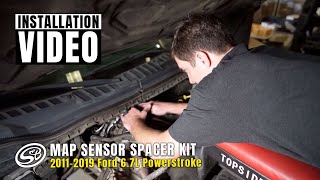
(OEM #BC3Z-9F479-A)— While often just clogged, the sensor can fail electronically. It's a common replacement part after ruling out software and clogs. 🎬 Watch: Installing a MAP sensor spacer to prevent soot buildup
Trusted brands: Motorcraft, Bosch, Standard Motor Products
OEM price range: $40-$70
Aftermarket price range: $25-$50 - Mass Air Flow (MAF) Sensor
(OEM #BC3Z-12B579-A)— If cleaning the sensor doesn't resolve the issue, the sensor itself may have failed and require replacement.
Trusted brands: Motorcraft, Hitachi
OEM price range: $120-$180
Aftermarket price range: $60-$120
Related Codes That Often Appear With This One
- P2073 — This code for 'Manifold Absolute Pressure/Mass Air Flow - Throttle Position Correlation at Idle' is the direct counterpart to P2074. They are often triggered together by the same PCM software issue mentioned in Ford's TSBs.
- P0299 — This code indicates a 'Turbocharger/Supercharger Underboost' condition. A large intake leak from a ruptured cold-side pipe that causes P2074 will also prevent the turbo from building proper boost pressure, often triggering P0299 simultaneously.
Technical Service Bulletins (TSBs) & Recalls
- TSB 22-2115: Specifically for 2011-2012 models, states that P2073/P2074 can be caused by a PCM software issue and the fix is to reprogram the PCM.
- 23B63 / 22N14 S1: Customer satisfaction programs related to state inspection failures due to P2073/P2074, often resulting in a no-charge PCM reflash for affected owners.
- SSM 47597: A Special Service Message noting that a dirty air filter can cause P2074 and to perform a MAF parameter reset after replacement.
Platform-Specific Known Issues
- Owner Experience: Chasing the Code: A user on Ford-Trucks.com with a 2011 F-250 reported a recurring P2074. A dealer first replaced a damaged MAF connector. When the code returned, the owner replaced the MAF sensor, then the MAP sensor, all with Motorcraft parts, but the code kept coming back. This highlights the importance of checking for software updates and hard-to-find leaks before replacing multiple sensors.
- Owner Experience: The Simple Fix: On PowerStrokeArmy.com, a 2013 F-250 owner who was completely stock kept getting P2074 during highway driving with rolling hills. After getting advice, he replaced the air filter and cleaned the MAF sensor, which resolved the code.
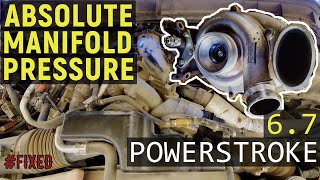
- Owner Experience: The Hidden Clog: A video creator demonstrated that on his 6.7L Powerstroke, the MAP sensor itself was only lightly coated, but the port in the intake manifold was almost completely blocked with soot. Cleaning out this hole with a simple tool fixed the P2074 code, and it did not return after many months.
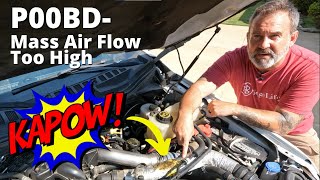
- Owner Experience: The 'Shotgun' Failure: Multiple owners describe the cold-side intercooler pipe failure as sounding like a 'shotgun went off' under the hood, followed by a massive loss of power and black smoke. One owner was on his first wedding anniversary trip when it happened, leaving him stranded on the side of the interstate.
Mechanic-Grade Diagnostic Values
- MAP Sensor Signal Voltage — expected: The sensor receives a 5-volt reference and returns a signal between 0-5 volts, corresponding to 0-51 PSI of absolute pressure. At idle, voltage is typically 0.85 to 1.3 volts.. Failure: Voltage that is stuck, does not change with engine load, or is outside the expected range.
- MAF Sensor Live Data at Hot Idle — expected: Approximately 14-16 g/s on a healthy, warmed-up engine.. Failure: Readings that are significantly lower, higher, or erratic at a steady idle can indicate a faulty sensor or a vacuum leak.
- Throttle Position Sensor (TPS) Voltage — expected: Approximately 0.5V at closed throttle and 4.5V at wide-open throttle.. Failure: Voltage that doesn't sweep smoothly as the throttle is opened, has dead spots, or is out of range.
Scan Tool Commands That Help
- Ford IDS / FDRS: MAF Parameter Reset — Ford TSB 19-2160 specifies performing a MAF parameter reset after reprogramming the PCM for a P2074 code. It is also recommended after replacing a dirty air filter per TSB SSM 47597. The path is typically Toolbox > Powertrain > Service Functions > Reset/Clear Specified Function > MAF Sensor.
- Ford IDS / FDRS or high-end scan tool: Throttle Body Relearn / Reset Adaptive Memory — After cleaning or replacing the throttle body, a relearn procedure helps the PCM quickly adapt to the new baseline idle position. While the system can self-learn over several drive cycles, a manual reset can resolve immediate performance issues.
Wiring & Ground Locations
- PCM Grounds — The PCM has multiple ground pins that terminate at a common location. On the 6.7L, the body connector of the PCM handles power and grounds. A wiring diagram for a 2013 F-250 shows ground GD176-BK wh is relevant to engine controls.. A poor ground connection to the PCM can cause intermittent and difficult-to-diagnose issues, including erroneous sensor readings and correlation codes like P2074. This is especially important to check if the cab has ever been removed for service.
Real Owner Repair Stories
- PowerStrokeArmy forum user 'jwanck11' (2015 Ford F-250 6.7L, with full delete, No Limit Stage 2 CAI, and IDP tunes.) — Persistent P2074 check engine light that would appear after a couple of days of driving, under both heavy acceleration and steady highway cruising.
❌ Tried (didn't work) Replaced MAP sensor, Replaced MAF sensor, Checked for vacuum leaks, Updated SCT tuner firmware
✅ What actually fixed it The issue was resolved by changing the aftermarket tune. The user had the code with 'PiP' tunes, switched to 'IDP' tunes and still had the code, but noted another user's similar issue was fixed by switching to PIP tunes, indicating the specific tune file was the root cause. - Ford Truck Enthusiasts forum user (2011 F-250 with 104,xxx miles, 100% stock.) — Randomly recurring P2074 Check Engine Light. Truck runs and drives fine.
❌ Tried (didn't work) Dealer replaced MAF connector, Owner replaced MAP sensor with a new Motorcraft part
✅ What actually fixed it The user did not post a final resolution, but the thread highlights a common scenario where replacing both the MAP and MAF sensors (or their connectors) does not fix the code, pointing towards either a software issue (TSB), a wiring problem, or a physical blockage like a clogged MAP port.
OEM Part Supersession History
BC3Z-6F073-A→BC3Z-6F073-D— Standard part revision by Ford for the plastic cold-side intercooler outlet pipe.
Heads up: The new part is a direct replacement for the old one. The OEM part comes with a new air temperature sensor pre-installed.
Model Year Variations Within This Range
- 2011-2014: These first-generation engines used a smaller, dual-compressor Garrett GT32 SST turbocharger. Early 2011-2012 models are particularly prone to software-related P2074 codes as noted in TSBs and had ceramic turbo bearings which were less durable. 2011 models also used a plastic oil pan that was prone to leaking and was switched to steel in 2012.
- 2015-2016: The engine was updated for the 2015 model year, often called the 'Gen 2' 6.7L. It received a larger, single VGT Garrett GT37 turbocharger, an improved high-pressure fuel pump (CP4.2), and revised injector nozzles. These changes increased factory power from 400 hp/800 lb-ft to 440 hp/860 lb-ft. This makes the 2015+ models less susceptible to some of the airflow limitations of the earlier design.
Helpful Videos
We Have This Part in Stock


The information in this article is provided for general reference and educational purposes only. Vehicle specifications, procedures, and part compatibility can vary by production date, trim level, and region. Always consult your vehicle's factory service manual and verify part numbers before purchasing or performing repairs. Safety-critical components such as airbags, seat belts, and braking systems should be installed by a qualified professional.
- Ford F-250 SD:
- 🎬 Helpful Videos
- 🛍️ Shop This Part
- What's Unique About the 2011-2015 Ford F-250 SD
- Diagnostic Flowchart
- Symptoms You May Notice
- Most Likely Causes
- Rare But Worth Checking
- Diagnosis Steps
- Parts You'll Likely Need
- Related Codes That Often Appear With This One
- Technical Service Bulletins (TSBs) & Recalls
- Platform-Specific Known Issues
- Mechanic-Grade Diagnostic Values
- Scan Tool Commands That Help
- Wiring & Ground Locations
- Real Owner Repair Stories
- OEM Part Supersession History
- Model Year Variations Within This Range
- 🎟️ Get 5% Off