

P2066 on 2014 Ram 3500: Fuel Level Sensor 'B' Performance Explained
This code means the secondary fuel level sensor is sending erratic readings. The most common causes are a faulty sensor inside the fuel tank or a wiring issue. However, for this specific truck, several Technical Service Bulletins (TSBs) indicate a software update for the powertrain control module (PCM) can resolve this code without replacing parts, particularly on models with the 6.4L engine.
- For a 2014 Ram 3500, P2066 is often a software problem. Always check for available PCM updates before replacing any parts.
- The most common symptoms are an inaccurate fuel gauge and the Check Engine Light.
- If not a software issue, the cause is likely the sensor itself or the wiring leading to it.
- Repair involves accessing the fuel tank, which is a difficult DIY job.
What's Unique About the 2014-2014 Ram 3500
For the 2014 Ram 3500, the P2066 code is frequently mentioned in manufacturer Technical Service Bulletins (TSBs). These bulletins (18-096-16, 18-042-15, 1800414, 18-004-14) suggest that the code can be triggered due to a software glitch in the Powertrain Control Module (PCM). TSB 18-096-16, for example, specifically applies to vehicles with the 6.4L engine. This is a critical distinction, as the first step for a dealership would be to reflash the computer, not immediately replace the fuel level sensor. This platform-specific issue means a software update could be a permanent, no-parts-needed fix.
Diagnostic Flowchart
Tap your situation to follow the diagnostic path that matches what you're seeing on this vehicle.
Symptoms You May Notice
- Check Engine Light is on
- Fuel gauge is inaccurate, erratic, or stuck on full or empty
- Distance-to-empty calculation is incorrect or displays dashes
- Low fuel warning light may stay on or flash, even with a full tank
- Replacing the fuel level sensor without first checking for software updates. Given the numerous TSBs for this model year, a simple reflash could solve the problem without the expense and labor of accessing the fuel tank.
Most Likely Causes
- Powertrain Control Module (PCM) Software Glitch 🔴 High Probability Multiple TSBs (#18-096-16, #18-042-15, #1800414, #18-004-14) were issued by the manufacturer for the 2014 model year specifically to address this code with a software update. TSB 18-096-16 applies to models with the 6.4L engine.
How to confirm: A Ram dealership or a qualified shop with access to OEM software (like wiTECH) can check if your vehicle's VIN has the latest calibration available.
Typical fix: Reflashing the PCM with the updated software.
Est. part cost: $0 - Faulty Fuel Level Sensor 'B' 🟡 Medium Probability The sensor is a moving part (a float on an arm connected to a variable resistor) that can wear out, get contaminated, or fail over time.
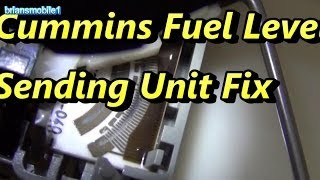
How to confirm: After accessing the sensor, test its resistance with a multimeter while moving the float arm. The reading should change smoothly. For this generation of Ram truck, the resistance should be approximately 220-240 ohms when empty and 40 ohms when full. Any dropouts, open circuits, or readings outside this range indicate a failed sensor.
Typical fix: Replacing the fuel level sensor. It is often integrated with the secondary fuel pump module or sending unit assembly and not sold separately.
Est. part cost: $70-$200 - Damaged Wiring or Corroded Connector 🟡 Medium Probability The wiring harness runs along the chassis to the top of the fuel tank, where it is exposed to road debris, moisture, and corrosion, especially at the tank-top connector (C315).
How to confirm: Visually inspect the wiring harness from the PCM to the fuel tank. Check the connector on top of the tank for corrosion, moisture, or pushed-out pins. A continuity test with a multimeter can confirm a break or short in the wire.
Typical fix: Repairing the damaged section of wire or cleaning/replacing the connector.
Est. part cost: $10-$50
Rare But Worth Checking
- Faulty Powertrain Control Module (PCM): This is rare. Before condemning the PCM, all other possibilities (software, sensor, wiring) must be exhaustively ruled out. A PCM failure can cause this code, but it's the least likely culprit.
- Faulty Fuel Transfer Pump: On vehicles with a saddle tank, a secondary transfer pump may be used to move fuel from one side of the tank to the other. If this pump fails, it can create a discrepancy between the two fuel level sensor readings that the PCM interprets as a sensor performance fault. This should be considered if sensor and wiring tests pass.
Diagnosis Steps
- Check for TSBs: First, verify with a dealer or using a professional database if your vehicle's VIN is covered by TSBs 18-096-16, 18-042-15, 1800414, or 18-004-14. If an update is available for your specific engine, this is the most logical and cost-effective first step.
- Scan Tool Data: Use an OBD-II scanner to observe the live data for Fuel Level Sensor 'A' and 'B'. See if the reading for sensor 'B' is stuck, erratic, or clearly illogical compared to sensor 'A' and the calculated fuel consumption.
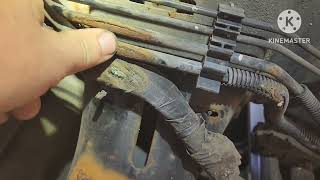
- Visual Inspection: Inspect the wiring harness running to the fuel tank for any obvious signs of damage, chafing, or corrosion. Pay close attention to the connector on top of the fuel tank (C315).
- Test the Circuit: If wiring looks good, disconnect the sensor and test for proper voltage and ground at the connector. You can also use a resistor to simulate a sensor reading to see if the gauge responds, which helps isolate the problem to the sensor itself.
- Test the Sensor: Access to the sensor is required. This can be done by dropping the fuel tank or, as some owners prefer, by removing the truck bed for easier top-down access. Once the sensor is accessible, use a multimeter set to ohms to test its resistance as you manually move the float arm. The resistance should change smoothly from approximately 220-240 ohms (empty) to 40 ohms (full). Any dead spots or open circuits indicate a failed sensor.
- Replace Component: Based on the test results, replace the faulty fuel level sensor/sending unit or repair the wiring.
Parts You'll Likely Need
- Fuel Level Sensor / Sending Unit
(OEM #Varies by engine and tank size. Example for 6.7L Diesel is Mopar 68237110AA (superseded by 68643799AA). For 6.4L/5.7L gas engines, part numbers like 4560227AC may apply. Always verify with VIN.)— This is the sensor that fails, causing the performance code. It is almost always integrated with the secondary fuel sending unit or the entire fuel pump module in the tank.
Trusted brands: Mopar, Bosch, Delphi
OEM price range: $150-$250
Aftermarket price range: $70-$150
Technical Service Bulletins (TSBs) & Recalls
- 18-096-16: Mentions P2066 - Fuel Level Sensor 2 Performance as one of several codes that can be addressed with a PCM software update on 6.4L models.
- 18-042-15: Also lists P2066 as a code that can be resolved with a PCM reflash.
- 1800414: Cites P2066 - Fuel Level Sensor 2 Performance in relation to software improvements.
- 18-004-14: Notes P2066 - Fuel Level Sensor 2 Performance as a code that may be set, with improvements available via software update.
Platform-Specific Known Issues
- A significant number of 2014 Ram 3500 trucks, particularly those with the 6.4L engine, can trigger code P2066 due to a software issue, which is correctable with a PCM flash per TSBs #18-096-16, #18-042-15, #1800414, and #18-004-14.
Mechanic-Grade Diagnostic Values
- Fuel Level Sensor 'B' Resistance — expected: ~40 Ohms (Full) to ~240 Ohms (Empty). Failure: An open circuit (OL), a short (0 ohms), or a reading that does not change smoothly as the fuel level changes.
- Fuel Level Sensor 'B' Signal Voltage — expected: A smooth sweep between approximately 0.5V and 4.5V, corresponding to empty and full.. Failure: Voltage that is stuck high (near 5V), stuck low (near 0V), or jumps erratically.
Scan Tool Commands That Help
- wiTECH 2.0: View ECU Data > PCM > Data > Fuel Level Sensor 2 Voltage/Resistance — This is a critical first step after checking for codes. It allows a technician to see the raw voltage and calculated resistance the PCM is receiving from the sensor in real-time, without needing to physically access the sensor. An erratic or stuck value here strongly points to a sensor or wiring issue.
- wiTECH 2.0: All Flashes Tab — Used to check if a PCM software update is available for the vehicle's VIN, which is a common cause for a false P2066 code on this platform per multiple TSBs.
Wiring & Ground Locations
- C315 — The main electrical connector on top of the fuel pump module/fuel tank.. This is the primary connection point for the fuel level sensor. It is highly susceptible to corrosion and moisture intrusion, which can cause erratic readings and trigger P2066.
- Fuel Level Sensor 2 Wires — Within the harness running from the fuel tank to the PCM/BCM.. The signal wire is typically Dark Blue/Light Green, and the sensor return is Dark Blue/Gray. Knowing these colors is essential for performing continuity and voltage drop tests.
- G304 — On the driver's side frame rail, near the fuel tank.. This is a major chassis ground point for rear components, including the fuel pump module. A loose or corroded connection here can cause a floating ground, leading to inaccurate sensor readings and various fuel system codes.
- BCM Connector C5 — At the Body Control Module (BCM), typically located behind the driver's side lower dash/kick panel area.. In some cases, the fuel level sense wire terminates here. A backed-out or loose pin in this connector can cause an open circuit, leading to a P2066 code even when the sensor and tank wiring are perfect.
Real Owner Repair Stories
- cumminsforum.com user report (2014 Ram 3500) — P2066 code with an erratic fuel gauge.
❌ Tried (didn't work) Initial diagnosis from a dealership suggested replacing the entire fuel pump assembly.
✅ What actually fixed it The owner traced the wiring and found a ground wire (Black/Orange) had backed out of its pin at the Body Control Module (BCM) connector C5. Reseating the pin securely into the connector resolved all symptoms and the code did not return. - Go-Parts.com repair log (2014 Ram 3500) — P2066 code and fluctuating fuel gauge.
❌ Tried (didn't work) Replacing the fuel sending unit assembly did not fix the problem.
✅ What actually fixed it A chafed wire was discovered in the main wiring harness where it passes near the transfer case. Repairing the damaged wire insulation and protecting the harness resolved the issue.
OEM Part Supersession History
68237110AA, 68237110AB→68643799AA— Standard part revision and improvement by the manufacturer.
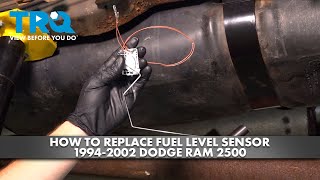
Helpful Videos
We Have This Part in Stock


The information in this article is provided for general reference and educational purposes only. Vehicle specifications, procedures, and part compatibility can vary by production date, trim level, and region. Always consult your vehicle's factory service manual and verify part numbers before purchasing or performing repairs. Safety-critical components such as airbags, seat belts, and braking systems should be installed by a qualified professional.
- Ram 3500:
- 🎬 Helpful Videos
- 🛍️ Shop This Part
- What's Unique About the 2014-2014 Ram 3500
- Diagnostic Flowchart
- Symptoms You May Notice
- Most Likely Causes
- Rare But Worth Checking
- Diagnosis Steps
- Parts You'll Likely Need
- Technical Service Bulletins (TSBs) & Recalls
- Platform-Specific Known Issues
- Mechanic-Grade Diagnostic Values
- Scan Tool Commands That Help
- Wiring & Ground Locations
- Real Owner Repair Stories
- OEM Part Supersession History
- 🎟️ Get 5% Off